Affiliate disclosure: we may earn a commission from partner links on this page. This doesn't affect how we rate brokers. Editorial policy →
I trade my own options on Webull, so this Webull review starts from lived experience rather than a feature tour. The short answer: it is one of the strongest homes for an intermediate options trader who wants $0 commissions on equity options and a platform worth customizing. The tradeoff is that zero is not the whole story. Regulatory pass-through fees apply to every contract, index options cost $0.50 per contract, and the sheer depth of features means some of the best tools take real digging to find.
My history here is ordinary in a useful way. I kept stocks at Webull for several years, moved my options trading over in early 2026 after Robinhood went down during opportunities I wanted to trade, and now run long calls and puts, straddles, and multi-leg spreads through it at Level 3 approval.
This review covers what that experience has actually been like, verified line by line against Webull's published fee schedule and regulator records. If you are comparing platforms more broadly, our broker reviews hub covers every major options broker we rate.
Key Takeaways
- Commissions are $0, costs are not: regulatory pass-throughs average about $0.06 per contract on my statements, charged to open and to close.
- Built for intermediates: four approval levels, with spreads unlocked at Level 3; true beginners will find Robinhood simpler.
- Reliability is the quiet edge: I left Robinhood over downtime and have not hit an outage on Webull since.
- Feature depth cuts both ways: tools like Turbo Trade's options mode are excellent and genuinely hard to find.
- Premium is cheap and usually worth it: $3.99 a month adds Level 2 data, tiered margin discounts, and an IRA match.
- No built-in trade journal: per-trade P&L tracking needs an external tool.
How I Ran This Webull Review
The basis for this review: an individual margin account with Level 3 options approval, the top tier available to me, used for stocks over several years and for options since early 2026, on both the desktop platform and the mobile app. My trading there is real money, mostly long calls and puts, plus straddles, strangles, and defined-risk spreads.
I judged Webull against the criteria we apply to every broker: options pricing, platform quality for multi-leg trading, execution and reliability, account terms and approval levels, and support. Every figure in this review is verified against Webull's own published pages or a regulator, and the claim trail is checked again before each update. Matt Marino reviewed this piece and stands behind the rating with me.
Two things I did not test, so this review does not judge them: futures trading, which runs through a separate entity, and the standalone crypto app. My contact with customer support has been minimal, and I say so where it matters.
Options Pricing and Fees
What it costs: $0 commission on equity and ETF options, roughly $0.06 per contract in regulatory pass-throughs on my statements, and $0.50 per contract on certain index options.
The table below is the fee picture an options trader actually faces. It reads simply, and the footnotes are where the money hides.
| Fee | Amount | Notes |
|---|---|---|
| Equity and ETF options commission | $0.00 | Applies to open and close |
| Index options | $0.50 per contract | "Certain index option trades," per Webull |
| Oversized option orders | $0.10 per contract | Disclosed in Webull's fee footer |
| SEC fee | $0.0000206 x trade volume | Sells only, pass-through |
| CAT fee | $0.000003 x trade volume | Buys and sells, pass-through |
| Outgoing stock transfer | $75.00 | Charged by Apex, the clearing firm |
Source: Webull fee schedule, verified August 2026.
The pass-throughs deserve a plain explanation, because "commission-free" invites the wrong conclusion. These are charges from regulators, exchanges, and clearing bodies like the Options Clearing Corporation that Webull passes along without profiting from them, and they hit both when you open and when you close. On my account statements they average about $0.06 per contract. That is small on a single call, and it compounds quietly on complex positions.
Here is the worked example I actually budget with. A 10-lot iron condor is four legs, so 40 contracts to open and 40 more to close. At my observed average of $0.06 per contract, that is roughly $4.80 in pass-throughs for the round trip on a trade that might only target $200 in profit. On high-volume, low-premium strategies, this line item belongs in your profit target math.
Against the field, the structure holds up well. Interactive Brokers charges $0.65 per contract on its fixed plan, as we documented in our Interactive Brokers review, so a spread trader doing size pays materially less at Webull on equity options. Robinhood matches the $0 headline with its own pass-throughs, and the real differences there are platform depth and approval structure rather than price.
Platforms and Tools
The desktop platform is where Webull earns its rating, and it is the reason I moved my options book here. The workspace is fully modular: watchlists, chain, order ticket, positions, and charts arrange however you want them, and the layout below is the one I actually trade from.
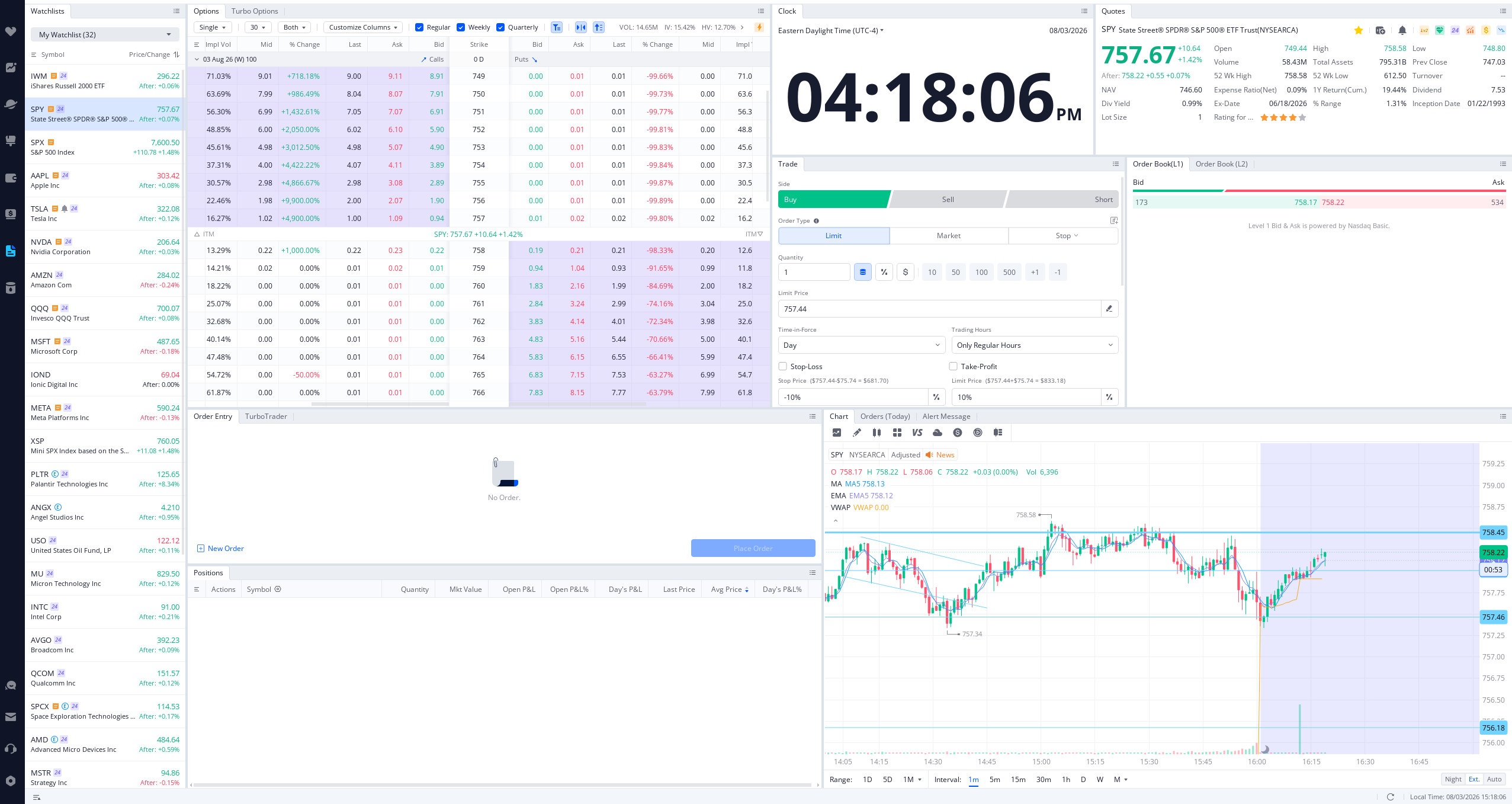
The options chain condenses bid, ask, mid, implied volatility, volume, and percent change into one readable ladder, which sounds minor until you have traded on a platform that makes you click into each strike. Multi-leg entry is straightforward: pick a strategy type at the ticket, and legs populate with sensible defaults. The order ticket also takes stop-loss and take-profit brackets before you submit, with the trigger prices computed as you type.
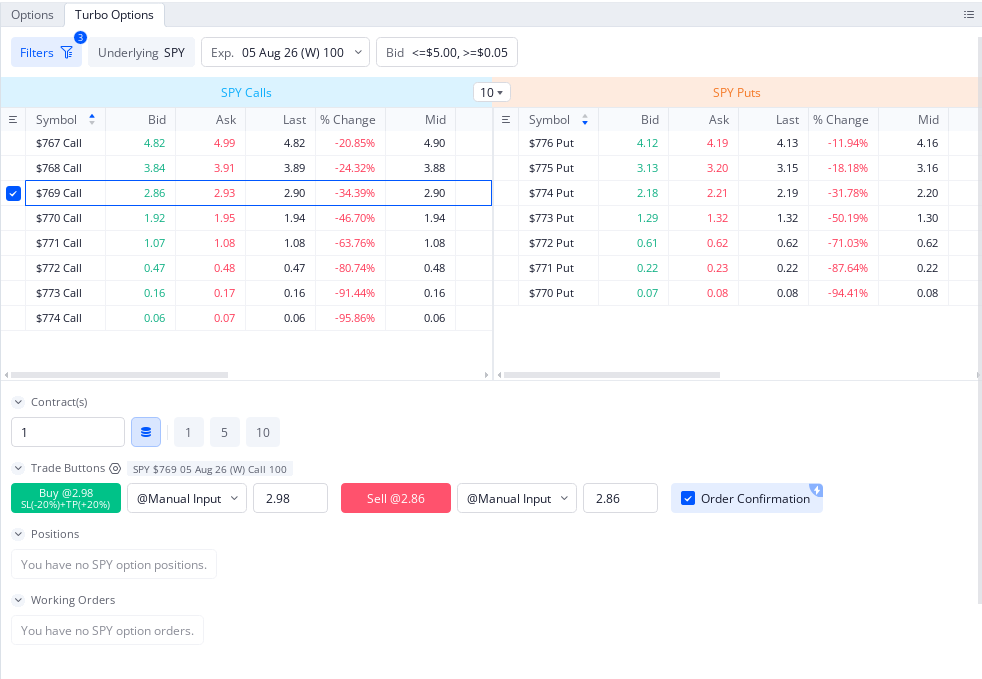
Turbo Trade deserves its own mention, and an honest one. There is an options-specific Turbo mode that enters positions with your exits predefined, and it is genuinely good. It also took me real digging to find, because at first it seemed built only for the underlying shares. That is Webull in one sentence: great depth of features, and enough of them that specific tools hide.
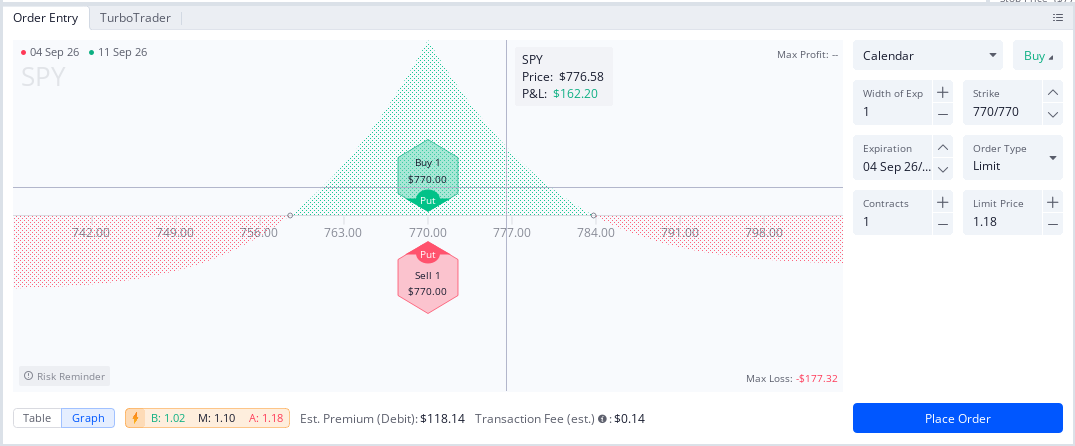
Charting covers what a discretionary options trader needs without a separate service: EMA, DMA, MA, Bollinger Bands, VWAP, MACD, RSI, and volume studies, plus drawing tools for rays, horizontals, and trend lines. The position P&L graph is the power feature I point people to. It visualizes where a strategy makes or loses money as price and time move, which turns an abstract spread into something you can actually reason about before committing.
The honest weakness is record keeping. Webull shows positions and history, but per-trade P&L tracking across closed options trades is a hassle, and I keep my journal in OptionsPro instead. Full disclosure: OptionsPro is our own product, built by the team behind this site, and I would use a spreadsheet before I would rely on the built-in history alone.
Mobile is good, and I still prefer the desktop for order management. The app handles quotes, alerts, and simple entries well, but managing a four-leg position on a phone screen is cramped on any broker, and Webull is no exception.
Webull Premium: What $3.99 a Month Actually Buys
The short version: Webull Premium costs $3.99 per month, or $40 per year paid annually, and its value sits in data, interest, and margin rather than in options commissions.
The table shows where the subscription actually moves numbers, using Webull's published figures as of August 2026.
| Feature | Free | Premium |
|---|---|---|
| Real-time data | Nasdaq Basic (Level 1) | Nasdaq TotalView + OPRA (Level 2) |
| Cash APY | 0.50% | 3.35% |
| Margin rate | 8.74% flat | 5.20% tiered down to 3.90% |
| IRA contribution match | 1% | 3.5% |
| Index options | $0.50 per contract | $0.10 off with monthly volume tiers |
Source: Webull Premium, rates subject to change.
The honest framing matters here, because equity options are already commission-free for every customer. Premium does not make your covered calls cheaper. What it changes is the cost of everything around your trading: the 3.35% APY on uninvested cash, margin rates cut from a flat 8.74% to a tiered schedule starting at 5.20%, and an IRA match that reaches 3.5% on contributions, with a 3% match on IRA transfers running until December 31, 2026.
The index options and futures discounts are real but conditional, since the per-contract reductions require meeting monthly executed-contract minimums. My own view after paying for it: if you hold any meaningful cash balance or trade on margin at all, the subscription covers itself without the discounts ever entering the math.
Account Types, Minimums, and Options Approval
Webull offers cash, margin, and IRA accounts with no minimum to open any of them, which is Webull's choice rather than a rule. Margin trading requires maintaining $2,000 in margin equity, the industry-standard threshold, and that number matters for options because spreads require it.
Options approval runs four levels, and the structure decides what you can actually trade.
| Level | Adds | Requirements |
|---|---|---|
| 1 | Covered calls, buy-writes, cash-secured puts | Any approved account |
| 2 | Long calls and puts, collars, straddles and strangles | Straddles and strangles need margin |
| 3 | Credit and debit spreads, butterflies, condors, iron variants | Margin account, $2,000 start-of-day equity |
| 4 | Naked equity calls and puts | $10,000 minimum net account value |
Source: Webull options trading levels.
Two structural details are worth knowing before you apply. Cash accounts, including IRAs, cap at Level 2, so spread traders need margin. And Level 4, which is newer, limits naked writing to S&P 500 stocks, indices, and certain index ETFs; calendar and diagonal spreads are also unavailable on cash-settled index options.
My own approval was painless: a straightforward application, a decision inside two days, and quick funding after. I hold Level 3, the top tier available to me, and it covers everything a defined-risk trader realistically needs.
On the regulatory side, Webull Financial LLC is an SEC-registered broker-dealer, CRD 289063, regulated by FINRA out of New York, with six disclosure events on its BrokerCheck record that anyone can read in the detailed report. Securities accounts carry SIPC protection up to $500,000 per customer with a $250,000 cash sublimit, and Webull layers excess SIPC coverage above that through its clearing arrangements.
Paper Trading
Paper trading used to be the bare-bones corner of Webull, without stops or take-profits, and it has been rebuilt properly. It now runs as a toggle rather than a separate walled-off section, and anything available in a live account works in simulation, bracket orders included.
That makes it genuinely useful for two groups: newer traders working up the approval ladder, and Level 3 traders rehearsing a structure they have not run before. One caveat for honesty, which some reviewers note: simulated fills tend to land near mid-price, which flatters your results against what live spreads will actually give you. Treat paper results as a test of process, not of expected profit.
Execution, Reliability, and Support
Execution has been solid across my time on the platform. Fees, slippage, and spreads have all been reasonable for the products I trade, and while I see occasional partial fills on wider spreads, the large majority of my orders fill completely and without drama.
Reliability is the reason this review exists at all. I switched from Robinhood partly because it went down during strong trading windows, and in my time trading Webull with real money I have not personally hit an outage. That is my experience rather than a guarantee, and no platform is immune, but uptime during fast markets is exactly the moment a broker earns or loses trust.
Support is the section I can only report honestly: I have barely needed it. Webull runs email and phone channels, my limited contact has left a positive impression, and I have not stress-tested them with an account emergency. Weigh that as one trader's soft data point rather than a verdict.
How Webull Compares
The realistic cross-shop for Webull is Robinhood on one side and the heavyweight platforms on the other, and the table keeps to figures we have verified.
| Webull | Robinhood | Interactive Brokers | |
|---|---|---|---|
| Equity options commission | $0 plus pass-throughs | $0 plus pass-throughs | $0.65 per contract, fixed plan |
| Options approval | Four levels, spreads at 3 | Simpler tiering | Deepest permissions |
| Best fit | Intermediate | Beginner | Advanced and professional |
The detailed matchups are their own articles: Webull vs. Robinhood for the beginner-to-intermediate decision, Webull vs. Interactive Brokers for traders weighing pro-grade depth, and Webull vs. Charles Schwab plus Webull vs. E*TRADE for the full-service comparison.
The one-paragraph version: Robinhood is the smoother first platform and the weaker place to grow into spreads. The full-service brokers bundle research and support that Webull does not try to match. Webull's lane is the middle, where a self-directed trader wants real multi-leg tooling and commission-free equity options without paying for services they will not use.
Who It's for, and Who It Isn't
Webull fits you if you are past your first hundred contracts and trading defined-risk structures: the chain, the multi-leg ticket, bracket orders, and the P&L graph are built for exactly that work. It also fits platform tinkerers, because the workspace rewards customization, and traders for whom uptime during volatile sessions is non-negotiable.
It is the wrong first stop for a complete beginner who wants the gentlest possible on-ramp; Robinhood remains the simpler learning environment, and Webull's Level 1 plus paper trading is the better path only once you intend to grow into spreads. Advanced traders who need portfolio margin, an API, or institutional-grade routing should read our Interactive Brokers review instead, linked above in the pricing comparison. And anyone who wants their broker to double as a trade journal will be disappointed, because per-trade P&L review is Webull's clearest gap.
The Verdict
Webull earns 4.0 out of 5. What earned the points: genuinely low all-in options costs with the pass-throughs stated plainly, a chain and order ticket that treat multi-leg trading as the main event rather than an afterthought, full-featured paper trading, and reliability that has held up in exactly the moments that pushed me off my previous broker.
What cost the fifth star: discoverability, because excellent tools like the options Turbo Trade mode should not require an expedition; the missing trade journal; and index options pricing that only gets competitive through Premium volume tiers.
The deciding consideration for most readers is trajectory. If you are learning covered calls, start simpler. If you are building toward spreads, condors, and deliberate risk management, Webull is the strongest commission-free platform we rate for that middle stretch of a trading career, and it is where my own options orders go.
Frequently Asked Questions
The questions options traders ask most about Webull, answered from hands-on use and Webull's own published terms.
Is Webull really commission-free for options?
What options level do I need to trade spreads on Webull?
Does Webull offer Level 4 options approval?
Is Webull Premium worth it for options traders?
Is Webull safe and regulated?
Is Webull good for beginners?
Pros
- Commission-free equity and ETF options with transparent pass-through costs
- Options chain and multi-leg order ticket built for spread traders
- Bracket orders and an options-specific Turbo Trade mode
- Full-featured paper trading behind a simple toggle
- No personal downtime in years of hands-on use
- Premium adds real value for $3.99 a month
Cons
- Feature depth hurts discoverability; key tools take real digging to find
- No built-in per-trade P&L journaling
- Index options cost $0.50 per contract unless Premium volume tiers kick in
- Mobile is capable but cramped for managing multi-leg positions
Sources
- FINRA BrokerCheck: Webull Financial LLC, CRD 289063, FINRA
- SIPC investor protection, SIPC
- Webull fee schedule, Webull
- Webull Premium, Webull
- Webull options trading levels, Webull