
Whether you’re trading around market breakouts, pattern reversals, or trend continuations, you’re likely using a high-probability trade that has the potential to produce passive income. What are these trades characterized by, and how can you incorporate them into your reading sessions?
“High-probability trades” that we’ll be highlighting in this guide are trading setups with a greater chance of success than the average trade. The likelihood of these trades producing consistent, respectable profits is determined by technical analysis, market trends, and general risk management principles. High-probability trades are best for passive income because they minimize losses through size and frequency, while also maximizing profits.
The potential income readers can generate by using high-probability strategies is enticing because of the predictable, steady returns that come without a lot of active management and with a lot more peace of mind compared with some other higher-risk strategies. Our guide will address the 10 best high-probability options trades for producing passive income for investors and traders in various market conditions. There’s a little bit of something for everyone in this guide!
What Makes an Options Trade “High-Probability”?
What are the criteria for a high-probability trade? This is information that’s important to know if you’re looking to arrange your trading strategies around high-probability moves that secure passive income. We’ll review some factors to consider when choosing options traders that are considered “high probability.”
Factors to Consider
Implied Volatility | IV is an important factor to consider because higher volatility can lead to significant price swings which traders or investors can take advantage of. When the trade has a greater likelihood of becoming profitable through volatility, this makes it a “high probability” trade, but this can change with time. |
Probability of Profit | Also known as POP, probability of profit refers to the likelihood of a trade making at least a small profit by a specific date. POP can help traders assess the likelihood of success for a certain trade or strategy instead of focusing on potential gains or losses. POP is one of the foremost factors to consider when finding “high probability” trades. |
Delta | Finding trades with a high probability of being in-the-money at expiration can be done by examining the delta values of the option. A delta closer to +1 or -1 is a good indicator of greater intrinsic value, which is a good signal of the option being a higher probability trade. |
Risk Management and Consistency | Another key consideration of high probability trades is how the trader executes their approach. If they have the right risk management principles in place like stop-loss limits, correct position size, and hedging contingencies, then this can result in the likelihood of a high probability trade. |
Advantages of Using High-Probability Options Strategies for Passive Income
What are the primary advantages of using these high-probability options strategies, aside from generating passive income during your trading sessions? We’ll highlight these perks below to give you a clear understanding of why so many online traders like using these trading strategies so much. There are a few benefits that one might not initially think about on first viewing.
- Reduced Stress—Peace of mind is a perk in trading that cannot be stated enough. The high-probability trades we’ll discuss in this guide are lower-risk trades that have a good likelihood of letting the trader profit and they come with fewer, more manageable risks. These strategies can put traders at ease more so than other trading techniques which carry higher levels of risk.
- Consistent Income—These moves help traders generate consistent income through premiums, a great form of passive income. In many cases, traders can keep their premiums even if the option expires as worthless but it comes down to the type of trade being used. Premiums can also be used to ease the losses that traders might incur with certain trades.
- Less Active Management Required—Because these trades are likely to produce the results that traders are looking for, they require much less active management. They’re the kind of trades where investors can set up stop-loss and take-profit limits and still have their trade executed to their criteria and preferences without much oversight or manual intervention.
10 High-Probability Options Trades
Now that you know what high probability trades are and how they can be used the secure some passive income, let’s discuss 10 option trades that are high-probability and work well for traders who are interested in less active management, lower risk trades, and the ability to generate consistent income.
Selling Cash-Secured Puts

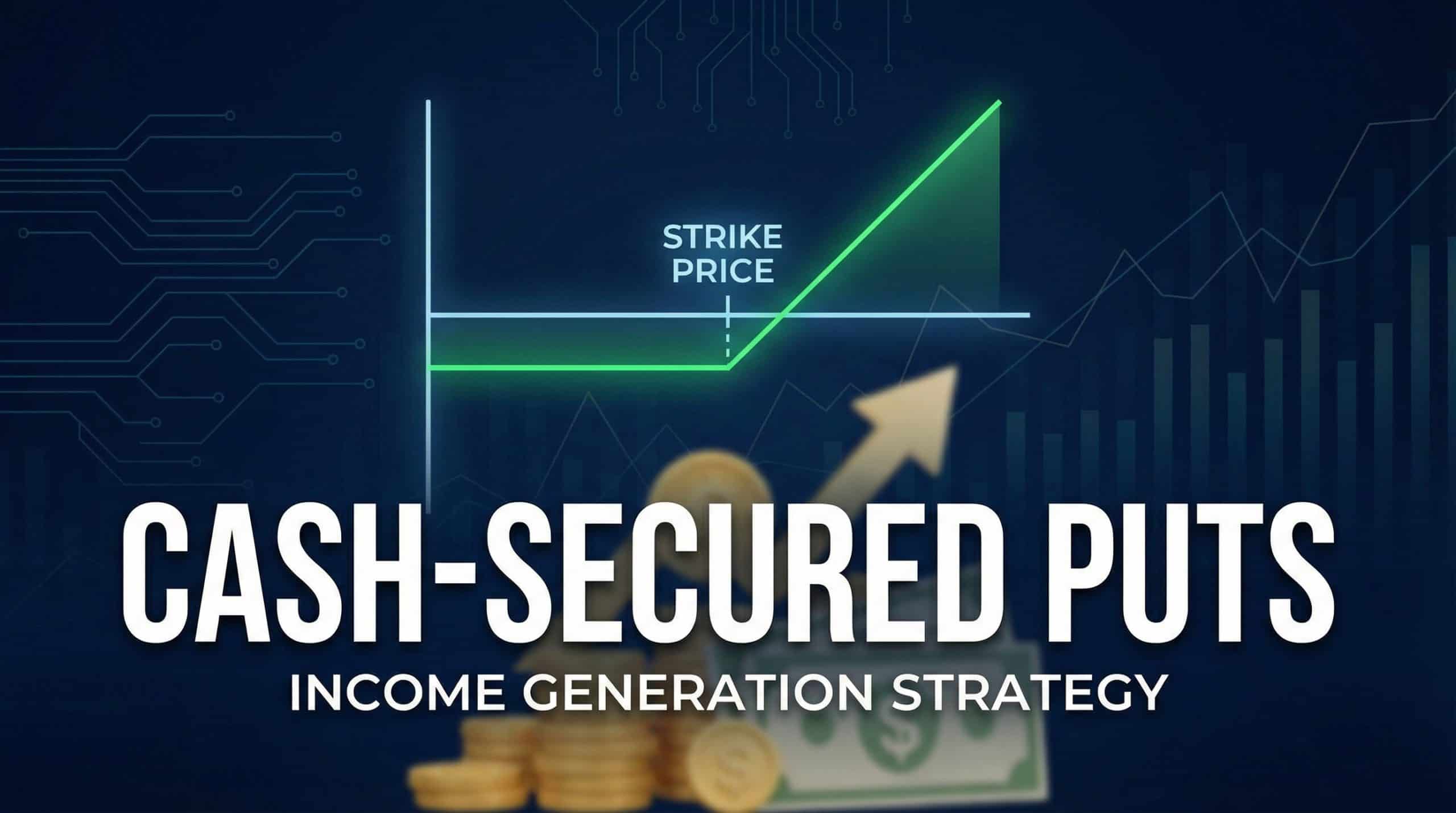
Traders can generate passive income by selling put options, while also setting aside enough cash in your account to buy the shares at the strike price if the put option is assigned. They can receive a premium upfront for the sale, but it comes with the obligation of buying shares at a set price if the stock price falls below that level. If the stock price stays above the strike price, the put option will expire as worthless, and the seller gets to keep the premium they receive for initial the option sale. If the stock price falls below the strike price, the trader is obligated to buy the shares at the strike price, but the cost basis per share is lower due to the premium received from the sale.
Ideal Scenarios for Cash-Secured Puts
If the trader is willing to buy a stock that they feel bullish about, the cash-secured put might be a good strategy to use. It’s a great move, especially if the trader feels that the stock will perform well long term, but it might experience some setbacks in the short term. There is a significant risk of the trader having to buy the stock well above the market price if there’s a big stock price drop. The other aspect of the cash-secured put that traders must have arranged before they try it is having the money set aside to buy back the stocks if it goes to assignment.
Example Trade Setup
For this cash-secured put example, let’s say you’re dealing with a stock that’s trading at $62. The trader would sell a put option with a strike price of $60 for a $2 premium. They would also need to set aside $6,000 in cash to cover a possible put assignment ($60 strike price x 100 shares per contract).
If the stock price goes above $60, the trader gets to keep the premium they received upfront for initiating the sale in the first place. The premium is worth $200 ($2 premium x 100 shares per contract).
In the worst-case scenario, if the stock price goes to zero, the trader is obligated to buy a worthless stock at the strike price, which would cost $6,000. If the stock price falls below $60, the put buyer can exercise the right to sell you the stock at the strike price, and you’re obligated to buy it, but that cost can be offset by the premium you got upfront.
Covered Calls

Traders can use a covered call to sell call options on a stock they already own, with the primary benefits being limited losses and earning some passive income. When it comes to generating passive income, traders can still generate this extra money even in bearish market conditions or even if the market is flat. It’s best used when traders think that the stock price will remain steady or continue to rise over time.
Choosing the Right Stocks
The best stocks to use for a covered call strategy are those that are relatively stable or have moderately bullish price movements. However, it’s key to know that you don’t have to choose stocks where you have complete certainty about what will happen with the stock price’s performance. You just don’t want to select stocks that have large price swings because this can make it super challenging to predict outcomes.
Example Trade Setup
For this example, let’s say that a stock that you own 100 shares of is trading at $40 per share. You believe that the stock prices will either remain stable or it will decline in the short term. However, you also believe that the stock price will rise in the long term.
To initiate a covered call trade, you would sell a call option with a strike price of $45 that expires in 30 days. Upfront, you receive a premium of $3 per share for simply selling the call option. This is $300 altogether because you’re taking the $3 per share and multiplying that by 100 shares per contract.
Outcomes
- If the stock price stays below $45, the option will expire as worthless, and you get to keep your premium of $300. Even with the option expiring, you still own the 100 shares of the stock.
- If the option buyer buys your shares at $45 per share, you can still keep the premium. The profit is limited to $48 per share (the $45 strike price + the $3 premium).
- The other outcome is the stock price falling below the initial $40 per share that it was trading when you set up the covered call.
Iron Condors

This is an option-neutral strategy that involves selling a call spread and a put spread with the same expiration date at the same time. The call spread consists of buying a call option at a lower strike price and selling a call option at a higher strike price, while the put spread consists of buying a put option at a higher strike price and selling a put option at a lower strike price.
How does the iron condor strategy generate income for traders? The ultimate goal of the iron condor is to profit from collecting premiums when selling the options. Profits are maximized when the price of the underlying asset remains within a defined range at the expiration date, or in other words, a sideways market.
Optimal Scenarios
The best-case scenario for using an iron condor is when the stock stays below the lower strike price of the calls. These conditions allow the trader to keep the entire premium they collected for initiating the sale. When it comes to setting up the expiration timeframe of your iron condor, it’s best to have it set about two weeks out. The further out in time the expiration is set, the more chance the stock has to move out of range. The ideal expiration for the iron condor comes down to the trader’s personal risk tolerance and trading style.
Example Trade Setup
Let’s say there’s a stock that’s trading at $40 per share and you’re expecting it to remain relatively stable in the near term. You could set up an iron condor to secure a premium in a sideways market where the price is likely to stay rangebound.
Bull Put Spread (Selling a Put Option)
- The short put would consist of selling a $37 put option
- The long put would consist of buying a $34 put option
Bear Call Spread (Selling a Call Option)
- The short call would consist of selling a $43 call option
- The long call would consist of buying a $46 call option
The maximum profit is realized if the stock price ends between $37 and $43 upon expiration, at which point the trader would lock in a profit of $1 per contract (considering that the net credit is $1 per contract for this example).
Credit Spreads (Bull Put and Bear Call Spreads)

Credit spreads involve the trader buying an option with a lower premium and selling an option with a higher premium on the same underlying asset and expiration date. Upfront, the trader receives a net credit for entering the position because the premium that is received for initiating the sale goes above the premium paid for the option purchased.
Understanding credit spreads involves knowing the primary differences between bull put and bear call spreads. A bull put spread is a more bullish outlook that aims to profit from a rising or stable market, while bear call spreads are a bearish outlook that looks to profit from a declining market. Each of these moves is similar in that they come with limited profit potential and limited risks.
Example
A good way to illustrate a simple credit spread is to sell a $40 call option for $3, while also buying a $45 call option for $1, which would result in a net premium of $2. The maximum gain you’re dealing with in a credit spread is the premium you collect at the start of the trade, and the maximum loss is the difference between the two strike prices, minus the net premium you received. In this case, the maximum loss is $0, which is the clearest example of why credit spreads are considered one of the best high-probability trades.
Short Strangles

Short strangles are best used when traders believe that the price of the underlying asset will remain within a certain range and not experience any significant price movement, allowing traders to capitalize on range-bound markets.
Ideal Stocks and Volatility Scenarios
When it comes to volatility and short strangles, the best possible situation is for the market to experience low to moderate volatility. The premiums from the sold options can be fully collected as profit if the stock price remains stable or only experiences a minimal amount of volatility. Low or moderate volatility is that sweet spot for traders looking to collect passive income with a short strangle.
Example
Let’s say that a certain stock is trading at $20. Traders can use a short strangle by selling a call option with a strike price of $22 and selling a put option with a strike price of $18. Both options have the same expiration dates. As long as market volatility is low or moderate, the stock price should stay within this range, and the trader gets to keep the premium they collected at the onset of the trade.
Risk Considerations
- High Volatility—When volatility kicks up, this can greatly increase the risk of the trade due to sudden price movements that can bring options in the money.
- Margin Requirements—Some options contracts have margin requirements, and short strangles are no exception. If options move in the money due to higher volatility levels, traders might be required to pay extra money to maintain the needed margin.
- Time Decay Factor—The time value of the option decreases as the expiration date draws closer. It can lead to profits if the underlying asset remains within the range, but it could lead to losses if it moves out of range.
Short Straddles

The short straddle involves selling a call and put option with the same strike price and expiration date. Traders are expecting the price of the underlying asset to remain stable or within a narrow range, much like the short strangle. However, the short straddle is different from the strangle in that the strike prices are the same (the strangle has two different strike prices). With both strategies, the highest potential loss is technically unlimited.
Higher Income Potential
Another of the main differences between the short straddle and the short strangle is the maximum profit potential. With the short straddle, the premium received, coupled with the max profit potential for the straddle (one call and one put), is much bigger than the max profit potential you’ll experience with one strangle.
Example
When executing a short straddle strategy, traders must sell a call and a put on the same underlying asset with the same strike price. For instance, a trader would sell a call option with a strike price of $90 and sell a put option with a strike price of $90. Let’s say the premium they received outright for starting the trade is $45. The breakeven points for the trade would be $45 and $135.
Put Ratio Spreads

In an options strategy where you buy one put option and sell two or more put options with a lower strike price, put ratio spreads are used by traders who anticipate that the price of an underlying asset will stay stable or decrease. The trader aims to collect a net premium and profit if the underlying asset stays stable or falls. Put ratio spreads involve traders collecting a net premium from selling the short puts, which can offset the cost of the long put.
Best Market Conditions
To use this strategy to the best effect, it’s ideal for traders to use it when they’re expecting the market to remain neutral or experience slightly bearish conditions. This is the case because the put ratio spread turns a profit from a modest decline in the underlying asset.
Detailed Example
To set up a put ratio spread on a stock that is currently trading at $80, you would buy one put with a strike price of $75 and sell two puts with a strike price of $70. Each of these options contracts would have the same expiration date.
If the stock stays above $75, the option will expire as worthless, and the trader can keep the net premium they received when initiating the trade. However, the stock could fall below $75, and the short puts would be exercised. What this means is that the trader is obligated to buy shares at the $80 strike price. Another notable part of this outcome is that you can limit your losses by the long put, which lets you sell those shares at $75.
Calendar Spreads

With calendar spreads, traders are looking to collect premiums by selling near-term options and then turning around and buying longer-term options with the same strike price. The idea of the calendar spread is to profit from underlying asset prices that either stay stable or are slightly declining. They can also profit from time decay.
Profiting From Time Decay
The near-term option has its premium decay faster than the far-term option as the contract gets closer to its expiration date. Traders can keep the net premium they collected when the short option expires as worthless if the underlying asset price slightly declines or remains somewhat stable.
Selecting Strikes and Expirations
Choose strike prices that are at-the-money or slightly out-of-the-money. This can help to balance the cost of the trade as well as your ultimate profit potential. These kinds of strike prices also ensure that the underlying asset prices stay near the strike prices as the expiration date gets closer.
In a calendar spread, you’re buying a long-term option and selling a shorter-term option—both of these options come with the same expiration date. For the long calendar spread, you should buy a long-term option that is farther out in time and sell a shorter-term option that’s closer to the expiration date.
Practical Example
To pull off an effective calendar spread, the trader would need to choose a stock that they believe will remain near its current market price but they expect the option premium to be eroded by time decay. For this example, let’s say that the current market price is $60.
The trader would need to buy a call option with a longer expiration and choose a strike price that’s the same as the current stock price ($60). They also need to sell a call option with a shorter expiration and the same strike price of $60. The long-term expiration could be set for 60 days out, while the short-term expiration could be set for 30 days out.
- Max Profit—The largest potential profit is realized if the short-term option expires as worthless, the stock price stays near the strike price of $60, and the long-term option keeps its value.
- Max Loss—The largest potential loss is limited to the net premium paid to enter the calendar spread.
Diagonal Spreads

In a diagonal spread, a trader combines a calendar and a vertical spread, which offers increased flexibility for the trader and can lead to increased profit potential. It gives the trader or investor the advantage of being able to adjust to various market conditions. Plus, they can profit from price movements as well as time decay while also effectively managing risks along the way.
When to Use
Diagonal spreads can be used in a wide range of market conditions, which include bullish and bearish environments. They are especially good moves when traders are anticipating the price of the asset to move in a certain direction. Diagonal spreads can also be used to profit from time decay when there’s a difference in the value between the long and short options.
Example of Diagonal Spread
If you believe that a stock will increase in price over the next few months, you could set up a diagonal spread where you buy long-term call options and simultaneously sell a short-term call option. For the call option, the trader would select a strike price of $100 and set an expiration date of six months. The short-term call option would have the trader choosing a strike price of $105 and setting the expiration date for three months.
The stock price could increase significantly, and the long-term options will go up in value. It would offset losses incurred from the short-term option. However, if the stock price remained stable or even went down in value, the short-term option would lose value faster with time decay, leading to a profit.
Jade Lizard

This is a slightly bullish strategy where traders combine a short put and call spread with the intent of generating premium income with limited upside risk. Traders expect the stock price to stay above the strike price, which means they have to sell a short put option. The most profit is made when the stock price stays within the range of the short put and the short call spread strikes.
Unique Benefits
- The Jade Lizard has no upside risk.
- The maximum loss is limited to the net premium received (it doesn’t matter how high the stock price moves).
- The breakeven point is the strike price of the short put minus the total net premium received.
Conditions For Optimal Use
Jade lizards are best used when the market conditions are neutral or slightly bullish. This means that this move is best when the trader feels that there will be a small price increase but not a major one.
Trade Setup
The jade lizard is the combination of two vertical spreads, including a short put and a short call spread. For this move, the short call spread is selling a call option and buying another call option at a higher strike price.
Our example will focus on a stock that is trading at $90. The short put would have a strike price of $80, and the trader can enter this position for a premium of $2. Next, the trader needs to form the short call spread by selling a call option with a strike price of $100 ($1.50 premium) and by buying a call option with a strike price of $105 ($0.50 premium). The long call would consist of buying a call option with a strike price of $105 ($0.50 premium), the same setup as the second part of the short call spread.
Expected Outcomes
- The maximum profit for the jade lizard is the net credit the trader gets from selling the put option and the call spread.
- The maximum loss is the difference between the strike price of the short put and the net credit received.
- If the stock price moves significantly above the strike price of the short call spread, you also have to factor in the possible cost of buying back the call spread when figuring out the maximum loss.
Tips for Maximizing Success with High-Probability Trades
To use high-probability trades for everything they’re worth, check out these tips for maximizing your success. Most of these tips come down to simple best practices for online options traders in all kinds of scenarios. You can apply these principles to other kinds of trades, not just for high-probability moves where you’re looking to collect passive income.
- Proper Diversification—Have your investments spread out across multiple trades in multiple sectors or industries to keep from getting burned by big losses due to a high concentration of investments in a single place. You can offset potential losses by gains in other sectors or industries, keeping a decent ratio of losses to gains.
- Regular Review and Adjustments—Keep an eye on your trades to ensure you’re using the strategy that’s best for the situation at hand. You can make adjustments if the market shifts, like extending the expiration date to give your trade time to profit or to fix strike prices that are no longer working in your favor.
- Clear Stop-Loss Strategies—Have automated stop-loss orders in place for your high-probability trades to exit money-losing positions earlier rather than later. This tool can help you minimize potential losses and to retain your available capital as best as possible.
Common Mistakes to Avoid
Although high-probability options trades have a great likelihood of producing passive income for online options traders, there are some mistakes that traders or investors can make which could lead to less-than-desirable results. Keep reading to learn about the most common mistakes with high-probability trades and how you can avoid them altogether.
Overleveraging Positions | Don’t fall into the mistake of using too many borrowed funds to control a large position. The big risk here is incurring amplified losses, but there are a few other risks that come with overleveraging. If the market moves against your position, you might receive a margin call which would require you to deposit more funds to cover the potential losses. Traders who fail to meet these margin calls can incur realized losses if the broker automatically closes out their position. |
Ignoring Volatility and Market Conditions | Many of these high-probability trades rely on volatility to get the market moves necessary for traders to keep their premiums. However, some trades require only minimal volatility to work to the trader’s benefit, while others require more. You must keep a close eye on the market conditions, including volatility levels, to ensure you’re using a trading strategy that lets you benefit from the expected level of IV. Ignoring these conditions can lead to losses. |
Failing to Implement Exit Strategies | Another major mistake is not setting up a limit on how much you’re willing to lose on these trades. You should implement a stop-loss order to take care of this matter to ensure that manual intervention isn’t needed. You can set up an exit strategy that executes automatically when the stock prices drop to the lowest level you’re comfortable with. |
Tools and Resources for Identifying High-Probability Trades
Having the right tools and resources for identifying high-probability trades makes the process of pinpointing these opportunities that much easier. Not only will you need a solid broker platform that lets you execute the trades discussed in our guide, but you will also want to use important trading tools like scanners, screeners, economic calendars, and news sources to improve the accuracy of your trading decisions.
Best Broker Platforms
Check out the best trading apps and brokerage platforms that we love to promote at our OptionsTrading.org Reviews. These are terrific platforms for identifying and executing high-probability trades.
AI Tools
Leverage the power of artificial intelligence to spot high-probability trades and get recommendations for best strategies for taking advantage of the current market conditions.
- Tickeron
- TrendSpider
- TradingView
Best Option Scanners
Scan the market in real-time to filter through options data based on user-defined criteria. Use these tools for finding prime trading opportunities that could generate passive income through high-probability trades.
- Stock Rover
- TradingView
- StocksToTrade
- Finviz
- Trade Ideas
- TrendSpider
- Blackboxstocks
- Benzinga
- StockFetcher
- Market Chameleon
- The Trading Analyst
- TC2000
- Yahoo! Finance
Best Option Screeners
Filter through and pinpoint potential options trading opportunities for collecting passive income using these options scanners. Arrange your search around special criteria like option types, trading volume, strike price, expiration date, implied volatility, and open interest.
- Stocker Rover
- Zacks Investment Research Inc.
- StocksToTrade
- Stocker Rover
- TradingView
- Yahoo! Finance
- Seeking Alpha
- Benzinga Pro
- Block Trade Screener
- TC2000
- Zacks Stock Screener
- ChartMill
- Fidelity Investments
- StockFetcher
- TrendSpider
- TD Ameritrade
- Trade Ideas
Economic Calendars
Check out the most reliable and most popular economic calendars for planning your high-probability trades around significant events like earnings announcements or new product rollouts.
- Investing.com
- FXStreet
- TradingView
- Forex Factory
- CME Group
- Yahoo Finance
- MarketWatch
- New York Fed
- US Census Bureau
Best News Sources
If you’re looking for timely updates on events in the options markets, you can also use these news sources to track what’s going on.
- CNBC
- Bloomberg
- Seeking Alpha
- Reuters
- MarketWatch
- The Wall Street Journal
- CNN Business
- Yahoo! Finance
- WallStreetZen
- Financial Times
Your Roadmap to Consistent Options Income
There’s a ton of value to enjoy when you’re dealing with high-probability options trading, as they are a prime source of passive income. Not only do these trading strategies and techniques help traders experience a consistent income through premiums or net credits, but high-probability trades also come with the perk of less active management and reduced stress.
If you’re new to making passive income from high-probability trades, it’s always a good idea to start small and work your way up as you gain experience. We’d recommend using paper trading simulators or trading demo accounts to get your feet wet. Another great piece of advice in this realm is to make a concerted effort to continuously learn about these strategies for improved success.