
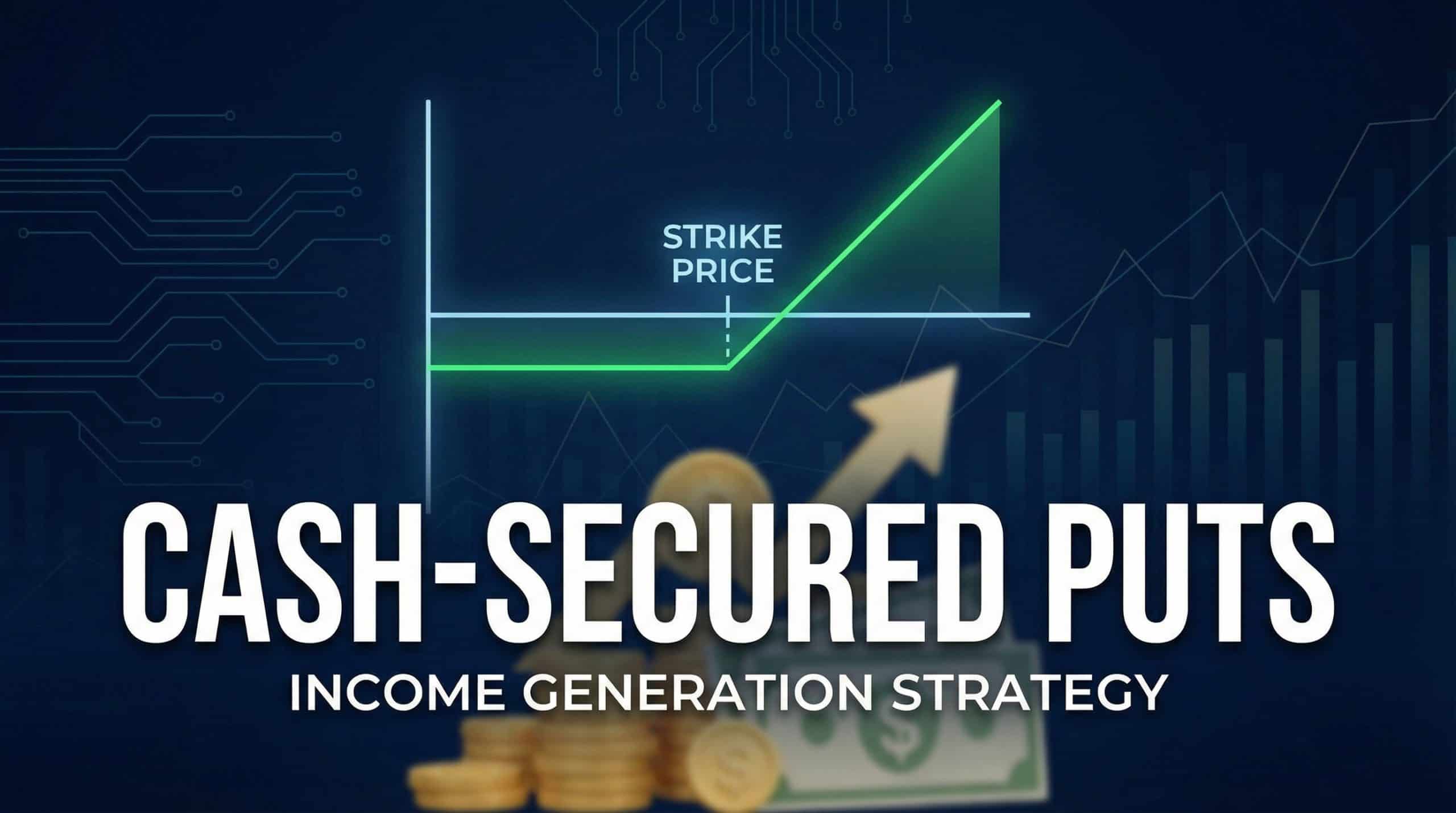
What if you could get paid to wait for a stock to drop to your target buy price? That’s exactly what a cash-secured put does. It’s one of the most beginner-friendly options strategies out there — and it’s the first strategy many investors use when they make the move from buying stocks to trading options.
The core idea is simple: you sell someone the right to sell you 100 shares of a stock at a specific price. In exchange, they pay you a premium upfront. If the stock stays above that price, you keep the premium and walk away. If it drops below, you buy the shares — at a price you were already willing to pay. Either way, you get paid.
Key Takeaway
A cash-secured put lets you collect premium income while waiting to buy a stock at a discount. Your maximum gain is the premium collected. Your risk is owning the stock at the strike price minus the premium — which is the same risk you’d have if you just bought the stock outright.
Table of Contents
- How Cash-Secured Puts Work
- Step-by-Step: How to Sell a Cash-Secured Put
- A Real-World Example
- The Three Possible Outcomes
- How to Choose the Right Strike Price
- When to Use (and When to Avoid) Cash-Secured Puts
- Cash-Secured Puts vs. Covered Calls
- Frequently Asked Questions
How Cash-Secured Puts Work
When you sell a put option, you’re taking on the obligation to buy 100 shares of a stock at the strike price if the buyer exercises their option. The “cash-secured” part means you have the cash in your account to cover that purchase — you’re not using margin or leverage. You can learn more about the standardized contract specifications for equity puts at the Cboe.
Here’s why this strategy makes sense for investors (not just traders): if you were planning to buy a stock anyway, selling a cash-secured put is almost always better than just buying the stock outright. You either buy it at a discount (strike price minus premium), or you keep the premium and try again next month. You’re getting paid either way.
Strategy Type Short put (selling a put option)
Market Outlook Neutral to bullish — you’re OK owning the stock
Max Profit Premium collected upfront
Max Loss Strike price × 100 − premium (stock goes to zero)
Breakeven Strike price − premium collected
Capital Required Strike price × 100 (held as cash collateral)
The cash requirement is the key constraint. If you sell a put with a $50 strike price, you need $5,000 in your account as collateral — because you might have to buy 100 shares at $50. This is also what makes the strategy “defined risk” — you know your maximum possible loss before you enter the trade.
Step-by-Step: How to Sell a Cash-Secured Put
Here’s the exact process for entering a cash-secured put trade on most broker platforms:
- Identify a stock you want to own. Cash-secured puts work best on stocks you’d genuinely be happy to own at the strike price. Don’t sell puts on stocks you’d panic-sell if assigned.
- Check the options chain. Navigate to the options chain for your chosen stock. Look at puts expiring 20–45 days out (this is the sweet spot for theta decay).
- Choose a strike price. Select a strike at or below the current stock price. A strike 5–10% below the current price gives you a buffer and still collects meaningful premium.
- Sell to open. Select “Sell to Open” on the put option. You’ll receive the premium immediately in your account.
- Ensure cash is reserved. Your broker will hold the collateral (strike × 100) until the option expires or is closed.
- Manage the trade. If the option reaches 50% of max profit before expiration, consider closing it early to lock in gains and free up capital.
Pro Tip
Most professional options sellers close their short puts at 50% of max profit rather than holding to expiration. Collecting 50% of the premium in half the time and redeploying the capital is more efficient than holding for the last few cents — and it eliminates gamma risk near expiration.
A Real-World Example
Let’s walk through a concrete example. Suppose Apple (AAPL) is trading at $220. You’ve been wanting to buy AAPL but think it’s a bit expensive right now. You’d be happy to own it at $210.
You look at the options chain and find a put option with a $210 strike expiring in 30 days. It’s trading for $2.50 per share. Since options contracts represent 100 shares, you’d collect $250 in premium by selling one contract.
Trade Detail | Value |
|---|---|
Stock (AAPL) current price | $220.00 |
Strike price selected | $210.00 |
Days to expiration | 30 days |
Premium collected | $2.50/share = $250 total |
Cash collateral required | $21,000 (210 × 100) |
Breakeven price | $207.50 (210 − 2.50) |
Annualized yield (if repeated monthly) | ~14.3% ($250 / $21,000 × 12) |
You set aside $21,000 in cash and sell the put. The $250 premium lands in your account immediately. Now you wait.
The Three Possible Outcomes
At expiration (or whenever you close the trade), one of three things will have happened:
Scenario | What Happens | Your Result |
|---|---|---|
AAPL stays above $210 | Put expires worthless | Keep $250 premium. Trade again next month. |
AAPL falls to $210–$207.50 | Assigned — you buy 100 shares at $210 | Effective cost basis: $207.50. You own AAPL at a discount. |
AAPL falls below $207.50 | Assigned — you buy 100 shares at $210 | Unrealized loss, but you own a stock you wanted at a price you chose. |
Notice that even in the “worst case” scenario, you’re buying a stock you already wanted to own, at a price you already decided was acceptable — and you got paid $250 for the privilege of waiting. The only scenario where this strategy truly hurts is if the stock crashes far below your strike and you’re holding a large unrealized loss. This is why stock selection matters enormously.
⚠️ Risk Warning
Never sell cash-secured puts on stocks you wouldn’t want to own. If AAPL drops to $150 and you’re assigned at $210, you’re sitting on a $6,000 unrealized loss. The strategy works best on high-quality, large-cap stocks you’d hold through a downturn — not speculative names or stocks in downtrends.
How to Choose the Right Strike Price
Strike selection is the most important decision in a cash-secured put trade. Here’s how to think about it:
The most common approach is to sell a put at a delta of -0.20 to -0.30. Delta on a put option represents (roughly) the probability that the option will expire in the money. A -0.25 delta put has approximately a 25% chance of being assigned — meaning you have a 75% chance of keeping the full premium with no assignment.
Strike Selection | Delta Range | Premium | Assignment Probability | Best For |
|---|---|---|---|---|
At the money (ATM) | ~0.50 | High | ~50% | Aggressive income, OK with frequent assignment |
Slightly OTM (5% below) | ~0.30–0.40 | Moderate-high | ~30–40% | Balanced income + buffer |
OTM (10% below) | ~0.15–0.25 | Moderate | ~15–25% | Conservative — most common for beginners |
Deep OTM (15%+ below) | <0.10 | Low | <10% | Very conservative — minimal premium |
For beginners, starting with a delta around -0.20 to -0.25 (roughly 10% out of the money) is a good balance. You collect meaningful premium while giving yourself a reasonable buffer before assignment. As you get more comfortable with the strategy, you can experiment with different strike levels based on your goals.
When to Use (and When to Avoid) Cash-Secured Puts
Cash-secured puts work best in specific market conditions. Knowing when to deploy the strategy — and when to step aside — is just as important as knowing how to execute it.
Condition | Use CSPs? | Reason |
|---|---|---|
Stock in uptrend, IV elevated | Yes — ideal | High premium + bullish backdrop = best of both worlds |
Stock flat/sideways, IV moderate | Yes — good | Theta works in your favor, stock unlikely to crash |
Stock in downtrend | Caution | High assignment risk; wait for trend reversal signal |
Earnings within the expiration window | Avoid or use shorter expiry | IV crush after earnings can help, but gap-down risk is real |
IV very low (IVR < 20) | Reduce size or skip | Premium too thin to justify the capital tie-up |
The sweet spot for cash-secured puts is a stock you know well, in a neutral-to-bullish trend, with IV Rank above 30. This gives you enough premium to make the trade worthwhile while keeping assignment risk manageable. For more on how implied volatility affects your premium, see our guide on implied volatility for options traders.
Cash-Secured Puts vs. Covered Calls
Cash-secured puts and covered calls are often discussed together because they’re mathematically equivalent strategies — a concept called put-call parity. Both involve selling premium, both have defined maximum profit (the premium), and both have substantial downside risk if the stock crashes.
Feature | Cash-Secured Put | Covered Call |
|---|---|---|
When you use it | Before owning the stock | After owning the stock |
Capital required | Cash (strike × 100) | Stock (100 shares) |
Max profit | Premium collected | Premium + any stock gain to strike |
Risk | Stock drops below breakeven | Stock drops (same as owning stock) |
Assignment outcome | You buy the stock | You sell the stock |
Many traders use these two strategies together in a cycle: sell a cash-secured put → get assigned → own the stock → sell a covered call → get called away → repeat. This is sometimes called the “wheel strategy,” and it’s one of the most popular income-generating approaches for retail options traders.
Key Takeaway
Cash-secured puts are the ideal entry point for the wheel strategy. You start by selling puts to collect premium and potentially acquire stock at a discount. Once assigned, you transition to selling covered calls to generate income on the shares you now own.
Getting Started: What You Need
To sell cash-secured puts, you need a brokerage account with options approval at Level 1 or Level 2 (the exact naming varies by broker). Most brokers grant this level of approval easily — it’s the most basic options permission tier. You’ll also need enough cash in your account to cover the collateral requirement.
For tracking your cash-secured put trades, monitoring your cost basis after assignment, and analyzing which strikes and expirations work best for your style, a dedicated options journal is invaluable. OptionsPro tracks multi-leg strategies and shows you your P&L by strategy type — so you can see exactly how your cash-secured put program is performing over time.
Frequently Asked Questions
Here are answers to the most common questions beginners have about cash-secured puts. For more on options income strategies, visit our full strategy section.
What is a cash-secured put in simple terms?
A cash-secured put is when you sell someone the right to sell you 100 shares of a stock at a set price (the strike price), and you keep enough cash in your account to buy those shares if needed. In exchange for taking on this obligation, you collect a premium upfront. If the stock stays above the strike, you keep the premium and the trade is over. If it drops below, you buy the shares at the strike price — which you already decided was a fair price to pay.
How much money do I need to sell cash-secured puts?
You need enough cash to buy 100 shares at the strike price. For example, if you sell a put with a $50 strike, you need $5,000 in cash collateral. This is held by your broker until the option expires or you close the trade. The cash isn’t spent — it’s just reserved as collateral.
What happens if I get assigned on a cash-secured put?
If the stock drops below your strike price at expiration, you’ll be assigned — meaning your broker will use your reserved cash to purchase 100 shares at the strike price. Your effective cost basis is the strike price minus the premium you collected. You now own the stock, and you can choose to hold it or start selling covered calls against it.
Is selling cash-secured puts risky?
The risk is the same as buying the stock outright — if the stock drops significantly, you’ll have an unrealized loss. The premium you collected provides a small buffer (your breakeven is strike minus premium), but it won’t protect you from a major decline. This is why stock selection is critical: only sell puts on stocks you’d genuinely want to own and hold through a downturn.
What is the best expiration date for cash-secured puts?
Most options traders target 20–45 days to expiration (DTE) for cash-secured puts. This range captures the fastest portion of theta decay (time value erosion), which works in your favor as a seller. Going shorter than 20 DTE increases gamma risk near expiration; going longer than 45 DTE ties up capital for too long relative to the premium collected.
What is the wheel strategy?
The wheel strategy is a systematic income approach that cycles between selling cash-secured puts and covered calls. You start by selling puts on a stock you want to own. If assigned, you own the shares and begin selling covered calls. If called away, you’re back to cash and start selling puts again. The goal is to collect premium continuously through each phase of the cycle.
Disclaimer: The information provided on OptionsTrading.org is for educational and informational purposes only. We aim to help users make informed decisions about options trading, but we are not providing financial advice. We do not make recommendations on specific trades or investment strategies. Options trading carries significant risk, including the potential loss of your entire investment, and may not be suitable for all investors. Always conduct your own thorough research and/or consult with a licensed financial advisor before making any trading decisions.