
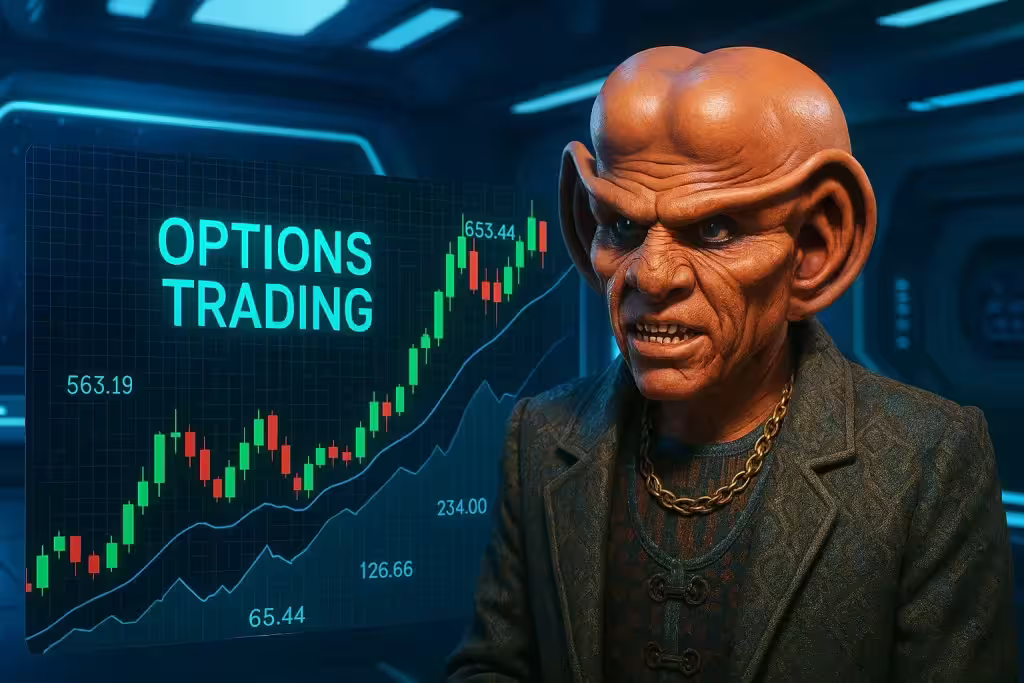
What could a bunch of greedy alien merchants from Star Trek possibly teach us about trading stock options? More than you would think! We’re about to boldly go where no trader has gone before (sorry for using the overused Trekkie tagline) and explore the profit-obsessed mindset of the Ferengi. It’s not every day that you see a sci-fi comparison with finance, but if it works? It works. Not only is it a solid analogy, but it’s fun!
We are gonna go galactic and find out exactly what the deal is with Star Trek’s Ferengi (yup, those big-eared aliens who are obsessed with making a profit) and what they can teach us about options trading. The Ferengi live by the “Rules of Acquisition,” which is a collection of business maxims that guide every single deal that they make.
And yes, some of these rules are a little on the extreme (and pretty cheeky) side, most of them come with surprising wisdom that applies really well to making money here on Earth.
Who knows, by the end you might be channeling your inner Ferengi when you’re managing your next options trade (no weird earlobes or beaming up required). Make some raktajino (that’s Klingon coffee, for the uninitiated), and let’s get galactic!
Who Are the Ferengi? A Crash Course for Traders
If you’re not a Trekkie, you are most definitely wondering, “Who (or what) the heck is a Ferengi?” It’s an alien species for whom profit is the one and only goal in life—that’s the series in a nutshell.
They were introduced in Star Trek: The Next Generation and popularized in Deep Space Nine and are known across the galaxy as shrewd traders and deal-makers. As we said before, they’ve got these massive ears (which are perfect for “listening” for opportunity) and a knack for turning just about everything into a money-making scheme. Their entire culture revolves around commerce, bargaining, and accumulating wealth (their currency is gold-pressed Latinum, which is space money). The Ferengi are kinda like the Wall Street wolves of the Alpha Quadrant, only greedier (if that’s possible) and with funnier hats.
But the Ferengi are a species like no other due to their legendary “Rules of Acquisition,” which are a set of 285 aphorisms that every Ferengi entrepreneur knows by heart. The rules are a Ferengi trader’s bible.
- Rule #1: “Once you have their money, never give it back.” (Sound advice for locking in profits, even if it’s ruthless.)
- Rule #21: “Never place friendship before profit.” Yikes, these guys have never heard of “don’t mix money and friends.”
The Rules of Acquisition go from shrewd (“Opportunity plus instinct profit”) to slick and unethical (“Never be afraid to mislabel a product if it gets you a better price”). You get the picture—the Ferengi will do anything for the sake of a deal. Now, we humans have things like laws, ethics, and, you know, basic decency, so not all of the Ferengi tactics are for us. But if you strip away the hyperbole, you’ll find that some Ferengi “rules” actually highlight very real principles of smart business and trading. And as options traders, we do love the idea of a guiding framework for making profitable trades, right? Right! So, let’s translate some of those Ferengi rules into our world of calls, puts, and spreads.
Ferengi Lessons for Options Trading
Now it’s time to turn those Ferengi proverbs into options trading tactics. It’s pretty uncanny how some of the Ferengi Rules of Acquisition are actually decent options trading wisdom. Let’s take a look at a few Ferengi-inspired lessons (and see how our favorite alien profiteers would handle an options portfolio on Earth)!

Rule #1: “Once You Have Their Money, You Never Give It Back.”
This is an obvious one—you need to protect your profits! This is classic risk management. If an options trade goes in our favor and we’re sitting on gains, we should make sure that we don’t round-trip any profits back to the market.
Case in point: Let’s say that we bought call options that have doubled in value; a Ferengi-minded trader might sell a portion to lock in gains or, at the very least, set a stop-loss on the position. The idea is never to let a winning trade turn into a loser. We’ve all been there—holding too long, watching a profitable options play go south, and thinking, “I should’ve cashed out when I had the chance.”
Ferengi would be shaking their big ears at us! The takeaway is this: once you’re “in the latinum” (profitable), think about taking some money off the table or adjusting your trade to secure those gains. As traders on Earth, we have tools like stop orders and options spreads to help out with this. You can use them to set profit targets and stop-loss levels—it’s a little human risk management to complement the Ferengi wisdom.
Rule #3: “Never Spend More for an Acquisition than You Have To.”
A Ferengi always drives a hard bargain, and so should we. In options trading, this means that you don’t overpay for your trades. Be mindful of the price (premium) you pay for an option and the commissions or fees involved.
If an option’s implied volatility is sky-high, making it super expensive, you should look for a better value play or a different strategy. We can channel the l Ferengi by shopping around for the best possible entry.
You can use limit orders instead of market orders because why should you give the market maker more money than necessary? Or think about using spreads to decrease your net cost: a Ferengi would totally approve of getting some premium back. (One of our favorite tricks: If we buy one option, maybe sell another against it to subsidize the cost, as long as it fits in with our strategy.)
The bottom line is this: lower costs mean higher net profits. Every dollar that’s saved on an entry or commission is a dollar that stays in our account.
Rule #21: “Never Place Friendship above Profit.”
The Ferengi aren’t exactly known for being sentimental, and Rule #21 drives that home: “Never place friendship above profit.”
To them, every single decision they make is filtered through a single lens—does it make money? And we human traders aren’t always so clear-headed. Getting emotionally attached to a ticker, holding on to a trade because “it did well before,” or getting swept up in a hype-fueled stampede (hi, meme stocks) is the kind of mistake that would make a Ferengi cringe from secondhand embarrassment.
Emotional trading—buying into a name because everyone else is or refusing to sell it because it feels like betrayal—is the kind of loyalty that tanks portfolios. A Ferengi would never hesitate to dump a stock if the numbers turned. The trade either makes sense or it doesn’t. No nostalgia. No “what ifs.” No Reddit threads asking for others’ opinions. Just hard data and discipline. That’s the mindset that options traders should have—profit over sentiment, always.
Rule #62: “The Riskier the Road, the Greater the Profit.”
This one sounds like it was written specifically for options traders. Options, by their very nature, mostly involve taking calculated risks for potentially higher rewards. A deep out-of-the-money option can double or triple in value (or more) if the underlying stock makes a big move—that’s a high-risk, high-reward road.
Ferengi aren’t afraid of risk; they actually seek it out when the potential payoff justifies it. As traders, we should understand the risk/reward trade-off in every position that we take. Rule #62 doesn’t mean throwing darts at the riskiest bets and hoping one hits the bullseye—quite the opposite! A Ferengi would never gamble with their Latinum. But it does encourage us to take some risks when we see a commensurate potential profit.
If you identify a biotech stock that’s about to announce trial results, the options are at a decent price, and you believe there’s a solid chance of a pleasant surprise? Go for it! Buying a call option (or call spread) ahead of that news is riskier than, say, buying the stock of a stable utility company—but the profit, if you’re right, could be much larger.
A Ferengi would smirk at this setup: small outlay, defined risk (limited to the premium paid), and a shot at a big win. We just have to be sure that we’re comfortable with the possibility of losing that premium entirely if the trade doesn’t pan out (that’s the risk part!).
The lesson here is not to shy away from risk but to manage it and use it in a deliberate fashion. Allocate a portion of your capital to higher-risk/high-reward trades, but keep the rest in more stable plays. It’s exactly what a Ferengi would do—diversify the “risk portfolio” while always swinging for worthwhile profits. In practice, this will look like balancing that one lottery ticket trade with a couple of conservative income trades (like selling covered calls or cash-secured puts for a steady premium).
Rule #285: “No Good Deed Goes Unpunished.”
And then there’s Rule #285: “No good deed goes unpunished.” This is also a human saying, but not in a financial way. Leave it to the Ferengi to remind us that the market never rewards kindness—it punishes it.
In options trading, that shows up as the temptation to take the “nice-looking” trade: a cheap out-of-the-money option that expires tomorrow, a setup that seems like a no-brainer because of a news headline, or that seductive feeling that the market owes you a bounce-back. A Ferengi would never take the bait and bite. They’d recognize a trap that is only dressed up as an opportunity.
Those low-premium, high-risk positions lure traders with the illusion of a huge upside, but the odds are plain terrible. The premium might be 10 cents, sure, but the chance of that option landing in the money? Not great. And if you’re wrong, the whole thing goes to zero—fast. Ferengi wisdom says it clearly: the market doesn’t care how clever or generous your intentions were. It only pays for results. Don’t confuse a tempting setup with a profitable one!
Those are just a few of the Ferengi Rules of Acquisition that can be incorporated into our trading world. The gist is crystal clear: protect your gains, be cost-conscious, seize opportunities, trust your well-honed instincts, and understand the risk/reward payoff. Not a bad checklist for any options trader! Who knew that aliens could be such great trading coaches?
The Dark Side of Ferengi Trading: What NOT to Do
Now, before we all start chanting, “Greed is eternal!” on the trading floor, we need to pump the brakes. The Ferengi, for all their business acumen, aren’t exactly role models in ethics or moderation. And some of the Ferengi trading habits? They’re perfect examples of what NOT to do in options trading (or any trading).
Greed Overload
Yes, the Ferengi are greedy, but even they occasionally get burned by it in the shows. In trading, uncontrolled greed is the quickest way to turn a winning streak into a blown account. It might start out innocently enough—you made a nice profit on a trade, great! But then the greed shows up and tells you, “Double down, go bigger!” If you find yourself upping your position sizes beyond your risk comfort or holding on to a waning option, hoping for just a little more profit even as signs tell you to exit, that’s greed messing with your decision-making.
A Ferengi might double down until the cows come home (anything for more Latinum!), but we should never. Stick to your risk management rules: position sizing, take-profit levels, and stop-losses. Don’t chase trades out of sheer envy of others’ gains or an unrealistic desire to turn $5,000 into $5,000,000 overnight. When we let greed rule us, we stop following logic—and that’s when the proverbial starship fleet hits the asteroid. The Ferengi say, “Greed is eternal,” but our trading capital is not—once it’s gone, it’s gone. So keep that greed in check and channel it into strategic planning instead of impulsive trades.
Deception Backfires
For all of their business acumen, the Ferengi have a rep for bending the truth—or straight-up breaking it in half—if it means they can turn a profit.
But Rule #285 wasn’t the only warning tucked into their code—there’s an unspoken one, too: when deception is the game plan, it usually backfires. And in options trading? That translates to market manipulation, you know, the kind of stunt that might get you clicks and clout on social media but will get you in real trouble with regulators.
If you spread false rumors, coordinate pump-and-dumps, or make trades to mislead other investors, you are being deceptive. A Ferengi might sneer at how transparent things have to be (or are supposed to be) on Wall Street, but even they’d know the consequences just aren’t worth it.
Unlike Ferenginar, where trickery is currency, modern markets have rules—and crossing the line doesn’t end with a slap on the wrist. It ends with frozen accounts, big fines, or worse. So be ambitious, sure, but leave the scheming out of it. There’s more profit (and far less risk) in doing everything above board.
Putting It Into Practice: A Ferengi-Inspired Options Strategy
Okay, have you had enough of the theories and background on the Star Trek aliens? It’s time to have some fun and see how we could put the Ferengi lessons to work in a real options trade. How would a Ferengi-inspired trader approach an opportunity in the market? We are gonna walk you through a hypothetical (and totes Ferengi-approved) options strategy from start to finish.

Scenario
Suppose we’ve been studying a tech stock—we’ll call it Galactic Tech Corp (GTC)—and it’s trading at $50 per share. GTC has an earnings report next week, and our analysis (a mix of good research and a bit of gut instinct à la Rule #9) tells us there’s a good chance that the stock could go through the roof on a great report. Maybe their new product is selling like tribbles at a pet shop, or there are rumors of a big partnership. We see opportunity written all over this, and a Ferengi would say there’s profit in the wind, and we’re inclined to agree.
We could buy 100 shares of GTC for $5,000 and hope to catch the upward ride. But remember Rule #62 (risk and profit) and Rule #3 (cost consciousness)—an options play that could give us more bang for our buck. So, instead of shelling out five grand on stock, we decide to deploy a Ferengi-inspired options strategy: a bull call spread.
The Ferengi Plan: We buy a call option and simultaneously sell a higher-strike call option, both expiring after the earnings date. For example, we buy a $55 strike call for, say, $1.50 (or $150 per contract since options are 100 shares each). At the same time, we sell a $60 strike call for $0.50 ($50 per contract). What does this do? A couple of things:
- It dramatically lowers our cost (Rule #3 in action). The net cost of the spread is $1.00 (1.50 paid – 0.50 received), which is $100 total. That’s all the latinum we’re putting at risk here: $100. Compare that to $5,000 if we bought the shares outright—that’s capital efficiency!
- It aligns with “once you have their money, never give it back” thinking. We got $50 from selling the call, which partly funds our long call purchase. Of course, we do now have an obligation (if GTC really goes above $60, the person who bought that call from us will expect us to hand over shares or cash above $60–but that’s fine, because our $55 call will cover it…more on that below).
- It defines our risk and reward clearly. Our maximum risk is the $100 we paid. That’s it—worst case, GTC’s earnings flop, the stock stays below $55 through expiration, and both calls expire worthless. We lose our $100 premium. A Ferengi won’t be happy losing money, but even they know sometimes the deal just doesn’t go your way. The point is that we limited the loss. We’re not losing $5,000, only $100. We can live to trade another day with minimal damage (and our profit-obsessed Ferengi ego a little bruised but still intact).
- Our max profit is the difference between the strikes minus net cost. That’s $5 spread width ($60 – $55) minus $1 cost = $4 per share, or $400 potential profit per contract. We put up $100; we could get back $400 profit if all goes perfectly—that’s a 4x return or 400%. Not too shabby! Even if we account for the fact that one trade won’t make us rich, a Ferengi would lose their dang minds at the idea of quadrupling their money on a single deal.
Strategy
Now we have to talk strategy management—because a Ferengi always has a plan and a backup plan for their plan. Our expectations are if GTC’s earnings are great and the stock shoots above $60, we’ll hit max profit on this spread. In that happy scenario, we’d close the spread and pocket the ~$400 gain. (Yes, we’d cap our upside at $60 due to selling that call, but in return, we dramatically reduced cost/risk—a classic trade-off that even a Ferengi would take when they’re not 100% sure a stock will go to the moon. Remember, Rule #1 is to keep your money— we’d rather take a sure $400 than risk the full $100 for an uncapped play that might not pan out.)
If the stock only goes up a little, like $54 or $57–we won’t get full profit, but our $55 call will have some value. We could sell the spread for a partial profit. Maybe we turn $100 into $150 or $200. Not life-changing, but it’s still a nice return. And most importantly, we would still be giving money back—we’d close the trade while it’s profitable instead of holding it for too long. A Ferengi would definitely take a smaller profit over no profit. Profit is profit.
If we’re wrong and GTC actually drops or flatlines (look, it happens, maybe the earnings were a dud), our spread will lose value. This is where we channel our disciplined side: we could decide in advance, “If this $55/$60 spread falls to $50 in value, we’ll cut our losses.” That way, we save half of our capital instead of riding it to zero. Or if it looks hopeless after earnings, we accept the $100 loss. We are cutting our losses on a bad deal to free up capital for the next opportunity. The aliens wouldn’t throw good money after bad, and neither should we. There’s always another trade.
We acted like the Ferengi but stayed sensible. We used leverage (options instead of stock) to aim for a higher percentage return (Rule #62’s logic). We controlled costs and even brought in a credit by selling an option (Rule #3 and a pop of Rule #1). We had an exit plan both for gains and losses (something that any Ferengi dealmaker worth his big ear lobes would do—they always look for an escape hatch in a contract!). And we did our homework on why this trade had promise!
Why It’s Ferengi
Could we have gone even more Ferengi? Sure, we could have just bought a bunch of cheap out-of-the-money calls for pure explosive upside—maximum risk/reward play. Or we could have sold put options to get paid upfront, counting on the stock to stay strong (Ferengi do love instant money, and selling puts is like getting paid to buy a stock you wanted anyway potentially). There are a lot of ways to skin the targ, as they say on Ferenginar. The point is this: with a Ferengi mindset, we looked for a smart, profit-packed angle on the trade instead of a plain vanilla approach. And we made sure we weren’t exposing ourselves to unrecoverable loss if things went wrong.
Conclusion: Beaming Up Profits: Final Ferengi Wisdom for Traders
What have we learned? That this mischievous Star Trek species with ginormous ears is obsessed with gold-pressed Latinum, but they can give us some valuable wisdom about options trading.
Before we call it a day on Ferenginar (or your next options play), let’s go over the main takeaways:
- Lock in gains early. Don’t let a profitable trade disappear because you got greedy or distracted. A Ferengi would never.
- Look for value. Overpaying for an option is like bidding above asking price at a garage sale. Unforgivable.
- Keep emotions out of it. Loyalty to a stock is really adorable—until it tanks your P&L.
- Take calculated risks. Ferengi love big payoffs (who doesn’t), but only the kind that is backed up by odds, not just optimism.
- Watch out for traps. If it looks too good to be true, it probably is. The market doesn’t hand out free money.
You don’t need to hail from Planet Ferenginar to appreciate the value of a well-executed trade. We can take Ferengi wisdom with a grain of salt (or a slug of snail juice, their fav drink) and still apply the good parts to our strategy.
Trading is a human endeavor, and we have our own rules and risk tolerances, but it never hurts to think outside the box (or outside the galaxy) for a little extra inspiration. The next time you’re about to pull the trigger on an options play, you may find yourself using one of the Ferengi-inspired tips. Maybe you’ll tighten up that stop-loss, negotiate a better entry price, or smile as you close a trade and think to yourself, “Once you have their money, never give it back.”
Before we sign off, if you want your portfolio to “live long and prosper,” you can check out OptionsTrading.org for more tips and resources! “Qapla’! (That means “success” in Klingon, but it’s from Star Trek, so it counts).