Key Takeaways
- About 6.8% priced: at the November 12 close, Nvidia options priced roughly a 6.8% move for November 18, the session after its November 17 report.
- Rich against two years: Nvidia's last eight next-day earnings moves averaged about 4.0%.
- Fair against four years: over its last 16 reports the average was about 6.7%, and six of the 16 topped the move priced at the November 12 close.
- Crush is priced too: as of November 12, November 18 implied volatility was about 93.5%, against about 71.4% for November 27.
- A CEO change first: Nvidia's board accepted Jensen Huang's resignation as president, CEO and director on November 11, announced before the open on November 12; Nvidia closed down 4.34% that day and still reports as scheduled.
Nvidia earnings land after the close on Tuesday, November 17, 2026, with the conference call at 2 p.m. PT, according to Nvidia, a date the company reaffirmed when it announced Jensen Huang's resignation. At the November 12, 2026 close, Nvidia (NVDA) options priced an expected move of about 6.8%, or roughly $11, for November 18, the first session after the report, on our calculation from Cboe's delayed quotes.
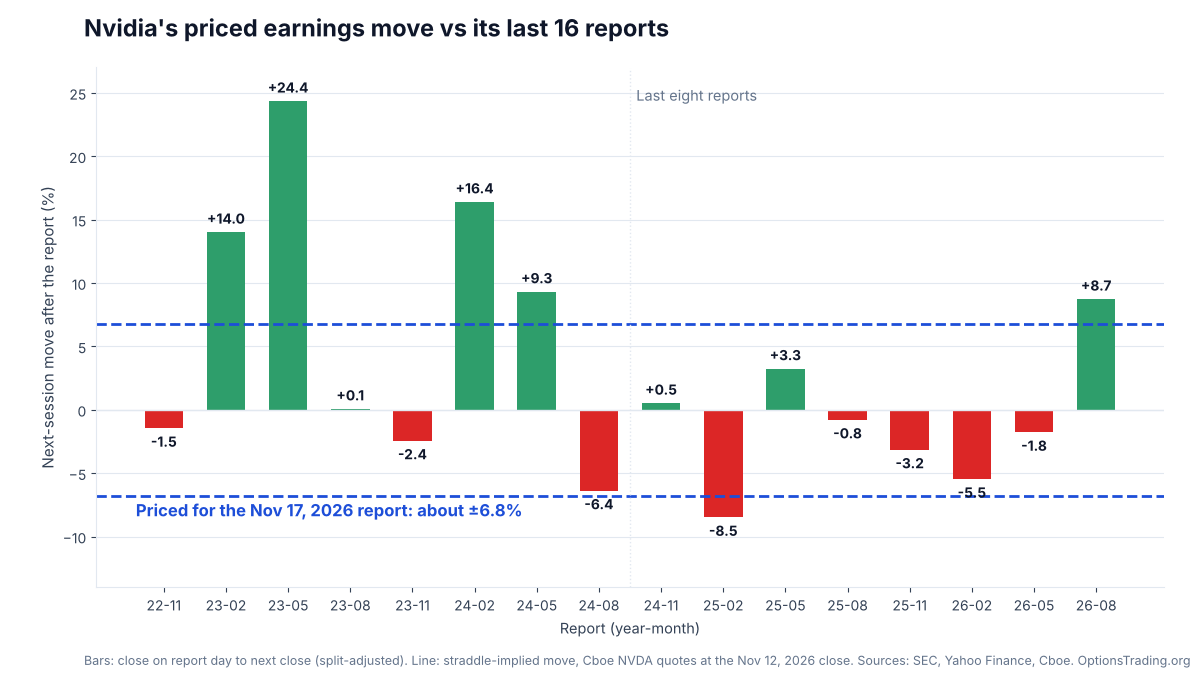
Our read is that the premium looks rich against the past two years and about fair against the past four. Nvidia's last eight next-day earnings moves averaged about 4.0%, but its last 16 averaged about 6.7%, based on Yahoo Finance's daily closes (set the date range to 2022 onward). Which window you trust decides whether the straddle is expensive. Confidence: medium, over the period through the November 18 session.
The report now comes days after a leadership change. Nvidia's board accepted Jensen Huang's resignation as president, chief executive and director on November 11, according to the company's 8-K filing, filed before the open on November 12. The board named chief financial officer Colette Kress interim CEO, and she remains CFO. Results still come on November 17 as previously scheduled, according to the press release filed with it. Nvidia fell as much as about 14% on November 12 before closing at $166.19, down 4.34%, on Cboe's delayed quotes.
Why This Matters for Options Traders
The short version: an earnings expected move is the size of the one-day stock reaction that option prices imply, usually read from the at-the-money straddle. Comparing it with what the stock has actually done shows whether the premium looks rich or cheap.
That's the core of the expected move, and it matters most for the names whose reports move the whole market. Nvidia fell 9.3% on November 5 as the AI trade sold off, so its report is a test of that trade, not only of one company. Options that expire just after the report carry most of the event premium, and that premium tends to drain out once the news is known, the pattern our IV crush explainer walks through.
What Options Are Pricing for Nvidia Earnings
The data: at the November 12 close of $166.19, the at-the-money straddles and implied volatility looked like this, from Cboe's delayed quotes:
| Expiration | Strike | Straddle (mid) | Share of the close | Implied volatility |
|---|---|---|---|---|
| Fri, Nov 13 | 165 | $6.35 | 3.82% | 90.2% |
| Mon, Nov 16 | 165 | $9.25 | 5.57% | 65.2% |
| Wed, Nov 18 | 165 | $16.00 | 9.63% | 93.5% |
| Fri, Nov 20 | 165 | $17.23 | 10.36% | 87.6% |
| Fri, Nov 27 | 165 | $19.10 | 11.49% | 71.4% |
| Fri, Dec 18 | 166 | $24.23 | 14.58% | 58.2% |
The straddle's price rises about 73% between the November 16 and November 18 expirations, which bracket the November 17 report and the November 18 reaction session. That jump, from Cboe's delayed quotes in the table above, is the event premium.
Isolating the earnings move: an at-the-money straddle's price as a share of the stock roughly equals the expected size of the move, in either direction, through expiration (the average absolute move, not a maximum). Because volatility scales with the square root of time, we subtract in squared terms.
On Cboe's delayed quotes, the November 16 straddle (5.57%) covers two ordinary sessions, about 3.9% each. The November 18 straddle (9.63%) covers those, an ordinary November 17 and the earnings session. What's left is an implied move of about 6.8% for the reaction itself. The split is less precise than usual before the November 17 report, because options price the sessions before it unusually high after the CEO news. If the November 17 session alone is a calmer 2.7%, close to Nvidia's November 11 move, the earnings share rises to about 7.4%.
That's the straddle-based expected move, the average size of the move, which is smaller than the one-standard-deviation figure some platforms show.
The worked example: as a hypothetical example, a November 18 165 straddle bought at the November 12 close would have cost about $16.00 per share at mid prices, or $1,600 per contract before commissions ($16.10, or $1,610, at the ask). That premium is the maximum loss: the buyer loses all of it if Nvidia closes at exactly $165 at expiration on November 18, and part of it anywhere between the breakevens of $149.00 and $181.00. From the $166.19 close, that's a drop of about 10.3% or a gain of about 8.9%. Those breakevens are wider than the 6.8% earnings move because the November 18 straddle also pays for the other sessions before expiration. A fall in implied volatility after the report can cause losses before expiration even if the stock moves.
Against the past two years the premium looks rich. Against the past four, it looks about right.
Free tool from OptionsPro
Load the hypothetical November 18 at-the-money Nvidia straddle from our example and see its breakevens. The calculator spreads volatility evenly over the week, so its expected-move and probability figures differ from our earnings-only estimate.
How That Compares With Nvidia's Past Reports
The data: we measured each reaction from the close on the day Nvidia filed its results with the SEC to the close of the next session, using split-adjusted daily closes. Filing dates come from Nvidia's 8-K filings, such as the August 2026 report.
| Report date | Close that day | Next close | Move |
|---|---|---|---|
| Aug 26, 2026 | $209.66 | $227.98 | +8.74% |
| May 20, 2026 | $223.47 | $219.51 | −1.77% |
| Feb 25, 2026 | $195.56 | $184.89 | −5.46% |
| Nov 19, 2025 | $186.52 | $180.64 | −3.15% |
| Aug 27, 2025 | $181.60 | $180.17 | −0.79% |
| May 28, 2025 | $134.81 | $139.19 | +3.25% |
| Feb 26, 2025 | $131.28 | $120.15 | −8.48% |
| Nov 20, 2024 | $145.89 | $146.67 | +0.53% |
| Aug 28, 2024 | $125.61 | $117.59 | −6.38% |
| May 22, 2024 | $94.95 | $103.80 | +9.32% |
| Feb 21, 2024 | $67.47 | $78.54 | +16.41% |
| Nov 21, 2023 | $49.94 | $48.72 | −2.44% |
| Aug 23, 2023 | $47.12 | $47.16 | +0.08% |
| May 24, 2023 | $30.54 | $37.98 | +24.36% |
| Feb 22, 2023 | $20.75 | $23.66 | +14.02% |
| Nov 16, 2022 | $15.91 | $15.68 | −1.45% |
Over the last eight reports, moves ranged from 0.53% to 8.74% and averaged about 4.0%; only August 2026 (up 8.74%) and February 2025 (down 8.48%) beat the move of about 6.8% priced at the November 12 close. Over all 16, the average was about 6.7%, and six topped it, including the February 2025 report and several in 2023 and 2024.
The straddle is not a forecast of direction. It is the price of not knowing.
What's Driving the Setup
Our read: the market is paying for a leadership change and the AI trade's recent volatility, and the longer record says that's not unreasonable.
The November 5 selloff is fresh. The Nasdaq closed in correction territory on November 5 as the AI trade sold off, and Nvidia fell 9.3% that day, CNN reported, in a selloff that followed the midterm elections. Cboe's Nasdaq-100 volatility index closed at 38.26 that day and was back to 26.74 by November 11, according to Cboe's VXN history.
CoreWeave showed what an AI report can do. CoreWeave filed its results after the close on November 10, in an 8-K with the SEC, and the stock closed at $60.77 on November 11, up 24.7% from $48.73, according to Yahoo Finance's daily closes.
The calendar adds weight. The report also comes three weeks before the Fed's December 9 decision, where a half-point hike became a live risk after the October CPI report, as our October CPI analysis explains. In our view, a large Nvidia move would land in a market that's already sensitive to rates.
Counterarguments
This report is unlike the last 16. It's the first report since Jensen Huang's resignation and since Colette Kress became interim CEO, per the company's CEO transition filing. Guidance and commentary on leadership could move the stock more than the quarter's numbers, which makes past reactions a weaker guide.
Past moves are a small sample. Eight or even 16 reports isn't much history, and the debate over AI spending has changed over those four years. The past may understate or overstate the next reaction.
Rich-looking premium can still be fair. A straddle that looks rich next to the average can still be fair if the occasional large move is large enough. That tail risk is what our buy or sell premium before earnings guide warns sellers about.
This isn't an average week. With tech volatility a week removed from its November 5 spike and CoreWeave's one-day jump fresh, a bigger move than Nvidia's two-year average wouldn't be surprising.
What We'd Watch
- The November 16 to November 18 straddle gap. If it widens into the report, traders are paying more for the event itself.
- The VXN. A rise back toward its November 5 close of 38.26 would make Nvidia's priced move look more ordinary; a further decline would make it look richer. Cboe's VXN dashboard shows the current level.
- Other AI reports and headlines. CoreWeave's move shows how quickly sentiment in the group can change.
- November 18 implied volatility after the report. How far it falls tells you how much of the premium was event risk.
Implications for Traders
For premium sellers: by our measure the event premium looks rich next to Nvidia's two-year record, but two of the last eight reactions and six of the last 16 were larger than the 6.8% move priced at the November 12 close on Cboe's delayed quotes, as the reaction table above shows. That's an observation about pricing, not a recommendation to sell premium.
An uncovered short straddle has unlimited risk if the stock rises and large losses if it falls, and short options can be assigned early; defined-risk structures cap that tail at a known maximum loss, and the IV crush explainer linked above covers what can go wrong when the crush doesn't save the trade.
For premium buyers: a long straddle in the November 18 expiration needs a drop of about 10.3% or a gain of about 8.9% from the November 12 close to break even at expiration. Buyers are paying for the chance of an outsized surprise, not the typical one.
For stockholders and spread traders: protection through the report is expensive in implied volatility terms. Our guide to how earnings change implied volatility explains why options cost the most just before the event, and the gap between November 18 and November 27 implied volatility is the setup our calendar spreads for earnings guide describes.
What Would Change Our View
We'd change our view if the implied move falls well below the four-year average before the report while tech volatility holds steady, which would make it look cheap, or if the Nasdaq-100 volatility index climbs back toward its November 5 close of 38.26.
Our confidence in this read is medium, over the period through the November 18 session. The options data and the history are clear, but the answer depends on which stretch of Nvidia's history you weight, and the AI trade has been unusually volatile in November.
This is market commentary for educational purposes, not a recommendation to buy or sell any security or option. Options involve risk and aren't suitable for all investors.
FAQ
These answers cover what options traders are asking before Nvidia's third-quarter fiscal 2027 report.
Is Nvidia Still Reporting Earnings on November 17?
Yes. Nvidia's press release on its CEO change says results will come on Tuesday, November 17, as previously scheduled. Wednesday, November 18, is the first session to react.
Its 8-K filing says the board accepted Jensen Huang's resignation on November 11 and named CFO Colette Kress interim CEO.
When Does Nvidia Report Earnings?
Nvidia reports third-quarter fiscal 2027 results after the market close on Tuesday, November 17, 2026, and hosts its conference call at 2 p.m. PT (5 p.m. ET), according to Nvidia's announcement. Wednesday, November 18, 2026, is the first full trading session to react.
What Is Nvidia's Expected Move for Earnings?
Nvidia's expected move for its November 17, 2026 report is about 6.8%, or roughly $11, for the November 18 session. That's our calculation from Nvidia's at-the-money straddles on Cboe's delayed quotes at the November 12, 2026 close.
How Big Have Nvidia's Recent Earnings Moves Been?
Nvidia's last eight earnings reactions, from November 2024 through August 2026, averaged about 4.0%, measured close to close with Yahoo Finance's daily closes. Over its last 16 reports, back to November 2022, the average was about 6.7%.
Will Implied Volatility Drop After Nvidia Reports?
Option prices point to a volatility crush. As of November 12, 2026, Nvidia's November 18 options carried about 93.5% implied volatility, against about 71.4% for November 27 options, on Cboe's delayed quotes. That gap is the volatility the market expects to drain out once the report is known.