
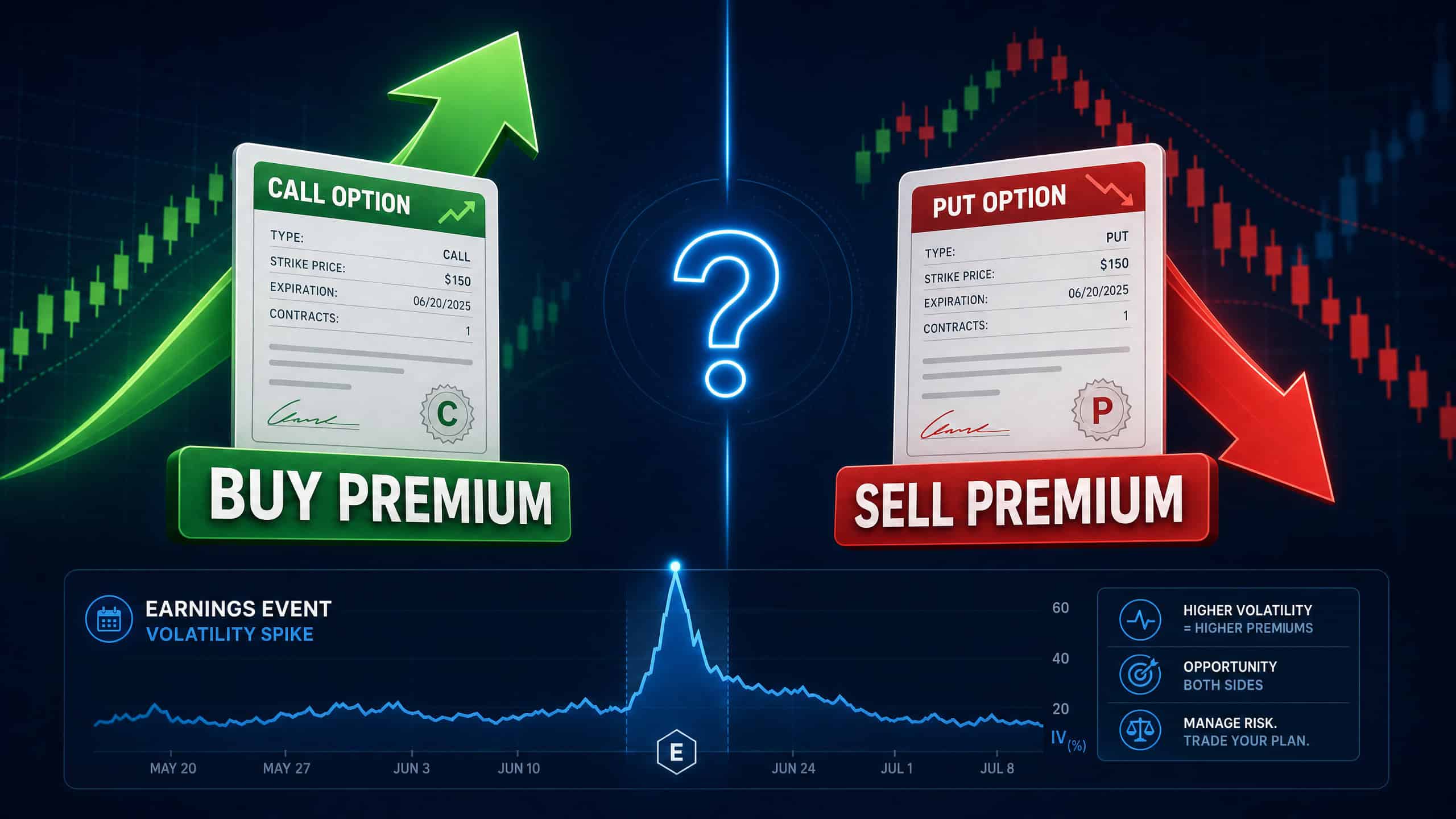
Earnings season is the Super Bowl for options traders. Four times a year, the market practically guarantees volatility as companies open their books and reveal whether they crushed expectations or fell flat. But with this predictable volatility comes a massive dilemma: Should you buy premium or sell premium before earnings?
It is the classic options trading tug-of-war. Buying premium gives you unlimited upside if the stock makes a massive move, but you fight a relentless battle against time decay and the dreaded “IV crush.” Selling premium puts time decay on your side and lets you profit from that same IV crush, but leaves you exposed to catastrophic losses if the stock gaps hard against your position.
So, which side should you take? The truth is, there is no single “right” answer—only the right strategy for the right setup. In this guide, we are going to break down exactly what happens to options prices around earnings, why the implied volatility crush destroys so many beginner traders, and how to decide whether you should be a buyer or a seller during earnings season.
Key Takeaway
Options premiums inflate before earnings due to uncertainty. Once the report is released, that uncertainty vanishes, causing implied volatility to drop sharply (IV crush). Selling premium capitalizes on this drop, while buying premium requires the stock to move further than the market expects to overcome the loss in volatility value.
Understanding Implied Volatility and the “IV Crush”
Before you can decide whether to buy or sell options around an earnings report, you must understand the mechanics of implied volatility (IV). IV is essentially the market’s expectation of future price movement. When uncertainty is high, IV goes up. When uncertainty is resolved, IV goes down.
Leading up to an earnings announcement, nobody knows exactly what the company will report. Will they beat estimates? Will they slash forward guidance? Because of this uncertainty, market makers pump up the prices of options to account for the potential of a massive gap up or down. This means that options premiums are artificially inflated right before the earnings release.
Then comes the report. The numbers are out, the conference call happens, and the market reacts. Instantly, the uncertainty is gone. The market now knows how the company performed. Because the “unknown” factor has been removed, implied volatility plummets. This rapid deflation of options prices is known as the IV crush.
⚠️ Risk Warning
The IV crush is the number one reason beginner options buyers lose money during earnings season. Even if you guess the direction of the stock correctly, if the IV crush is severe enough, the value of your option can still drop. You can be right on direction and still lose money.
Buying Premium Before Earnings: The Case for Long Options
Buying premium means you are purchasing long calls or puts (or combinations like straddles and strangles). When you buy premium, your risk is strictly limited to the amount you paid for the options. Your potential reward, however, is theoretically unlimited (or down to zero in the case of puts).
Why Traders Buy Premium
The main appeal of buying premium before earnings is the asymmetric risk-to-reward ratio. You know exactly what your maximum loss is before you enter the trade. If you buy a call option for $500, the absolute most you can lose is $500, even if the stock drops 50% on bad earnings.
Traders who buy premium are betting on an “earnings surprise”—a move that is significantly larger than what the market makers have priced into the options. To calculate the expected move, you can look at the options pricing for the front-month straddle. If the straddle costs $10, the market expects the stock to move up or down by $10. To profit as a premium buyer, you need the stock to move more than $10.
The Long Straddle Strategy
One of the most popular ways to buy premium before earnings is the long straddle. This involves buying an at-the-money (ATM) call and an ATM put with the same expiration date. By holding both sides, you don’t care which direction the stock moves; you just need it to move violently.
For example, if a stock is trading at $100, you buy the $100 call and the $100 put. If the stock gaps up to $120, your call skyrockets in value while your put goes to zero. If it drops to $80, your put explodes while your call dies. Either way, you win—as long as the move is large enough to cover the cost of both options and the subsequent IV crush.
The Downside of Buying Premium
The major headwind for premium buyers is the IV crush. Because options are so expensive right before earnings, you are paying top dollar for that straddle or directional bet. If the company reports earnings and the stock barely moves, the IV crush will instantly wipe out a massive chunk of your options’ value. You can easily lose 50% or more of your investment overnight if the stock stays flat.
Best for: Traders who expect a massive, historic move that exceeds the market maker’s expected move, and those who want strictly defined risk.
Selling Premium Before Earnings: The Case for Short Options
Selling premium means you are the one collecting the inflated options prices. Instead of buying calls or puts, you are selling them to open (or using credit spreads). Your goal is to profit from the rapid deflation of options prices—the IV crush—that happens immediately after the earnings report.
Why Traders Sell Premium
Premium sellers act like the casino. They know that market makers tend to overestimate the actual move a stock will make on earnings. Historically, implied volatility often overstates realized volatility. By selling premium, you put the math on your side.
When you sell options before earnings, you are shorting that inflated implied volatility. The moment the earnings report hits the wire, IV drops. Even if the stock moves slightly against your position, the massive drop in IV can often keep the trade profitable. You don’t need to be perfectly right on direction; you just need the stock to stay within a certain range.
The Iron Condor Strategy
A favorite strategy for premium sellers during earnings is the iron condor. This is a defined-risk strategy that involves selling an out-of-the-money (OTM) put credit spread and an OTM call credit spread simultaneously.
With an iron condor, you are establishing a wide profit zone. If the stock is at $100, you might sell the $90 put spread and the $110 call spread. As long as the stock stays between $90 and $110 after earnings, all the options expire worthless, and you keep the entire premium collected. The IV crush works entirely in your favor, rapidly decaying the value of the options you sold.
The Downside of Selling Premium
The risk of selling premium is the dreaded “tail risk.” If you sell a naked strangle (an uncovered call and an uncovered put), your risk is theoretically unlimited. If the stock gaps 30% on a massive earnings surprise, you will suffer devastating losses that far exceed the small premium you collected.
This is why most retail traders should stick to defined-risk strategies like iron condors or calendar put spreads when selling premium around earnings. Even with defined risk, however, a bad beat means taking the maximum loss on the spread.
Best for: Traders who believe the stock will stay within the expected move, and those who want to profit directly from the post-earnings IV crush.
How to Decide: Buy or Sell?
Deciding whether to buy or sell premium comes down to evaluating the specific setup for the stock in question. You shouldn’t just blindly buy or blindly sell every earnings report. Here is a checklist to help you decide.
1. Check the IV Rank and IV Percentile
Before placing an earnings trade, you must look at the stock’s IV Rank or IV Percentile. These metrics tell you how high the current implied volatility is compared to its historical range over the past year.
If a stock has an IV Rank of 80%, that means its implied volatility is higher than it has been 80% of the time over the last year. This is extremely expensive premium. In this scenario, selling premium is generally favored because the options are historically overpriced, and the impending IV crush will be massive.
Conversely, if a stock has an IV Rank of 20% right before earnings, the options are relatively cheap. The market isn’t pricing in a big move. This might be an opportunity to buy premium, as the risk of a devastating IV crush is much lower, and any significant surprise will yield a huge payoff.
2. Analyze the Expected Move
Look at the at-the-money straddle for the expiration cycle immediately following earnings. Add the price of the call and the put together. This is the market maker’s expected move. Ask yourself: Do I think the stock will move more than this, or less than this?
If the expected move is $5, and the stock routinely moves $10 on earnings, buying premium might make sense. If the expected move is $15, but the stock usually only moves $5, selling premium is the mathematical play. Research from Charles Schwab highlights that understanding the expected move—often displayed as the Market Maker Move (MMM) on platforms like thinkorswim—is one of the most valuable tools for earnings traders.
3. Consider Calendar Spreads for a Hybrid Approach
If you want to trade earnings but don’t want to take on the massive risk of buying a straddle or selling an iron condor, consider a calendar spread. This involves selling a short-term option (the one expiring right after earnings) and buying a longer-term option at the same strike price.
The short-term option will experience the massive IV crush and lose value rapidly, which benefits you. The longer-term option will hold its value better because it has more time until expiration. This strategy allows you to profit from the IV crush while strictly defining your risk.
Pro Tip
Always close your earnings trades quickly. The IV crush happens in the first few minutes of trading the morning after the report. Whether you bought or sold premium, don’t overstay your welcome. Take your profits or cut your losses and move on to the next trade.
The Role of the Options Greeks in Earnings Trades
When trading earnings, understanding implied volatility is only half the battle. To truly master the art of buying or selling premium, you must also understand how the options Greeks interact with your positions during these high-stress events. The Greeks are mathematical calculations that measure the sensitivity of an option’s price to various factors, such as changes in the underlying stock price, time decay, and volatility.
Vega: The Volatility Engine
The most critical Greek to monitor during earnings season is Vega. Vega measures an option’s sensitivity to changes in implied volatility. Specifically, it tells you how much the option’s price will change for every 1% change in implied volatility.
When you buy premium before earnings, you are inherently long Vega. You want implied volatility to expand, or at least remain stable, while the stock makes its move. However, because earnings reports are known events that resolve uncertainty, IV almost always drops immediately after the announcement. This means that as a premium buyer, you are fighting a massive headwind from Vega. The IV crush will aggressively erode the value of your long options, forcing the stock to move even further just to break even.
Conversely, when you sell premium, you are short Vega. You actively want implied volatility to collapse. The post-earnings IV crush is your best friend, as it rapidly deflates the value of the options you sold, allowing you to buy them back for a fraction of the price or let them expire worthless.
Theta: The Silent Thief
Another crucial Greek is Theta, which measures the rate of time decay. Options are wasting assets; every day that passes, they lose a portion of their extrinsic value. Theta quantifies this daily loss.
For premium buyers, Theta is the silent thief. If you buy a straddle a week before earnings, you are bleeding time value every single day while you wait for the announcement. This is why many traders prefer to buy their options as close to the earnings date as possible, minimizing the amount of time decay they must endure before the event.
For premium sellers, Theta is a powerful ally. Every day that passes puts money in your pocket. When combined with the IV crush (Vega), the rapid acceleration of time decay right before expiration can turn a short premium trade into a quick profit.
Gamma: The Acceleration Factor
Finally, we have Gamma, which measures the rate of change of an option’s Delta. Gamma is highest for at-the-money options and increases as expiration approaches. This makes short-term options highly sensitive to small movements in the underlying stock.
When you buy a straddle right before earnings, you are long Gamma. If the stock makes a massive move, your Gamma will cause the Delta of your winning option to rapidly approach 1.00 (acting like 100 shares of stock), while the losing option’s Delta drops to zero. This acceleration is what allows premium buyers to generate outsized returns on massive earnings surprises.
However, if you are selling premium, you are short Gamma. This is where the danger lies. If you sell a short-term iron condor and the stock gaps violently through your short strikes, the negative Gamma will rapidly increase your losses. This is why risk management and proper strike selection are paramount for premium sellers.
Using Options Tools to Analyze Earnings
To successfully navigate earnings season, you need the right tools to analyze IV Rank, expected moves, and historical volatility. While many brokerages offer these metrics, having a dedicated options analysis platform can give you a significant edge.
Tool | Best For | Key Feature | Free Tier | Pricing |
|---|---|---|---|---|
1. OptionsPro #1 PICK | Earnings Analysis | AI Volatility Tracking | ✓ Yes | Free; Pro from $8.33/mo |
2. TradingView | Technical Charting | Advanced Charting | ✓ Yes | From $14.95/mo |
OptionsPro
Best for: Comprehensive earnings analysis and IV tracking
When it comes to tracking IV Rank, expected moves, and historical earnings reactions, OptionsPro is a top-tier choice. It allows you to quickly scan for stocks with inflated implied volatility, making it easy to find premium-selling candidates before earnings announcements.
Best For Earnings Analysis
Pricing From $8.33/mo ✓ Free Tier
Our #1 Pick OptionsPro Track multi-leg strategies, analyze your patterns with AI, and sync your brokerage automatically.
TradingView
Best for: Technical analysis around earnings gaps
While not strictly an options platform, TradingView is essential for mapping out support and resistance levels. If you are selling an iron condor, you want to ensure your short strikes are placed beyond major technical levels to give yourself the best chance of success if the stock moves.
Best For Technical Charting
Pricing From $14.95/mo ✓ Free Tier
The Psychological Aspect of Earnings Trading
Beyond the math and the Greeks, trading earnings requires a specific psychological fortitude. Earnings announcements are inherently binary events; they are coin flips. No amount of fundamental analysis or chart reading can perfectly predict how the market will react to a company’s forward guidance or revenue miss.
Because of this unpredictability, you must detach your ego from the outcome. If you buy a call option because you are convinced a company will crush earnings, and they do, but the stock still drops 10% because the market didn’t like the CEO’s tone on the conference call, you cannot take it personally. The market is irrational in the short term, and earnings reactions are often counterintuitive.
This is why position sizing is the most critical element of trading earnings. Whether you are buying or selling premium, you should never allocate more than 1% to 2% of your total account capital to a single earnings trade. By keeping your position sizes small, you remove the emotional stress of the trade. If you take a maximum loss on an iron condor, it’s just a small paper cut, not a fatal blow to your portfolio.
Furthermore, you must have a predefined exit plan. If you are selling premium, you should have a target profit in mind—perhaps 50% of the maximum credit collected. The moment the market opens the day after earnings and the IV crush hits, if you have hit your target, close the trade. The same applies to buying premium; if you catch a massive gap, take your profits quickly before the market reverses or IV continues to deflate.
Historical Context: Why Selling Premium Often Wins
While buying premium can lead to spectacular, screenshot-worthy gains, the mathematical reality is that selling premium tends to be the more consistent strategy over the long term. This is rooted in a concept known as the Variance Risk Premium (VRP).
VRP is the difference between implied volatility (what the market expects) and realized volatility (what actually happens). Historically, across broad market indices and individual equities, implied volatility consistently overstates realized volatility. Market makers are in the business of managing risk, and to protect themselves against catastrophic gaps, they price options slightly higher than the actual statistical probability of those gaps occurring.
When you sell premium, you are essentially collecting this Variance Risk Premium. You are acting as the insurance provider, taking on the risk of the outlier move in exchange for a steady stream of inflated premiums. Over hundreds of trades, assuming you manage your risk properly and avoid catastrophic losses, the math dictates that selling premium should yield a positive expectancy.
However, this does not mean selling premium is a guaranteed path to riches. The phrase “picking up pennies in front of a steamroller” is often used to describe short premium strategies for a reason. You can win nine trades in a row, collecting small credits, only to have the tenth trade gap massively against you, wiping out all your previous gains. This is why defined-risk strategies, such as iron condors and credit spreads, are vastly superior to naked options for retail traders navigating earnings season. For a deeper dive into managing these risks, check out our best options strategies for earnings season.
Alternative Approaches: The Pre-Earnings Run-Up
If the idea of holding a position through the actual earnings announcement sounds too stressful, there is an alternative approach: trading the pre-earnings run-up.
As we discussed earlier, implied volatility naturally expands in the weeks leading up to an earnings report. This expansion causes the value of options to increase, assuming the stock price remains relatively stable. Savvy traders can capitalize on this phenomenon by buying options (typically straddles or strangles) two to three weeks before the earnings date, and then selling them the day before the announcement.
By executing this strategy, you are entirely avoiding the binary risk of the earnings report and the subsequent IV crush. Instead, you are profiting solely from the predictable inflation of implied volatility. If the stock happens to make a directional move during those two weeks, you benefit from the Gamma expansion as well. For more on how to leverage this kind of volatility-based timing, our article on calendar spreads for earnings goes into further detail.
Final Thoughts: Aligning Strategy with Volatility
Trading earnings is not about guessing which way the stock will go. It is about understanding how implied volatility affects options pricing. If you buy premium, you must overcome the IV crush by getting a massive directional move. If you sell premium, you profit from the IV crush but take on the risk of an outlier move.
For most traders in 2026, selling defined-risk premium (like iron condors) when IV Rank is high offers a more consistent mathematical edge. However, buying premium can occasionally pay off handsomely if you spot a setup where the market is severely underpricing the potential for a surprise.
Whichever path you choose, always define your risk before entering the trade, and never risk more than a small percentage of your account on a single earnings event. For a broader look at how to approach volatile market conditions, visit our guide on improving your trading skills.
Frequently Asked Questions
Still have questions about buying or selling premium before earnings? Check out our FAQ below for quick answers to the most common queries.
What is an IV crush?
An IV crush is the rapid drop in implied volatility that occurs immediately after a known event, such as an earnings announcement, has passed. This drop in volatility causes the value of options premiums to deflate quickly, often wiping out a significant portion of a long option’s value even if the stock moves in the expected direction.
Is it better to buy or sell options before earnings?
It depends on the implied volatility. If IV is historically high (high IV Rank above 50%), it is generally mathematically better to sell defined-risk premium to capitalize on the IV crush. If IV is low relative to historical norms, buying premium might be viable if you expect a larger-than-priced move.
What is the best options strategy for earnings?
For premium sellers, defined-risk strategies like iron condors or credit spreads are popular because they limit maximum loss. For premium buyers, long straddles or strangles are common. Calendar spreads offer a hybrid approach to profit from IV crush with defined risk.
Can I lose money if I buy a call and the stock goes up after earnings?
Yes. If you buy a call option before earnings and the stock goes up, but the move isn’t large enough to offset the loss in value from the IV crush, your option can still lose value overall. This is why premium buyers need the stock to move significantly beyond the expected move.
What is the pre-earnings run-up strategy?
The pre-earnings run-up strategy involves buying options (typically straddles or strangles) two to three weeks before an earnings announcement to profit from the natural expansion of implied volatility, then selling the position the day before the report to avoid the IV crush entirely.