Key Takeaways
- Hot print: October CPI rose 0.4% and core 0.3%, both above forecasts.
- Size, not timing: a December hike now looks all but certain; the open question is 25 or 50 basis points.
- Waller's line was crossed: he said a half-point hike should be considered if core came in near 0.3%.
- CPI day scorecard: SPY options priced about a 0.8% move; SPY closed down 0.37%.
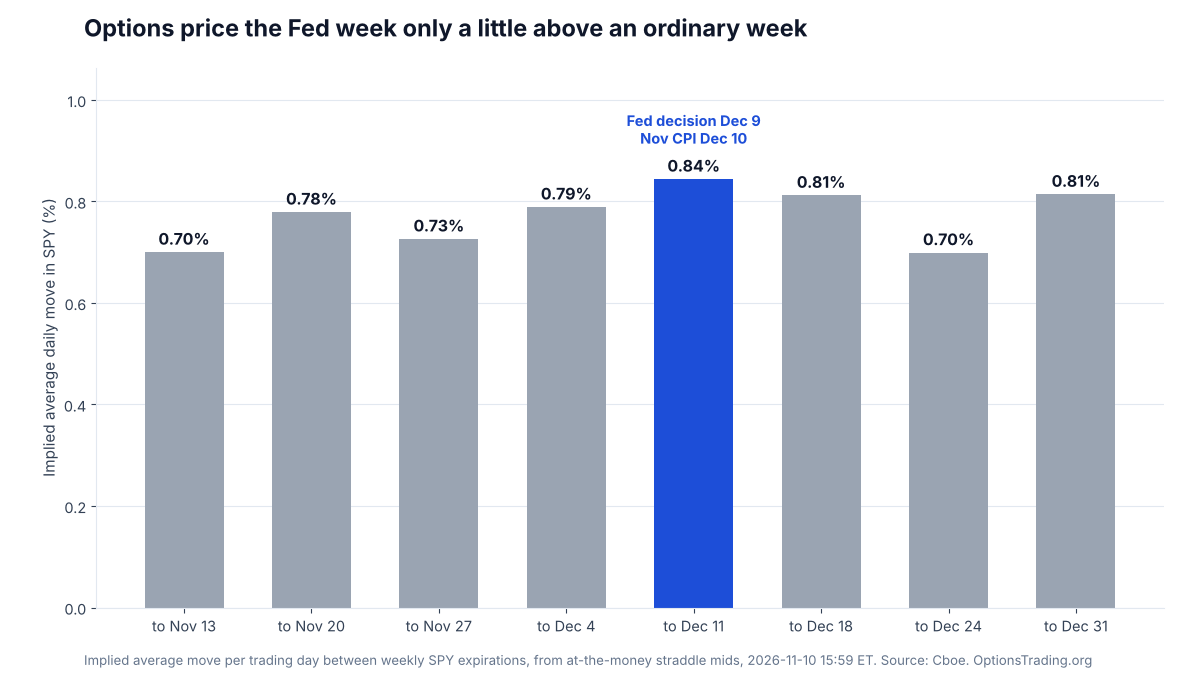
- A modest Fed-week premium: SPY options price the December 9 week only slightly above an ordinary week.
The October CPI came in hot. Consumer prices rose 0.4% in October and core prices rose 0.3%, according to the Bureau of Labor Statistics, both above forecasts. Hours earlier, Governor Christopher Waller had said that a core reading around 0.3% would make a half-point December hike worth considering.
Our read is that the report all but settled whether the Fed hikes on December 9 and made the real question how much. A half-point move went from roughly zero to about a 15% chance on CME Group's FedWatch tool, as CBS News reported. Yet SPY options price the Fed's week only modestly above an ordinary week. Confidence: medium, over the period through the December 9 decision.
Why This Matters for Options Traders
The short version: last week the December question was whether the Fed hikes. Today it is whether the Fed hikes by a quarter point or a half point, and only one of those outcomes is close to fully priced.
That matters for anyone holding options through December 9. A quarter-point hike that everyone expects is the kind of event where implied volatility tends to crush after the statement. A half-point hike that the market gives about one chance in seven is a surprise, and surprises are what move vega the other way. In our December rate hike odds analysis last week we argued the rate change itself barely moves option prices; the volatility around the decision does. The October CPI raised the stakes on that volatility.
What the October CPI Data Says
1. Inflation stayed hot across the board. The BLS release shows headline CPI up 0.4% after 0.6% in September. Core CPI rose 0.3% for a third straight month. Shelter rose 0.3% and accounted for over 30% of the monthly increase; food rose 0.5% and energy 0.7%. Used cars and communication were among the few major indexes that fell.
2. Both readings beat forecasts. Economists polled by FactSet expected a 0.3% headline gain, and core came in slightly above economists' forecasts, CBS News reported. The miss is small, but three straight 0.3% core readings is a run that annualizes to about 3.6%, far above the Fed's 2% goal.
3. There is no year-over-year number this month. The BLS did not collect price data for October 2025 during the 2025 lapse in appropriations, so it could not publish 12-month changes for most October 2026 series. That puts more weight on the monthly figures, which is where the surprise was.
4. Waller had drawn the line in advance. Speaking in London before the release, Governor Waller said he was "leaning toward supporting an increase in our policy rate of 25 basis points" in December. He added that if core CPI came in "around 0.3 percent or even higher," a 50 basis point hike "should be considered," and that "Hiking only 25 basis points would put our credibility at risk," according to the text of his speech.
5. The market priced out a hold and priced in a bigger hike. Before the report, FedWatch priced a better than 80% chance of a quarter-point December hike and no chance of a half point, per CNBC. After it, the tool showed 85% for a quarter point and 15% for a half point, per CBS News, which leaves no weight on a hold in those figures.
What Options Priced for CPI Day
The scorecard: at Monday's close, the SPY at-the-money straddle expiring Tuesday cost about $6.05 with SPY near 753, on Cboe's delayed quotes. That straddle priced a move of about 0.8% for CPI day, the same size of move our expected move guide shows how to read.
SPY closed at 749.92 on Tuesday, down 0.37% from Monday's 752.69 close, on Cboe's delayed quotes. At that close the 753 straddle was worth about $3.08 at expiration against its $6.05 cost, a loss of about $2.97 per share for buyers and the same gain for sellers, before costs. Even on a hot print, stocks moved less than options had priced.
The VIX ended Tuesday near 19.5 on Cboe's delayed data, a little below Monday's 19.92 close. Volatility traders, in other words, did not treat the hot print as a shock. For more on how traders build positions around these releases, see our guides to 0DTE options on CPI days and structuring trades around CPI and jobs reports.
How Options Are Pricing the December Fed Week
The method: an at-the-money straddle is roughly proportional to the square root of the total variance the market expects until expiration. That makes the squared straddle additive across time, so the difference between the squared straddles of two weekly expirations shows how much movement options price for the days between them. We express each window as an average absolute daily move, the same convention as the CPI-day figure above.
| Window | Trading days | Straddle at the later expiration | Implied average daily move |
|---|---|---|---|
| Nov 10 to Nov 13 | 3 | $9.11 (1.21%) | 0.70% |
| Nov 13 to Nov 20 | 5 | $15.95 (2.12%) | 0.78% |
| Nov 20 to Nov 27 | 4 | $19.32 (2.57%) | 0.73% |
| Nov 27 to Dec 4 | 5 | $23.43 (3.12%) | 0.79% |
| Dec 4 to Dec 11 | 5 | $27.38 (3.65%) | 0.84% |
| Dec 11 to Dec 18 | 5 | $30.59 (4.07%) | 0.81% |
| Dec 18 to Dec 24 | 4 | $32.34 (4.31%) | 0.70% |
| Dec 24 to Dec 31 | 4 | $34.57 (4.60%) | 0.81% |
What the numbers say: on our calculation from Cboe's delayed quotes, the window from December 4 to December 11, which holds the Fed decision on December 9 and November CPI on December 10, prices an average move of about 0.84% a day, the highest of the eight windows to year-end. The other windows average about 0.77% a day. The difference works out to an extra move of roughly 0.8% for the two events together, in this approximation, on top of an ordinary week. For comparison, Monday's straddle priced CPI day itself at about 0.80%. That is a premium, but not a large one for a week that holds a Fed decision with a live half-point tail and an inflation report.
The worked example: for example, buying the December 11 751 straddle at Tuesday's close cost about $27.38, or 3.65% of SPY. That is the full cost of the position, and the most it can lose. At expiration it breaks even only if SPY settles below 723.62 or above 778.38, and it loses time value every day the market sits still before the meeting.
The market no longer asks whether the Fed hikes in December. It asks by how much.
Free tool from OptionsPro
Load the SPY December 11 at-the-money straddle from our worked example and see its breakevens and how time decay and implied volatility change it before the Fed decision.
What's Driving the Setup
Our read: the quarter-point hike is priced, the half-point tail is not fully priced, and the calendar makes December 9 harder to read than a normal meeting.
The data the Fed won't see. The BLS schedule puts November CPI on December 10, the day after the decision. So the window that holds the meeting also holds the next inflation print, and a half-point hike followed by a soft CPI, or a quarter point followed by a hot one, are both possible within 24 hours.
The VIX curve shows only a small meeting bump. Each VIX futures contract prices 30-day volatility from its settlement date, so the November contract, which settles November 18, is the one whose window includes December 9. At Monday's settlement it was at 20.01, a little above December at 19.49 and January at 20.10, per Cboe's November contract file and its neighbors. Last week the whole curve was inverted.
A divided committee. The Fed held in October by a 10 to 2 vote, with two members preferring a hike. Waller now says a quarter point might put credibility at risk. A committee where the debate is about size rather than direction can still surprise.
Options are pricing December 9 like a busy week, not like a meeting that could surprise by a quarter point.
Counterarguments
One governor is not the committee. Waller set the half-point threshold himself, and other members may not share it. If other Fed speakers lean toward a quarter point over the next few weeks, the 15% half-point odds on FedWatch, as CBS reported, could fade quickly, and the modest Fed-week premium in options would look about right.
A half point may not be a volatility event. If the market comes to expect a larger hike before the meeting, the move itself would be priced, and the post-decision crush could look like the quiet one that followed the September 16 hike. What surprises markets is the gap between the decision and expectations, not the size of the hike.
Four weeks is a long time. Nvidia reports on November 17, and other data will land before December 9. Any of it could reprice the Fed week well before the meeting.
What We'd Watch
- FedWatch half-point odds. Above about 30% and the size question becomes the main event; back near zero and December looks routine again.
- Fed speakers. Whether other members echo Waller's credibility argument or push back on it.
- The November to December VIX spread. November futures cover the meeting window; if they pull further above December, traders are paying up for the meeting. Our guide to VIX term structure explains how to read it.
- The December 11 SPY straddle. It holds the decision and November CPI in one expiration; how it trades against the December 4 straddle is the cleanest read on the event premium.
Implications for Traders
For short-volatility traders: the expiration that holds December 9 and 10 carries only a modest premium today, which means selling it is not collecting much extra for a meeting with a live half-point tail. Our look at volatility crush and its hidden risks covers what can go wrong when an expected crush does not come.
For event traders: one way traders isolate the meeting week is to compare the December 4 and December 11 expirations, rather than look at a single long-dated option that also prices Nvidia, Thanksgiving week and year-end. Our trading the Fed with options playbook walks through the common setups.
For hedgers: protection into the meeting is cheaper than it was last Thursday, with the VIX back near 20 from its 28.18 close last Thursday, per Cboe's VIX history. Whether that is an opportunity depends on how much weight you put on the half-point tail.
What Would Change Our View
We would change our view if FedWatch odds of a 50 basis point hike fall back near zero after more Fed speakers push back, or if the weekly SPY straddles start pricing the December 4 to 11 window well above every other week, which would mean the size question is fully priced.
Last week we said we would change our December view if October CPI came in soft enough to pull hike odds well below 50%, or if the VIX fell back under 20 with its futures curve in contango. The CPI condition did not happen; the report ran hot. The VIX condition was briefly met on Monday: the VIX closed at 19.92 and the curve from December onward was in contango, with only the November contract slightly above December, per Cboe's settlement data. The hot October CPI reopened the question, because a half-point hike is exactly the kind of surprise a calm curve does not price.
Our confidence in this read is medium, over the period through the December 9 decision. The calendar and the odds are clear; how other Fed members respond to Waller is not.
FAQ
These answers cover what options traders are asking after an October CPI report that put a half-point December hike on the table.
What Did the October CPI Show?
Consumer prices rose 0.4% in October and core prices, which exclude food and energy, rose 0.3%, according to the BLS. Both beat forecasts, per CBS News.
Core inflation has now run at 0.3% for three straight months, per the BLS release, and economists polled by FactSet had expected 0.3% for the headline.
Why Is There No Year-Over-Year Inflation Rate for October?
The BLS did not collect price data for October 2025 because of the 2025 lapse in appropriations, so it cannot calculate 12-month changes for most October 2026 series.
Will the Fed Hike by Half a Point in December?
A quarter-point hike remains the base case. After the report, CME Group's FedWatch tool showed an 85% chance of a quarter point and a 15% chance of a half point, as reported by CBS News.
Will the Fed See November CPI Before the December Decision?
No. The decision is on December 9 and the November CPI is released on December 10, so October's report is the last CPI the committee sees before it votes.