AI and machine learning aren’t just Silicon Valley tech jargon anymore—they’re actively changing industries, and the financial markets are benefiting from it, too! The technologies are doing everything from automating trades to predicting stock prices, and they’re taking traditional strategies to a whole ‘nother level. In regards to options trading, where split-second decisions can make or break a deal, AI is making an impact.
In finance, AI and machine learning are becoming go-to tools for some, and options trading is seeing more and more action because of it. With algorithmic trading, computers are making trades faster than any human could, following specific rules and patterns. Then there’s predictive analytics, which is like having a personal psychic that helps traders guess where the market is headed. On top of that, AI is crunching massive amounts of data in real-time, giving traders info that was previously unimaginable. All of this is changing how traders—both dabblers and professionals—are approaching the market.
We’re going to talk about how AI and machine learning are being used in options trading—everything from how these technologies are being used to automate trades to predicting market trends. If you’re a trader trying to get in the game or an institutional investor looking to amplify your returns, it’s important to know (and understand) exactly how the landscape is changing in options trading!
The Current State of Options Trading
Options trading has changed dramatically over the years, transitioning from a discipline that is rooted in human judgment to one increasingly dominated by technology, and it has ushered in new opportunities and some challenges for traders. Knowing how it works together means looking back at the traditional methods, the implementation of algorithmic trading, and the hurdles that human traders now face!
Traditional Methods
In the past, options trading heavily relied on the intuition and expertise of individual traders. Traders used only fundamental analysis, which is evaluating a company’s financial health and economic conditions, to make decisions about which options to buy or sell. Technical analysis also played a big part by focusing on chart patterns, historical price data, and trading volumes in order to predict future price movements.
Before the advent of any advanced technology, traders basically developed and executed strategies manually. Some bare-bones algorithms were used to automate routine tasks like setting stop-loss orders or placing trades under predefined conditions, but these were super simplistic and still required a lot of human oversight. The process was time-consuming and prone to human error, especially in quick-moving markets where instantaneous decisions were important.
Introduction to Algorithmic Trading
The introduction of algorithmic trading marked a major transformation in how options trading is done! Algorithmic trading is using computer programs to automatically perform trades based on a set of predefined rules. This approach doesn’t just speed up the trading process but also cuts back on the likelihood of errors that can happen when trades are made manually.
Algorithmic trading laid the groundwork for the integration of AI and machine learning in trading strategies—early algorithms were strictly rule-based, and AI introduced a level of adaptability that was previously unattainable. AI-powered systems can learn from past data, adapt to changing market conditions, and make decisions that go past simple rule-following, a change that means traders can develop more sophisticated strategies that are responsive to real-time market dynamics.
Challenges Faced by Human Traders
Despite amazing technological advancements, human traders still face some big challenges in the options trading arena. One of the biggest is the sheer volume of info that needs to be processed. Global markets are more interconnected than ever, meaning that events in one part of the world have immediate effects on markets elsewhere. This can cause what’s known as information overload, making it harder for traders to stay on top of everything that’s happening and make timely decisions.
Emotional biases are another big challenge—traders are human, and emotions like fear, greed, and overconfidence tend to cloud judgment, resulting in bad decisions. This means a trader can hold onto a losing position for too long, hoping for a turnaround, or sell a profitable position too soon out of fear of losing gains.
The need for speed in decision-making is also a huge hurdle—markets move incredibly quickly, and human reaction times just cannot compete with the speed of automated systems. This puts human traders at a disadvantage, particularly when competing against algorithmic traders who can execute trades in milliseconds.
These challenges show why AI and machine learning are becoming increasingly appealing solutions—by doing some of the heavy lifting of data analysis and execution, these technologies let traders focus on bigger strategies and risk management, areas where human insight is still needed and cannot be replaced by technology.
Introduction to AI and Machine Learning in Trading

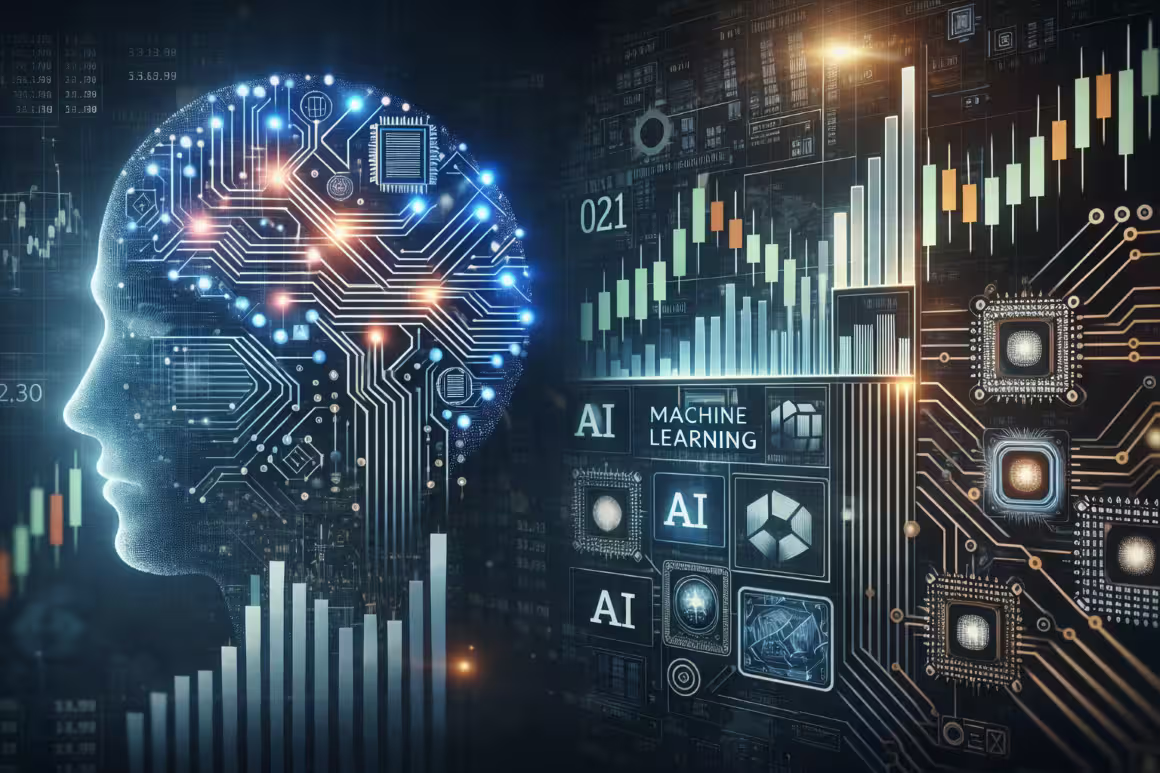
Artificial Intelligence (AI) and Machine Learning (ML) are revolutionizing the world of trading with strategies that are far more advanced and data-driven than ever before. Understanding these technologies, how they function in trading, and why they are particularly suited for the complexities of options trading is a must for anyone looking to stay ahead in the financial markets.
Definition of AI and Machine Learning
AI is the development of computer systems that can perform tasks that usually call for human intelligence, like decision-making, speech recognition, and language translation. Machine Learning, a subset of AI, is concentrated on teaching computers to learn from that data. Rather than being programmed with specific instructions, ML algorithms learn patterns in data and improve their performance over time based on this learning.
The main distinction between AI and ML lies in this learning process—AI encompasses a host of technologies and methodologies aimed at creating intelligent systems, while ML specifically deals with systems that can automatically improve and adapt by analyzing the data.
How AI and ML Work in Trading
AI and ML are being increasingly applied in trading via the development of sophisticated algorithms that predict how the market will move, suss out trading opportunities, and perform trades autonomously. Below are the primary types of learning models that are being used:
- Supervised Learning: This model is trained on labeled data, where the outcome is already known. For instance, in trading, supervised learning could involve analyzing historical market data where past prices are known, allowing the model to predict future price movements based on this data.
- Unsupervised Learning: Unlike supervised learning, unsupervised learning deals with data that doesn’t have labeled outcomes. The model is tasked with finding patterns and relationships within the data itself. In trading, this could look like clustering similar assets or identifying hidden structures in market data without any prior guidance.
- Reinforcement Learning: This is learning through trial and error, where an algorithm learns by interacting with its surroundings and getting feedback via rewards or penalties. In trading, reinforcement learning could be used to develop strategies that adapt based on market performance, optimizing actions to maximize returns over time.
The above learning methods enable models to handle massive amounts of data, adapt to new info, and refine their predictions constantly. This makes AI and ML really valuable in the breakneck, data-intensive world of trading!
Why AI/ML is Suited for Options Trading
Options trading is an intricate field and calls for the analysis of various factors like market volatility, price changes, and timing. The ability to process large datasets and detect subtle patterns is super important, making AI and ML perfect for this domain.
AI and ML can handle the intricacies of options trading by analyzing historical data, running simulations, and making real-time adjustments. Predictive models are able to forecast market movements based on past data, helping traders make smarter decisions. Additionally, these technologies can manage risk more successfully by constantly monitoring market conditions and switching strategies to prevent possible losses.
In the context of options trading, where every decision comes with big risks and rewards, the precision and speed of AI and ML give traders an advantage. These technologies help traders stay ahead of market trends, optimize their portfolios, and execute trades with a level of accuracy and efficiency that would be impossible to do manually.
Main Applications of AI and Machine Learning in Options Trading
AI and Machine Learning are reshuffling options trading with advanced tools that improve decision-making through better predictions and more accurate pricing models. How are these technologies applied in this field? Let’s find out!
Predictive Analytics
In options trading, predictive analytics is used to forecast market movements and trends by analyzing historical data and current market conditions. This helps traders anticipate changes and make better-informed decisions. The use of AI and machine learning allows for continuous monitoring and analysis, which gives traders up-to-date insights that can improve their strategies.
Implied Volatility Prediction
One of the main factors in options trading is implied volatility, which shows the market’s expectations of future price movements. Predicting implied volatility accurately has always been a difficult task, but AI and machine learning have introduced new capabilities in this area.
Machine learning algorithms are able to analyze huge amounts of historical data, along with other market indicators, to predict changes in implied volatility, continuously learning and adapting to new data, improving their predictions over time. By forecasting implied volatility more accurately, traders have the ability to better calculate the risks and rewards associated with their trades, meaning they can make smarter decisions. This helps traders decide the best times to enter or exit positions, maximizing their chances of success!
Pricing Models
Traditional options pricing models, like the Black-Scholes model, have been foundational in the industry. But these models rely on assumptions that don’t always hold true in real markets, like the constant volatility and normally distributed returns. AI and machine learning are improving these models by integrating real-time data and additional variables that better reflect the complexities of today’s markets.
AI-driven models also incorporate factors like market sentiment, trading volumes, and broader economic indicators, leading to more accurate and responsive pricing. These models continuously update as new data becomes available, letting traders respond successfully to market changes. This improvement in pricing accuracy means traders can identify opportunities that may have been missed with conventional models, giving them a competitive edge in the hurried world of options trading.
Algorithmic Trading and Strategy Automation

Integrating AI in developing and managing trading strategies in leveling up options trading. AI-driven algorithms and machine learning models are at the forefront, changing how trades are executed and optimized in the markets.
AI-Driven Trading Algorithms
AI develops and hones trading strategies by leveraging large datasets and advanced analytical techniques. The algorithms are designed to optimize trades by analyzing market data, identifying patterns, and predicting trends with startling accuracy. The goal is to execute trades more efficiently and profitably than the old ways, minimizing the need for manual intervention and decreasing the margin for error.
Dynamic Strategy Adjustments
Machine learning models go even further by constantly learning from market conditions—unlike static algorithms that rely on fixed rules, these models adapt at once, changing strategies as any new data becomes available, allowing traders to stay responsive to market changes, optimizing their strategies to match up with current trends, and mitigating risks associated with market volatility!
Sentiment Analysis
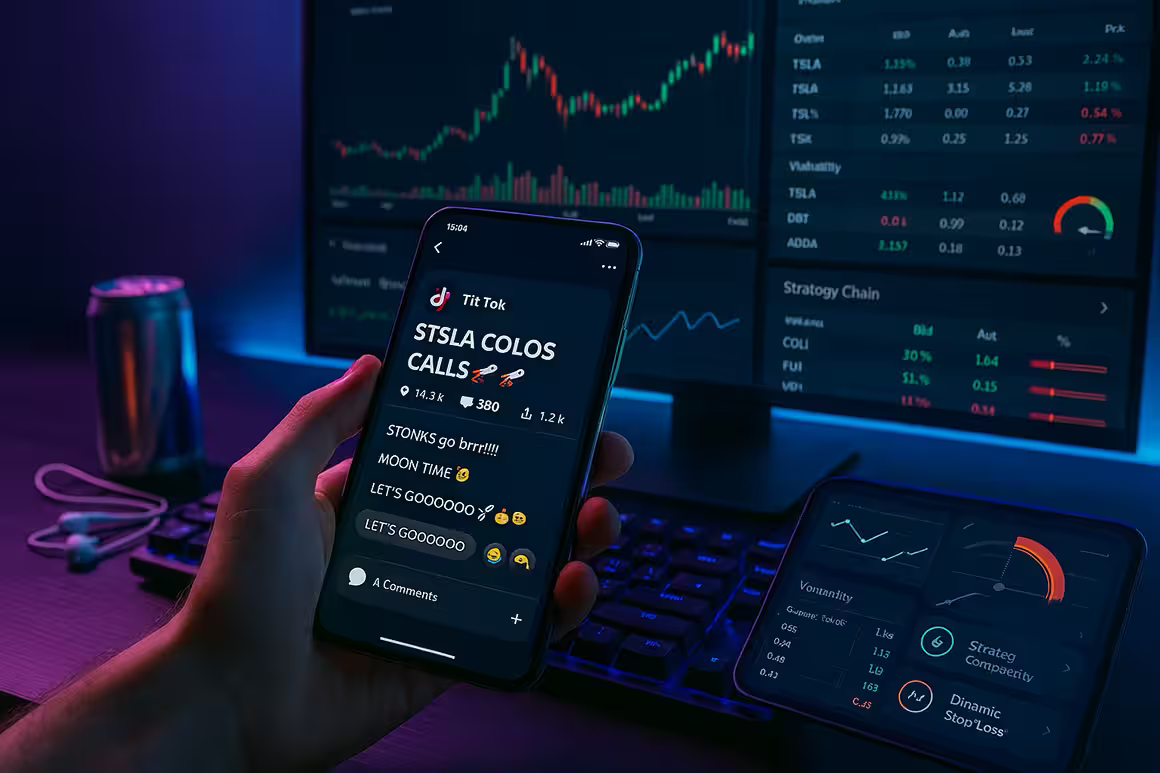
The collective mood of investors is another important component of trading strategies, and AI-powered sentiment analysis taps into this need by processing an assortment of data sources, including news, social media, and financial reports, all to anticipate market movements. This approach is super useful around events like earnings calls or major announcements, where the market’s reaction can be fast and big.
Market Sentiment Insights
Market sentiment is basically the general sentiment of investors on a specific asset or the market as a whole. AI-driven sentiment analysis tools are designed to sift through enormous amounts of data—from news articles and financial reports to social media posts—to gauge the prevailing sentiment. These tools analyze not only the content but also the tone and intensity of the info, giving a detailed picture of how the market feels about a specific asset.
When a company is set to release its quarterly earnings, AI can analyze the surrounding media coverage and social media chatter to predict how investors could react. If the sentiment in these sources is predominantly positive, it suggests that the market expects strong earnings results, possibly meaning a price increase. But if the sentiment is negative, it could mean that investors are bracing for disappointing news.
And AI systems don’t just stop at identifying the sentiment, no sir; they also track how it changes over time. This lets traders see if sentiment is building up to a big market move, giving them an early warning system for possible price swings. This is really valuable in the lead-up to major market events like earnings announcements, where sentiment can change on a dime in response to new info.
Incorporating Sentiment into Options Strategies
Once sentiment data is gathered and analyzed, it can be integrated into options trading strategies! Sentiment analysis is very useful in helping traders decide when to buy or sell options. If AI-driven analysis shows a strong positive sentiment around a particular stock ahead of its earnings report, a trader can decide to buy call options, anticipating that the stock price will go up following the announcement.
Conversely, if sentiment analysis shows a negative outlook, the trader can opt to buy put options, betting that the stock price will go down. The ability to gauge market sentiment and act accordingly allows traders to line up their strategies with the broader market mood, and that means increasing their chances of making profitable trades.
Sentiment analysis can be used in contrarian strategies, too! When sentiment is overwhelmingly positive, it could mean that the market is overbought, suggesting that a correction is coming. In this scenario, a trader could sell calls or buy puts, anticipating a reversal. Similarly, when sentiment is extremely negative, it could mean that the market is oversold, which presents a chance to buy calls or sell puts in anticipation of a rebound.
Risk Management and Portfolio Optimization
AI and machine learning are increasingly crucial in refining how risks are managed and portfolios are optimized. These technologies provide sophisticated, automated approaches that can adjust to market conditions with limited human intervention.
Automated Risk Management
AI enables concurrent risk assessment and automatic adjustments to portfolios based on predetermined risk levels—AI systems can monitor the market ceaselessly, detecting changes that could affect a portfolio’s exposure. When a certain risk threshold is reached, the system can automatically rebalance the portfolio, adjusting asset allocations to prevent potential losses. This automation is really effective in managing downside risk, as it operates faster and more precisely than traditional methods, meaning traders have a better edge in volatile markets.
Hedging Strategies
Machine learning takes hedging strategies to another level by adjusting positions in response to market changes. Instead of only relying on static, pre-set rules, AI-driven systems perpetually analyze data to identify correlations between assets. This opens the door for the creation of more effective hedges that are responsive to current market conditions. Whether it’s adjusting positions in response to expected downturns or finding opportunities in correlated assets, AI makes hedging more efficient and less reliant on constant human supervision.
Case Studies and Real-Life Examples
As artificial intelligence (AI) and machine learning (ML) continue to infiltrate and change the financial industry, their impact on options trading has been pretty profound! They are enabling hedge funds, financial institutions, and even retail traders to develop sophisticated trading strategies that are much more responsive to market dynamics. Below is a closer look at how some of the biggest names in finance are leveraging AI and ML in their trading strategies, as well as the role these technologies play in retail trading platforms!
Hedge Funds and Institutions
There are six well-known hedge funds and financial institutions that have integrated AI and ML into their trading strategies. Their use of these technologies has not only improved their ability to analyze large datasets but also improved their decision-making processes, particularly in options trading!
- BlackRock Inc. (BLK): As the world’s largest asset manager, BlackRock has been at the forefront of adopting AI and ML in its trading operations. BlackRock’s Aladdin platform is a prime example, utilizing AI to process massive amounts of data to assess risk, optimize portfolios, and make more informed trading decisions. This platform is integral to how BlackRock manages its investment strategies, including options trading, where precision and timing are vital.
- JPMorgan Chase & Co. (JPM): JPMorgan has developed several AI-driven tools to enhance its trading capabilities. One notable example is the firm’s use of LOXM, an AI-powered execution system designed to improve trade execution and reduce costs. LOXM uses machine learning to analyze historical trading data and optimize the execution process in real-time, which is particularly beneficial in the fast-moving options market.
- Morgan Stanley (MS): Morgan Stanley has embraced AI through its Next Best Action initiative, which uses machine learning algorithms to provide traders with tailored recommendations based on real-time market data. This approach allows Morgan Stanley’s traders to make more informed decisions in options trading, helping the firm maintain its competitive edge.
- Vanguard Group: Vanguard has integrated AI into its trading strategies, concentrating on improving the efficiency of its operations and bettering client outcomes. AI helps Vanguard analyze market conditions and execute trades more successfully, guaranteeing that the firm’s massive portfolio of assets, including options, is managed with precision.
- Goldman Sachs Group Inc. (GS): Goldman Sachs has long been a leader in adopting technology for trading. The firm uses AI and ML to analyze market trends, predict price movements, and optimize its trading strategies. In options trading, where timing and accuracy are critical, Goldman Sachs leverages these technologies to stay ahead of the curve.
- Fidelity Investments: Fidelity has incorporated AI into various aspects of its trading operations, including options trading. The firm uses machine learning models to analyze vast datasets and identify trading opportunities that traditional methods might miss. This approach has allowed Fidelity to improve its trading strategies and portfolio performance.
Retail Trading Platforms
Think AI and ML are just for large institutions? Nope! They are also being used in the retail trading space. Three platforms have emerged that give retail traders access to sophisticated tools powered by AI so they can compete in markets that were once only dominated by the professionals.
- AlgoTrader: AlgoTrader is a comprehensive platform that gives retail traders access to advanced algorithmic trading capabilities. The platform integrates AI and ML to automate trading strategies so users can backtest and deploy intricate algorithms without needing extensive programming knowledge. This democratization of trading technology is enabling more retail traders to take part in sophisticated trading strategies, including options trading.
- QuantConnect: QuantConnect is a cloud-based platform where traders can develop, backtest, and execute trading strategies using AI and ML. The platform supports multiple asset classes, including options, and enables backtesting access to a large amount of previous data. By leveraging AI, QuantConnect lets retail traders refine their strategies and make data-driven decisions immediately.
- MetaTrader: MetaTrader is one of the most popular trading platforms in the world and is used by both retail and institutional traders. The platform offers AI-driven tools, like Expert Advisors (EAs), which automate trading strategies based on predefined criteria. These EAs are powered by machine learning algorithms that constantly adapt to changing market conditions, making MetaTrader a powerful tool for retail traders looking to get into options trading.
Success Stories
A study conducted by the CME Group illustrates a particularly compelling success story involving a mid-sized hedge fund that faced challenges in improving its trading strategies and managing risk. The fund, which managed approximately $100 million in assets, decided to leverage machine learning to improve its operations. By partnering with DataMine, the fund automated its data collection and investment analysis processes, allowing it to stay updated with the latest market trends and identify opportunities that might have otherwise been missed.
Through the implementation of custom machine learning models, the fund was able to reduce errors in its analysis and improve the accuracy of its trading decisions. The models were trained to match with the fund’s investment philosophy, verifying that the strategies were tailored to the firm’s specific goals. Additionally, the fund used AI to develop a custom risk management model that continuously analyzed market trends and portfolio risks.
The results were impressive: the hedge fund achieved more consistent returns for its investors, effectively managing risk across its portfolio. This case shows how even smaller funds can benefit from AI and machine learning, achieving outcomes that might not have been possible with traditional methods alone!
Challenges and Risks of AI in Options Trading

AI and machine learning undoubtedly give options traders advantages, but they also come with their own set of challenges and risks that traders have to watch out for!
Model Overfitting
One of the biggest risks in using AI for trading is the tendency of models to become overfitted to historical data. What is overfitting? Well, it happens when an AI model learns the noise in the data rather than the underlying patterns, so it has a high performance during backtesting but poor results in live markets. This is particularly problematic in options trading, where market conditions change rapidly, rendering an overfitted model ineffective.
To avoid this risk, traders will use techniques like out-of-sample testing and cross-validation to make sure that the model generalizes well to new, unseen data. Simpler models with fewer parameters can also help prevent overfitting, as they are way less likely to latch onto irrelevant patterns in the training data.
Data Quality and Availability
The effectiveness of AI and machine learning models heavily depends on the quality of the data they are trained on. Poor-quality data, which could be incomplete, inaccurate, or biased, can result in erroneous predictions and suboptimal trading decisions. This is absolutely critical in options trading, where decisions are made based on subtle market signals.
Data quality issues can come from different sources, including errors in data collection, processing, or integration. Guaranteeing that the data used is clean, representative, and free of biases is a must for sustaining the reliability of AI models. Additionally, traders have to consider the availability of actual data—delays or gaps in data can impact the accuracy of predictions.
Black Box Models
AI models, especially those based on deep learning, are referred to as “black boxes” because their decision-making processes are not easily interpretable. This lack of transparency poses a big challenge in trading, where understanding the rationale behind a trade is a necessity for managing risk and being in compliance. Traders and financial institutions are increasingly concerned about the potential risks associated with relying on AI models that cannot be explained simply or in an understandable way.
Explainable AI (XAI) is an emerging field whose goal is to address this issue by developing methods to make AI models more transparent and interpretable. But getting to a balance between model complexity and interpretability remains a problem as of now.
Market Dynamics
Markets are inherently dynamic, influenced by a range of factors, including regulatory changes, geopolitical events, and macroeconomic shifts. AI models, while indeed powerful, are not immune to these changes! A model that performs well in one market environment can struggle in another if it has not been properly recalibrated to account for new conditions.
This need for constant recalibration is a big challenge in options trading because the market is always changing. Reinforcement learning and adaptive algorithms are used to help models adjust to changing market conditions, but even these methods have their limitations. Regularly updating and fine-tuning AI models is necessary to keep them aligned with current market dynamics!
The Future of AI and Machine Learning in Options Trading

As AI and machine learning keep moving ahead, the effect they have on options trading is expected to continue, bringing changes that are advantageous for both institutional and retail traders alike. Below is a sneak peek at what lies ahead!
Evolution of AI Models
AI models are becoming increasingly capable, processing massive datasets and learning from more intricate patterns. This ongoing development is leading to models that are not just smarter but also better at adapting to new market conditions. As these technologies evolve, AI will become more integrated into the decision-making processes of traders, giving them insights that were previously out of reach. The trend is moving towards models that constantly learn and polish their strategies, making them more successful at predicting market movements and managing risk in the here and now.
Increased Accessibility for Retail Traders
Our favorite development has to be the democratization of AI tools—what was once the exclusive domain of large institutions is now accessible to individual traders, and we love that! Platforms like QuantConnect and MetaTrader are making it possible for retail traders to access sophisticated AI and machine learning tools, and the platforms let traders develop and test their strategies. It’s possible for anyone with an internet connection to jump into the market, and increased accessibility is likely to cause a more competitive market where smaller traders can compete on a more level playing field.
Integration with Quantum Computing
Quantum computing is on the verge, and looks like it will come with big changes. With its ability to process info at unprecedented speeds, quantum computing would be able to supercharge AI models so they can analyze more data, faster, and with greater accuracy. This would enable traders to simulate countless scenarios in a fraction of the time it takes today, meaning smarter decisions and possibly higher returns. While this tech is still in its early stages, its potential effect on AI-driven trading strategies is enormous, and it’s something that traders should keep a close eye on as it develops.
We think (and the industry agrees) that the future of AI and machine learning in options trading is chock full of promise, with advances that will make these tools more powerful and accessible than ever before! As AI keeps adapting and as new technologies like quantum computing enter the picture, the world of options trading is set to change in ways that will benefit traders, no matter their level.
Final Thoughts: Embracing AI in Options Trading
AI and machine learning are changing the way options trading works! With tools that make trading smarter, faster, and more accessible for all. they’re becoming ordinary tools of a trader’s toolkit. Because of AI, traders can process huge amounts of data, pick up on patterns they might have otherwise missed, and make decisions with way more confidence.
AI and machine learning have opened up exciting avenues in options trading, and it’s the perfect time to get in on it! It doesn’t matter if you’re a pro trader or just trying it out for the first time—seeing how these tools can improve your strategies is well worth it. Platforms like QuantConnect, MetaTrader, and AlgoTrader make it easier than ever to integrate AI into your trading, and you don’t need to be a tech genius. You can start out by experimenting with pre-built algorithms or creating your very own strategy.
AI and machine learning are definitely shaking things up in the world of trading, but it’s important to remember that they’re not a magic solution. Human judgment and experience still play a crucial role, especially in markets where things can change in an instant. The best results usually come from combining the power of AI with the insight that only human traders can bring to the table.
What are your thoughts on AI in options trading? Have you tried using any AI tools in your strategies? If so, how did it affect your performance? We always want to hear about our readers’ experiences—give us a holler in the comments!
Further Reading Suggestions
Still curious? To learn more about algorithmic trading and AI development, AI in finance, and helpful tutorials, check out the resources below!
- Medium: Learning AI from the Perspective of Algorithmic Trading
- Mint: How Will AI Help Democratize Intelligence in Algorithmic Trading? Here Are 5 Ways
- IG Group: Using AI for Options Trading
- QuantConnect Tutorial: A Beginner’s Guide to Algorithmic Trading
- Udemy: Algorithmic Trading with Python and Machine Learning
- Yahoo Finance: Intuit Forecasts Annual Revenue Above Estimates on AI-driven Financial Tools
- Ocrolus: 6 Benefits of AI in Financial Services