Key Takeaways
- The tradable VIX: spot VIX cannot be bought, so traders use VIX futures instead.
- $1,000 per point: a standard VX contract settles in cash; the Mini VXM is one-tenth the size.
- A forecast, not a copy: each future is the market's price today for where the VIX will settle.
- Smaller moves than spot: longer-dated futures react less to a selloff than the VIX itself.
- Rolling has a cost: VIX ETFs that roll futures tend to lose value when the curve slopes upward.
VIX futures are cash-settled contracts on where the Cboe Volatility Index will settle on a specific future Wednesday. The VIX itself is a calculation, not an asset, so it cannot be bought or sold. VIX futures are the closest tradable thing to it, and they are what volatility ETFs hold or track, as well as the reference point traders use to price VIX options.
The catch is that a VIX future is not the VIX. It prices a forecast of the VIX at its settlement date, so it routinely moves less than the headline number, trades above or below it, and only meets it on settlement morning. Understanding that gap explains most of the surprises traders run into with volatility products.
What VIX Futures Are
A contract on a forecast. FINRA's guide to volatility investing puts the starting point plainly: "the VIX itself is not investible," so exposure to volatility generally comes through VIX futures or other derivatives. Cboe's own fact sheet makes the same point from the exchange side, noting that while the VIX Index is not tradeable, VIX futures are.
The contract specifications are short. According to Cboe's VIX futures and options fact sheet, a standard VIX futures contract (ticker VX, which is why traders often call them VX futures) carries a $1,000 multiplier, trades nearly around the clock on business days on Cboe Futures Exchange, and is listed in up to nine near-term monthly expirations, additional quarterly months and up to six weekly contracts. With that multiplier, each one-point move in a VX contract is a $1,000 change in its value.
There is also a smaller version. Cboe's Mini VIX futures notice describes VXM futures as cash-settled futures on the VIX with one-tenth the contract size and a $100 multiplier, first traded in August 2020, with specifications otherwise similar to the standard contract.
Neither contract involves anything changing hands at expiration. Both are cash-settled: on settlement day the difference between your trade price and the final settlement value is paid or collected in cash. If futures in general are new to you, that comparison covers margin and daily mark-to-market, which apply here in full.
You cannot buy the VIX. Every VIX trade you can actually make is, one way or another, a trade on a forecast of the VIX.
How VIX Futures Are Priced and Settled
Priced as an expectation of the settlement value. Each VIX future settles to a Special Opening Quotation of the VIX on its expiration Wednesday, calculated from the opening prices of SPX options that morning, as set out in the Cboe VIX methodology. Before then, the futures price is the market's risk-adjusted estimate of that number. Our explainer on how VIX options expire covers the settlement mechanics in detail, and VIX futures share them.
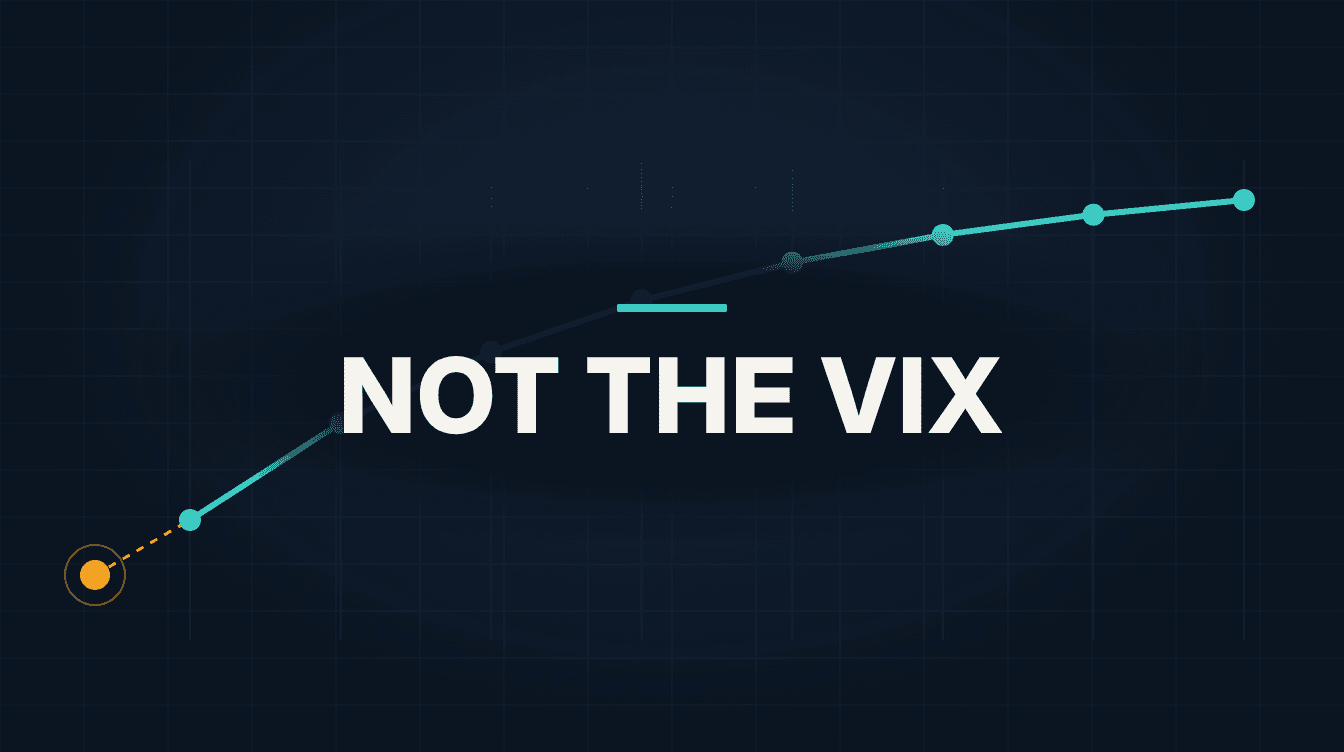
That is why several futures on the same index trade at different prices at the same moment. Suppose spot VIX reads 16, the future expiring in about a month trades at 17.50 and the next one at 18.60. None of those numbers is wrong. Each is a separate forecast for a separate Wednesday.
Work through what a position does from there. Suppose you buy one standard VIX future at 17.50 and hold it to settlement:
- If volatility stays quiet and the settlement value comes in at 16.00, you lose (17.50 − 16.00) × $1,000 = $1,500.
- If a selloff hits and the settlement value comes in at 30.00, you gain (30.00 − 17.50) × $1,000 = $12,500.
- With the Mini contract at $100 per point, the same outcomes would be a $150 loss or a $1,250 gain.
Notice what the quiet case shows. The VIX never fell in that example; it sat at 16 the whole time. The loss came entirely from buying a forecast that was higher than where the VIX ended up, which is what convergence means in practice.
Why futures move less than spot. Cboe's fact sheet puts the historical beta of spot VIX to the S&P 500 at about −1.2, meaning the VIX has tended to rise about 1.2 volatility points for every 1% decline in the index. Citing a July 2015 Goldman Sachs paper, it gives the beta of a VIX future as 0.18 × ln(days to VIX settlement) − 1.15. For example, with 30 days to settlement that formula gives 0.18 × 3.40 − 1.15 = −0.54, and with 5 days it gives 0.18 × 1.61 − 1.15 = −0.86.
Apply those to a hypothetical 3% drop in the S&P 500. Spot VIX would be expected to rise about 3 × 1.2 = 3.6 points, a future 5 days from settlement about 3 × 0.86 = 2.6 points, and a future 30 days out only about 3 × 0.54 = 1.6 points. The further a future is from settlement, the less of the spike it tends to capture, which is consistent with FINRA's observation in Regulatory Notice 17-32 that movements in the futures are generally smaller in magnitude than those of the VIX. These are historical averages, not predictions: in a real selloff the VIX and its futures can move far more or less than this, and the relationship is not linear for large moves.
A VIX future is not a delayed copy of the VIX. It is the market's price today for the VIX on one specific Wednesday morning.
How VIX Futures Differ From VIX ETFs
Same exposure, very different holding experience. Many traders first meet VIX futures indirectly, through exchange-traded products with "VIX" in the name. FINRA's notice explains that these products are designed to track VIX futures indices, not the VIX, and that to keep a constant maturity they continually sell nearer contracts and buy later ones. The two routes differ along five dimensions:
- What you hold. A futures trader owns specific contracts with specific settlement dates. An ETP holder owns a share in a product that rolls through contracts on its own schedule.
- Expiration. A future ends on its settlement Wednesday and converges to the VIX. An ETP has no settlement date of that kind and never converges, because it keeps rolling, although exchange-traded notes carry issuer credit risk and can mature, be called early or be delisted.
- Roll cost. When later futures are priced above nearer ones, rolling means selling low and buying high. FINRA calls this a negative roll yield, and its 2017 notice observed that some volatility ETPs tracking shorter-dated futures had lost more than 90% of their value since they launched.
- Leverage and margin. Futures require margin and can lose more than the deposit. The most an ETP bought with cash can lose is its purchase price, but FINRA warns that volatility ETPs can lose some or all of their value very quickly, and buying them on margin amplifies that risk.
- Intended holding period. FINRA states that volatility-linked ETPs may be unsuitable for investors who plan to hold them as buy-and-hold investments.
The roll cost is the piece that surprises people most. Suppose a product holds a future at 16 that is about to expire and must replace it with the next contract at 17.50. Each time it rolls, it buys a contract priced above spot, and if volatility stays calm that contract drifts down toward spot before the next roll, so the product gives up value roll after roll. Cboe's fact sheet, using Bloomberg data from November 2014 through 2019, notes that VIX futures were in contango, with later contracts priced higher, 81% of the time. Our article on the VIX term structure covers contango and backwardation in more depth.
Why VIX Futures Matter to Traders
They set the price of everything else in volatility. VIX options settle to the same quote as the futures and in practice are priced off them, which is why a call on the VIX typically gains less in a spike than the headline number suggests. Anyone using VIX options is, in effect, trading options on where these futures will settle.
They also explain why volatility hedges behave the way they do. A hedge built on near-dated futures responds more to a selloff than one built on later contracts, but it typically costs more to hold through calm periods. Our comparison of VIX calls versus SPY puts walks through how that trade-off plays out against a simpler index hedge.
Finally, the VIX futures curve itself carries information. When near-dated futures trade below spot, that is usually read as the market expecting a spike to fade; when they trade above spot, which is the more common state, the market is pricing volatility to drift back toward more typical levels over time, plus a premium for bearing volatility risk. That shape adds information the VIX alone does not show.
Edge Cases and Gotchas
The simple picture breaks down in a few specific places:
- Holidays move the settlement date. If the settlement Wednesday or the Friday 30 days later is a Cboe Options holiday, the fact sheet says settlement moves to the business day before that Wednesday.
- Expiring futures trade on settlement morning. Unlike expiring VIX options, which stop trading the day before, expiring VX and VXM futures keep trading until 8:00 a.m. Central on settlement morning, according to Cboe's Mini VIX notice, which also states that VXM trading hours match VX.
- Weekly contracts use different SPX inputs. Cboe notes that standard VX futures settle from A.M.-settled SPX options while weekly VX contracts use P.M.-settled ones, so check the exact contract you hold.
- Losses can exceed the deposit. Futures are leveraged, and Cboe's risk disclosure warns that the risk of loss can be substantial and can exceed the amount of money deposited.
- Options on the futures are a separate product. Cboe has also listed European-style options whose underlying is the front-month VIX future rather than the VIX index, and they settle into a futures position rather than cash.
FAQ
These answers cover the questions people most often search for once they learn that the VIX itself cannot be traded.
Can You Buy VIX Futures?
Yes, through a brokerage account approved for futures trading.
They trade on Cboe Futures Exchange, where a standard contract carries a $1,000 multiplier and the Mini contract a $100 multiplier. Futures are leveraged, so losses can exceed the margin deposited.
When Do VIX Futures Expire?
Standard monthly VIX futures settle on the Wednesday 30 days before the third Friday of the following month, moving earlier when a holiday interferes. Weekly VIX futures settle on the Wednesday of the week named in their ticker.
Why Don't VIX Futures Match the VIX?
Because each future is priced on where the market thinks the VIX will be at its settlement date, not where it is now. Spot VIX can jump in a selloff while the market still expects it to calm down by expiration, so futures usually move less, and they only converge with the VIX at settlement.
What Is the Symbol for VIX Futures?
Standard monthly contracts trade under VX, weekly contracts under VX01 through VX53 for the week of the year they settle, and the Mini contract under VXM. Charting platforms often show a continuous front-month series under their own symbol.
What Happens When VIX Futures Expire?
They settle in cash to a Special Opening Quotation of the VIX calculated that morning from SPX option opening prices.
No index is delivered; the difference between your entry and the settlement value is paid or collected at $1,000 per point for a standard VX contract or $100 per point for the Mini VXM.