
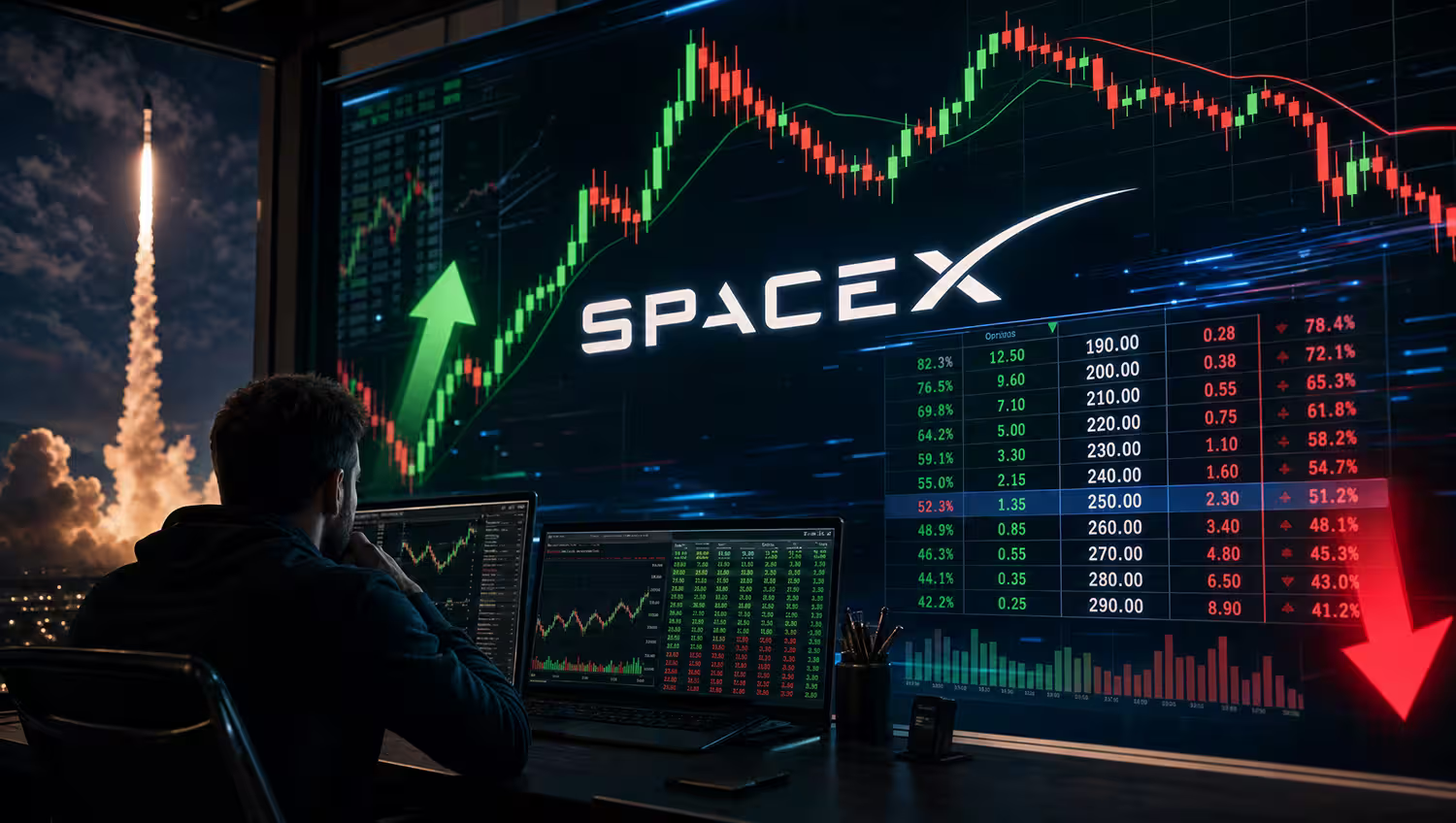
SpaceX options have the ingredients of a retail trading battleground: a famous company, a newly public stock, a strong Elon Musk connection, intense retail demand, limited early trading history, and an options chain that can turn a stock opinion into a leveraged volatility bet.
That does not mean SpaceX options are automatically good or bad trades. It means the market structure around them can become emotional quickly. Traders may not only argue about whether SpaceX is worth its valuation. They may argue about whether call buyers are chasing, whether put buyers are early, whether market makers are amplifying moves, and whether the options market is pricing a realistic path or a fantasy.
As of June 18, 2026, this is a live, fast-changing story. The practical question for options traders is not whether SpaceX is exciting. It is whether the option premium, liquidity, implied volatility, strike selection, and expiration leave any room for the trade to work after the crowd has already arrived.
Why This Story Is Different From a Normal IPO Options Launch
Most new public companies do not immediately become major options battlegrounds. SpaceX is different because the stock arrived with a built-in retail audience, a large narrative, and immediate speculation about whether it belongs with the market's dominant tech names.
- The brand is familiar before most traders have read a full set of public-company financials.
- Retail traders already connect SpaceX with Elon Musk, Tesla, AI infrastructure, rockets, satellites, defense, and Starlink.
- A new options chain can concentrate attention into a few short-dated strikes.
- Limited trading history makes implied volatility harder to judge.
- Large call demand can force hedging activity that affects the stock, especially when float is tight.
Fast Takeaways
- SpaceX options are not just a directional trade on rockets or Starlink. They are also a trade on volatility, liquidity, valuation, and crowd behavior.
- Early retail buying in SpaceX shares has been unusually strong, which can spill into call-option demand.
- Record first-day options volume does not prove that the next move is higher. It proves that disagreement and demand are intense.
- Short-dated out-of-the-money calls may look cheap in dollars while still being expensive in probability terms.
- Put buyers can be right about valuation risk and still lose if implied volatility is too high or timing is wrong.
- Defined-risk structures may limit loss, but they do not remove bad fills, IV crush, assignment risk, or overtrading risk.
The Current Setup: Retail Demand Met a New Options Chain
The retail-interest side of the story is already visible. Business Insider reported on June 18, 2026, that Vanda Research data showed individual investors bought $369.8 million of SpaceX shares over the first three trading sessions, more than several long-running retail favorites over the same window.
That matters for options because retail attention often migrates from shares into calls, puts, spreads, and short-dated speculation. A trader who missed the IPO pop may look at calls as a way to catch up. A trader who thinks valuation is stretched may look at puts. A trader who owns shares may look at covered calls. The same stock can become a meeting place for completely different agendas.
The options market then adds a second layer. A stock buyer only needs the stock to rise to profit. A call buyer may need the stock to rise enough, soon enough, after paying a premium inflated by demand. That is where SpaceX can become more dangerous for beginners than the share chart alone suggests.
The Options Debut Was Already Loud
The Wall Street Journal reported that roughly 1.8 million SpaceX options contracts traded on June 16, 2026, according to Cboe Global Markets data, breaking the first-day record for a single-stock options listing. The article also noted heavy activity in call options tied to higher strikes.
That kind of debut can pull in even more attention. Screenshots of unusual volume, top-traded strikes, and large premium totals can make the options chain look like a scoreboard. But volume by itself does not say who is hedging, who is speculating, who is closing, or who is trading multi-leg spreads.
A battleground forms when different traders interpret the same activity differently. Bulls may see call demand as confirmation that institutions and retail traders expect another leg higher. Bears may see the same call demand as froth. Market makers may see a risk-management problem. Beginners may only see the chance to buy a lottery ticket.
What Could Turn SpaceX Options Into a Battleground
The battleground is not one factor. It is the combination of narrative, flow, volatility, and structure.
Driver | Why It Matters | What Traders Can Misread |
|---|---|---|
Retail attention | A large audience can push volume toward the most visible strikes and expirations. | High volume can be mistaken for informed conviction. |
Limited trading history | Newly public stocks have less public price history for volatility comparison. | Implied volatility can look high without an obvious fair baseline. |
Call concentration | Demand for upside calls can affect hedging and short-term sentiment. | A busy call strike is not automatically a bullish forecast. |
Valuation debate | A huge valuation can attract both momentum buyers and skeptics. | Being right on valuation can still lose money if timing is wrong. |
Short-dated options | Weekly or near-term contracts can respond violently to small stock moves. | Low dollar premium can hide low probability and fast time decay. |
Social trading | Narratives can spread faster than careful risk math. | Screenshots may omit premium paid, breakeven, spread width, and exit plan. |
Why Call Buyers May Be Tempted
The bullish case is easy to understand. SpaceX is not an obscure IPO. It is tied to launches, satellites, space infrastructure, defense demand, global broadband, and a founder whose companies already have a history of attracting retail traders. A call option can look like a cleaner way to express that excitement with less capital than buying 100 shares.
The problem is that obvious excitement is rarely free. When many traders want the same upside exposure, call premiums can rise quickly. A trader can be right that SpaceX moves higher and still lose if the stock does not clear the option's breakeven before time decay and implied volatility work against the position.
That is why the first question should not be 'Do I like SpaceX?' The first question should be 'What move is this option already pricing?' A 20 percent stock rally can still disappoint a call buyer if the contract was priced for something even larger or faster.
Why Put Buyers May Be Tempted
The bearish case is also easy to understand. A high-profile IPO can overshoot. Limited float, forced attention, and enthusiasm can push a newly public stock to a valuation that skeptics consider detached from near-term fundamentals. Puts give those skeptics a defined-risk way to bet on a reversal.
But puts on a crowded, volatile name can be expensive too. A trader who buys puts after implied volatility has already surged may need a sharp and timely decline. A slow fade, sideways consolidation, or brief dip followed by a rebound can leave the put buyer with the right instinct but the wrong contract.
The key is separating valuation opinion from options math. Options do not pay for being philosophically right. They pay when the realized move, timing, and volatility path beat what was embedded in the premium.
How the Same SpaceX View Can Produce Different Option Trades
These are educational examples of trade types, not recommendations. The point is that the same stock view can lead to very different risks.
Trader View | Possible Options Expression | Main Risk |
|---|---|---|
Strong upside momentum | Long call or call debit spread | Premium may be too high, and the stock may not move far enough by expiration. |
Bullish but premium-aware | Call debit spread | Upside is capped, and both strikes still need liquidity. |
Owns shares and expects chop | Covered call | Shares can be called away, and downside stock risk remains. |
Thinks IPO enthusiasm is overdone | Long put or put debit spread | Timing must be sharp if implied volatility is elevated. |
Wants income from rich premiums | Cash-secured put or credit spread | Defined risk still needs assignment, margin, and gap-risk planning. |
Unsure but expects huge movement | Long straddle or strangle | Both sides can lose if the expected move is overpriced. |
The Risk Is Not Only Being Wrong on Direction
The biggest trap in a high-attention options market is thinking the only question is up or down. For SpaceX options, the trade can lose for several reasons even if the stock story remains compelling.
- Implied volatility can fall after the initial excitement, reducing option value even if the stock does not move against the trader.
- Wide bid-ask spreads can make entry and exit worse than the quoted midpoint suggests.
- Short-dated options can lose value quickly if the move does not happen right away.
- Out-of-the-money strikes can require a dramatic move just to reach breakeven.
- Multi-leg strategies can behave differently than expected if one leg becomes hard to close.
- Short options can create assignment or margin problems if the trader sizes too aggressively.
Where Retail Traders Can Get Pulled In
The battleground label fits because each side can tell a persuasive story. Bulls can point to brand, scarcity, growth, and retail enthusiasm. Bears can point to valuation, post-IPO lockups, hype risk, and the difficulty of pricing a company this unusual. Options turn those arguments into high-speed bets with expiration dates.
The danger is that retail traders may react to the argument instead of the contract. A social post that says a call option is up 300 percent does not show the trader who bought too late. A bearish chart does not show the implied volatility paid by the put buyer. A large options-volume number does not show whether the trade was a hedge, a spread, or an outright bet.
For readers comparing high-attention names, the same discipline used for unusual options activity applies here: start with the contract details, not the screenshot.
What Would Make the Trade More Orderly
SpaceX options would become easier to analyze if the market develops deeper liquidity across expirations, tighter spreads, more stable implied-volatility surfaces, and a longer public trading record. More earnings reports, more float, and more institutional coverage could also help traders separate business fundamentals from launch-week emotion.
Until then, the options chain may behave less like a mature mega-cap options market and more like a price-discovery arena. That does not make every trade reckless. It does mean traders should demand more margin of safety from their own process: smaller size, clearer exits, and less confidence in any single signal.
The trader who treats SpaceX options as a complete plan because volume is high is taking the wrong lesson from the debut. The better lesson is that high volume can create opportunity and danger at the same time.
Before Trading SpaceX Options
- Check the option's breakeven, not only the strike price.
- Compare implied volatility across expirations before choosing a contract.
- Look at bid-ask width and open interest, not just volume.
- Decide whether the trade is directional, volatility-based, income-focused, or a hedge.
- Avoid sizing a short-dated contract as if it were a stock position.
- Review whether a spread, covered call, or cash-secured put creates assignment or margin obligations.
- Have an exit rule before entering, especially if the trade is based on a news-driven move.
- Do not treat retail flow, call volume, or a famous ticker as a complete trade thesis.
- Read the current options risk disclosure before trading newly listed, high-volatility contracts.
What To Check If You Keep Watching SpaceX Options
If the options chain stays crowded, the useful next step is not to read more predictions. It is to check the parts of the contract that decide whether a SpaceX trade has room to work.
- Start with options risks so position size is based on possible loss, not only the SpaceX story.
- If you are looking at weeklies, review what happens when an option expires before holding a contract into the final session.
- Check why a tight bid-ask spread matters because a popular strike can still be expensive to enter or exit.
- When a large call or put print appears, compare it with how traders misread unusual options activity before treating flow as conviction.
FAQ
These answers are educational and reflect public information reviewed on June 18, 2026. SpaceX trading conditions, option chains, and market data can change quickly.
Are SpaceX options already trading?
Yes. Public reports reviewed on June 18, 2026, describe SpaceX options as having begun trading earlier that week, with unusually high first-day volume.
Does heavy SpaceX call volume mean the stock will keep rising?
No. Heavy call volume shows demand and disagreement, but it does not prove that the next move will be higher. Calls can be bought for speculation, hedging, spreads, or market-making activity.
Why can a popular call option still lose money?
A call option can lose if the stock does not rise enough, fast enough, to overcome the premium paid, time decay, bid-ask costs, and changes in implied volatility.
Are puts safer because SpaceX valuation looks stretched?
Not necessarily. Puts can be expensive when volatility is high. A trader can be right about valuation risk and still lose if the stock does not fall far enough before expiration.
What is the biggest beginner mistake with SpaceX options?
The biggest mistake is treating the ticker and the story as the whole trade. The contract's premium, breakeven, expiration, liquidity, implied volatility, and position size matter just as much.
The Better Way to Watch the Battleground
SpaceX options may become a major retail battleground because they bring together story, scarcity, momentum, skepticism, and leverage. That mix can produce huge volume and strong opinions, but strong opinions are not the same as good trade construction.
The better approach is to watch the options market like a risk dashboard. Which strikes are active? Are spreads tight enough to trade? Is implied volatility rising or falling? Are traders chasing weekly calls, building spreads, buying protection, or selling premium? Those details matter more than whether the stock is exciting.
For retail traders, the cleanest edge may be patience. Let the chain develop. Let spreads settle. Let the first wave of emotion show where the real liquidity is. A battleground can create opportunity, but it can also punish traders who arrive with a story and leave without a plan.
Source and Freshness Note
Current-event context was reviewed on June 18, 2026 using Business Insider's retail-flow report, Wall Street Journal reporting on first-day SpaceX options volume, and the OCC options disclosure document.
This article intentionally limits external links to three. SpaceX share price, option volume, implied volatility, available strikes, spreads, and retail-flow data can change quickly; readers should verify live market data and broker requirements before trading.