
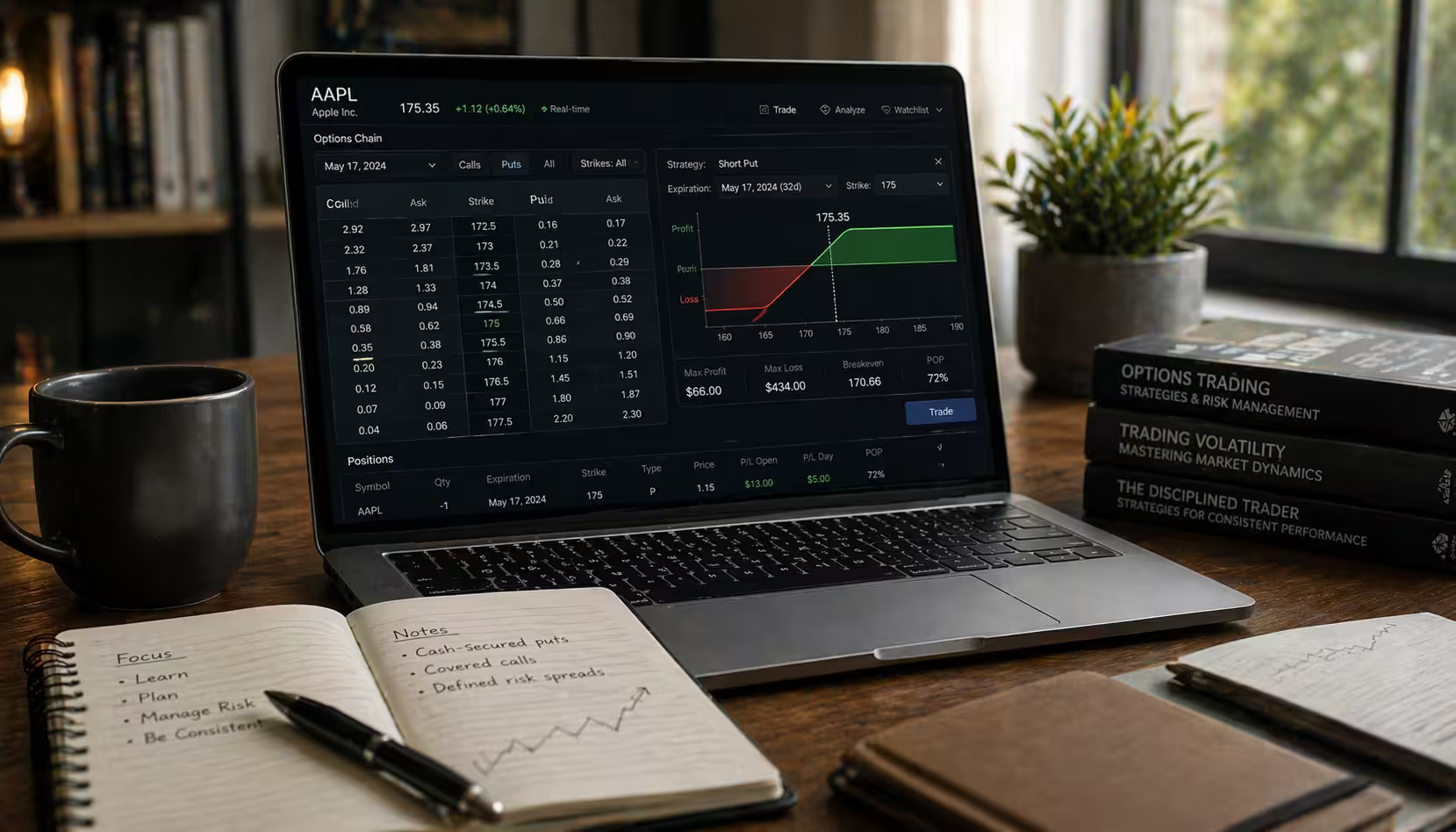
Options trading has been around for a long time, but the public has been figuring out in recent years that it’s a great way for ordinary investors to make some extra money. As a result, options trading has been becoming more popular with inexperienced or intermediate investors alike. Many beginners are hesitant to start with small accounts, but they can be effective and profitable with the right approach.
The purpose of this guide to trading options with small accounts is to show our readers how they can start options trading with limited funds while managing risks. Continuing reading to learn winning strategies for managing limited capital and still growing the account as well as the best brokerage apps for trading with small accounts and the importance of tracking trades to hone future options trading decisions.
Understanding Options Trading Basics
Options trading appeals to small account traders, but they come with their unique rewards and risks. We’ll highlight the advantages and disadvantages of using these smaller accounts and cover some of the basic ideas and terminology regarding options trading online.
What Is Options Trading?
Options are when traders or investors speculate on the future value of an asset by buying or selling options contracts. These contracts are agreements where the buyer has the right to buy or sell the underlying asset by a certain date for a specific price. Some of the most common types of options trades include “calls” and “puts.” Call options give the buyer the right to buy the underlying asset at the strike price, while put options give the buyer the right to sell the underlying asset at the strike price.
Why Options Trading Appeals to Small Account Traders
Trading options online has a unique appeal to small account traders because it’s a cost-effective way to invest in the stock market. Options also let traders control larger stock positions with a small amount of money—this is known as leverage. Because options trading lets traders access several times more shares than trading the stocks directly, they stand a better chance of experiencing amplified returns, especially if the market moves in the correct, anticipated direction.
Small account traders can enjoy potential rewards, but some risks come from options trading as well. For instance, options can be used to hedge against falling stock prices, and traders can use different strategies that align with investment goals and personal risk tolerance. Options trading is more complicated than stock trading, and inventors can incur significant losses if the market moves against them.
Advantages and Challenges of Trading with a Small Account

Trading with a small account is suitable for some investors, but not for others. As a result, there are some primary advantages and disadvantages to this type of trading. We’ll outline these pros and cons below to show where this practice can be advantageous and when it might not be preferable based on your investment goals or needs.
Advantages
- Accessibility—Investors with limited capital can enter the market more easily than they could by using a larger account.
- Learning Environment—Newbies can practice trading strategy with a smaller account and can gain valuable experience while only taking on minimal financial losses.
- Lower Risk Exposure—Smaller accounts are preferable for inventors with a lower risk tolerance because the potential losses are much smaller due to lower capital requirements. Smaller accounts are much better for investors who don’t want to take on too much risk.
- Discipline Trading—Investors need to effectively manage risk with the limited capital they’ve invested using a smaller account. This leads to better position sizing and more carefully constructed entry and exit points.
- High-Quality Trading Experience—Using a smaller account helps an investor focus on finding high-quality opportunities that come with a decent risk-reward profile.
Challenges
- Less Room for Mistakes—The smallest mistake using a smaller account can result in negative impacts on your capital. You ultimately have less wiggle room to make mistakes when investing with a smaller account.
- Hard to Diversify—With limited capital, it can be difficult for investors or traders to diversify their portfolios when using a small account. This ultimately leads to an increased risk potential.
- Increased Pressure—Some of the downsides of trading with a smaller account include poor decision-making and emotional trading pressures.
- Prone to Fluctuations in the Market—Investors trading with a smaller account are more vulnerable to market swings, both up or down. It can negatively impact the trade if it’s not properly managed.
- Limited Profit—It can become difficult to generate significant returns for one’s portfolio when dealing in smaller accounts due to the smaller amount of capital at play.
Setting Realistic Expectations and Goals
When trading options with a small account, it’s best to keep a realistic mindset when it comes to your trading goals and expectations. Trading with a small account is a long game where growth happens over a long period using the power of compounding gains. It requires patience and it’s centered around setting manageable goals that are oriented toward slow, long-term growth.
Long-Term Growth Mindset
The basic idea behind small accounts is to grow gradually with the primary goal being compounding gains. It’s not about short-term gains. The long-term growth mindset is focused on developing a money management plan to foster growth in the account and the discipline to stick with the trading plan.
Avoiding “Home Run” Mentality
Trading with a small account isn’t about the pursuit of a high-risk strategy to realize substantial returns quickly. It’s all about slowly building up the investment over time. High-risk strategies can cause investors to burn through their limited capital quickly—it doesn’t take much to wipe out these small accounts with foolhardy investment plans.
Setting Manageable Goals
Set up achievable goals that lead to steady growth over a long period. For instance, focus on increasing your investment by 5-10% instead of trying to double the account overnight. If you can manage to increase the value of the investment by that much, consider doing it again the next day or the following week.
Choosing the Right Brokerage for Small Account Options Trading

If you’re interested in trading using small account balances, it’s best to choose a brokerage website or mobile app that offers minimal fees or commissions, low minimums, flexible margin policies, and top-notch educational resources to help inform an investor’s strategy and technique when dealing with a small account.
Low Fees and Commissions
As we’ve already talked about, trading with smaller accounts carries the disadvantage of offering little room for error to investors who are trading with limited capital. One wrong move could cause a trader to burn through a lot of money making the entire endeavor pointless. But there’s another factor aside from the losses an investor might incur while trading with a smaller account: brokers’ fees and commissions. Low fees are essential, as they eat into profits quickly on small accounts. Choose a platform that has minimal fees!
Account Minimums and Margin Requirements
Look for online brokers who offer flexible account minimums that work with your investment budget and flexible margin policies for options trading. These are a feature of margin accounts that let the investor borrow money against their investments without a fixed repayment schedule. The plus of a flexible margin policy is increased potential for trading and purchasing power.
User-Friendly Platforms and Educational Resources
A user-friendly brokerage app is beneficial in general, so we’d only recommend platforms that are easy to learn and come with an intuitive design. Another advantageous feature would be the inclusion of educational resources that can help out newer investors with little experience. Access to these resources can help newcomers learn how to successfully trade with a much smaller account balance.
Suggested Brokers
There are several great online broker apps for dealing with smaller accounts and trading using smaller amounts of capital:
- Robinhood
- Webull
- TD Ameritrade
- Fidelity Investments
- Charles Schwab
- Interactive Brokers
- Ally Invest
- E*TRADE
- tastytrade
- TradeStation
- Firstrade
- eToro
- Vanguard
- SoFi
- Merrill Edge
Strategies for Options Trading with a Small Account
Learn about some of the best strategies for trading options using a smaller account. When it comes to trading with limited capital, it’s generally best to focus on high-probability trades, focus on low-cost options, and avoid over-leveraging whenever possible.
Focus on High-Probability Trades
Focus your efforts on simple strategies like covered calls, cash-secured puts, and credit spreads. Because there’s so little room for error trading with a smaller account and using a smaller amount of capital, you’ll want nearly all of your investments to be trades where there’s a great probability of growing your account.
Low-Cost Options
Focus on affordable options and avoid high-premium options that consume a large percentage of account value. Remember the principles of responsible account management, including correct position sizing. You should never dedicate any more than 1-2% of your total capital to any one position. Choose the low-cost options to avoid burning through all your money if the market turns against you.
Avoiding Over-Leveraging
While one of the perks of trading with smaller accounts is the ability to control large positions with little capital (leverage), there is such a thing as being over-leveraged where you have borrowed money than you can afford to repay. Excessive leverage can deplete an investor’s account quickly if the market moves against them and results in greater losses than is necessary.
The Importance of “Defined Risk” Strategies
Defined-risk strategies are ideal for small accounts because they allow traders to limit potential losses. These are positions where the maximum loss is defined at the trade’s entry. Because they can be used to create a maximum loss scenario ahead of time, defined-risk strategies can help investors manage downside exposure in the trade.
Risk Management Techniques for Small Accounts
It’s important to use the right types of investment strategies when trading with smaller accounts, but it’s key to also practice good risk management techniques along the way. As is the case with other investment opportunities, it’s best to use the correct position size, diversify the investments, and use stop losses to limit potential losses.
Setting Stop Losses and Managing Position Size
When it comes to effective risk management in dealing with smaller accounts, it’s best to use strict stop-loss measures to ensure that you don’t lose any more money than you can afford to lose. Avoid oversize positions and instead focus on conservative position sizing (1-2% of your total capital for each position).
Diversification and Trade Frequency
It can be challenging to diversify the investments that are in a small account due to the limited capital available. However, investors who use conservative position sizes can get a wide range of trades to avoid concentrating all funds in a single trade. It’s also important to limit trade frequency to manage risk effectively and avoid excessive fees.
Avoiding the “All In” Mentality
Capital preservation is the key to success in trading with smaller accounts and smaller allotments of capital. Over-aggressive profit-seeking is a guaranteed way for investors to burn through the limited funds they have if the market turns in an unanticipated direction. It’s important to avoid the “all in” mentality and focus instead on improving your account’s balance slowly over time in steady increments.
Utilizing Technical and Fundamental Analysis on a Budget

Investors dealing with smaller accounts are typically on a budget and they might be in a situation where they need to use technical or fundamental analysis tools to inform their trading decisions. If you’re interested in finding quality top-notch tools for getting this job done, we’ll highlight some of the best free resources to help investors make well-informed choices for their options portfolio.
Leveraging Free Resources and Tools
Leveraging your investments correctly ensures that you aren’t subjecting yourself to any unnecessary risk that comes from borrowing too much money to increase the potential return on investment. To keep a healthy amount of leverage present in your investments, we’d recommend using free charting and analysis tools such as those found on TradingView or Yahoo Finance.
Focus on Key Indicators for Beginners
Checking on a few simple indicators like moving averages or the Relative Strength Index (RSI) can help with decision-making. You can view these key indicators for free on platforms such as TradingView or EasyRSI.
Researching on Fundamentals without Paid Subscriptions
Investors can also find free fundamental data without having to become a paid member of a service that provides this information. Investors and traders can find these data points in places like company websites, SEC filings, and free earnings reports.
Using a Trading Journal to Track and Learn
It cannot be stated enough the importance of keeping a trading journal to find out which strategies and techniques are working best for online options trades. They are important to help investors develop a consistent approach, something that’s highly important when dealing with a smaller account. Discover how a trading journal can be invaluable when learning how to properly navigate trading with a small amount of available capital.
Importance of Tracking Every Trade
A trading journal helps small account traders identify strengths, weaknesses, and patterns. They can quickly find out what’s working and what’s not. It’s best to track multiple factors of each trade and to use this information to make improvements to your trading strategy and approach over time.
Key Elements to Include in a Trading Journal
Certain details are important to track when keeping an accurate trading journal. It’s best to track details such as the entry/exit points of each trade, trade rationale, emotions, and outcomes. Tracking the entry and exit points helps you find out how profitable each trade is and what could be done differently. Tracking factors like the rationale for each trade and the emotions that came with each help investors realize the correct and incorrect motivations for choosing their investment positions.
How a Journal Helps Small Account Traders Improve Over Time
Consistent tracking and analysis can lead to smarter trade choices. We had mentioned that it’s key to track the outcomes of each trade to find out what strategies and techniques ultimately worked. Use the things that worked on certain traders in future trades and test them again to find out if it’s something that can be replicated again in a future trade.
Tips for Maintaining Discipline and Sticking to a Plan
The only way to effectively trade using a small account with limited funds is to stick with a sound trading plan and maintain discipline all the way. It’s best to set up a trading routine, stay consistent when dealing with loss, and establish a long-term trading mindset that focuses on small, steady gains over time.
Setting Up a Trading Routine
As a way to avoid impulsive trading habits, investors trading with small accounts should have a scheduled and structured approach. They should set up a trading routine where they have clear entry and exit plans for each position (it’s recommended to use stop-loss or take-profit orders to simplify the process). Investors will also benefit from having clear time limits in place for their sessions to avoid spending too much time trading which could lead to temptations like revenge trading or other bad trading habits.
Dealing with Losses and Staying Consistent
It’s key to realize that losses are part of the learning process and account growth, even when dealing with a small account. So long as you haven’t overleveraged yourself in your investments, you’re using conservative position sizes, and you’re not losing any more than you can afford with stop-loss orders, you can effectively deal with losses where you don’t burn through a ton of your available capital. Stay consistent with these principles and you should be able to effectively manage a small account to grow.
Establishing a Trading Mindset for Long-Term Success
Cultivate patience and consistency when dealing with a small account with a small balance of available capital. Prioritize a consistent approach and a focus on slow, steady growth over chasing “quick wins.” Pursuing these kinds of gains will likely result in significant losses that will eat right through your bankroll balance quickly.
Keep Patient and Use a Solid Plan
The name of the game with options trading using smaller accounts is setting up realistic expectations and employing diligent risk management to keep the smaller amount of available capital intact and growing. Come up with a sound trading strategy that has small, realistic, achievable goals. The key to growing an account with a small amount of money is to have a long-term mindset where you build the balance incrementally over time. While it takes time, disciplined options trading with a small account can lead to consistent growth.
Remember to:
- Focus on high-probability trades
- Choose low-cost options
- Avoid over-leveraging
- Use defined-risk strategies
Keep a trade journal to find out what strategies and approaches are working for you and which aren’t. Use reputable options brokers that come with minimal fees, account minimums, and margin requirements and come with great education resources for reference.