
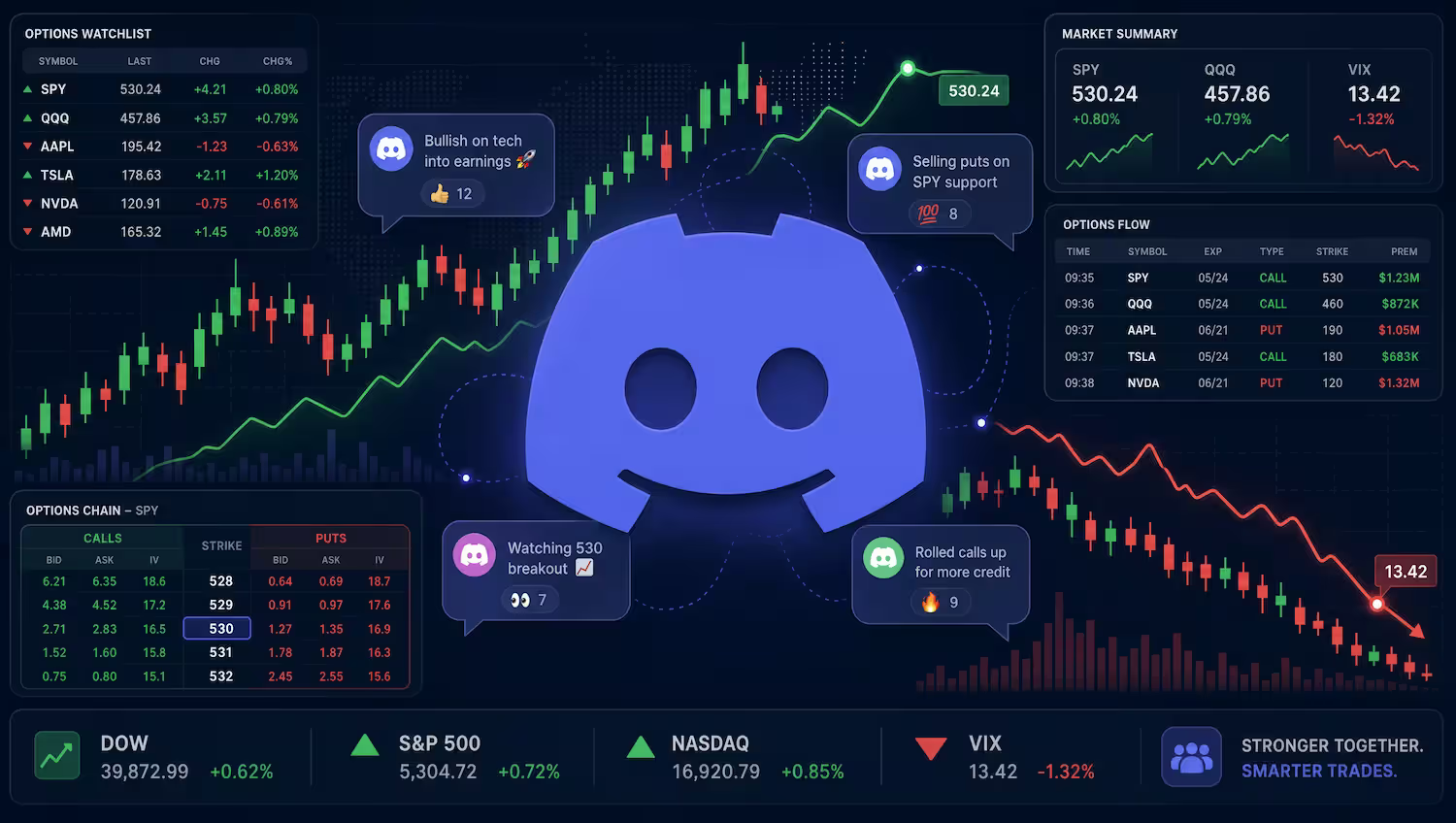
An options trading Discord can feel useful within minutes. Charts move in real time, members post fills, moderators explain setups, and an alert can turn a quiet afternoon into a room full of conviction.
The same speed can make the group dangerous. A trade that worked for the person posting it may be untradeable by the time members see it. Screenshots can hide losses. Private messages can lead to fake brokers, credential theft, or requests for more money. A busy room can create the illusion that a trade has been researched when it has only been repeated.
The honest answer is conditional: some communities are worth joining for education, peer review, and accountability. Very few are worth joining simply to copy alerts. The deciding factor is whether the group improves a trader’s process when no alert is available.
Quick Answer
- A useful Discord teaches members how to evaluate strike, expiration, premium, liquidity, maximum loss, and exit rules rather than only posting Buy and Sell messages.
- Trade-alert results are highly sensitive to posting delay, bid-ask spread, contract size, and who received the first fill.
- Performance screenshots are not a track record unless losing trades, timestamps, position sizes, edits, and realistic member fills are also visible.
- Paid membership can be reasonable for structured education or live review, but the subscription price does not prove trading skill or suitable advice.
- Unsolicited DMs, guaranteed returns, secret information, account-access requests, crypto deposits, and extra fees to release funds are reasons to leave immediately.
- Use a community as a source of questions and perspectives, not as permission to place a trade you cannot explain independently.
What A Good Options Community Actually Provides
The best use case for a trading community is not prediction. It is process. A good room helps members learn vocabulary, compare trade structures, notice missing risk checks, and review decisions after the outcome is known.
Useful channels may include scheduled educational sessions, annotated trade journals, market-mechanics questions, strategy case studies, risk reviews, and moderated post-trade analysis. A beginner should be able to observe without feeling pressured to enter every trade.
FINRA notes that investing chat groups can widen access to information, let members share viewpoints, and improve engagement. It also warns that the same channels can contain inaccurate, misleading, harmful, or intentionally false information. See FINRA’s overview of social media communication tools.
A worthwhile group makes uncertainty visible. It distinguishes education from personalized advice, shows what could invalidate a setup, and treats skipping as a complete decision.
Why Options Alerts Are Especially Hard To Copy
An options alert needs more than a ticker and direction. The strike, expiration, premium, order type, spread, implied volatility, position size, catalyst, and exit conditions can all change the result.
Options can move sharply while an alert is being typed. The leader may buy at the offer before posting. Members then arrive after the underlying moves, implied volatility rises, and market makers widen the quote. In short-dated contracts, time decay keeps running during the delay. That is not necessarily dishonest, but it makes the posted result difficult to reproduce.
A market order can make the gap worse. The OptionsTrading.org comparison of limit orders and market orders explains why price control matters in options. Even a limit order may sit unfilled while the room celebrates a trade that members could not enter.
The alert also lacks account context. A defined-risk spread that is small for one member may be oversized for another. A short option may create assignment or margin risk the alert poster never discusses. Copying the contract is not the same as copying the risk capacity.
Example: The Alert Was A Winner, But The Member Lost
This hypothetical example shows why a screenshot of the leader’s percentage return is not enough.
Moment | Alert Leader | Discord Member | Why The Results Differ |
|---|---|---|---|
Entry | Buys a weekly 105 call at $0.85 before posting. | Sees the alert with the option quoted $1.10 bid and $1.25 ask; fills at $1.20. | The underlying moved and the spread widened before the member entered. |
Position size | Buys one contract and risks $85. | Buys five contracts after seeing strong reactions and risks $600. | The member copied direction but not the leader’s dollar risk. |
Exit alert | Sells at $1.40, a gain of about 65% before costs. | Receives the post late and sells at $1.15. | Quote movement and queue position change the attainable exit. |
Reported result | Posts a winning trade screenshot. | Loses $25 per contract before fees, or $125 total. | Both records can be factually correct even though the member lost. |
Lesson | The alert worked for the original fill. | The copied trade did not work at member prices. | Evaluate timestamped, executable member outcomes rather than headline returns. |
The Bid-Ask Spread Is Part Of Every Alert
A Discord often shows the last traded price because it is easy to screenshot. The last price may be stale, outside the current market, or based on one small trade. Members need the live bid, ask, midpoint, and quote size.
Spread width matters in percentage terms. A $0.20 spread on a $1.00 option is a 20% gap. If the alert needs a 25% profit target, much of the expected gain may already sit between bid and ask.
Our guide to tight bid-ask spreads covers the execution problem in more detail. A strong Discord should make poor liquidity a reason to cancel an idea, not a challenge to chase harder.
Moderators should also separate theoretical marks from executable fills. Marking a position at the midpoint may make a performance channel look cleaner than the prices members could receive.
Performance Screenshots Leave Out The Denominator
A screenshot can prove that one contract changed price. It does not prove that the poster entered before the move, used the stated size, exited at the displayed value, or included every losing trade.
Percentage gains can also hide portfolio risk. A 100% gain on a $50 contract does not offset repeated $500 losses. Ten winning alerts mean little without the number of total alerts, average gain, average loss, drawdown, open positions, canceled orders, fees, and rules for counting partial exits.
Look for a complete timestamped log that cannot be edited after the fact. It should include losing trades and distinguish the leader’s fills from reasonable member fills. Deleted messages, changing entry prices, and wins posted publicly while losses disappear into a private channel are serious credibility problems.
A community can still be educational without publishing audited performance. The problem begins when it sells access using performance claims that cannot be reconstructed.
Free, Paid, Or Skip?
The comparison criteria are educational depth, moderation, conflicts, security, cancellation terms, and whether the group improves the reader’s independent process.
Choice | Best Fit | Potential Value | Main Trade-Offs |
|---|---|---|---|
Free community | Traders who want discussion, peer questions, and a low-commitment learning environment. | Broad viewpoints, public resources, and a chance to observe culture before paying. | More noise, weaker moderation, spam, impersonation, and little accountability for claims. |
Paid education-focused group | Traders who value a curriculum, scheduled review, journaling, and access to an identifiable instructor. | Structured lessons, office hours, archives, and clearer moderation can save research time. | Subscription cost, possible affiliate conflicts, no guarantee of trading results, and risk of dependence. |
Paid alert-focused group | Rarely a strong best fit; only for traders able to independently reject alerts and model realistic fills. | Fast idea flow and observation of how another trader frames setups. | Latency, fill mismatch, selective performance, urgency, oversizing, and incentives to keep members trading. |
Skip the group | Traders who feel pressured, copy without understanding, or encounter unclear ownership and security practices. | Preserves attention, capital, and decision independence. | Less real-time social interaction, which can be replaced with a journal or slower study group. |
Paid Does Not Mean Vetted
A monthly price can create an impression of professionalism, but it is only a business model. The owner may earn from subscriptions, broker referrals, affiliate links, sponsored tools, order flow, or courses. Those incentives are not automatically improper, but they should be disclosed.
Ask what the fee buys. A library, scheduled instruction, searchable archives, and thoughtful feedback can be evaluated as educational services. A promise of profitable alerts is much harder to verify because member fills and risk tolerance differ.
Review renewal timing, cancellation steps, refund terms, upsells, and whether important channels are locked behind additional tiers. Pressure to upgrade for a secret strategy or private signal room is a warning sign.
Never fund a trading account, send crypto, or transfer securities to a Discord moderator. A community subscription and a regulated brokerage relationship are different things.
Private Messages Are A Separate Security Risk
A legitimate public server can still attract impersonators. A scammer may copy a moderator’s name and avatar, then send a private message offering managed trading, account recovery, a special broker, or a guaranteed allocation.
The SEC’s December 2025 alert on investment group chats warns that fraudsters may impersonate experts, use fake trading apps, display invented profits, and demand fees or deposits when victims try to withdraw.
Never share a brokerage password, one-time code, API key, remote-desktop access, seed phrase, driver’s license image, or credit-card image through Discord. Turn off unsolicited server-member DMs where practical and verify moderators through a second public channel.
If someone says a regulator froze the account or that another payment is required to release profits, stop sending money. The displayed balance may be part of the scam.
Immediate Red Flags
- Guaranteed returns, unusually high win-rate promises, or claims that losses are impossible.
- Urgent alerts that punish questions with phrases such as enter now or you will miss it.
- Screenshots without full timestamps, losing trades, position size, or realistic bid-ask fills.
- Claims of inside information, secret order flow, or a private relationship with a company or regulator.
- Unsolicited DMs from moderators, assistants, recovery agents, or supposed brokers.
- Requests for brokerage credentials, one-time codes, remote access, crypto transfers, or extra withdrawal fees.
- Thin-stock campaigns where members are told to buy at a coordinated time or price.
- Deleted trade messages, edited entries, silenced criticism, and no visible conflict-of-interest policy.
Crowd Confidence Is Not Independent Confirmation
A fast chat can make ten versions of the same opinion look like ten independent signals. They may all originate from one moderator, one social post, or one unusual-options scanner.
FINRA warns that social-media discussion can encourage emotionally driven or impulsive decisions. Its current research also describes a knowledge-confidence gap among social-media-informed investors: strong self-rated confidence can coexist with weak objective knowledge.
Before acting, leave the chat and rebuild the idea from primary information. Check the underlying news, option chain, expiration, strike, implied volatility, spread, open interest, maximum loss, and event calendar. If the trade no longer looks attractive without the room’s excitement, that is useful evidence.
The OptionsTrading.org discussion of why options can lose money even when the underlying moves your way is a good reminder that direction alone is not an options thesis.
Use The Group To Improve A Journal, Not Replace One
A personal trade journal makes a Discord easier to evaluate. Record the alert time, visible quote, price you could actually receive, reason for taking or rejecting the idea, maximum loss, exit plan, and final outcome.
After a sample of alerts, compare the leader’s posted results with member-executable results. Track how many ideas were impossible to fill, how many were chased, and whether the group encouraged larger size after wins or losses.
The journal should also record non-trades. A community that helps a member reject poor liquidity, avoid an earnings gamble, or reduce size may be providing more value than one that produces constant alerts.
If the group makes the journal less detailed because everything feels too fast, the community is probably weakening the process.
Seven-Day Discord Evaluation Checklist
- Observe for at least several market sessions before paying, copying, or sharing personal information.
- Identify the owners and moderators, then independently verify any claimed professional background or registration.
- Read the rules for performance reporting, edited messages, conflicts, affiliate links, private messages, and member complaints.
- Count educational posts, risk reviews, and post-trade analyses separately from raw entry and exit alerts.
- For each sample alert, record the exact strike, expiration, posted premium, live bid-ask spread, quote size, and attainable member fill.
- Check whether maximum loss, position size, invalidation, exit plan, assignment, and event risk are stated before entry.
- Compare winners and losers in one complete log rather than relying on a highlight channel.
- Test whether you can explain and reject an alert without asking the moderator what to do.
- Review subscription renewal, cancellation, refund, upsell, and data-collection terms before paying.
- Leave immediately if anyone requests account credentials, remote access, deposits, crypto transfers, or a payment to unlock funds.
A Simple Worth-It Test
At the end of the trial, ask what improved. Did the group make trade plans more complete? Did it improve understanding of execution, volatility, assignment, and risk? Did it create a useful review habit? Those are durable benefits.
Then ask what worsened. Did trade frequency rise? Did the member chase fills, increase size, hide losses, or feel anxious when away from the chat? Did the subscription create pressure to trade so the fee felt justified? Those costs belong in the evaluation.
The group is worth joining only when its educational and process value exceeds its financial cost, attention cost, and behavioral risk. If the main benefit disappears when alerts are muted, the community is probably selling dependency rather than skill.
FAQ
These answers focus on practical evaluation of options Discord communities, not recommendations for specific servers.
Are paid options Discord groups scams?
Not automatically. Some sell legitimate education, moderation, or community access. Payment does not verify trading skill, performance, registration, or suitability. Evaluate ownership, disclosures, complete records, security practices, cancellation terms, and educational quality.
Can I trust verified profit screenshots?
A screenshot can show one price or account view, but it rarely proves a complete track record. Look for original timestamps, entries and exits, losing trades, position size, edits, fees, and realistic member fills.
Why do members get worse results than the alert leader?
The leader may enter before posting and exit before members receive the update. Options spreads, fast price movement, implied volatility, queue position, contract size, and notification delay can all produce different fills.
Should beginners use options alert rooms?
Beginners are especially vulnerable to copying contracts they cannot evaluate. A slower education-focused group may help, but a beginner should be able to calculate premium risk, breakeven, liquidity, expiration, and assignment consequences before acting on any alert.
How can I verify a Discord moderator's credentials?
Use official regulator databases and the person's employer or firm website rather than links sent in private messages. Verify the legal name and firm independently. Remember that an impersonator can copy the identity of a real professional.
What should I do if a moderator asks for account access or more money?
Do not provide credentials, one-time codes, remote access, API keys, or additional deposits. Preserve the messages, contact the platform and your financial institution through official channels, and report suspected fraud to the appropriate regulator or law-enforcement portal.
Source and Freshness Note
This article was source-reviewed on July 2026. Social-media scam patterns, platform features, server ownership, subscription terms, and regulator guidance can change. Readers should verify current identities, registrations, and payment terms through official sources.