
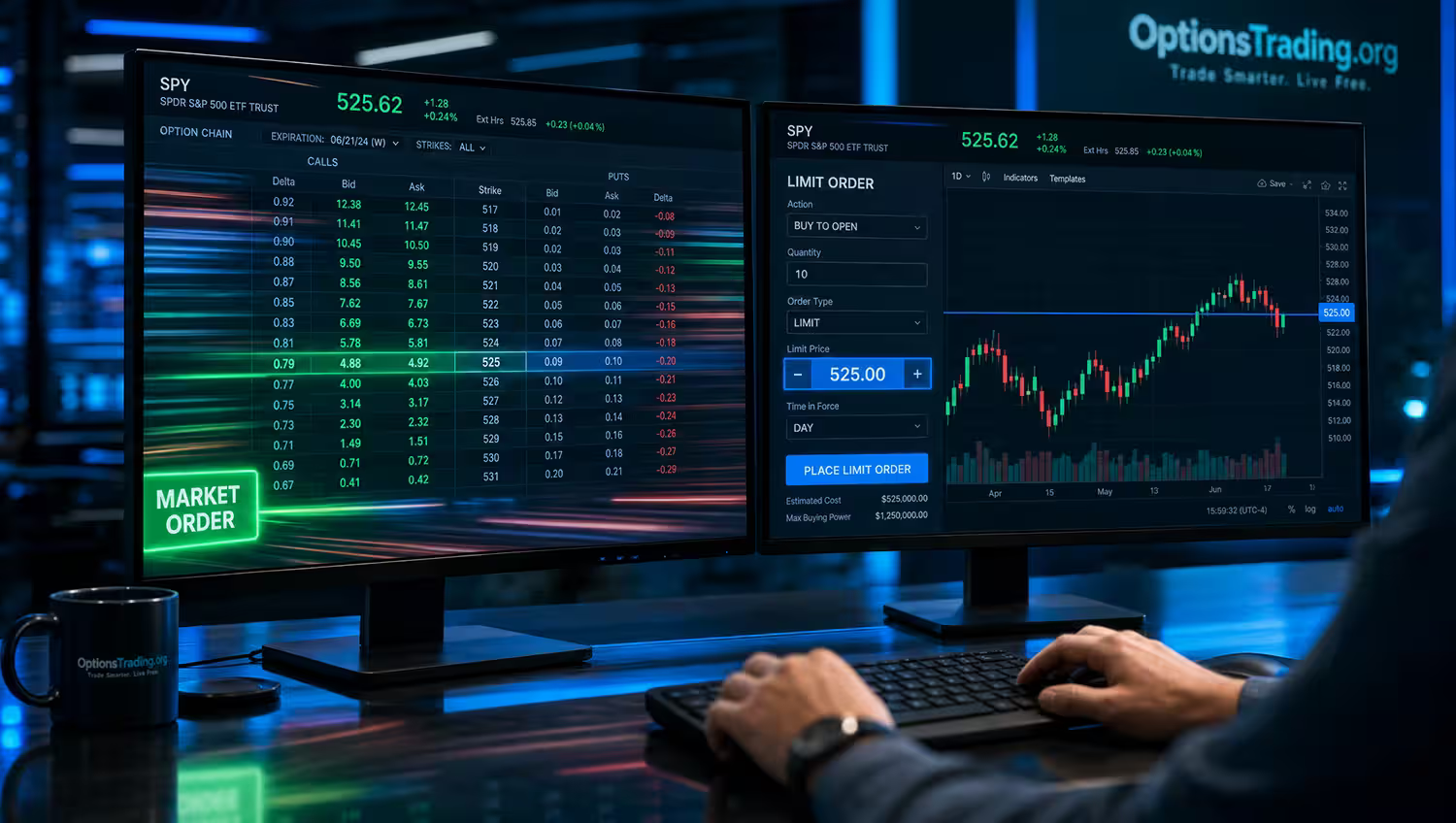
In options trading, the order type can matter almost as much as the trade idea. A trader may pick the right underlying, strike, and expiration, then give up more than expected because the order was sent in a way that surrendered price control.
That is why the market order versus limit order decision deserves special attention in options. Stocks with deep liquidity may have tight spreads and fast fills. Options can be different. Each strike and expiration has its own market, and some contracts trade with wide bid-ask spreads, thin size, or quotes that move quickly when the underlying stock moves.
A market order prioritizes getting filled. A limit order prioritizes the price. Neither order type is automatically good or bad, but they solve different problems. The practical question is whether the trader needs speed badly enough to accept uncertain execution, or whether the trader should define the worst acceptable price and risk not getting filled.
The Short Version
A market order tells the broker to buy or sell at the best available price. It is designed for execution, not a guaranteed price. Investor.gov warns in its order-type bulletin that a market order can fill at different prices in a fast-moving market.
A limit order sets the highest price a trader is willing to pay when buying, or the lowest price a trader is willing to accept when selling. Investor.gov defines a limit order as an order to buy or sell a security at a specific price or better.
In options, that difference is amplified by the option chain. The bid is the highest displayed price someone is currently willing to pay, and the ask is the lowest displayed price someone is currently willing to sell for. The Options Industry Council explains those bid and ask prices in its option-chain quote guide.
Quick Takeaways
- Market orders emphasize execution speed, but the final fill price is not guaranteed.
- Limit orders define the maximum buy price or minimum sell price, but they may not fill.
- Options often have wider spreads than heavily traded stocks, especially in less active strikes or expirations.
- A market order can be especially risky in thin options, fast markets, near expiration, or multi-leg trades.
- A limit order can help manage slippage, but an unrealistic limit may leave the trader watching the contract move away.
- The best order choice depends on liquidity, urgency, trade size, spread width, and whether the order is opening or closing risk.
Market Orders And Limit Orders Compared
The difference is not just terminology. It changes what the trader controls and what the trader gives up.
Order Type | What It Prioritizes | Main Tradeoff |
|---|---|---|
Market order | Getting the order filled quickly | The fill price can be worse than the quote the trader expected. |
Buy limit order | Not paying above the limit price | The order may not fill if sellers will not accept that price. |
Sell limit order | Not selling below the limit price | The order may not fill if buyers will not pay that price. |
Marketable limit order | Faster execution with a price ceiling or floor | It may still fill near the displayed market, but it keeps a boundary on the worst acceptable price. |
Unrealistic limit order | Price discipline | The trader may miss the trade entirely or chase later at a worse price. |
Why This Matters More In Options Than In Many Stocks
A stock ticker has one main market. An option chain has many smaller markets sitting on top of that stock: calls and puts, multiple strikes, multiple expirations, and different levels of open interest. The at-the-money contract expiring next month may be active, while a far-out-of-the-money weekly option may have little displayed size.
That is why an option quote should not be read like a fixed price tag. A displayed ask may be the best seller available at that moment, not a promise that the same price will remain available for the trader’s entire order. A displayed bid may be the best buyer at that moment, not a floor that protects a seller from a worse execution if a market order sweeps through available liquidity.
The practical result is slippage. Slippage is the gap between the price a trader expected and the price actually received. A narrow spread may make that gap small. A wide spread can make the cost large enough to change the trade before it even starts. It belongs with the broader options risks that shape real account outcomes, not off to the side as a minor platform detail.
This is why the bid-ask spread becomes part of the trade rather than a minor quote detail. A $0.05 spread and a $0.80 spread create very different order-entry decisions.
The Comparison Criteria That Matter
The useful comparison criteria are not market order good, limit order bad, or the reverse. The decision should be compared across fill certainty, price control, spread width, contract liquidity, order size, urgency, and what happens if the order does not fill.
The reader-use-case fit changes with the job. A trader opening a new long call may be able to wait for a better limit price. A trader closing a short option near expiration may value faster execution because the position risk is changing by the minute.
There are platform trade-offs too. Some brokers make midpoint pricing, net spread prices, order staging, and price adjustment easy to see. Others require more manual checking. The order type is still the trader’s decision, but the platform can make disciplined order entry easier or harder.
A Simple Options Quote Example
The numbers below are simplified, but they show why the same trade can feel very different depending on the order type.
Quote Detail | Example | Why It Matters |
|---|---|---|
Bid | $2.00 | A seller sending a market order might receive around the bid, but fast quotes can change. |
Ask | $2.40 | A buyer sending a market order might pay around the ask, but the final price is not guaranteed. |
Midpoint | $2.20 | The midpoint is a useful reference, not a guaranteed fill price. |
Buy limit at $2.20 | May fill if sellers come down | The trader controls price but may not get the contract. |
Buy market order | Likely fills faster | The trader gives up control over the final execution price. |
When A Market Order Can Create Problems
A market order can make sense when the contract is extremely liquid, the spread is tight, the order size is small relative to displayed liquidity, and immediate execution is more important than a few cents of price improvement. Even then, the trader is relying on the market available at the moment the order reaches execution.
The risk grows when the option is thin, the spread is wide, or the underlying stock is moving quickly. In that setting, a market order can fill at a price that looks surprising compared with the quote on the screen. FINRA explains that market orders focus on execution certainty, while limit orders add price restrictions.
Options add another layer because the contract price can move even when the stock move looks modest. Delta, implied volatility, time to expiration, and changing demand can all shift the option quote. A trader who sends a market order during a fast move may be accepting more uncertainty than intended.
That uncertainty can be painful when the stock moves your way but the option does not. A poor entry fill raises the hurdle the trade has to clear before it can become profitable.
Why Limit Orders Are Common In Options
Limit orders are common in options because they let traders define the worst price they are willing to accept. A buy limit order might say, in effect, do not pay above $2.20 for this option. A sell limit order might say, do not sell below $2.10.
That control is valuable when spreads are wide. Instead of crossing the entire spread immediately, a trader might start near the midpoint and adjust only if the order does not fill. This does not guarantee a better outcome, but it forces the trader to make a conscious price decision.
The drawback is non-execution. A limit order can sit without filling. The option can move away. The trader can miss an entry or fail to exit at the desired price. That is not a flaw in the order type; it is the price of insisting on a boundary.
A limit order also does not make a bad contract good. If the option is overpriced, illiquid, or mismatched with the thesis, a cleaner fill only solves the execution problem. The trade still needs a sound reason to exist.
Choosing The Order Type
The order type should match the situation. The table below is not a rulebook, but it shows the questions a trader should be asking before pressing submit.
Situation | Order Type Traders Often Consider | Question To Ask First |
|---|---|---|
Tight spread, active contract, small order | Limit order or marketable limit order | Is the expected fill close enough to the displayed quote? |
Wide spread or low volume | Limit order | What is the maximum price worth paying, or the minimum price worth accepting? |
Fast-moving news event | Limit order with extra caution | Is speed worth the risk of a poor fill? |
Closing a risky short option | Marketable limit order | How much price flexibility is acceptable to reduce exposure now? |
Multi-leg spread | Net debit or credit limit order | Does the whole spread price make sense, not just one leg? |
Near expiration | Limit order with realistic pricing | Will time decay or assignment risk make waiting more expensive? |
Marketable Limit Orders: The Middle Ground
A marketable limit order is a limit order priced aggressively enough that it can execute against the current market, while still keeping a boundary on the worst acceptable price. For example, if an option is quoted $2.00 bid and $2.40 ask, a trader might enter a buy limit at $2.35 or $2.40 rather than sending a pure market order.
That approach does not guarantee a perfect fill. It can still execute at a price the trader would rather improve. But it prevents the order from filling above the limit if the quote moves suddenly or displayed size disappears.
For exits, this can matter even more. If a trader needs to close risk before expiration, a marketable limit can provide urgency without giving the order unlimited room to chase the market. The balance is delicate: too tight and the order may not fill; too loose and the trader has not protected much.
Execution Risks To Respect
- A market order can fill at a worse price than the screen quote suggested.
- A limit order may not fill, even when the option briefly touches the limit price.
- Displayed bid and ask size may not be enough for the full order.
- Fast markets can change quotes before an order reaches execution.
- Multi-leg option orders can fill differently than single-leg orders because the net price matters.
- Near expiration, waiting for a better price can collide with time decay, pin risk, or assignment risk.
Opening Trades Versus Closing Trades
Order choice can change depending on whether the trader is opening a new position or closing an existing one. Opening trades usually allow more patience. If the fill is not available at a reasonable price, the trader can often walk away.
Closing trades can be different. A trader exiting a long option may be racing time decay. A trader closing a short option may be reducing assignment or margin risk. In those cases, the order still needs price discipline, but the cost of not filling may be higher.
That is especially true when expiration is close. If a short option is near the money, assignment can turn an order-entry decision into an account event. If the position remains open into the final session, expiration mechanics can take over.
The OCC states that investors should read the Characteristics and Risks of Standardized Options before trading listed options. That disclosure is not just background reading; order entry, exercise, assignment, and expiration are part of the real risk system.
Options Order Entry Checklist
- Check the bid, ask, midpoint, spread width, volume, and open interest on the exact contract.
- Decide whether execution speed or price control matters more for this trade.
- Set a maximum acceptable buy price or minimum acceptable sell price before entering a limit order.
- For spreads, focus on the net debit or credit instead of treating each leg separately.
- Use extra caution around the open, close, earnings, economic releases, and fast underlying moves.
- If closing risk, decide how much price flexibility is acceptable before the order is sent.
- Avoid chasing a missed fill unless the new price still fits the original trade thesis.
The Practical Answer
For many options traders, limit orders are the default because they put a boundary around execution price. That does not mean every limit order is smart. A limit price that is too optimistic can leave the trader unfilled, and a limit price that is too loose may behave almost like a market order.
Market orders are not automatically reckless, but they require the right conditions: tight spreads, strong liquidity, small size, normal market conditions, and a genuine need for immediate execution. The less those conditions are present, the more a market order can become an expensive shortcut.
A good order ticket should make the trade more deliberate. The trader should know the contract, the spread, the midpoint, the acceptable price, and what happens if the order does not fill. The goal is not to win every penny of price improvement. It is to avoid letting the order type quietly change the risk-reward of the trade.
FAQ
These answers are educational and reflect public order-type and options-risk information reviewed on June 30, 2026. Broker platforms, routing practices, option chains, and market conditions can change.
Is a limit order always better than a market order for options?
No. A limit order gives price control, but it may not fill. A market order gives more execution certainty, but the final fill price is not guaranteed. In options, many traders prefer limit orders because spreads can be wide, but the right choice depends on liquidity, urgency, and risk.
Can a limit order fill at a better price than the limit?
Yes. A buy limit order can fill at the limit price or lower, and a sell limit order can fill at the limit price or higher. The limit sets the boundary, not necessarily the exact fill price.
Why are market orders risky in options?
Options can have wide spreads, limited displayed size, and fast-moving quotes. A market order can execute at the best available prices when it reaches the market, which may be worse than the quote the trader saw when placing the order.
What is the midpoint in an option quote?
The midpoint is halfway between the bid and ask. Traders often use it as a reference point for limit orders, but it is not a guaranteed execution price.
Should spreads use limit orders?
Multi-leg option spreads are commonly entered with a net debit or net credit limit. That helps the trader control the total spread price rather than focusing only on one leg.
Source and Freshness Note
This article was reviewed on July 2026 using public investor education from Investor.gov, FINRA, the Options Industry Council, and OCC options disclosure materials. It is educational only. Order handling, platform behavior, available order types, option liquidity, and displayed quotes can change, so traders should confirm current broker rules and live contract data before placing an order.