
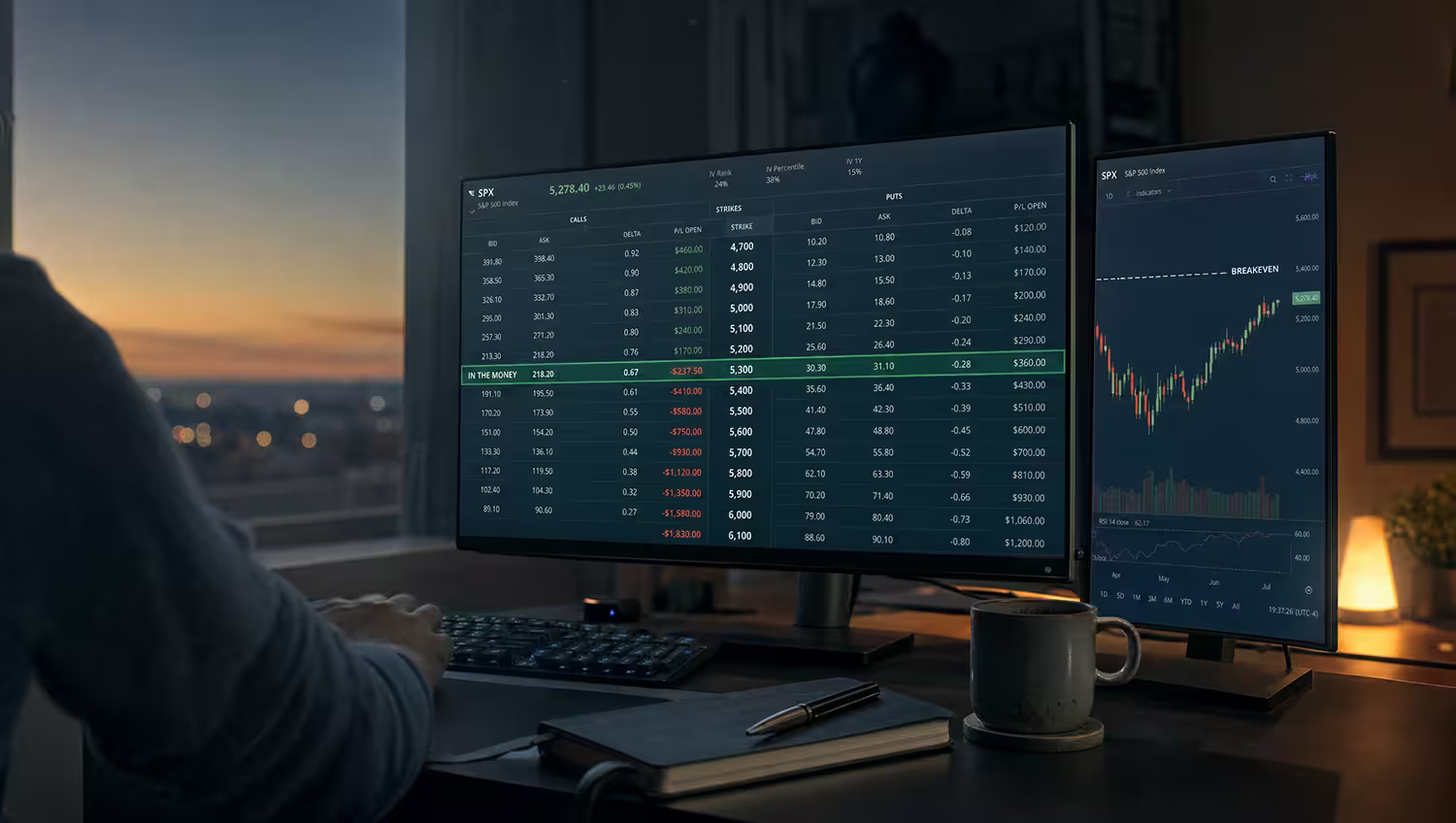
Yes. An option can be in the money and still lose money, and for buyers that outcome is ordinary rather than exceptional. Being in the money is a statement about where the underlying sits relative to the strike, and nothing else. It describes the contract. It says nothing about what you paid for the contract, and what you paid is the only number that decides whether your position is up or down.
The distance between those two ideas is where the losses live. For example, a call bought for $6.50 that finishes $4.00 in the money returns $400 against a $650 cost, so the trade is down $250 while every screen in the platform still marks the contract in the money. Three further mechanisms produce the same result: extrinsic value that drains away, exercise that converts the contract into stock, and, for anyone short the contract, assignment. Each is worked through below.
Key Takeaways
- Moneyness ignores cost: in the money means intrinsic value exists, not that it covers your premium.
- Breakeven is the line: a long call profits only above the strike plus the premium paid.
- Deeper can be cheaper: extrinsic value can fall faster than intrinsic value builds.
- A penny exercises: contracts one cent in the money are exercised automatically unless you instruct otherwise.
- Sellers invert it: for a written option, being in the money is the losing condition.
What Being in the Money Actually Measures
Moneyness is a comparison of two numbers, and your cost is not one of them. Moneyness describes the relationship between the underlying's market price and the strike price fixed in the contract at listing. FINRA states the definition plainly: an option is in the money when the market price of the underlying security is above the strike price of a call or below the strike price of a put. The premium appears nowhere in that sentence.
What moneyness does determine is intrinsic value, the amount the contract would be worth if it were exercised at this instant. For a call that is the underlying price minus the strike, floored at zero, and for a put it is the strike minus the underlying price, floored at zero. An option is in the money precisely when this figure is positive, which makes "in the money" and "has intrinsic value" two names for the same condition.
Everything a buyer pays above intrinsic value is extrinsic value, sometimes called time value. It compensates the writer for the time remaining and for the uncertainty priced into that time, and it is the reason an option almost always trades above its intrinsic value while any life remains. Both components are bought in a single payment, but only one of them survives to expiration.
The near neighbour that gets confused with moneyness, relentlessly, is profitability. The two are computed from different inputs, they can point in opposite directions, and only one of them shows up on your statement. The contrast comes after the mechanism.
Why an Option Can Be in the Money and Still Lose Money
Profit at expiration is intrinsic value minus premium, not intrinsic value alone. A long option's result is the contract's final worth measured against what you paid for it. FINRA Rule 2360 sets out the arithmetic that scales those per-share figures, defining the aggregate exercise price as the exercise price multiplied by the number of units of the underlying security the contract covers, which for a standard equity option is 100.
Work it through with round numbers. Suppose XYZ trades at $100.00 and you buy one call struck at $95.00 with 30 days remaining, paying a premium of $6.50 per share, or $650.00 for the contract. The option is already in the money at entry: intrinsic value is $100.00 minus $95.00, or $5.00, and the remaining $1.50 of the premium is extrinsic value.
Now suppose the contract is held to expiration with XYZ at $99.00. The stock has drifted down a dollar, but the call is still comfortably in the money, by $99.00 minus $95.00, or $4.00. That intrinsic value is worth $4.00 times 100, or $400.00, against the $650.00 paid. The position loses $250.00 on a contract that finished $4.00 in the money.
The full set of outcomes at expiration, per contract, shows where the line actually sits:
| XYZ at expiration | Moneyness | Contract value | Net profit or loss |
|---|---|---|---|
| $94.00 | Out of the money | $0 | -$650 |
| $96.00 | In the money by $1.00 | $100 | -$550 |
| $99.00 | In the money by $4.00 | $400 | -$250 |
| $101.50 | In the money by $6.50 | $650 | $0 |
| $104.00 | In the money by $9.00 | $900 | +$250 |
Four of those five rows are in the money. Two of them lose money outright, one returns exactly what it cost, and only the last one profits. In this case breakeven is the strike plus the premium, $95.00 plus $6.50, or $101.50, which means the stock has to finish 1.5% above where it started before the trade clears zero. At $101.00 the stock is up 1%, the call is $6.00 in the money, and the contract still returns $600.00 against $650.00 paid.
In the money is a fact about the contract. Profit is a fact about your position. The contract does not know what you paid for it.
Four Ways an In-the-Money Position Still Loses
The example above is the first and most common of four distinct mechanisms. They are independent of each other, and a single position can suffer more than one at a time.
The Intrinsic Value Is Smaller Than the Premium Paid
This is the base case, and it reaches every long option bought with any extrinsic value attached, which is very nearly all of them. The contract has to travel far enough past the strike to repay the whole premium before a single dollar of profit appears, so the entire band between the strike and breakeven is in-the-money territory that loses money.
Puts mirror it exactly. Suppose you buy one XYZ $105.00 put for $6.00 while XYZ trades at $100.00, so the contract is in the money by $5.00 at entry with $1.00 of extrinsic value on top. Breakeven is $105.00 minus $6.00, or $99.00, so a finish at $101.00 would leave the put $4.00 in the money and the position $200.00 down.
Extrinsic Value Bleeds Out Faster Than Intrinsic Value Builds
This one surprises people, because the position moves the right way and loses anyway. Cboe describes theta as the measure of the change in an option's price as expiration approaches, and vega as the sensitivity of that price to changes in implied volatility. Both act on the extrinsic portion of the premium, and both can subtract more than a favourable move in the underlying adds. The full directional version of this problem has its own treatment in why an option loses money when the stock moves your way.
Return to the $95.00 call, and suppose twelve days pass with XYZ rising to $100.75. Intrinsic value has grown from $5.00 to $5.75. Over the same twelve days time decay and a fall in implied volatility have cut the extrinsic component from $1.50 to $0.55.
Add the two components back together and the contract is quoted at $6.30 in this case, which is $0.20 below the $6.50 paid, a loss of $20.00 per contract. The option is $0.75 deeper in the money than the day it was bought and worth less than it cost. Nothing has gone wrong mechanically. Two things were bought in one payment and one of them is being consumed on schedule.
An option can move deeper into the money and lose value on the same day, because intrinsic value and extrinsic value are bought and lost separately.
Exercise Converts a Losing Option Into a Stock Position
At expiration, being in the money stops being a description and becomes an instruction. FINRA notes that standardized equity options finishing in the money are generally exercised automatically, and that for calls the money to buy 100 shares of the underlying stock becomes due at that time. The threshold is small: Cboe's regulatory circular records the automatic exercise threshold for equity options being cut from $.05 to $.01, effective for the June 2008 expiration.
Take the same $95.00 call and suppose XYZ settles at $95.03, a classic case of pin risk. Intrinsic value is $0.03 per share, so the contract is worth $3.00 against the $650.00 paid, which is already a near-total loss. It is also past the threshold, so unless the clearing member instructs otherwise it is exercised, and the following Monday the account holds 100 shares that cost $9,500.00, carried over a weekend nobody planned to be long through.
That conversion is the part traders underestimate. A worthless contract simply disappears, while a barely-in-the-money contract hands over a capital requirement, an unhedged stock position, and whatever the underlying does before it can be sold.
On the Short Side, Being in the Money Is the Loss
For the writer of a contract the arithmetic runs backwards: in the money is not a hopeful sign, it is the condition under which money is owed. Suppose you sell one XYZ $105.00 call for $2.00 and collect $200.00. If XYZ finishes at $108.00 the contract is $3.00 in the money, worth $300.00 to the holder, and the short position nets a loss of $100.00 despite the credit.
Short positions also lose the ability to wait. FINRA explains that the OCC randomly assigns exercise notices to firms carrying short option positions, and the firm then allocates the notice to one of its own customers. Because an American style contract can be exercised at any point in its life, a seller can be assigned well before expiration, whenever the holder decides the position is worth converting.
Moneyness vs Breakeven: The Distinction That Costs Money
Two levels, two jobs, and only one of them is yours. The strike and the resulting moneyness belong to the contract series. Breakeven belongs to your fill. Confusing the two is what turns a correctly forecast move into a losing trade, and it is the same confusion behind the related question of whether the underlying has to reach the strike at all.
They separate along four dimensions:
- What each measures. Moneyness measures the underlying against a fixed contractual level. Breakeven measures the underlying against your cost basis.
- How many numbers it uses. Moneyness needs two, the underlying price and the strike. Profit needs three, because the premium joins them.
- Who shares it. Every holder of a series shares one moneyness at any moment. Breakeven is personal, because it depends on the price you individually paid.
- What it decides. Moneyness decides whether the contract settles into stock or cash. Breakeven decides whether the trade was worth making.
In practice the distinction shows up in where people set alerts. Watching for XYZ to cross the strike in the example above would be watching an event with no profit-and-loss meaning attached, because in this case the position is already in the money there and losing its entire premium. The level that carries meaning at expiration is breakeven. Before expiration, the only level that carries meaning is whatever the contract itself is bid at.
Why This Matters to Traders on Both Sides
The clearest thing this fixes is the habit of judging an open position by its moneyness. A trader reading "in the money" as "winning" will hold through the exact window in which the position was profitable and could have been closed, then be genuinely puzzled when a contract that never left the money settles for less than it cost. The information needed to avoid that sits on the same screen: the bid, next to the fill price.
It also reframes what an in-the-money entry actually buys. Paying up for a contract that already carries intrinsic value buys a higher probability of finishing in the money and a lower percentage return when it does, because the intrinsic portion of the premium is repaid rather than earned. That is a legitimate trade-off, and one of the standard risks of trading options worth pricing deliberately rather than absorbing by accident.
For sellers the same arithmetic runs the other way and is easier to hold in mind. The credit received creates a cushion beyond the strike, so a written call can be in the money and still profitable anywhere between the strike and strike plus credit. The cushion is real, it is finite, and it does nothing to prevent an early assignment.
Edge Cases and Gotchas
A penny in the money is enough to exercise. The one-cent threshold means there is no rounding in your favour and no minimum size that gets ignored. A contract finishing one cent in the money is a near-total loss on the premium and still converts into 100 shares.
The deadline for saying no is earlier than you think. FINRA's information notice on the exercise cut-off time states that holders of expiring options have until 5:30 p.m. Eastern on the expiration date to make a final exercise decision, and that members may not accept instructions after that point. Brokers routinely impose their own earlier cut-offs, so the workable deadline is usually well before the published one.
Cash-settled index options settle against a print you cannot trade. Cboe's SPX specifications state that trading in SPX options ordinarily ceases at 5:00 p.m. Eastern on the business day preceding the day the exercise-settlement value is calculated, usually a Thursday. A cash-settled index position can therefore be comfortably in the money at its last tradeable moment and settle against a value set after the ability to act on it has gone.
Exercising early throws away the extrinsic value. Exercising an option collects intrinsic value only, so a contract quoted at $6.30 with $5.75 of intrinsic value would give up $55.00 per contract that selling it captures instead. Exercise is the right move when you want the shares, not when you want the money.
The mark is not the bid. Positions are marked at the midpoint but exit at the bid, and in-the-money series away from the front strikes are often thinly quoted. For example, a contract marked at $6.30 that is bid $6.15 pays $615.00 rather than $630.00, which is enough to turn several of the marginal outcomes above from small gains into small losses.
Frequently Asked Questions
These answers cover what traders usually ask after watching a position finish in the money and still settle for less than it cost, or after a winning contract turned into an unwanted stock position over a weekend.