

Cash reserves in an options trading account are the spare cash that no open position has claimed. That leaves out the premium already paid for long options, the cash securing short puts, and the margin requirement held against short positions. Whatever remains is the reserve, and its role is to meet the cash demands positions create after they're opened, before those demands force a sale.
Those demands come in four forms. An assignment or exercise can turn a contract into a stock trade worth many times its premium, and a margin requirement can rise faster than the loss that triggered it. Settlement timing can restrict what unsettled sale proceeds are allowed to pay for, and a position under pressure can cost more to close or roll than anyone planned. When the reserve covers those demands, the trader decides what happens next; when it doesn't, the broker can decide instead.
Key Takeaways
- Spare cash only: a reserve is cash no open position has claimed, not the account's cash balance.
- Requirements outrun losses: a short put's margin requirement can climb faster than its loss.
- Collateral isn't spare: cash securing a put stays committed until the put closes or is assigned.
- Settled cash matters: options settle one business day after the trade, which constrains cash accounts.
- Reserves help keep exits yours: in a deficit, the broker chooses what to sell and when.
What Cash Reserves Are in an Options Trading Account
The definition: a cash reserve is the cash that would still be free after every open position's premium, collateral and margin requirement has been paid for.
A brokerage balance screen rarely labels cash by purpose, which is why the reserve is easy to overstate. Cash in an options account plays one of three roles, and only one of them can absorb a surprise:
| Role of the Cash | What It Covers | Can It Absorb a Surprise? |
|---|---|---|
| Spent | Premium paid for long options and debits paid for spreads | No, it already bought the position |
| Committed | Collateral for cash-secured puts and margin requirements on short options | No, it stays pledged until the position closes |
| Spare | Everything left over | Yes, this is the cash reserve |
The committed row causes most of the confusion. To write a put in a cash account, the Cboe Margin Manual calls for a deposit of cash or cash equivalents equal to the aggregate exercise price, so the collateral for a cash-secured put sits in the account looking exactly like any other cash. It can't pay for anything else until the put expires, is closed, or is assigned.
Suppose a $20,000 cash account sells one XYZ $95 put for $2.00. The cash balance rises to $20,200, but $9,500 of it secures the put, so the reserve is $10,700. Counting the full $20,200 as a reserve would count the same $9,500 twice: once as the money that buys the shares on assignment and once as protection against everything else.
The concept this gets confused with is buying power, the figure a broker calculates for how much more the account can open. The two can look alike on a quiet day and diverge sharply on a volatile one, which is why the difference gets its own section below.
How Cash Reserves Work: The Four Jobs Spare Cash Does
A reserve looks idle because it isn't positioned in anything. Its value shows up in four situations, and the first is the least intuitive.
Absorbing Margin Requirements That Rise Faster Than Losses
The mechanism: a short option's margin requirement is recalculated as market values change, so the move that creates a loss also raises the amount the broker has to hold.
For an uncovered equity put, the minimum under FINRA Rule 4210 is 100% of the option's current market value plus 20% of the stock's market value, reduced by any out-of-the-money amount, with a floor of the option's value plus 10% of the put's aggregate exercise price. Firms can set house requirements above that minimum.
Suppose a trader in a margin account sells one XYZ $95 put for $2.00 with XYZ at $100 and 45 days to expiration. The requirement is $200 for the option, plus $2,000 for 20% of the $10,000 of stock the contract covers, minus the $500 the put is out of the money, for $1,700. The floor works out to $1,150, so $1,700 applies.
Now suppose XYZ opens 10% lower at $90 and implied volatility doesn't change. The put is worth about $6.82, so the position has lost $482. The requirement becomes $682 plus $1,800, with no out-of-the-money amount left to subtract, for $2,482. It rose by $782, so the move used up $1,264 of spare cash: $482 to absorb the loss and $782 to meet the new requirement.
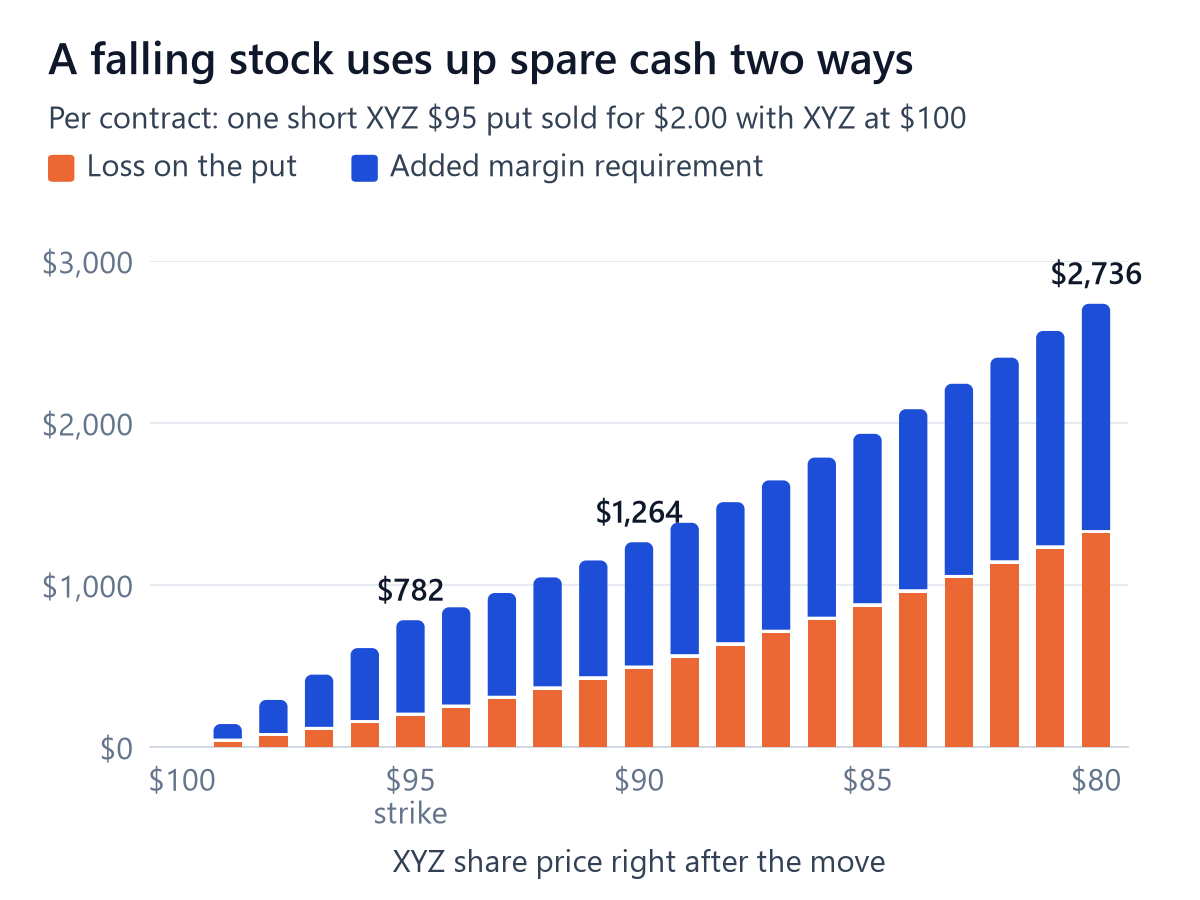
The chart shows why the first few dollars of a decline hit spare cash so hard. While the put is out of the money, each $1 drop in XYZ strips $100 of out-of-the-money credit from the calculation and trims the 20% charge by only $20, before counting the option's own gain in value. At $95 in this case, the loss is only $191, but the requirement has already risen $591.
Volatility adds a second squeeze. The requirement includes 100% of the option's current value, so when implied volatility rises and the put gets more expensive, every dollar of added premium is a dollar of loss and a dollar of added requirement at once. For example, if implied volatility rose from about 30% to 40% with XYZ still at $100, the put would be worth about $3.32, and the $132 loss would arrive with a $132 higher requirement.
A dollar of loss on a short option can use up two dollars of spare cash: one to absorb the loss and one to meet the higher requirement.
Paying for Assignment and Exercise
The mechanism: an option that is exercised or assigned stops being an option and becomes a stock trade, and a stock trade has to be paid for with cash or margin.
A short put that's assigned obligates the account to buy 100 shares per contract at the strike, and a short American-style option can be assigned on any day the equity markets are open, for as long as the position stays open. A cash-secured put has its collateral waiting. A put sold on margin doesn't: the $1,700 requirement from the example above covers only a fraction of the $9,500 purchase that assignment would trigger.
Suppose that put finishes in the money at expiration with XYZ at $90 and is assigned. The account pays $9,500 for shares worth $9,000. For a stock purchase in a margin account, Regulation T sets initial margin at 50%, so in this case the account needs $4,750 of equity behind the new shares on the day of assignment, more than twice the $2,300 the short put required on its final day.
Long options create the mirror-image demand. An equity option that finishes in the money by $0.01 or more is exercised automatically unless the holder instructs otherwise, so a long call can become a purchase of 100 shares per contract that the account has to fund. What happens when the account can't is covered in what happens if you can't afford to exercise a call option.
Spreads aren't exempt. If the short leg of a credit spread is assigned early, the account holds the stock, or a short stock position for a call spread, alongside a long option that still caps the loss. For example, an XYZ $95/$90 bull put spread ties up at most the $500 difference between the strikes, but assignment on the $95 put means buying $9,500 of stock, and that position needs cash or margin until the shares are sold or delivered by exercising the $90 put.
Keeping Settled Cash on Hand
The mechanism: options settle one business day after the trade, and in a cash account a purchase has to be paid for in full before it's sold.
In a margin account, the broker's credit smooths over that one-day gap. In a cash account, there's no credit to lean on, so a trader who sells one position and immediately buys another is relying on money that hasn't settled yet.
Buying with unsettled proceeds is generally allowed. The trouble starts when the new position is sold before those proceeds settle, which FINRA describes as a good faith violation. Selling a security that was never paid for in full is freeriding, and Regulation T's cash account rule answers it by withdrawing the privilege of paying after the trade date for 90 calendar days, so every purchase in that window has to be covered by funds already in the account.
Suppose a trader closes a long call on Monday for $1,500 and uses the proceeds to buy a put the same morning. If the trader also sells that put on Monday afternoon, the put was bought and sold before the $1,500 settled on Tuesday. With $1,500 of settled cash in reserve, the same round trip would have been paid for outright.
Funding Exits and Repairs
The mechanism: closing or adjusting a short option costs cash, and it tends to cost the most when the position is under the most pressure.
Buying back a short option that has moved against the trader, or rolling it to a later expiration, can require a debit. In a fast market that debit is often larger than the last calm quote suggested, because option premiums rise with volatility and bid-ask spreads tend to widen. Without spare cash, funding the repair usually means depositing more money or closing something else first, which turns one decision into two and can force both at unfavorable quotes.
The Same Put in Two Accounts
The four jobs are easiest to see side by side. Suppose two traders each hold $20,000 in a margin account and sell the same XYZ $95 put for $2.00. Trader A sells 3 contracts, while Trader B sells 11, which ties up most of the account at entry. Then XYZ opens at $90 and implied volatility jumps to 45%, which lifts the put to about $8.66 in this case.
| Account Measure | Trader A: 3 Puts | Trader B: 11 Puts |
|---|---|---|
| Requirement at entry | $5,100 | $18,700 |
| Spare cash at entry | $14,900 | $1,300 |
| Loss after the move | $1,998 | $7,326 |
| Requirement after the move | $7,998 | $29,326 |
| Spare cash after the move | $10,004 | $16,652 deficit |
In this case, Trader A absorbed a 10% gap and a volatility jump and still has $10,004 of room to decide what to do next. Trader B's $16,652 deficit is larger than the account's remaining equity of $12,674, so the next decision may not be Trader B's to make. As the margin disclosure covered below makes clear, a firm in that position can sell without contacting the customer.
How Cash Reserves Differ From Buying Power
The distinction: buying power is a ceiling the broker calculates at current market values, while a reserve is a floor the trader sets against moves that haven't happened yet.
Buying power, often shown as option buying power, is the broker's estimate of how much more the account can open right now. It already nets out committed cash and current requirements, so on a calm day it can look like the same number as the reserve. They part ways on four points:
- Who sets it: the broker calculates buying power from margin rules and house requirements, while the trader sets the reserve before opening the next position.
- What it's measured against: buying power uses current market values, while a reserve is sized against a stress scenario the account has to survive.
- What a sharp move does: buying power shrinks, often faster than the loss grows, while the reserve gets spent absorbing that same increase.
- What zero means: zero buying power blocks new positions and can come just before a deficit, while a zero reserve means the next surprise lands on positions already open.
The practical consequence is that an account using all of its buying power has little or no reserve, so an adverse move against its short options can quickly produce a deficit. Many broker screens show that deficit as negative buying power, and it's the condition that can lead to a margin call or a forced sale.
Buying power measures what the broker will let you open at today's prices. A reserve measures how much can go wrong before the broker decides for you.
Broker platforms label these figures differently, and a few terms come up constantly:
- Excess liquidity or maintenance excess: equity above the maintenance requirement, the closest live reading of the reserve in a margin account.
- Buying power reduction: how much a new position would tie up if it were opened.
- Net liquidation value: what the account would be worth if every position closed at current marks.
- House requirement: a broker's own minimum, which can sit above the FINRA requirement.
How to Size a Cash Reserve With a Stress Test
No rule sets a reserve level, and rules of thumb that hold back a fixed percentage of the account have a common flaw: the same percentage protects very different books. A reserve sized to the positions' own worst plausible demands is more defensible, and building one takes five steps:
- List every obligation. For each short option, note today's requirement and the stock trade that assignment would create.
- Pick a stress move. Choose an overnight gap and a volatility jump the account should survive without forced action, such as the 10% gap above.
- Reprice the requirements. Recalculate each requirement at the stressed values, using the broker's risk or what-if tool where it has one, and add the losses.
- Add the largest likely assignment. Most assignments arrive at or near expiration, but a short option deep in the money can be assigned earlier, so include the extra cash or margin the largest one would need beyond the requirement already counted.
- Leave room for house changes. Brokers can raise house requirements without advance written notice, so hold a buffer above the calculated total.
For example, the two-account comparison shows Trader A's three puts using $4,896 of spare cash in one gap and volatility jump: $1,998 of loss plus $2,898 of added requirement. That figure belongs to those positions. Add a fourth contract or a second short put on a related stock, and the number changes with them, which a fixed percentage can't do.
Sizing the reserve is a different question from how much of a portfolio belongs in options at all, covered in portfolio allocation for options trading, and from how many contracts one trade should carry. The reserve answers a narrower question: how much can go wrong in the positions already open before someone else starts managing them.
Why Cash Reserves Matter to Options Traders
The first reason is control. The margin disclosure statement that FINRA Rule 2264 requires firms to give customers reads like a list of what a reserve guards against: the firm can force the sale of securities in the account, can sell them without contacting the customer, doesn't have to let the customer choose which ones go, and can raise its house maintenance requirements at any time without advance written notice. A reserve doesn't remove those rights. It makes them less likely to be used.
The second is timing. Forced sales tend to come right after requirements jump, which usually means the market has just moved sharply and option quotes are wide. A liquidation turns a paper loss into a realized one at those quotes and removes any chance for the position to recover.
The third is judgment. A trader with spare cash can close, roll or hold a position on its merits. A trader without it has to fund one problem by closing another, which is how a manageable loss in one position can become an unwind of the whole account.
Edge Cases and Gotchas
Several situations break the simple picture of a reserve as cash sitting in the account:
- Portfolio margin works from a stress test. Under portfolio margin, Rule 4210 sets the requirement from the largest theoretical loss across ten price points, plus or minus 15% for an individual stock, rather than from a fixed formula. Because those points are priced off current option values, a volatility spike can raise the requirement on some positions and lower it on others, while any rise in the options' value still comes straight out of equity.
- Margin accounts are measured during the day. Since June 4, 2026, Rule 4210 has replaced the pattern day trader requirements with intraday margin standards for margin accounts, and FINRA's guide to the new intraday margin requirements explains that an intraday margin deficit has to be satisfied as promptly as possible. FINRA gave firms until October 20, 2027 to phase the change in, so the switch can land at different times at different brokers.
- Swept cash isn't protected the same way everywhere. Brokers often sweep uninvested cash into a bank deposit program or a money market fund, and an SEC release on the customer protection rule spells out the difference: fund shares are securities protected under SIPA if the broker fails but can lose value, while bank deposits carry FDIC protection if the bank fails. Neither covers a loss on the positions the cash was meant to support, a distinction covered further in what happens to your options if your brokerage firm fails.
Frequently Asked Questions
These answers cover the questions traders ask once they start measuring spare cash: how much to hold, what counts toward it, and why a broker's screen can show negative buying power.