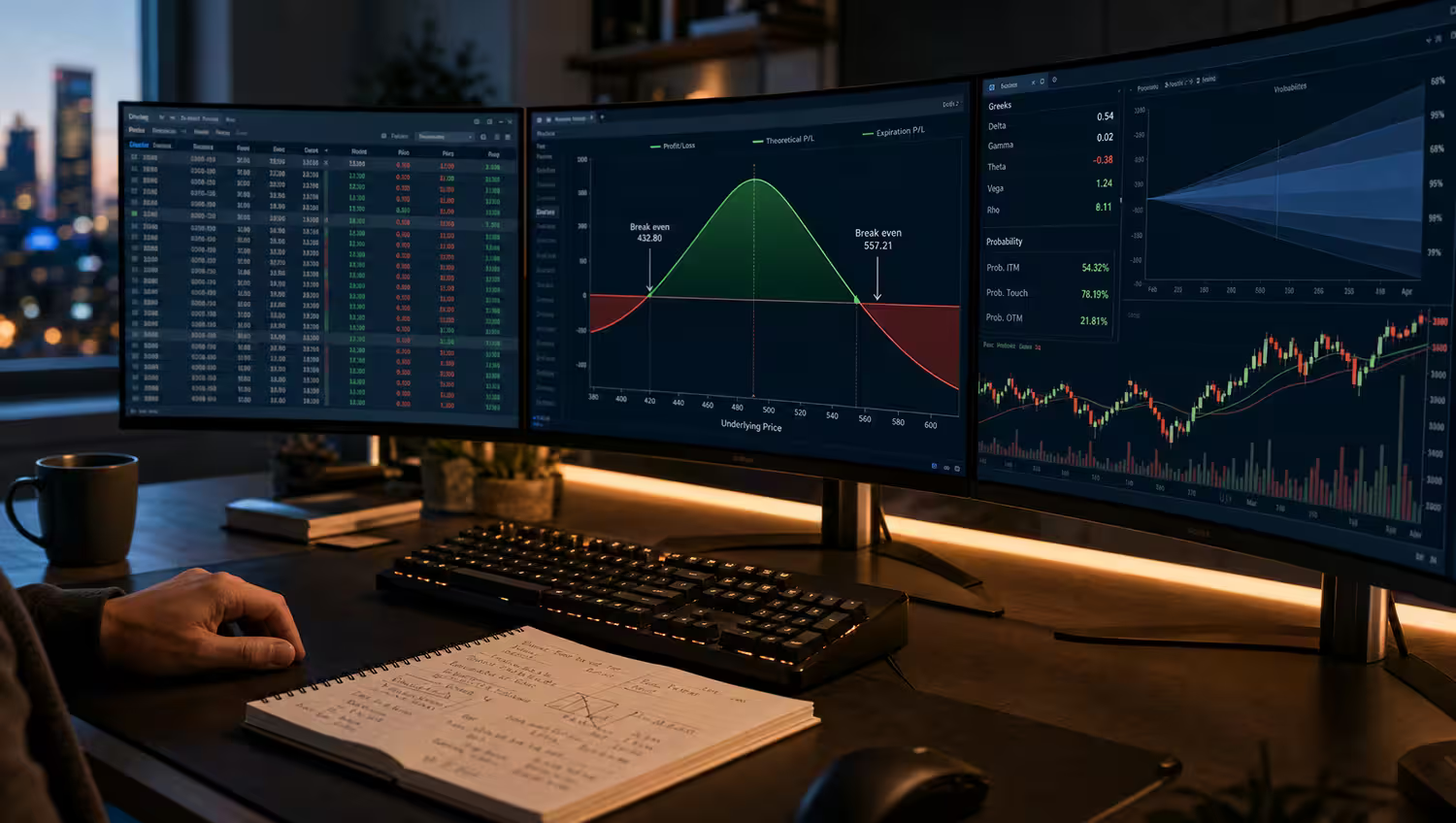

Earnings season can be overwhelming for options traders. With hundreds of companies reporting in a single week, finding the right setups manually is nearly impossible. Learning how to use AI to scan earnings trades faster is a game-changer for anyone who wants to stay ahead of the curve.
When you AI scan earnings trades using modern screening tools, you can filter through thousands of options chains in seconds. Instead of guessing which stocks offer the best risk-reward, these platforms highlight the exact setups that match your strategy.
Key Takeaways
- Speed is Everything: AI scanners can process thousands of earnings reports and options chains in seconds, a task that would take a human trader hours.
- Data-Driven Decisions: AI tools compare current implied volatility against historical actual moves to find mispriced options.
- Strategy Matching: You can program AI to find specific setups, like high-probability credit spreads or undervalued long straddles.
- Risk Management: Advanced scanners automatically calculate risk-reward ratios and suggest position sizing based on your portfolio.
- Post-Earnings Analysis: AI isn’t just for entering trades; it can also help you analyze post-earnings price action for continuation plays.
Why Manual Scanning Fails During Earnings Season
During peak earnings season, it is not uncommon for over 500 publicly traded companies to release their quarterly reports in a single week. For an options trader, this presents a massive opportunity, but also a logistical nightmare.
Manually scanning for earnings trades involves looking up the reporting date, checking the current implied volatility, reviewing historical price moves, and analyzing the options chain for liquidity and pricing. Doing this for just one stock can take 10 to 15 minutes. Doing it for 500 stocks is physically impossible.
Furthermore, the options market moves fast. By the time you manually identify a great setup, the pricing may have already changed, eliminating your edge. Manual scanning often leads to analysis paralysis, where traders miss the best opportunities because they are bogged down in spreadsheets and charts.
⚠️ Risk Warning
Trading options around earnings events carries significant risk due to unpredictable price gaps and rapid implied volatility crush. Never risk more than you can afford to lose on a single binary event.
How AI Changes the Game for Options Traders
Artificial intelligence and machine learning algorithms are uniquely suited for the data-heavy environment of options trading. AI in finance has evolved rapidly, and retail traders now have access to tools that were once reserved for institutional desks.
An AI-powered options scanner can ingest real-time market data, historical earnings reactions, and complex options pricing models simultaneously. It can then filter this massive dataset based on your specific criteria, presenting you with a curated list of actionable trade ideas.
This technology doesn’t just save time; it removes human emotion and cognitive bias from the screening process. An AI scanner doesn’t care if a stock is popular on social media; it only cares if the math supports a profitable trade.
Key Metrics to Scan For Using AI
When you set up an AI scanner for earnings trades, you need to tell it what to look for. Here are the most critical metrics to include in your scan parameters.
Implied Volatility Rank (IVR) and Percentile (IVP)
Earnings events naturally inflate implied volatility. However, not all elevated IV is created equal. You want to find stocks where the current IV is exceptionally high relative to its own history.
AI scanners can instantly calculate IV Rank and IV Percentile across the entire market. You can set a rule to only show stocks with an IVR above 70%, ensuring you are only looking at options that have a high probability of experiencing significant IV crush after the report.
Historical Expected Move vs. Actual Move
This is perhaps the most powerful use of AI in earnings trading. The options market prices in an “expected move” for every earnings event. AI can look back at the last 10 or 20 earnings reports for a company and compare the market’s expected move to the actual price move that occurred.
If an AI scanner finds a stock where the options market consistently overprices the expected move (e.g., the market prices in a 10% move, but the stock historically only moves 4%), that stock is a prime candidate for premium-selling strategies like iron condors or short strangles.
Liquidity and Bid-Ask Spreads
A great setup is useless if you can’t get filled at a fair price. AI scanners can filter out options chains with low open interest, low volume, or wide bid-ask spreads. You can program the scanner to only show trades where the bid-ask spread is less than $0.10, ensuring efficient entry and exit.
Setting Up Your AI Screener for Specific Strategies
The beauty of AI scanning is its flexibility. You can tailor the scan to fit your preferred trading style. Here is how to set up scans for two popular earnings strategies.
Scanning for Iron Condors (Premium Selling)
Iron condors profit when a stock stays within a defined range and implied volatility drops. To find the best iron condor candidates, set your AI scanner to look for:
- IV Rank: Greater than 75%
- Historical Move: Actual historical moves are consistently less than the expected move
- Liquidity: Minimum open interest of 1,000 contracts on the near-the-money strikes
- Stock Price: Greater than $50 (to ensure sufficient premium)
Scanning for Directional Debit Spreads
If you have a directional bias and want to use debit spreads, you need to find situations where options are relatively cheap, or where the historical move often exceeds the expected move. Set your AI scanner for:
- IV Rank: Less than 50% (to avoid overpaying for options)
- Historical Move: Actual historical moves frequently exceed the expected move
- Trend Alignment: The stock is in a strong, defined trend (e.g., trading above its 50-day moving average)
Feature | Manual Scanning | AI-Powered Scanning |
|---|---|---|
Speed | 10-15 minutes per stock | Seconds for the entire market |
Historical Analysis | Requires tedious spreadsheet work | Instant, automated comparisons |
Emotion | Prone to bias and fatigue | 100% objective and data-driven |
Scalability | Limited by human capacity | Unlimited; can track thousands of tickers |
Post-Earnings Analysis with AI
The utility of AI doesn’t stop once the earnings report is released. Many traders prefer to avoid the binary risk of the earnings event itself and instead trade the post-earnings reaction. This is often referred to as a “post-earnings announcement drift” (PEAD) strategy.
AI scanners can be configured to alert you the morning after an earnings report if a stock meets specific criteria. For example, you can scan for stocks that gapped up more than 5% on heavy volume and are holding their gains in the first hour of trading. This can highlight excellent opportunities for continuation trades using short-term options.
Integrating AI Into Your Trading Routine
Adopting AI scanning tools requires a shift in your daily workflow. Instead of spending hours hunting for trades, your time is shifted toward analyzing the curated list of setups the AI provides.
A structured trading routine incorporating AI might look like this:
- Weekend Prep: Run a broad AI scan to identify all companies reporting in the upcoming week that meet your baseline liquidity and price criteria.
- Daily Scan: Each morning, run a targeted scan for the companies reporting after the close that day or before the open the next day. Filter for IV Rank and historical expected move discrepancies.
- Trade Selection: Review the top 3 to 5 candidates the AI generated. Perform your own manual chart analysis and confirm the options pricing.
- Execution and Sizing: Determine your position sizing based on your portfolio rules and execute the trades.
Key Takeaway
Never blindly follow an AI scanner. The AI is a tool to find the setups, but you must still apply your own risk management rules and market context before executing the trade.
Frequently Asked Questions
Traders often have questions about transitioning from manual analysis to AI-assisted scanning. Here are some of the most common inquiries.
Do I need to know how to code to use an AI options scanner?
No. Modern AI options scanners feature user-friendly, drag-and-drop interfaces. You simply select the metrics you want to filter for (like IV Rank > 50%), and the software handles the complex algorithms behind the scenes.
Are AI options scanners expensive?
Prices vary widely. Some basic scanners are included free with advanced brokerage accounts, while dedicated, professional-grade AI platforms can cost anywhere from $50 to several hundred dollars per month. The cost is often justified by the time saved and the quality of setups found.
Can AI predict earnings results?
Absolutely not. No AI can predict what a company’s earnings numbers will be or how the market will react. AI is used to analyze data, find statistical anomalies, and identify options that are mispriced relative to historical norms.
Does using AI guarantee profitable earnings trades?
No tool can guarantee profits. AI gives you a statistical edge by finding high-probability setups faster, but you still face market risk, execution risk, and the inherent unpredictability of earnings events. Proper risk management is always required.
Final Quick Thoughts
Using AI to scan for earnings trades gives you a massive speed and data processing advantage. By automating the tedious work of crunching IV ranks, expected moves, and historical data, you can focus your energy on trade execution, strategy refinement, and risk management.
As the options market becomes increasingly sophisticated, traders who leverage AI tools will have a distinct edge over those who rely solely on manual analysis. Remember to log all your AI-assisted trades in your options trading journal to see which setups actually perform best over time, allowing you to continually refine your scanning parameters.