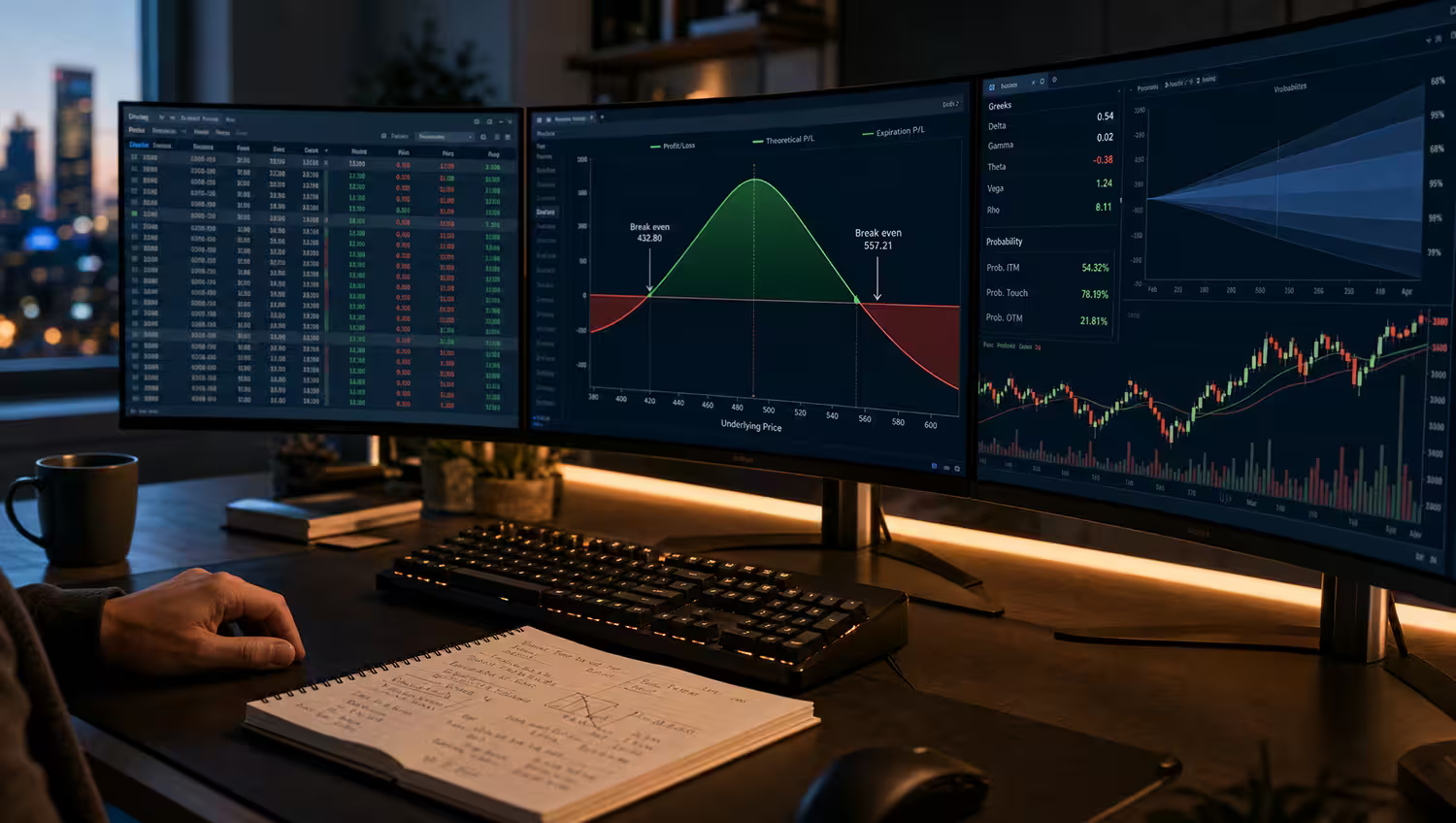

A trading assistant that summarizes news, drafts a checklist, or explains an options spread is one thing. A software agent that has permission to send an options order is a very different thing. The first helps with thinking; the second touches trade authorization, account controls, broker rules, and real money.
That is why the agentic AI question should not start with whether a bot sounds smart enough. The harder question is who authorizes the order, what the bot is allowed to do, what it is forbidden to do, how errors are stopped, and whether the trader understands the option contract before automation enters the workflow.
As of June 3, 2026, official investor-protection sources are still telling readers to be skeptical of AI trading-bot claims, especially claims tied to easy profits, secret signals, or hands-off auto-trading. Options add another layer because order type, expiration, margin, bid-ask spread, gamma, and broker permissions can change the outcome quickly.
Agentic AI Is Not The Same As Permission To Trade
Agentic AI usually refers to software that can take multi-step actions toward a goal. In a trading workflow, that might mean reading research, checking a calendar, building a watchlist, drafting an order ticket, or asking for approval after a set of rules is satisfied.
Permission to trade is different. A live options order requires account access, broker approval, a specific order ticket, and a clear instruction to buy, sell, open, close, route, cancel, or replace an order. The trader should know exactly where the software stops and where the human decision begins.
That boundary belongs near the top of any AI trading review. A useful AI trading workflow can make a trader more organized. A weak automation workflow can make a bad instruction faster, larger, and harder to catch.
Quick Takeaways
- Agentic AI can support options research, but placing trades introduces a higher-risk authorization problem.
- AI bots should not be treated as prediction engines or guaranteed-return systems.
- Options automation needs strict limits around strategy type, order size, expiration, margin, and maximum loss.
- Order tickets, bid-ask spreads, and broker permissions matter as much as the AI output.
- Regulators and investor-protection groups have warned readers about AI trading-bot and auto-trading claims.
- The safest starting point is human-approved decision support, not unattended live execution.
Three Levels Of AI Trading Autonomy
The useful distinction is not AI versus no AI. It is how much authority the software has. The more authority it gets, the stronger the controls need to be.
Autonomy Level | What The AI Might Do | Control That Should Be Visible |
|---|---|---|
Research assistant | Summarize earnings notes, explain a strategy, list risks, or create a checklist. | Human reviews sources, option-chain data, assumptions, and final decision. |
Order-ticket assistant | Draft a possible spread, strike, expiration, limit price, or exit rule for review. | Human confirms every field and reviews options order types before sending anything. |
Conditional automation | Alert, stage, cancel, or route an order only inside predefined limits. | Strict permissions, max size, position limits, logs, alerts, and a kill switch. |
Unattended execution | Place options trades without fresh human approval. | Highest-risk path; most retail traders should be extremely cautious before allowing this. |
Why Options Make Bot Trading Harder
A stock order is already serious. An options order can be more fragile because the contract contains extra moving parts. The bot has to understand whether the trade opens or closes a position, whether the strategy is single-leg or multi-leg, whether the expiration is near, whether the contract is liquid, and whether the account is approved for that strategy.
The order ticket matters. A market order can cross a wide spread. A limit order can sit unfilled. A spread order can be entered with the wrong debit, credit, strike, expiration, or open-close instruction. Automation does not remove those risks; it can simply make them happen faster.
Margin and buying power also matter. A bot that misunderstands margin, cash availability, assignment exposure, or broker strategy approval can create account-level problems that the trader did not intend. Broker controls and permissions are not paperwork. They are part of the risk system.
Short-dated options add speed. A 0DTE or weekly contract can change rapidly as price moves and time runs out. High gamma risk can make small underlying moves matter more, especially if the bot is reacting to a noisy signal, stale quote, or incomplete catalyst summary.
Where AI Trading Bots Can Go Wrong
- The bot treats a fluent market summary as a trade signal.
- The order uses the wrong open-close action, expiration, strike, or spread direction.
- The strategy requires options approval, margin, or permissions the trader has not reviewed.
- The bot crosses a wide bid-ask spread or chases a midpoint that is not realistically fillable.
- The system sizes a trade from confidence language instead of defined risk.
- A scammer uses AI branding, fake performance, or auto-trading promises to collect deposits or account access.
- The trader cannot review logs, override the bot, or shut automation off quickly.
The Options-Specific Risk Map
A high-quality automation review should turn the bot’s proposed action into separate risk checks. If any layer is unclear, the order should not be automated.
Layer | Question Before Automation | Why It Matters |
|---|---|---|
Contract layer | Is the bot using the correct underlying, strike, expiration, and open-close instruction? | A small field error can create a different position from the one intended. |
Pricing layer | Does the limit price account for the bid-ask spread and realistic liquidity? | Screen prices can look cleaner than the actual fill. |
Risk layer | Is maximum loss, assignment exposure, margin, and position size defined? | Automation should not rely on vague confidence scores. |
Speed layer | Does the contract have short-dated gamma or event risk that can change in minutes? | Fast contracts can punish slow review and stale inputs. |
Control layer | Can the human pause, cancel, audit, and override the system immediately? | A kill switch matters when the software or data feed is wrong. |
A Simple Bot-Trade Scenario
Imagine a stock is trading near $100 after a product announcement. An AI agent drafts a same-week $105/$110 call spread: buy the $105 call for $3.20, sell the $110 call for $1.35, and enter a $1.85 net debit. The ticket looks defined because the maximum risk is $185 per spread before commissions and fees.
The bot’s summary is still incomplete. The breakeven is $106.85, the stock has to move far enough before expiration, and both legs need realistic liquidity. If the $105 call is $3.00 bid and $3.40 ask while the $110 call is $1.15 bid and $1.55 ask, a market order can pay far more than the neat $1.85 estimate.
The safest version of this workflow is not the bot placing the order on its own. It is the bot producing a trade packet: thesis, source links, contract fields, maximum risk, order type, liquidity notes, margin impact, cancellation rule, and what would make the idea invalid. Then the human decides whether to reject it, stage a limit order, or do nothing.
What Official Warnings Are Really Saying
The CFTC has warned investors not to assume AI trading bots can produce reliable profits. That warning matters because many bot pitches are framed around speed, secret models, or passive income rather than transparent risk controls.
FINRA, the SEC, and NASAA have also warned that AI language can be used in investment fraud. A reader should be cautious when a tool promises high returns, claims special access, hides who operates the service, or asks for account access before the risks are clear.
FINRA’s auto-trading material adds another useful lens: readers should understand who is behind an auto-trading service, whether the entity is registered where required, how the service handles orders, and what happens if the software, signal, or market condition changes.
For firms, FINRA’s GenAI notice emphasizes that existing obligations still matter when generative AI is used. For readers, the practical translation is simple: new software language does not erase supervision, suitability-style concerns, disclosure, recordkeeping, privacy, cybersecurity, or basic options risk review.
Before Letting Any Bot Near An Options Order
- Confirm whether the AI is only researching, drafting an order ticket, or allowed to send orders.
- Every order field is visible and confirmed before a live trade is placed.
- The workflow has maximum size, maximum loss, strategy, expiration, and account-permission limits.
- The bot cannot use market orders in contracts where spreads or liquidity are questionable.
- Review margin, buying power, assignment, and broker approval before automation is enabled.
- The system keeps logs showing source inputs, prompts, order fields, approvals, cancellations, and overrides.
- There is a clear kill switch that stops orders immediately.
- Check whether the provider, platform, or auto-trading service is legitimate and appropriately registered where required.
- Treat this as educational context, not personalized financial advice or a recommendation to automate trading.
How To Start Safely
The safest starting point is paper review. Let the AI draft a checklist or a hypothetical order ticket, then compare the output with the real broker platform without sending the order. This helps reveal whether the tool understands open-close actions, spreads, order types, and current contract data.
The next step, if a trader uses any automation at all, is human-confirmed staging. The software can prepare a ticket, but the human should review the contract, limit price, risk, account impact, and reason for the trade. Readers comparing active trader options platforms should look for controls, alerts, order previews, cancel workflows, and clear option-chain data.
Unattended execution should be treated as a separate risk category, not as the natural next feature. If the trader cannot explain the strategy, cannot audit the bot, or cannot stop it immediately, the workflow is not ready for live options orders.
FAQ
These questions focus on AI trading bots as an options workflow and risk-control issue, not as a recommendation to use automated trading.
Can AI legally place options trades for someone?
The practical answer depends on the broker platform, account permissions, service provider, regulatory status, and who authorizes the order. Readers should not connect a bot to an account unless they understand the service, permissions, registration status where relevant, and their own responsibility for orders.
Is agentic AI better than normal trading alerts?
Not automatically. An AI agent may take more steps than a simple alert, but more steps can mean more ways to be wrong. The value depends on source quality, controls, logs, human review, and whether the workflow reduces mistakes rather than hiding them.
What is the biggest options-specific risk?
The biggest risk is that the bot misunderstands the contract or acts too quickly. Wrong open-close instructions, wide spreads, short expirations, gamma exposure, margin impact, and event timing can all turn a plausible idea into the wrong order.
Should beginners use AI bots to trade options?
Beginners should be especially cautious. AI can help explain terms and create checklists, but beginners may not yet know when the answer is incomplete. Human-approved education and paper review are much safer starting points than live automation.
What should I verify before trusting any AI trading service?
Verify who operates it, what data it uses, whether it makes performance claims, how orders are authorized, whether the provider is registered where required, what fees apply, how account access is handled, and how quickly automation can be shut off.
The Real Question Is Control
Agentic AI may become more capable inside trading workflows. That does not make live options automation automatically safe. The important question is not whether the software can write a convincing plan. It is whether the trader can verify, limit, approve, audit, and stop the system before a bad instruction becomes a real order.
For most readers, the best near-term use is controlled decision support: better questions, cleaner trade notes, source checks, and order-review checklists. The moment a bot can place an options trade, the workflow needs stricter controls than the headline suggests.
Sources Used For Current Context
Current context was checked as of June 3, 2026 against the CFTC advisory on AI trading bots, Investor.gov’s alert on artificial intelligence fraud, FINRA’s investor alert on AI and investment fraud, FINRA’s warning on auto-trading services offered by unregistered entities, FINRA Regulatory Notice 24-09 on generative AI, and FINRA’s options education. Recheck tool claims, broker permissions, registration status, and live options examples during final editorial review.