
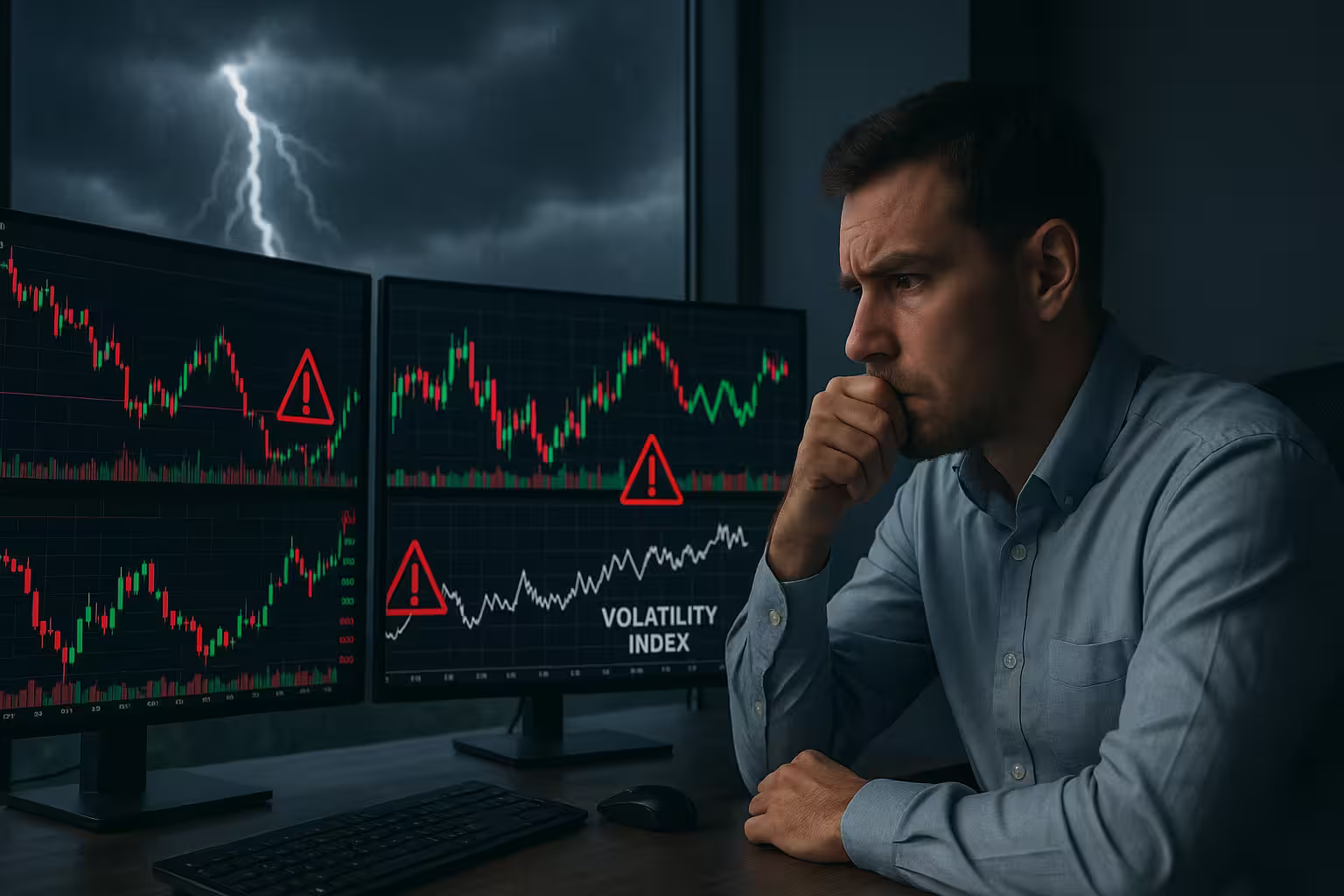
When trading online options, traders or investors mustn’t mistake low volatility for a safe trading environment. While traders love calm markets, that calm can be deadly. Low volatility doesn’t always equate to low risk. This guide will cover the most common psychological and strategic dangers of mistaking low volatility for safety, as well as ways to avoid getting caught up in a “volatility trap.”
Keep reading to learn how “quiet” markets trap traders with a false sense of security—and how to recognize the setup before it burns you. Once you begin to understand that not all calm trading conditions are as they seem on the surface, you can enter into specific options trading strategies with a broader and richer understanding of the volatility risks associated with these approaches.
What Is a Volatility Trap?
When it comes to investing and options trading, a volatility trap is a situation where traders react strongly to market volatility by selling off their positions. It’s a knee-jerk reaction to the market situation, and traders often end up missing out on future gains when the market returns to normal. The volatility trap is a result of emotional trading decisions driven by fear, and it can cause many investors to miss out on potential profits. You end up with lower overall returns if your reaction to unfavorable market conditions is to sell instead of riding out the rough patch.
To better understand the concept of volatility traps, we must first examine the conditions that can lull some traders into a false sense of security beforehand. Overconfidence sets in for many traders when there is low implied volatility and low historical volatility. That’s one example, but we’ll also dive into a few others:
- Low Volatility Being Misinterpreted: It can be easy to assume that the market won’t experience significant price swings when implied volatility (IV) is low, leading traders to believe they can predict future price movements relatively easily.
- Options Prices Can Be Misleading: Another mistake traders make that can lead to overconfidence is that they feel they’re getting a good deal on option prices when implied volatility (IV) is low because they believe the value will only increase. However, there’s the possibility that they could go down, a risk that some inexperienced traders don’t account for.
- Risk Tolerance: In this context, we refer to traders being overconfident in the amount of risk they are willing to take on, as it can become easy to overleverage in a low-IV market. A few other missteps that come with this overconfidence include taking on larger position sizes or trading more frequently.
The Psychology Behind the Illusion
Humans are naturally wired to seek predictability and avoid chaos, primarily as a survival instinct. Things that are predictable and that come with familiarity are the ones that offer humans the most safety and are ultimately the most resourceful or advantageous path.

You see these patterns play out with the decisions that people make when they’re investing or trading options online:
- Recency Bias: Traders tend to give more weight to recent information or experiences, which can lead them to ignore other relevant data points that offer equally valuable insights.
- Complacency: This feeling can settle in for traders who have experienced success and are overly optimistic about their abilities. It can lead to increased risk-taking, and some traders might even go against certain risk management practices because they’re so confident that they’ll continue to profit. There are other factors as well, such as choosing not to embrace continual learning or ignoring technical signals, which are hallmarks of complacency in online trading.
- Anchoring: This is a mistake where traders cling to a piece of information to guide their trading decisions, and it can become a problem if the information is outdated or irrelevant.
You can gain a good sense of when traders get caught in these traps by looking back at historical market moments. For instance, many traders became overconfident and lost a significant amount of money during the 2008 housing crash, as a period of relative calm preceded it from 2004 to 2007. The low-volatility environment of the housing market led to a sense of complacency, which contributed partly to the housing bubble driven by lax underwriting standards.
Real-World Setups That Trap Traders
What are a few of the trades that lull traders into this false sense of security before volatility rears its ugly head? We’ve outlined a few examples below of different strategies that might seem safe. Still, there are some considerable volatility concerns that traders should be aware of with these strategies in advance. You don’t want to be blindsided when volatility whips up and causes your trade to go south.
Iron Condors in Low Vol Environments
There are several aspects of the iron condor strategy that make it appealing to many traders, primarily its market-neutral nature, its high success rate compared to other methods, and the defined risk associated with the strategy. This is specifically within the context of a low-volatility environment.
- Market Neutral Move—The iron condor can profit so long as the stock price remains in between the strike prices. Investors don’t have to correctly predict the market direction to make money on an iron condor. It’s a decent way to make money when you’re expecting the markets to be sideways or have mixed prices.
- High Success Rate—Iron condors profit the trader when all four legs expire worthless, which means they are likely to generate a profit for the trader. The relative success of iron condors is due in part to its focus on specific price ranges, and, in most cases, the underlying asset remains within that range.
- Limited Maximum Loss—The loss on an iron condor doesn’t exceed the difference between the outer strike prices of the options and the premium received, which means that the strategy comes with a well-defined risk.
While the iron condor move may seem safe, it can quickly turn disastrous. There are several ways in which the iron condor strategy can go awry for a trader who is feeling overconfident about their choice of trading approach. The risks can whip up, especially when volatility spikes unexpectedly.
- Major Price Movements—If the price of the underlying moves aggressively beyond the strike prices of the iron condor setup, the loss can begin occurring because the strategy only profits when the prices stay within the pre-defined range.
- Spikes in Volatility—Sudden increases in implied volatility can result in the value of options going up. It can eventually lead to losses even if the price stays within the intended range of the iron condor’s initial setup.
- The Risk-Reward Ratio—Another weakness of the iron condor is the fact that you put more at risk with these kinds of traders for minimal gain. If the iron condor works, you end up making money, but if it doesn’t work, you end up losing more money than with other trades. For instance, an iron condor might have you risking $10 to make $4.
- Pin Risk—If the stock price moves unexpectedly in the money after the market closes on expiration day to a price close to the short strike price, the trader may be assigned the shares unexpectedly—this is known as pin risk. This tends to happen overnight when some traders are expecting it, which can result in some significant losses that weren’t foreseen.
- Over-Leveraging—Traders can amplify their losses by taking on a larger volume of contracts than is necessary as they seek higher profits.
- Liquidity Issues—Another simple risk that traders can encounter with their iron condors is that they may build it with some illiquid options in place, which can be difficult to sell quickly when the time comes. Iron condors should comprise options that can be exited promptly; otherwise, the trader may encounter scenarios where they lose money due to the inability to act swiftly.
Selling Naked Puts on Quiet Stocks
This is an options trading strategy that allows traders to generate income through premiums. Quiet stocks are those with low volatility. The prices don’t move as drastically as they do with other stocks. The reason that traders like to sell naked puts on these types of stocks is because they have a more predictable profit potential—the option seller is far less likely to be forced to buy the stock when they sell naked puts on quiet stocks.
Despite the fact that this strategy can help traders generate profits, there is a significant risk of being lulled into shorting volatility right before a surprise event, such as unexpected earnings announcements or key geopolitical events that create market volatility. These kinds of events can be detrimental to those selling naked puts—the chances of the options expiring in the money and being assigned increase significantly during these times.
VIX Complacency
Another major mistake that traders can make is interpreting low VIX as a guarantee of a stable market. This is a common misinterpretation because low VIX can sometimes be a sign of market complacency. It can be a signal that investors or traders are overly confident, and they might not be prepared for a potential market downturn.
Low VIX readings can also indicate underlying risks or market imbalances. It’s worth noting that sharp market corrections typically follow many historical VIX lows in the market. This means that traders or investors should use VIX readings as one indicator among others, rather than relying solely on it to gauge market risk.
“The Drift” Trap
It can become easy for traders to become comfortable with stocks and other underlying assets that are experiencing a slow upward market drift (which is extremely common during bull runs). It’s referred to as the “drift trap” because sharp reversions can catch unhedged traders off guard. While it is an excellent way for traders to make money over a longer time horizon, market volatility can undo much of the progress that traders make, especially in cases where they haven’t diversified their investments or implemented effective risk management techniques.
Signs You’re in a Volatility Trap
Do you suspect you may be in a volatility trap, but you want to know for sure? Keep reading, and we’ll go through the top signs of being in one of these traps. The sooner you know, the sooner you can begin dealing with getting out!

- IV is Unusually Low Relative to Historical Volatility—This relationship can indicate that the market expects less movement than past price behaviors. This situation can lead to options being mispriced. Not only that, but the prices don’t reflect or account for possible price fluctuations.
- Your Strategy Feels “Too Easy” or “Free Money”—Another good sign of being in a volatility trap is that your trade feels like too much of a sure thing. This is why traders need to learn as much as possible about the strategies they use, because each one comes with both advantages and disadvantages. A strategy that appears to generate a profit with minimal downside risk may still be susceptible to volatility risks.
- You’ve Stopped Checking Macro Risks or Event Calendars—Volatility risks can sneak up on traders who aren’t looking at the broader market risks or significant events that could impact the prices of the underlying assets they’re trading. You could fall into one of these volatility traps when you aren’t keeping an eye on events like geopolitical events that could have an impact on the businesses you’re trading options with, or planned events like earnings announcements.
- Position Sizing Has Increased without Reassessing Risk—Traders who increase the size of their positions without reassessing the risks could stand to lose additional money if unexpected market volatility sets in. It’s never a great idea to up the amount of risk you’re staking on each position without consulting additional technical indicators or looking at the broader market conditions.
- Most of Your Trades Are Premium-Selling Strategies With No Hedges—having no hedges in place can quickly undo any of the progress you make with strategies where you’re collecting premiums from selling calls or put options. Unexpected market volatility can cause traders to lose money when they don’t have a corresponding position in place to offset potential losses.
How to Protect Yourself
Check out some of the practical and actionable tips you can start taking to protect yourself and your investments against possible volatility traps. We’ve included some tricks and helpful hints that any trader can use to ensure that they don’t succumb to the negative impacts that volatility traps can wreak on their trading plan.
- Use Multi-Timeframe Volatility Analysis—To guard yourself against volatility traps; it’s essential to conduct sound volatility analysis that utilizes technical indicators covering various timeframes. This includes checking indicators such as IV Rank, HV comparisons, and Average True Range (ATR).
- Diversify Across Volatility Regimes—It’s key for traders and investors to not just focus on low IV setups. They should be taking on additional trades in higher-volatility environments, using trading strategies that generate profits when volatility is higher. This provides traders with a more diversified portfolio of investments that capitalize on all market conditions, not just low-risk ones.
- Hedge Premium-Selling Strategies—This one goes hand in hand with our last point. When traders focus too much of their efforts on a particular kind of trade, in this case, those that focus on collecting premiums like long puts and VIX calls, they can miss out on other opportunities with alternative strategies that could add to their overall bottom line.
- Implement Stop-Losses Based on Price Action—To avoid getting caught in a volatility trap, traders should place stop-loss orders based on current market prices and their personal risk tolerance. The stop-losses should be based solely on the Greeks, but they should also take the trader’s personal budget parameters into account.
- Stay Informed on Macro Events—Even in “calm” markets, traders should stay informed about the broader market context, including geopolitical events that could impact their investments, as well as predictable calendar events such as planned product rollouts or earnings reports.
Advanced Tools to Help Spot Volatility Traps
Now, let’s look over a few of the tools that traders can use to spot volatility traps from a mile away. Using any of these three tools could be the difference between avoiding volatility traps and falling victim to their adverse effects.

- IV Skew Analysis Tools—Traders can use these to identify and measure asymmetry in data distributions. You can help them understand the shape of data (as well as its distribution) to determine how IV might have an impact on future price movements. A few good examples of these graphical representations include histograms and box plots.
- VIX Futures Term Structure Trackers—Traders use this tool to understand and possibly take advantage of VIX futures with different expiration dates. This tool can be used to reflect the market expectations about future volatility by analyzing the shape of the VIX futures curve.
- Options Backtesting Platforms—Simulate or analyze the performance of your trading strategy by using historical market data as a basis. Backtesting platforms can be used as a way to test strategies without risking your own capital. It’s an excellent way for traders to assess their overall risks and to determine how effective or profitable specific techniques might be.
The Calm Before the Storm—Calm Isn’t Safe
When trading options or investing online, it’s crucial not to fall into volatility traps, as many new and experienced traders do. The key is to “read between the quiet line” to determine if the calm conditions are a green light for increased risk-taking or if there’s something beneath the surface that calls for an approach where you proceed with caution. Sometimes, safety is the most dangerous bet, and it’s essential to know the downsides of any strategy you use to know which are more susceptible to volatility risks.
Key Takeaways
- Low volatility can be a trap, not a sign of safety.
- Be wary of overconfidence in slow-moving markets.
- Use data, not assumptions, to assess actual risk.
- Recognize the illusion before it costs you real money.