Did you know that a single economic report can cause option prices to swing wildly in a matter of minutes?
If you’ve been trading options online for a while, this should come as no surprise whatsoever, but it’s a truth that can blindside newer traders who haven’t experienced much of this phenomenon. Economic reports can significantly impact option prices, and any kind of trader needs to be aware of these effects on the broader market conditions and the price of options contracts.
Economic reports are powerful tools for timing options trades, but understanding how to interpret and react to them is crucial. Our guide will outline how to successfully trade options around economic reports. Certain strategies and techniques work well going into the uncertainties of how the report will be received by the general public, and others work much better coming out the other side when the picture of what’s going on becomes more clear.
A Word to Newer Options TradersIf you’re new to options trading or if you have some experience but would still consider yourself to be a beginner, we’d like to emphasize that options trading has the potential for both profit and risk. You’re betting on where the options prices are going, so there are ways to make money even if the market is trending downward. Trading around economic reports is a prime example of how trading options work, so we hope to give you beginners some better insights into how it works and how it’s completely different from trading stocks.
Understanding Economic Reports
The first thing we’d like to address about using economic reports to correctly time your options trades is what they are exactly and how they can significantly impact the broader market. We’ll also touch briefly on “market moving events” and how these can present some timely opportunities for traders to profit both before and after the event. Understanding economic reports and their effects can deliver some great insight as to which options trading moves are best to use in these circumstances and scenarios.
What Are Economic Reports?
These are published documents that provide traders with information about the economy. Many economic reports are centered around current policy issues, and they include a ton of original research to give traders a good idea of the current state of the economy. There are a few examples that we could point to of economic reports, including the one released by the Federal Trade Commission (this one deals with antitrust and consumer protection) and the President’s Economic Report, which is more focused on economic progress for the country in question.
When traders pore over an economic report, they will find several economic indicators that are used to paint a complete and accurate picture of the economy’s current state:
- Inflation: A key indicator of economic health, inflation represents the rate of increase over time for goods and services.
- Unemployment: These figures represent the percentage of people not employed in the economy, as well as the number of people employed. Unemployment stats are another indicator of the health of an economy, giving traders a good idea of when there’s growth or contraction.
- GDP Growth: An indicator of economic growth for a country, gross domestic product numbers (GDP) are the total value of all goods and services produced in an economy.
In addition to the Economic Report of the President and the Federal Trade Commission’s Economic Report, it’s worth mentioning several other key reports that run through the details of the current economic state, including the following:
- Non-Farm Payrolls: The number of paid jobs in the United States, which excludes military personnel, farm workers, and other groups. It mainly focuses on jobs in government agencies, construction, manufacturing, and goods companies.
- Consumer Price Index (CPI): A measure of how much prices have changed for a representative group of goods and services over time. CPI comes with baskets of goods and services from one month to the next, using items like housing, food, medical care, transportation, and others.
- Federal Reserve Statements: These include the Summary of Economic Projections, the weekly Condition Statement of Federal Reserve Banks, and statements written following meetings of the Federal Open Market Committee.
The Impact of Reports on the Market
Market expectations can impact options pricing in a significant way when traders are expecting large price swings in the underlying asset. When traders sense that implied volatility is going to increase, they bid up the price of options, which can lead to significant price movements. This can be a common occurrence around events like earnings reports or other significant economic news.

Report data is another factor that can greatly impact options pricing, including things like corporate earnings reports. Report data can impact the underlying stock price, which can lead to significant IV (implied volatility) swings. The result is that the price of options contracts gets affected. You see this strongly when there’s a disconnect between the traders’ expectations and the market perception of the company’s performance.
Market Moving Events
Another key concept to understanding the impact of report data and market expectations on the broader market is what’s known as “market-moving events.” These are occurrences that can have a significant impact on the trajectory of the market and impact the price of financial assets. Market-moving events could be corporate actions, economic data releases, or geopolitical events.
A good example of a market-moving event would be something like a drought in the Midwest affecting the production of corn or soybeans, which would lead to rising prices based on fear around scarcity or limited supply in the future.
Online options traders can use economic calendars to track market-moving events by date and time. Plus, they can be organized by country and region to keep everything well-organized. A few other metrics that traders can track are the expected value and the previous data value.
Volatility and Options Pricing
There is a direct relationship between volatility and options pricing. When volatility increases, the price of options contracts also increases. The reason that options’ premiums rise when volatility is higher is because there’s a higher level of uncertainty in the markets and in the underlying asset’s future price movement.
How Economic Reports Can Increase or Decrease Volatility
Economic reports can increase volatility in a considerable way, especially when they are not in alignment with market expectations. This can cause traders to react strongly by either quickly buying up or selling off assets, depending on the current news and how they see the future of the market going. The result is larger price swings.
On the other hand, economic reports that fall in line with the market’s expectations can put a lot of fear or uncertainties to rest, which results in volatility going down and ultimately resulting in greater confidence amongst traders as well as better market stability.
Strategies for Using Economic Reports
To trade options dynamically and successfully using economic reports as a point of reference, traders should know which moves are best before and after the release of a report like the Consumer Price Index or the Federal Reserve Statements. Keep reading to learn about the prep work that goes into trading before a report release, as well as the best techniques for trading around the typical uncertainty before the report is shown to the public. And learn how to trade well, coming out on the other end of the release.
Trading Before a Report Release
The main idea before a report is released is for the trader to capitalize on increased volatility going into a major announcement. It can be a risky strategy because of the uncertainty of the stock’s reaction and the resulting inflated option premiums. However, we’ve outlined some of the best trading moves below if you’re interested in taking on these profit scenarios.
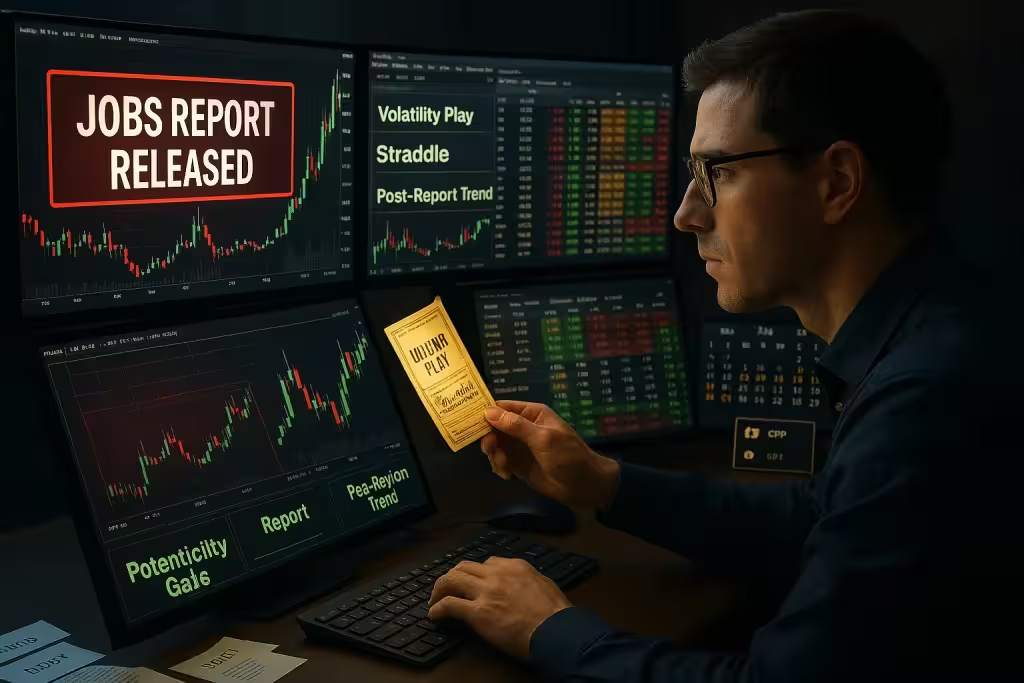
- Volatility Trading: This form of trading refers to buying options (especially straddles or strangles) ahead of a high-impact report to profit from increased volatility regardless of the direction of the market move.
- Directional Trading: This strategy involves buying or selling assets based on anticipation of the price increasing or decreasing. Traders expecting the market to rise usually take a long position, while traders expecting a decline would take a short position.
- Bullish Bets: Bullish bets are a form of directional trading. If the trader is expecting a positive report, they should consider buying call options or selling puts.
- Bearish Bets: Bearish bets are another form of directional trading. If traders are anticipating a negative report, it might be a good idea for them to buy put options or sell calls.
Trading After a Report Release
Typically, you’ll find there to be volatility following the initial release of an economic report, and good traders will take on positions that take advantage of that volatility. In essence, traders can use these as opportunities to profit from predicting how the market is going to react. To pull these moves off with success, traders must keep a close eye on economic calendars.
- Identifying Significant Market Reactions: Pinpointing significant market reactions can be the trader’s key to successfully dealing with the events following the release of an economic report. The main thing to look for is significant price increases followed by high trading volume, which can be detected using factors like trading volume and overall market analysis.
- Reacting to Unexpected Results: Once traders can identify significant market reactions, they can learn how to deal with the unexpected results of an economic report by adjusting their positions to successfully deal with the unexpected outcome. Some traders might have to scale back their current positions, while others might have to hedge against potential volatility. The best thing to do as a whole is to remain calm and avoid overreacting.
- “Fade the Move”: This is a term that’s used to describe a strategy in options trading where traders bet against the current market trend by selling when the price is rising or buying when the price is falling. This is a contrarian approach to trading, and it can be risky for traders, involving significant losses if the trend persists against the trader’s predictions.
Fading the move comes down to the expectation of a market reversal, seeing the initial price jump as exaggerated, and the belief that the price will go back to its previous level. It goes against the majority sentiment. The move is risky and could result in big losses if the trader is incorrect, so you see this move a lot with traders who have a lot of experience and background knowledge.
Tips for Success
Check out these tips for using economic reports effectively when trading options and spotting prime opportunities to lock in a profit. We cannot stress enough the importance of having a trading plan in place and using the right risk management tools to mitigate potential losses and maximize how much you bring in. Plus, we’ve included a few other tips and tricks for experiencing long-term success and sustainable growth. Keep reading to learn the best practices you need to know!

- Develop a Trading Plan: No matter what you’re dealing with or what circumstance you find yourself in when trading online options, it’s critical to have a sound trading plan in place, including a well-defined strategy and risk management rules. For instance, traders should have a position size in mind (usually 1-2% of their capital allocated to each trade), a set amount of money they’re okay with losing (stop loss order), and a plan to exit the trade (to either lock in profit or take the maximum loss they’re fine with incurring).
- Stay Informed: To keep in the loop on what’s going on in the economy, traders should regularly monitor the key indicators we discussed earlier, including the Consumer Price Index, unemployment rates, and GDP growth. You can check out other reliable sources for economic data and market news as well like the Federal Reserve or the Bureau of Labor and Statistics.
- Continuous Learning: The more knowledge you gain about trading around economic reports and the more you can put yourself in those experiences, the more you will improve with time as you refine your skills. Read books, take courses, and read online articles or blogs from other traders to glean knowledge on the subject. It’s critical to use paper trading simulators or demo accounts with virtual balances to practice trading scenarios without using your capital. Get yourself prepped before heading into a live market.
- Practice Risk Management: A few good principles to apply in your risk management refinement are to never risk more than you can afford to lose and consider using options strategies that limit potential losses. Of course, you want to use a conservative position size and have automated orders in place to execute trades instantly that either secure your targeted profit or limit your losses to a certain amount.
- Start Small and Gradually Increase: Begin with small positions and gradually increase your exposure as you gain experience. We’ve mentioned position size a few times. A good idea might be to start with a size of 0.5% and then increase it to 1% as you gain more confidence with trading around economic reports and other significant news.
Putting Economic Data to Work: Your Options Trading Edge
Economic reports are powerful tools for timing options trades, but they require careful analysis and risk management. Understanding how to interpret and react to them is crucial as there are some trading techniques that work better over others for dealing with the conditions going into the data release and coming away from the data release. Economic reports have a sometimes profound impact on option prices, and being in the know about these affects on the broader market conditions and for the price of options contracts cannot be understated.
We mentioned earlier that continuous learning is one of the critical keys to doing well trading around economic reports. If you’re looking for some learning resources and you want a good place to begin, we have some options over at OptionsTrading.org. Of course, check out other reputable sources, but this is a great starting point.
We’d also encourage anyone reading this to share their own experiences or ask questions in the comments section. We would love to hear from you!