
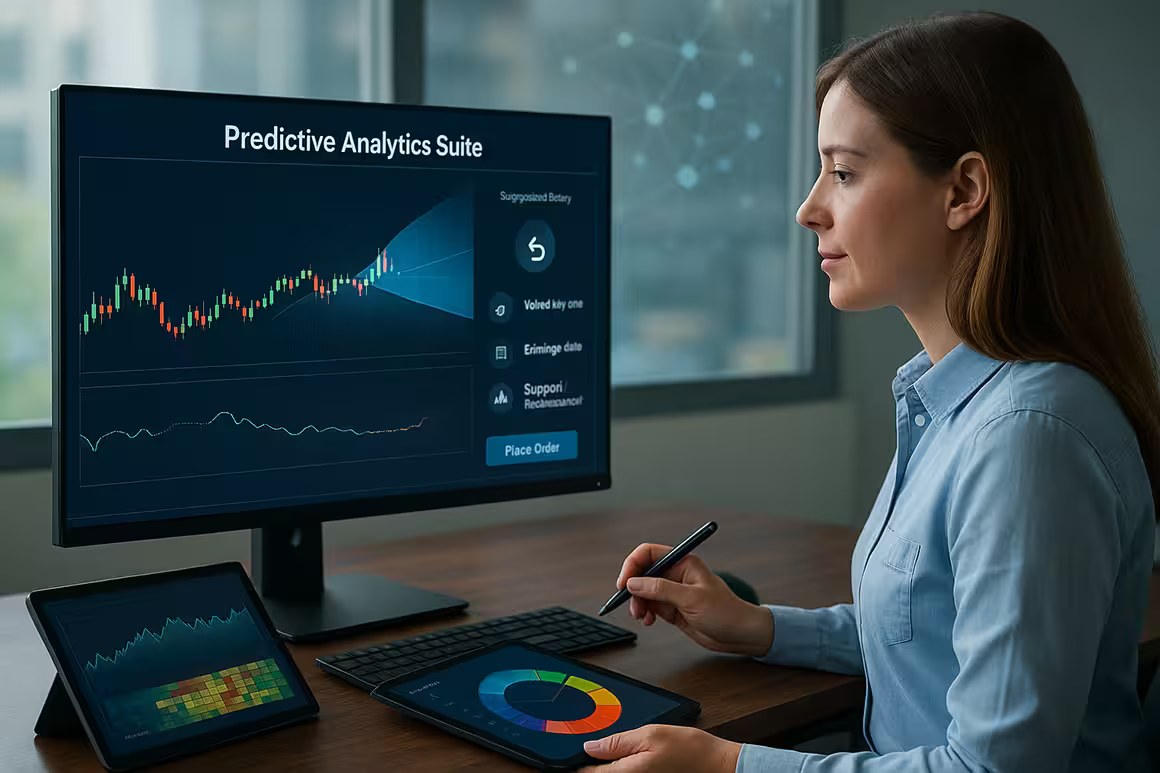
Are you tired of entering options trades at the wrong time? Predictive analytics might be the key to making better, data-driven decisions.
Predictive analytics in trading involves using tools like machine learning, historical data, and statistical data that can help time your options entries correctly, leading to better profitability with time. Accurate entry points can be the difference between profit and loss, especially in volatile markets.
Our guide will explore how predictive analytics can help traders time their options entries more effectively. We’ll run through the major perks to using these tools, in addition to some of the challenges and limitations that come with the process. For your convenience, we’ve included a short guide about how to incorporate this tool into your future trading sessions!
What Is Predictive Analytics in Trading?
In options trading, there is a helpful tool known as predictive analytics, which use historical data, statistical algorithms, and machine learning to predict future price movements. Traders and investors can leverage the power of predictive analytics to make better-informed trading decisions over time. This robust tool can lead to a more data-driven process, which can keep traders away from making decisions based on hunches or a gut feeling.
How do predictive analytics work? Their models process large sets of data to forecast trends, price movements, and optimal entry points for options traders. The data that these systems are based on includes things like market data, technical indicators, and other influencing factors like news sentiment or economic reports.
Example
What does the application of predictive analytics look like during an options trading session? A decent way to illustrate this idea is when a trader uses this process to find out if there’s a pattern where a certain stock goes up in value following a specific event, such as an earnings report release. Once predictive analytics have confirmed that the stock is due to go up in value during an event like this, the trader can plan on selling a call option on the stock before earnings to secure a profit.
Key Predictive Analytics Tools for Options Traders
Predictive analytics tools come in several shapes and sizes—we’ve included a wide range of these tools below, including moving averages, machine learning, sentiment analysis, and more. There are several interesting ways for traders to predict future price movements that keep the process engaging.

Moving Averages and Trend Analysis
Predictive analytics uses moving averages to spot trends through smoothing out data fluctuations while simultaneously pinpointing the underlying trend direction. As new data points are available to traders, the averages are recalculated. This is on top of moving averages, calculating the average of the available data points over the specified time period.
Traders need to analyze trend strength and duration to find good entry points. If moving averages are on the rise, it’s a sign of an uptrend in the data, while declining moving averages suggest a downtrend. To conduct a good trend analysis, though, you should pair moving averages with other indicators to get the full picture and to pick up on possible trend reversals.
Volatility Forecasting
Another useful form of predictive analytics is volatility forecasting. This tool can correctly gauge the role of volatility in each investment and its ability to impact potential price swings. Through the use of volatility forecasting, traders can accurately measure the price volatility of the underlying asset, which can help significantly with choosing the right options strategy for the situation at hand.
Tools like implied volatility (IV) and historical volatility (HV) go a long way for correctly forecasting how volatility can impact a trader’s investment. Implied volatility is a forward-looking measure which anticipates how the asset’s price might fluctuate, while historical volatility is a backwards-looking measure which looks at how the asset has historically reacted to different market stimuli. It’s key to use each together for best results.
Machine Learning and AI Models
Both of these are crucial elements in predictive modeling for options trading. Putting these two tools together can help traders to make informed decisions about their trading plan based around future events.
Machine Learning Techniques
- Regression Analysis—A statistical method that models the relationship between the option’s current price with the price of the underlying and the time that’s left until the expiration date. It can be used to estimate the theoretical price of an option, assess the fair value of an option, pinpoint pricing discrepancies, and better assess or manage positions from a risk management perspective.
- Neural Networks—Deep learning is used to process complex data and learn intricate patterns, which can produce more accurate predictions for options traders. Neutral networks can learn from historical option price data to figure out the fair price of an option. They can also forecast how volatile the market could possibly get. Neutral networks are a good tool for developing a trading strategy too.
- Decision Trees—This refers to a supervised learning algorithm that is used for regression modeling as well as for classification. The base of the entire structure are the root nodes, which represent the entire data set. The internal nodes of the tree represent tests on attributes, while the branches represent the outcomes of those tests. The leaf nodes represent the final prediction.
The Application of AI
AI is being increasingly used in options trading to optimize strategies and manage risk effectively. There are a number of real-world applications that can appeal well to retail investors and major financial investors working for big institutions.
- Algorithmic Trading—Execute trades automatically using AI-powered systems. They are based on pre-defined strategies and real-time data analysis.
- Currency Forecasting—Another key function of these AI models is to analyze factors like market sentiment and economic data to predict the future exchange rate of currencies around the world.
- Predictions for the Stock Market—AI can also be used to forecast future price movements. To do this, the models will analyze news sentiment and historical stock data to get an idea of where the price might be heading.
- Risk Management—Traders can use AI to detect anomalies while analyzing market data to predict potential losses. This is helpful in identifying and managing risks more effectively than one could have in the past.
- Sentiment Analysis—AI also has the power to gauge the sentiment of the markets as a way of predicting future price movements. It’s done by scanning textual data, news articles, and social media to get an idea of what other investors are feeling, be it bullish, bearish, or neutral.
- Trading Frequently—If you’re someone who is a high-frequency trader, you could be using AI models to pinpoint small but profitable price movements in real time to find places where you can make money off fluctuations in stock prices.
- Optimizing Your Portfolio—AI systems can be used to analyze historical data, market trends, and risk profiles to give traders a hand with optimizing each of their online investments.
- Technical Analysis—Use AI to automatically analyze multiple technical indicators at once, including the Relative Strength Index, moving averages, and Bollinger Bands. Use this function of AI tools to identify the best trading opportunities.
- Forecasting the Economy—Traders who are interested in predicting the main economic indicators which will impact their stocks the most can use AI tools to find out where GDP, interest rates, or inflations might be in the near future.
- Detecting Fraud—Discover possible fraudulent activities in the market using the power of AI systems to pick up on unusual behaviors or patterns from other retail traders or institutional investors.
Sentiment Analysis
Sentiment analysis of news, social media, and market sentiment can be integrated into predictive models. This can enhance their overall accuracy because the trader is incorporating subjective information into the mix, like market trends and other traders’ market outlook.
There’s something to be said about the impact of public sentiment on stock prices and options markets. Bullish sentiment can be felt in a market where the stock prices are on the rise—traders are optimistic in this kind of environment. When there’s a lot of bearish sentiment going around, you can sense that other traders or investors are nervous about entering new positions.
Using Predictive Analytics for Timing Entry Points
In the context of options trading, the optimal entry point is a strategy that helps traders decide when to enter any given options trade by taking certain factors into consideration, like support/resistance levels, risk management, or market trends. We’ve outlined the process for timing the entry points for your trades in a few key steps below for your convenience.
- Market Analysis and Trend Identification—This involves the trader identifying the market trends (bearish, bullish, sideways trend, etc.) and then looking for a continuation pattern to establish that this is the direction the market is likely to go.
- Support/Resistance Levels—Identify the levels where the asset has historically had difficulty breaking through. These could act as natural entry or exit points. The best support or resistance levels are found at points where the price level has been touched multiple times.
- Technical Indicators—Use tools like the Relative Strength Index, Moving Average Convergence Divergence, and moving averages for additional confirmation. Getting the trend right can lead to much better entry points in your positions.
- Risk Management—Before entering the position, it’s key to do a risk-reward ratio to ensure that the position is worth entering. As always, use the proper risk management techniques once you’ve entered the trade, including using a conservative position size and setting up parameters for the trade through stop-loss orders.
Backtesting with Predictive Analytics
In addition to backtesting, traders can use metrics like precision, recall, and accuracy to see how a predictive model could have performed in the past. Another good tool would be splitting historical data into training and testing sets. Put everything together, and you can simulate how the model might have handled past events and use these predictions to identify possible entry points.
Real-Time Predictive Models
Now let’s address the topic of how predictive analytics can assist traders in making real-time decisions to enter options trades at the right time. Real-time predictive models can help with the following aspects of trading online options in the most optimal way possible:
- Identifying Trends and Patterns—Predictive analytics can detect small patterns and indicators in historical data that could influence future price movements.
- Taking Risks into Account—Traders can learn about the risks associated with the option contracts they trade by forecasting market volatility using the predictive models discussed in this guide.
- Optimize Entries and Exits—AI-powered predictions, along with real-time predictive models, can help traders to determine the best time to buy or sell options by anticipating future price movements.
- Automated Strategies—Predictive analytics can be integrated into an automated trading system, which lets AI analyze the market data in real-time as well as execute trades based on the trader’s pre-determined criteria.
- Predicting Public Sentiment—Predictive analytics can also be used to interpret market movements based on factors like breaking news and public perceptions of markets. It’s a helpful way for traders to be able to anticipate the supply and demand shifts for certain options contracts.
Example Strategies
Let’s look at a few strategies that you could be using where predictive analysis plays a key role in determining the entry and exit points of your trades.
Breakout Strategy: This refers to using predictive analytics to identify breakout points. These occur when the asset price moves out of the established trading range. This strategy works so well because the movement is characterized by an increase in volume.
Mean-Reversion Strategy: This strategy involves timing entries based on predictive models which forecast price reversals. It’s all about leveraging the tendency of financial assets to revert to their historical price over time. Traders can buy the assets below their mean or sell assets above their mean with the expectation that the price will revert back to the average.
Benefits of Using Predictive Analytics for Timing Entries
How can using predictive analytics be beneficial for timing the entries of your online trades? We’d like to run through the four best reasons for using these important tools to enter trades at the right time and the right price.

Accuracy in Timing
How predictive analytics improves the likelihood of entering trades at the right moment. Think about it. This tool anticipates what is likely to happen in terms of market direction, and volatility, and what kind of impact these factors will have on the stock price. By having a rough guideline of what is likely to happen, traders can improve their overall accuracy in timing their entries correctly. It might not be perfect, but this tool can let them be on the winning side of the curve more often than not.
Reduced Emotional Decision-Making
Predictive analytics can be instrumental in keeping traders tethered to data-driven insights and much less reliant on entering positions based on fear or greed. Emotional decision-making doesn’t do a trader any good because it draws them away from their trading plan and objectivity.
Increased Profitability
Another considerable advantage to using predictive analytics is being able to predict favorable market conditions and timing options entries for higher reward-to-risk ratios. The more you can incorporate this process into your trading routine, the more profits you can capture over time through high-quality positions that give you a good chance to come out ahead.
Managing Risk
Predictive analytics can offer valuable insights to traders as to the maximum amount of money they should be willing to lose on each position in an effort to secure a profit, as well as how much they’re willing to take in profit. Setting up these stop-loss and take-profit levels based on these market predictions can significantly help traders to effectively manage risk as they time their options trades.
Challenges and Limitations of Predictive Analytics in Options Trading
Predictive analytics can bring a lot of perks and benefits to the online options traders, but these tools and processes come with plenty of challenges. Plus, there are some limitations that come with predictive analytics, which means that they cannot fully account for everything that could possibly happen with a trader’s investments.
Data Quality
It’s key for the trader to have access to clean, accurate data. Poor data can lead to misleading predictions. This could be the biggest challenge in using predictive analytics. The data needs to be accurate, otherwise, traders can screw up their entries.
Overfitting Models
There’s another risk where predictive models perform well on historical data but fail in real-world market conditions. This is known as overfitting the model, which can result in faulty conclusions and will ultimately have the trade entering trades at the wrong time and for the wrong price.
Market Unpredictability
While predictive analytics is a powerful tool, markets can behave irrationally or unpredictably, especially in times of economic uncertainty or unexpected events. Traders can put too much faith in the results that are coming from predictive analytics, which could cause them to lose money through a bad entry. It’s key to look at the entire market context before barreling ahead with an entry.
Cost and Complexity
Predictive analytics has to be done with software and programs, which can cost the trader extra money. There’s also the complexity involved with integrating them into your trading routine. The investment required in terms of knowledge of the markets and the learning curve for using the tools correctly are some other challenges/limitations you could possibly experience along the way.
How to Incorporate Predictive Analytics into Your Options Trading Strategy
If you’re ready to incorporate predictive analytics into your trading strategy, check out our condensed, step-by-step guide below as well as some tips and tricks for achieving best results as you work these tools into your trading routine.
Step-by-Step Guide
Follow this basic guideline for using predictive analytics tools in your trading strategy if you’re interested in making this metric a major part of your trading plan:
- Choose a tool or platform that supports predictive analytics. Check out these top AI-powered trading tools for a better idea of which platforms you could be using this year.
- Set up your preferred predictive indicators.
- Start with backtesting using historical data.
- Incorporate predictive analytics into your live trading. It’s best to start small and work your way up as you gain more experience.
Combining Predictive Analytics with Other Strategies
To get the most accurate picture of where the market could be heading and what the stock prices are likely to be, it’s best to blend predictive analytics with indicators like technical analysis, fundamentals, and other options strategies. Using two or three supporting indicators can confirm trends and give traders more confidence in their decisions.
Continuous Learning
Continuously improving your predictive models and adapting them to changing market conditions is key to growth, and a lot of this is driven by continual education on the subject, and with options trading in general. Our site has a ton of great learning resources that can help you grow in knowledge over time!
Making Smarter Entry Decisions with Predictive Analytics
Predictive analytics can help options traders time their entries more effectively. Tools like moving averages, trend analysis, volatility forecasting, and sentiment analysis are all power tools that can help traders gauge when the stock prices are likely heading so they can plan their entries much more efficiently.
It’s hard to say right now where the future of predictive analytics is going in the context of options trading, but we are sure there will continue to be developments and improvements with AI and machine learning technologies that will continually be incorporated into the process.
Experiment with predictive tools, but remember that there are risks, and it’s important to combine predictive analytics with solid risk management practices. Ready to time your options entries more effectively? Start using predictive analytics today and see how it enhances your trading strategy!