
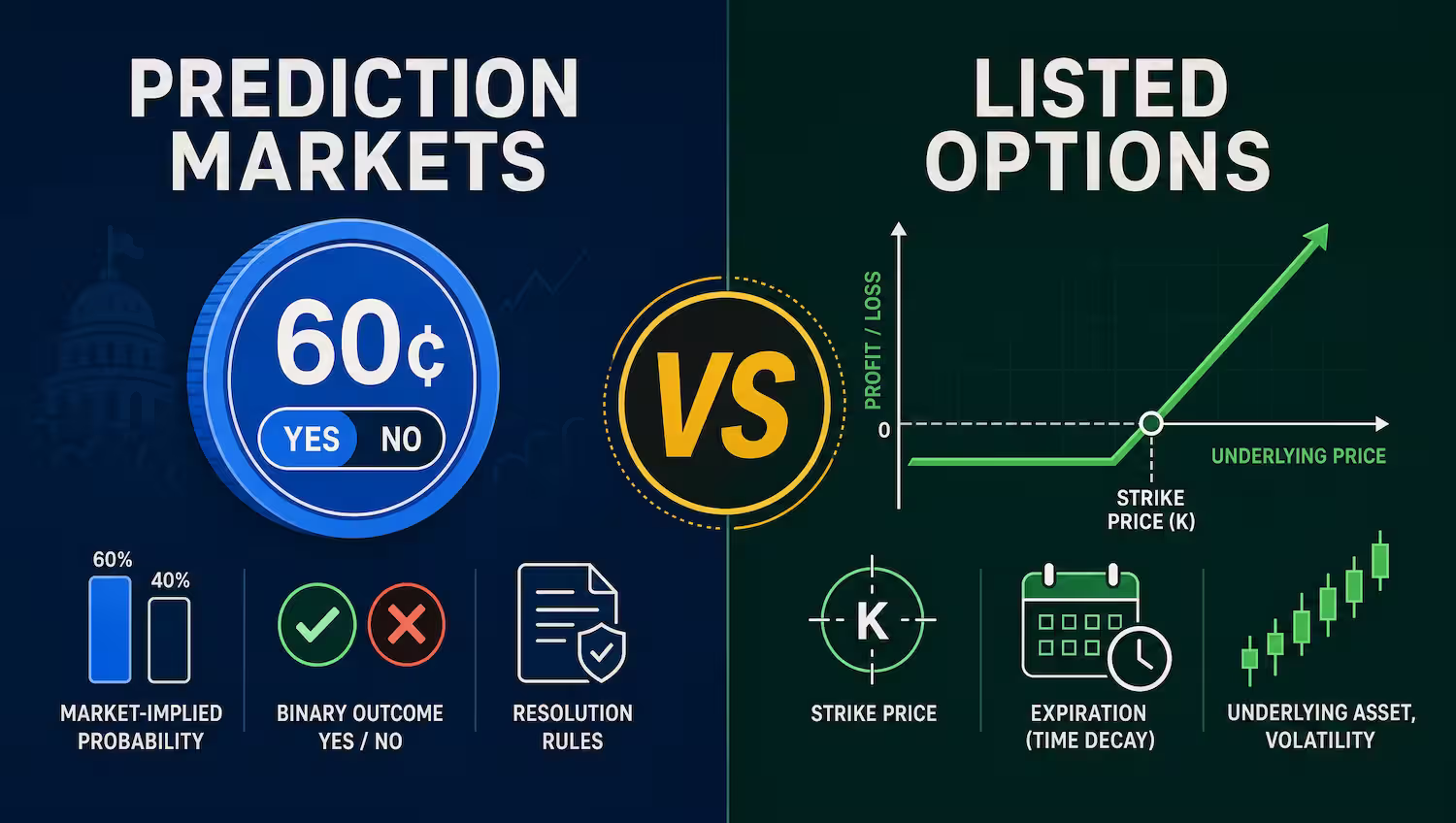
Prediction markets and options can look like close relatives. Both let traders put a price on an uncertain future outcome. Both can be bought and sold before a final date. Both attract speculators, hedgers, and market makers.
The resemblance is real, but it is easy to push it too far. A prediction-market contract usually asks whether a defined event will happen and pays according to written resolution rules. A listed option gives its buyer a right tied to an underlying asset, strike price, and expiration, while the seller takes on a corresponding obligation.
That difference changes how the contract is priced, what can make it gain or lose value, how it settles, and which risks matter most. This guide compares the mechanics without treating either product as a shortcut to easy returns.
Quick Takeaways
- Prediction markets commonly use event contracts that resolve from a specific outcome, source, and rule set; listed options derive value from an underlying asset.
- A 60-cent Yes contract may be read as roughly 60% market-implied odds, but the price is not an objective forecast or a guarantee.
- Option prices are not direct probability quotes. Premium reflects the underlying price, strike, time, implied volatility, rates, dividends, supply, demand, and execution conditions.
- Long event contracts and long options can both lose the full amount paid, but option writers can face obligations and losses that exceed the premium received.
- Liquidity, bid-ask spreads, fees, fast-moving information, and emotional overconfidence can damage results in both markets.
- Contract rules matter in both products, but prediction-market traders must pay special attention to the exact resolution criteria and official source.
The Core Difference
The CFTC describes prediction-market products as event contracts and notes that they are often based on Yes-No scenarios. Their value comes from an event outcome. On a typical binary contract, the winning side settles at a fixed amount and the losing side settles at zero. The exact design varies by venue and contract, so the rulebook controls.
A listed stock option works differently. Investor.gov defines an option as a contract giving the purchaser the right, but not the obligation, to buy or sell a security at a fixed price within a specific period. Calls provide a right to buy; puts provide a right to sell. The writer has the corresponding obligation if assigned.
In plain English, a prediction-market position usually expresses a view on the answer to a defined question. An option expresses a view through the future relationship between an underlying asset and a strike, with time and volatility also affecting the premium. Review the CFTC’s prediction-markets overview and the SEC’s introduction to options for the regulatory definitions behind that distinction.
Where Prediction Markets And Options Are Similar
Both are derivatives in the broad economic sense: their value depends on something outside the contract itself. For an event contract, that reference is the outcome described in the market rules. For an equity option, it is an underlying stock, ETF, or index together with the strike and expiration terms.
Both also use two-sided markets. Buyers and sellers submit prices, spreads form between bids and asks, and market makers may provide liquidity. A trader can be right about the eventual outcome and still receive a poor result from overpaying, crossing a wide spread, or trying to exit a thin market. The execution lesson is the same one covered in our guide to tight bid-ask spreads: the contract idea and the fill price are separate decisions.
The products can serve speculation or hedging. A business exposed to a weather or economic release might use an eligible event contract to offset a narrow event risk. An investor might use an option to hedge a stock or ETF position. In both cases, the hedge can be imperfect because the contract payoff may not match the real-world loss dollar for dollar.
Both products also have a clock. Prices can change as new information arrives and the final date approaches. Traders may close positions before settlement or expiration when liquidity is available. Waiting for the final outcome is a choice, not always a requirement.
Prediction Markets vs. Options At A Glance
This table describes common U.S. regulated-market structures. Individual contracts, platforms, and option classes can differ, so current terms must be checked before trading.
Feature | Prediction-Market Event Contract | Listed Option |
|---|---|---|
Core question | Will the defined event meet the resolution criteria? | What will the underlying asset do relative to the strike and expiration? |
Typical payoff | Fixed binary payout, often $1 or $0, though some contracts use other settlement structures. | Variable value before expiration; exercise or cash-settlement value depends on the underlying and contract terms. |
What the price means | Often interpreted as market-implied odds after accounting for market structure and costs. | A premium shaped by intrinsic value, time, implied volatility, rates, dividends, and supply and demand. |
Key document | Market-specific rules, resolution source, close time, and determination process. | Option symbol, underlying, strike, expiration, exercise style, multiplier, and deliverable. |
Long-side loss | Often limited to the purchase price plus fees for a fully paid contract. | Option buyer can lose the full premium plus transaction costs. |
Seller obligation | Depends on the venue’s contract and collateral model. | The writer can be assigned and may have to buy or deliver the underlying or make a cash payment. |
Important sensitivities | News, participation, liquidity, rule interpretation, and confidence in the resolution source. | Underlying price, delta, gamma, theta, implied volatility, rates, dividends, and liquidity. |
U.S. oversight | Federally regulated event-contract markets generally fall under CFTC derivatives oversight. | Listed securities options involve SEC-regulated markets, broker-dealers, and OCC clearing. |
Why A Prediction-Market Price Is Not A Pure Probability
A Yes contract trading at 60 cents is commonly described as the market assigning about a 60% chance to Yes. That shorthand can be useful, but it is not the same as a scientifically measured probability.
The displayed price comes from the orders and capital available at that moment. It can be influenced by a thin order book, one-sided demand, participant limits, fees, spread width, and who has access to the market. New information can move the price quickly, and a confident crowd can still be wrong.
A regulated platform may pair opposing orders rather than taking the other side itself. Kalshi’s educational explanation of how prices are determined illustrates the Yes-No matching model used on that venue. Other platforms may have different mechanics, access rules, collateral, or settlement arrangements.
Treat the price as a tradable market estimate, not a guarantee. Before acting on a perceived mispricing, ask whether you have better information, a better model, or merely a stronger opinion.
Why An Option Premium Is Not A Probability Quote
An option premium contains more moving parts. A call can gain when the underlying rises, but the result also depends on how far it rises, how quickly it moves, what happens to implied volatility, and what price the trader paid. A put has the same multidimensional problem in the opposite direction.
FINRA’s options basics and Greeks overview explains the sensitivities traders use to describe these changes. Delta estimates price sensitivity to the underlying. Theta describes theoretical value lost as time passes. Vega describes sensitivity to implied volatility. Gamma measures how delta changes.
This is why an options trader can predict direction correctly and still lose money. The move may be too small, arrive too late, or be offset by falling implied volatility and transaction costs. Our guide to why an option can lose money when the stock moves your way explores that problem in more detail.
Probability estimates sometimes appear in option platforms, but they are model outputs based on assumptions. They should not be confused with the premium itself or treated as certain odds.
A Simple Payoff Comparison
The following numbers are hypothetical, exclude fees and taxes, and compare structure rather than recommending either trade.
Detail | Event Contract Example | Long Call Example |
|---|---|---|
Trade | Buy Yes at $0.42 on whether a stated economic measure will meet a defined threshold. | Buy one 105 strike call for $3.00 when the underlying trades at $100. |
Amount paid | $42 for 100 contracts at $0.42 each. | $300 because one standard equity option usually represents 100 shares. |
Winning condition at final settlement | The official source and rules determine that the event resolved Yes. | The option has intrinsic value if the underlying finishes above $105; simplified expiration breakeven is $108. |
Maximum loss for buyer | $42 if the contracts settle at zero. | $300 if the call expires worthless. |
Maximum expiration gain | $58 if each winning contract pays $1. | Theoretically unlimited because the underlying can keep rising, less the premium paid. |
Important complication | A headline may look decisive while the official resolution source or timing says otherwise. | The call can change value before expiration because of price, time, and implied volatility. |
Prediction-Market Risk 1: Resolution Rules Can Decide The Trade
Prediction-market traders are not paid for being broadly right about a headline. They are paid according to the contract’s written rules. Those rules may name a specific agency, data release, publication time, geographic area, threshold, or fallback procedure.
A market can appear settled in everyday conversation while remaining undetermined under its formal source. A later revision may or may not count. Trading can close at a different time from determination. The words at, above, before, by, and officially reported can change the outcome.
Kalshi’s market-rules guidance is a useful platform-specific example: it tells traders to review the resolution criteria and verification source for each market. The broader lesson applies everywhere. If you cannot explain exactly what produces Yes, No, cancellation, or an alternative settlement, the contract is not ready to trade.
Prediction-Market Risk 2: Information And Regulatory Conditions Can Change
Event markets can concentrate information risk. Some participants may follow the subject more closely, react faster, or have relationships that create conflicts. In February 2026, the CFTC issued an enforcement advisory on prediction markets after cases involving improper influence over an outcome and potential access to material nonpublic information. That does not mean every market is compromised, but it is a reminder that a clean-looking price can hide uneven information.
The regulatory environment is also developing. In 2026, the CFTC withdrew an earlier event-contract proposal and opened a new rulemaking process. Product availability, platform access, state disputes, sports-related contracts, and intermediary rules may continue to change.
Use regulated entities where required, confirm that the product is available in your jurisdiction, and recheck current platform and regulator materials. A comparison article can explain today’s framework, but it cannot freeze a fast-moving legal landscape.
Options Risk 1: Time And Volatility Can Defeat A Correct View
Long options lose value as expiration approaches when other inputs stay equal. The effect is not perfectly linear, and it can become more noticeable near expiration. If the underlying does not move enough, the buyer may lose the full premium even when the general thesis eventually proves correct.
Implied volatility adds another layer. A trader can buy an option before a major announcement, see the underlying move in the expected direction, and still be disappointed if the premium had already priced in a larger move. The post-event decline in implied volatility can offset part of the directional gain.
Choosing an expiration should therefore match the time horizon of the thesis. A multi-week idea forced into a two-day option creates a timing problem. Review time decay and implied volatility before treating a low premium as a cheap opportunity.
Options Risk 2: Writers Face Assignment And Potentially Larger Losses
Buying an option generally limits the buyer’s loss to the premium and transaction costs. Writing an option is different. A short put can require buying shares at the strike. A short call can require delivering shares. An uncovered call can create theoretically unlimited loss as the underlying rises.
Assignment can occur before expiration for American-style options. Margin requirements can also change as the position or market moves. A trader who thinks only about premium collected may miss the stock position, buying power, dividend, and gap risk attached to the obligation.
The OCC’s Characteristics and Risks of Standardized Options is the core risk document for listed options. For a practical walkthrough, see what happens when an option gets assigned.
Risks The Products Share
- The full amount paid can be lost when a long contract finishes with no payout or value.
- Wide bid-ask spreads and thin order books can make entry and exit more expensive than the headline price suggests.
- Fees can materially reduce the expected return on small or frequently traded positions.
- Fast news can move prices before a retail trader can react or cancel an order.
- Crowd prices can be informative without being correct, complete, or suitable for a particular trader.
- A hedge can fail to match the real exposure because the contract’s payoff trigger differs from the actual loss.
- Overconfidence, chasing, oversized positions, and treating entertainment as analysis can turn a defined-risk trade into repeated losses.
Which Product Best Fits Which Use Case?
The best fit depends on the use case. A prediction-market contract is often the more direct instrument when the question is truly binary and the contract rules match it: will a named statistic exceed a threshold, will an official action occur by a deadline, or will a defined candidate win under the stated source? Direct does not mean easy; the price can still be wrong and the rule language can still surprise traders.
An option may be the more relevant tool when the objective is exposure to an asset’s price, volatility, or portfolio risk. Options support a wide range of strikes, expirations, and multi-leg structures, but that flexibility adds complexity.
The products are not interchangeable hedges. An economic event contract may settle Yes while a stock or ETF falls because investors expected an even stronger result. An option may gain before the event and lose after it even though the event contract resolves in the trader’s favor. One contract targets the defined event; the other reflects the market response of an underlying asset.
The right comparison starts with the exposure, not the excitement of the platform. Define the exact risk or view first, then ask whether the contract payoff actually matches it.
Questions To Ask Before Trading Either Product
- What exact outcome produces a profit, and what produces a full loss?
- Who operates and regulates the venue, and is the product available in my jurisdiction?
- What are the bid, ask, spread, visible depth, fees, and realistic exit choices?
- For an event contract, what are the resolution source, wording, close time, determination time, and fallback rules?
- For an option, what are the underlying, strike, expiration, multiplier, exercise style, settlement method, and deliverable?
- How much can be lost, and can any obligation, assignment, or margin requirement exceed the cash paid?
- Does the contract directly match the risk or thesis, or am I assuming two different outcomes will move together?
- What new information would invalidate the trade before final settlement or expiration?
- Am I relying on a market price as a guaranteed probability instead of one fallible estimate?
- Would skipping the trade be better than accepting unclear rules, weak liquidity, or an oversized position?
The Practical Bottom Line
Prediction markets and options share enough structure to invite comparison. They turn uncertainty into tradable contracts, support two-sided markets, and can be used for speculation or risk management. They also share the possibility of a total loss for the buyer.
Their differences are more important than their visual similarities. Event contracts are governed by the exact question and resolution rules. Options are governed by the underlying, strike, expiration, exercise terms, and a premium that responds to time and volatility. Option writers also take on obligations that do not have a simple equivalent in every prediction-market model.
Neither product makes uncertainty disappear. The disciplined approach is to read the contract, calculate the payoff, inspect liquidity and fees, understand the venue, and decide whether the instrument matches the actual question being traded.
FAQ
These answers cover common comparison questions for U.S. self-directed traders. Product rules and availability can change.
Are prediction markets the same as binary options?
They can have similar fixed Yes-No payoffs, but the legal structure, venue, regulator, collateral model, settlement rules, and customer protections may differ. Do not assume two products are equivalent because both display a binary outcome. Read the specific contract and platform disclosures.
Does a 70-cent prediction-market contract mean the event has a 70% chance?
It is commonly interpreted as roughly 70% market-implied odds, but it is still a traded price. Liquidity, fees, participant access, position limits, information quality, and market sentiment can all affect it. It is not a guarantee or an objective probability.
Can I lose more than I pay in a prediction market?
A fully paid long binary contract commonly limits loss to the purchase price plus fees, but platform structures vary. Review the venue's collateral, order, settlement, and risk disclosures. Do not assume every product labeled a prediction market has the same loss limit.
Can I lose more than I pay with options?
An option buyer generally risks the premium plus transaction costs. An option writer can face much larger losses and assignment obligations. Uncovered calls can have theoretically unlimited loss, and short puts can require purchasing shares at the strike.
Are prediction markets easier than options?
The payoff may be easier to describe, but the trade is not necessarily easier to win. Prediction markets add resolution-rule, information, venue, and regulatory risks. Options add strike, expiration, volatility, time-decay, assignment, and margin complexity.
Can prediction markets hedge an options position?
Sometimes an event contract may offset part of a specific event exposure, but the hedge can be imperfect. An event can resolve one way while the underlying asset reacts differently. Compare the exact payoff triggers and size the hedge from the real exposure rather than assuming a one-to-one relationship.
Source and Freshness Note
This article was source-reviewed on July 2026. Prediction-market regulation and product availability are evolving, so readers should verify current rules, jurisdictional access, fees, and contract terms before trading.