
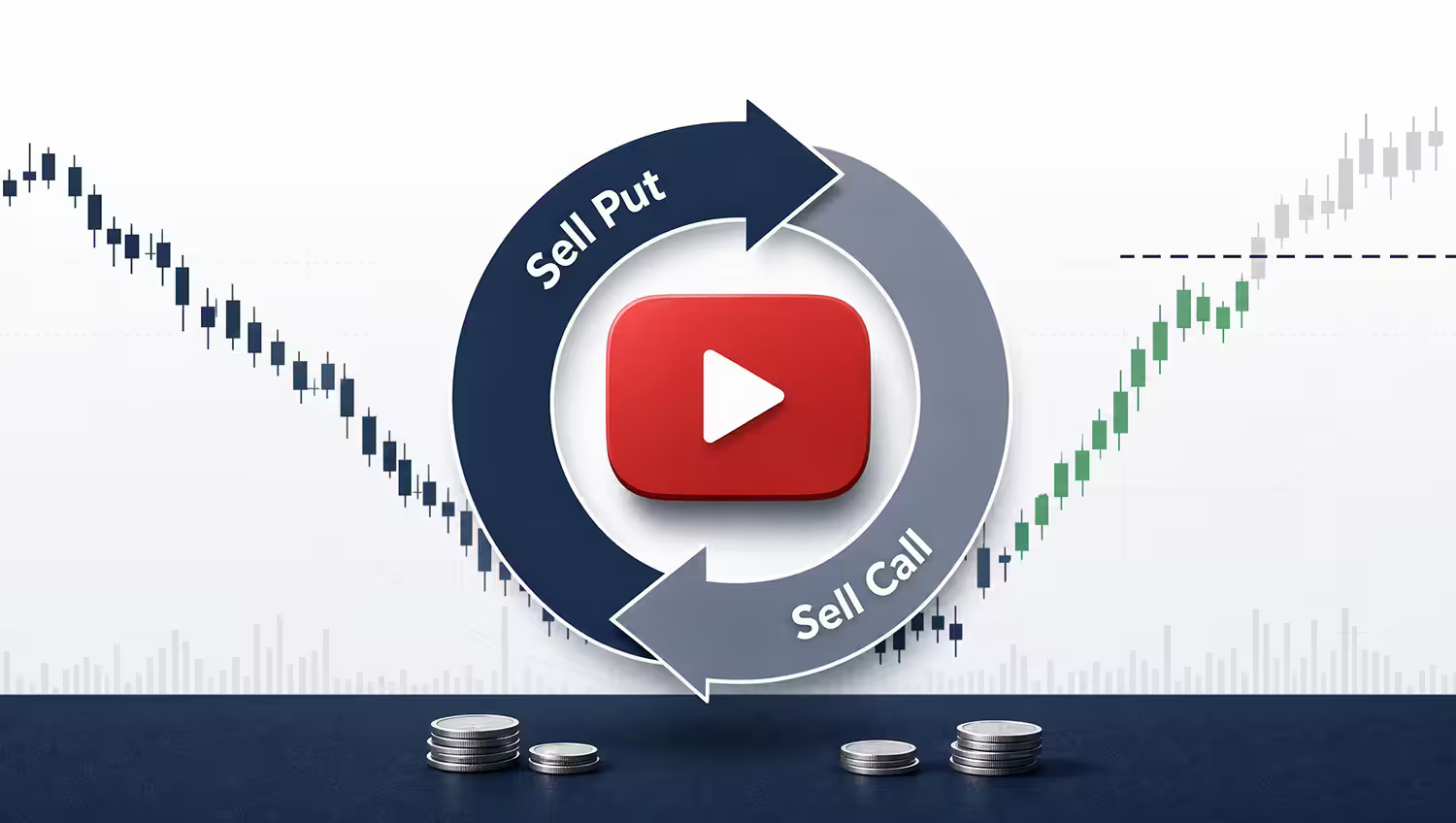
My pick for YouTube’s most overhyped options play is the Wheel. Not because it never works, and not because cash-secured puts or covered calls are illegitimate. It is overrated because the usual pitch turns a bullish, capital-intensive stock position into a story about effortless monthly income.
The videos tend to focus on premium arriving in the account. The harder parts get less screen time: a put seller can be assigned after a deep decline, a covered call can surrender the strongest part of a rebound, and the same capital can sit tied to one stock for months. The Wheel does not remove stock risk. It repackages that risk into a sequence that feels productive because cash keeps changing hands.
A fair critique should separate the trade structure from the sales pitch. The Wheel can be coherent for a price-sensitive investor who truly wants to buy a particular stock, can afford 100 shares, and is genuinely willing to sell those shares at a chosen call strike. It is a poor fit when the real goal is high return on capital, uncapped participation in a long-term winner, or passive income that requires little monitoring.
The Short Answer
- The Wheel cycles between selling a cash-secured put and, after assignment, selling a covered call.
- Both phases are bullish positions with limited option income and substantial downside tied to the stock.
- Premium collected is cash flow, not automatically profit or portfolio yield.
- The approach can miss a fast rally before assignment and can cap a recovery after assignment.
- The Wheel fits best as a disciplined stock-entry and stock-exit process, not as a universal income machine.
How the Wheel Actually Works
The Wheel has two stages. First, the trader sells a cash-secured put and sets aside enough cash to buy 100 shares at the strike price. If the option expires out of the money, the trader keeps the premium and may sell another put. If it is assigned, the trader buys the shares. Second, the trader sells a covered call against those shares. If the call is assigned, the shares are sold at the call strike and the cycle can begin again.
That basic description is not controversial. The Options Industry Council’s June 2026 no-hype Wheel overview describes the same two-stage cycle and emphasizes that strike, expiration, implied volatility, time decay, and assignment risk shape the result. For a slower introduction to the mechanics, OptionsTrading.org also has a separate Wheel strategy explainer.
The first stage is not free money while waiting for a bargain. A put with a $95 strike creates an obligation to buy at $95 if assigned, even if the stock is trading far below that level. The second stage is not extra yield without a trade-off. A short call creates an obligation to sell at the strike, even if the stock rallies far above it.
Expiration choice changes the balance. A short-dated option may decay quickly but requires more frequent decisions and creates more repeated exposure to spreads, slippage, and assignment windows. A longer-dated option can bring in more dollars but keeps the obligation open longer. Moneyness, delta, and implied volatility affect both premium and the probability that the stock crosses the strike. A larger premium is often compensation for a riskier situation, not a gift.
The YouTube Pitch vs. the Actual Trade
Popular Pitch | What the Payoff Really Says |
|---|---|
Get paid to wait for a stock you already like. | You accept the obligation to buy 100 shares at the strike while the stock can keep falling. |
Lower your cost basis every month. | Premium offsets part of a loss, but it does not change the stock’s market price or guarantee recovery. |
Create passive income from shares you own. | The call caps upside, can be assigned early, and may require active decisions around dividends and large price moves. |
Keep spinning the Wheel in any market. | The cycle is easiest to manage in a gently rising or range-bound stock; a crash or a sharp rally exposes its trade-offs. |
A high win rate means the method is safe. | Many small premiums can coexist with an occasional large stock loss. Win rate alone does not measure payoff quality. |
Two Phases Do Not Create Two Independent Edges
The Wheel feels diversified because the trader alternates between puts and calls. Economically, however, a cash-secured put and a covered call with the same strike and expiration have closely related expiration payoffs. The Options Industry Council’s cash-secured put guide describes the cash-secured put as having a risk profile identical to a covered call.
That matters because the Wheel is not switching from a bullish trade to a neutral income trade after assignment. It remains bullish. Before assignment, the short put benefits when the stock stays above the strike. After assignment, the covered call position still loses when the stock falls; the call premium provides only a limited cushion. The call merely gives up some future upside in exchange for cash today.
The repeated cycle can hide this continuity. A dashboard may show put premium in one month and call premium in the next, but the account has been carrying the same core risk: exposure to a stock that can fall much farther than the premium received. Different order tickets do not automatically create different sources of return.
This is also why stock selection does much of the heavy lifting. A Wheel on a durable company that trades sideways can look smooth. A Wheel on a stock selected only because its implied volatility and premium are high can become a concentrated bet on exactly the company the options market considers risky. The Wheel cannot rescue weak fundamental judgment.
A $100 Stock: What the Premium Does and Does Not Do
Consider a simplified example. A stock trades at $100. A trader sells one 30-day $95 put for $2.00, or $200 for a standard 100-share contract, and reserves $9,500 for possible assignment. Commissions, taxes, interest, and dividends are excluded.
Stock Price at Put Expiration | Put Outcome | Simplified Position Result |
|---|---|---|
$110 | Put expires worthless. | The trader keeps $200 but misses the stock’s $10 rally. Maximum put profit is still $200. |
$96 | Put expires worthless. | The trader keeps $200. The return is 2.11% on the $9,500 reserved for 30 days before costs and taxes. |
$93 | Put is assigned. | The $2 premium offsets the drop from the $95 strike, producing a $93 expiration breakeven. |
$70 | Put is assigned well above market. | The trader buys at $95, less the $2 premium, for a $93 net basis and a $2,300 unrealized loss. |
$0 | The company fails. | The simplified maximum loss is $9,300: the $9,500 purchase obligation minus the $200 premium. |
The Premium Is Small Relative to the Obligation
The example shows the central mismatch. The $200 premium is visible immediately, while the $9,300 worst-case loss feels remote. That asymmetry is why premium should not be described as return before the position closes. It is compensation for accepting an obligation.
The 2.11% figure in the $96 scenario is not a promised monthly yield. It is a one-period result under one hypothetical set of prices. Annualizing it assumes the same trade can be repeated at the same terms with no assignment, no losses, no idle time, no taxes, no slippage, and no change in volatility. Real markets do not preserve those assumptions.
The options market also does not hand out unusually rich premium without a reason. Higher implied volatility can lift the option price, but it also reflects greater expected movement. Selling the highest-premium stock on a scanner can be another way of selecting the largest perceived risk. A useful position-sizing process starts with the loss the account can absorb, not the premium the order ticket displays.
Breakeven deserves equal attention. The put seller does not break even at the strike. Breakeven at expiration is the strike minus premium, or $93 in the example. Before expiration, the position also responds to time decay, changes in implied volatility, the stock’s delta exposure, and liquidity. A trader who plans only around expiration may be surprised by the size of an interim drawdown.
The Awkward Part of the Wheel
- After a large decline, calls above the stock’s net basis may offer very little premium.
- Selling a lower call strike can generate more premium but creates a chance of being called away below the trader’s basis.
- Waiting for the stock to recover stops the advertised income cycle and leaves the account holding the stock.
- Rolling the put or call changes timing and strike exposure; it does not erase the existing economic loss.
- Adding more contracts to lower the average basis increases concentration and the number of shares that may be assigned.
- A falling stock can also bring wider bid-ask spreads, higher implied volatility, event risk, and less comfortable exit choices.
After Assignment, the Wheel Can Stop Feeling Automatic
Suppose the trader in the example is assigned at a $93 net basis while the stock is at $70. A call with a strike above $93 may be too far out of the money to pay much. A call near $75 may pay more, but a rebound through $75 could force a sale well below the trader’s basis. The position has reached a three-way conflict: accept weak premium, cap the recovery below basis, or stop selling calls.
This is where slogans such as reduce your cost basis can become misleading. A $1 call premium changes the running economic total by $100. It does not make the shares worth $1 more, and it does not guarantee that the next call can be sold without sacrificing recovery. The accounting label does not change the opportunity set.
Rolling can be useful when it improves a position’s fit with a revised plan, but a roll is a closing trade plus a new opening trade. A debit roll spends money. A credit roll usually extends time, changes the strike, or accepts another obligation. The original loss has not vanished; it has been combined with a new position.
The cleanest test is simple: if the trader would not buy 100 shares today at the put strike, the put does not become attractive merely because it is part of a Wheel. The site’s guide to cash-secured puts for beginners is most useful when assignment is treated as a planned stock purchase rather than a failed premium trade.
The Upside You Sell Can Matter More Than the Premium
The second blind spot is opportunity cost. A covered call exchanges some upside for premium. FINRA’s options overview describes the same trade-off: the writer receives income but may lose the shares’ upside appreciation if the option is exercised.
That can be a perfectly acceptable exchange when the investor already has a target sale price. It is much less attractive when the stock is a long-term compounder the investor does not actually want to sell. Traders often discover this only after a sharp rally, when buying back the call is expensive and assignment feels like losing a winner.
The Wheel can miss upside at both ends. During the put phase, the stock can rally without the trader owning it. During the covered-call phase, the stock can rally through the strike and be called away. The approach can therefore lag a simple buy-and-hold position in the market environment that produces the largest equity gains.
Cboe describes buy-write strategies as receiving premium in exchange for an upside cap. Its March 31, 2026 BXM fact sheet illustrates the trade-off: the hypothetical at-the-money S&P 500 BuyWrite Index returned 11.8% in 2023 versus 26.3% for the S&P 500 Total Return Index, and 8.9% in 2025 versus 17.9%. BXM also had lower long-run volatility and a less severe maximum drawdown in the fact sheet. This is not a backtest of a single-stock Wheel, but it is useful evidence that option income and lower volatility do not mean free extra return.
Capital, Execution, and Taxes Make It Less Passive
A cash-secured Wheel consumes real capital. One $95 put generally requires enough cash or cash equivalents to meet a $9,500 assignment obligation. Running the cycle across several stocks can quickly concentrate a modest account. Using margin instead may improve apparent capital efficiency, but it replaces reserved cash with borrowing, liquidation, and buying-power risk.
Capital has an opportunity cost even when no loss occurs. Cash reserved for a put cannot be freely committed elsewhere. Shares tied to a covered call cannot be sold without also addressing the short call; otherwise the position can become uncovered. A fair performance review should compare the entire account and capital base, not just add up premiums.
Execution also matters. The Wheel creates recurring orders to open, close, roll, or accept expiration. Bid-ask spreads, commissions, contract fees, and unfavorable fills reduce the result. The Options Industry Council’s covered-call guide also notes that assignment can occur before expiration and that dividend-related situations deserve attention.
Taxes can make frequent premium selling less attractive in a taxable account, depending on the product, holding period, assignment, and the investor’s broader return. A covered call can also affect stock holding-period analysis in some circumstances. Our options tax guide provides general background, but actual reporting and tax consequences belong with a qualified tax professional.
None of this makes the Wheel uniquely dangerous. It makes the workflow less passive than the content format suggests. The current OCC options disclosure page emphasizes that options involve risk and are not suitable for all investors. Monitoring obligations, upcoming dividends, liquidity, expiration, and assignment is part of the trade.
When the Wheel Can Make Sense
The Wheel is most coherent when every step is acceptable before the first put is sold.
Condition | Why It Matters |
|---|---|
You want to own 100 shares at the put strike. | Assignment completes a planned purchase rather than turning a premium trade into an unwanted investment. |
The cash is available without crowding the account. | The position can survive assignment without forced sales, borrowing pressure, or oversized concentration. |
You are willing to hold through a large decline. | The put premium is only a small buffer against stock downside. |
You are willing to sell at the call strike. | Assignment is then an intended exit, not a surprise that triggers an expensive call buyback. |
You compare the Wheel with simply buying fewer shares. | The comparison reveals whether the complexity, capped upside, and cash commitment improve the actual objective. |
You judge total return after costs and taxes. | Premium totals alone can overstate the strategy’s economic result. |
Before You Run the Wheel
- Write down the exact stock thesis. Do not choose an underlying only because its premium is high.
- Confirm the number of shares and dollars you must accept if the put is assigned.
- Calculate maximum put profit, expiration breakeven, and loss if the stock falls 20%, 40%, or to zero.
- Check strike, expiration, delta, implied volatility, earnings, dividends, liquidity, and bid-ask spread.
- Decide in advance whether you would sell the shares at the planned call strike.
- Model the awkward case: the stock falls far below basis and calls above basis pay very little.
- Compare the trade with buying fewer shares now, using a limit order, or doing nothing.
- Track total account return, open losses, cash reserved, costs, and taxes rather than premium alone.
- Use position size that does not depend on rolling, averaging down, or a quick rebound to remain tolerable.
FAQ
These answers address common defenses and misunderstandings around running the Wheel.
Is the Wheel a bad options strategy?
No. It can be a coherent way to enter a stock at a chosen price and later exit at a chosen price. It becomes overrated when it is presented as a universal passive-income program without equal attention to downside, capital use, and capped upside.
Can you lose money with the Wheel?
Yes. A cash-secured put can create a substantial loss if the stock falls far below the strike, and the covered-call phase still carries stock downside. Premium reduces the loss by a limited amount but does not eliminate it.
Does the Wheel have a high win rate?
It can produce many profitable option expirations, especially when out-of-the-money options are sold. Win rate does not show the size of losses, missed rallies, open stock drawdowns, or the capital reserved for assignment.
Is selling a cash-secured put better than buying stock with a limit order?
Neither is automatically better. The put pays premium but can miss a rally and creates an assignment obligation through expiration. A limit order has no premium but can be canceled or changed before it fills. The better tool depends on whether the investor values commitment, flexibility, and immediate stock ownership.
Should I sell covered calls below my cost basis after assignment?
That choice creates a real trade-off. A lower strike may generate more premium, but a rebound can call the shares away below the trader's basis. A higher strike may preserve more recovery room but pay very little. There is no adjustment that removes both constraints.
What is the biggest mistake Wheel traders make?
The biggest mistake is choosing the stock for premium rather than ownership quality. If assignment would be unacceptable after a 30% decline, the trader did not truly want the stock at the put strike.
How should Wheel performance be measured?
Measure total return on the full capital base after open gains and losses, transaction costs, taxes, and idle cash. Compare that result with an appropriate alternative such as buying the stock, buying fewer shares, or holding a diversified benchmark.
A Tool for a Narrow Job, Not an Income Machine
The Wheel is not overrated because it is complicated. It is overrated because its complexity is often hidden behind a simple picture of recurring income. The trader sells an obligation before stock ownership and sells upside after stock ownership. The premium is the payment for those concessions.
Used deliberately, the Wheel can connect a target purchase price with a target sale price. Used mechanically, it can turn a small-premium habit into a concentrated stock position with capped recovery. The difference is not a secret strike-selection formula. It is whether the trader wanted every possible outcome before entering the first contract.
The better question is not how much premium can this stock pay this month. It is: would I buy 100 shares at this strike, hold them through a major decline, and sell them at the call strike? If any part of that answer is no, the Wheel is solving the wrong problem.
Sources Used for Risk and Market Context
Source review completed July 28, 2026. This article uses current Options Industry Council, Cboe, FINRA, and OCC materials for Wheel mechanics, covered-call and cash-secured-put payoffs, assignment, writer risk, and buy-write performance context. The numeric stock example is hypothetical. Cboe BXM results are identified as a hypothetical index benchmark, not as a single-stock Wheel backtest.