
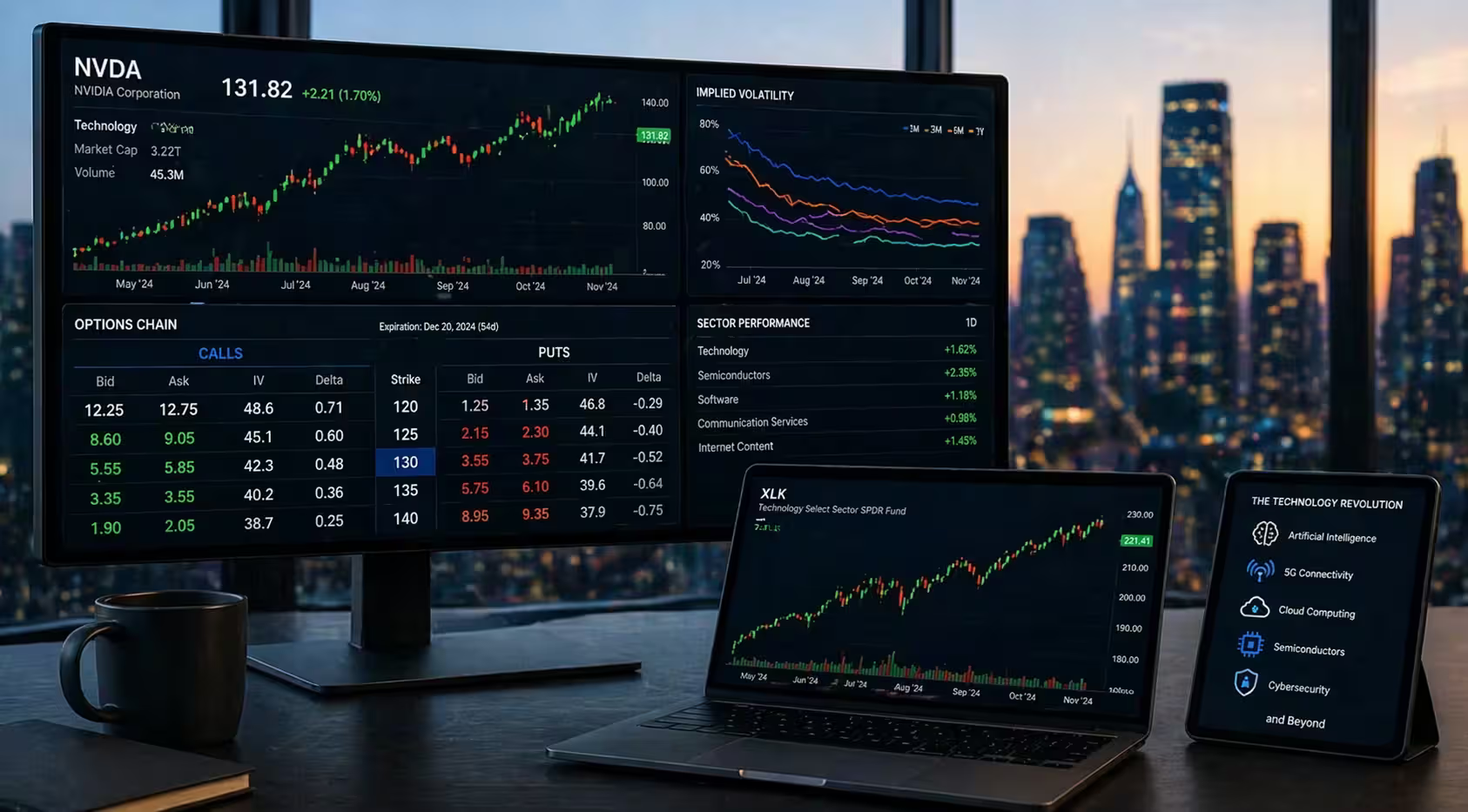
Imagine if you had invested in Amazon or Google during their infancy—how different would your portfolio look today? As we stand on the brink of another technological revolution with AI and 5G, similar opportunities are emerging. Emerging technologies like Artificial Intelligence (AI) and 5G are not just industry buzzwords—they are reshaping economies, industries, and daily life. You could think of this as the “technological tipping point.”
This guide will explore how options trading can be a powerful tool to capitalize on the growth of emerging tech industries like AI, 5G, and beyond, while effectively managing risk. Keep reading to learn how to invest in these emerging technology markets, but do so in a way where you can guard yourself against the potential risks that come with these sometimes volatile markets.
The Rise of Emerging Tech Industries
Artificial intelligence and 5G wireless cellular technology are two emerging tech sectors that have proven themselves to be lucrative investment opportunities for online traders. We’ll cover these two technologies as well as some other emerging technologies that you should keep an eye on in the future. Learn who the key players are and how these technologies are significantly impacting the US and international economies.
Artificial Intelligence (AI)
Artificial intelligence or AI is a useful tool that continues to develop over time and can lead to businesses and other sectors becoming more efficient and profitable once the systems have been integrated. It can be especially useful when dealing with problems or issues that arise or anticipating them. AI is currently transforming sectors from healthcare to finance.
Definition and Impact
AI refers to machines programmed to mimic human intelligence. Artificial intelligence uses math and logic in its systems to simulate human reasons, learning, and problem-solving. These machines can learn from mistakes to improve the accuracy of their performance, plus they can accurately and quickly process new information.

Market Growth
The AI industry is projected to reach a market size of $190 billion by 2025 (it grew beyond $184 billion in 2024) and then to $1.1 trillion by 2029 at a compound annual growth rate of 39.7% (2024-2029). On the lower end, AI industry growth might be around $826 billion US dollars in 2030, but experts are bullish in their predictions of the AI industry.
Key Players
Companies like NVIDIA, Alphabet (Google), and Tesla are at the forefront of AI development:
- NVIDIA: This company is primarily known for developing and providing hardware and software solutions that are responsible for accelerating AI computations. NVIDIA is a major player when it comes to AI due to their high-performance GPUs, which allow for faster trading and deployment of complex AI models. NVIDIA’s products are designed to handle the demanding processing needs of advanced AI algorithms.
- Alphabet (Google): Google is another key player who is at the forefront of AI developments. Google’s AI is a set of technologies that let computers perform complex tasks mostly through machine learning algorithms. Google currently has the AI overview feature, and they use AI to analyze data to identify patterns and trends to improve the relevance of search results.
- Tesla: This company uses AI technologies in its “Autopilot” systems, which make semi-autonomous driving a reality. AI is used for adaptive cruise control, automatic emergency braking, and lane keeping. These technologies process data from sensors and cameras to understand the surroundings and react accordingly to maintain safe driving practices.
5G Technology
5G is the wireless cellular technology in its fifth generation. Compared to previous networks, 5G is designed to be faster and more reliable, and it has a higher capacity to handle more work and connect more devices at the same time.
Revolutionizing Connectivity
5G offers faster speeds, lower latency, and the capacity to connect more devices simultaneously. The peak speed of 5G is 10 times faster than the 4G and 3G networks (20 gigabits per second). It allows users to download large files in less than a second. 5G also takes less time for the data to travel from one place to the next due to lower latency.

Economic Influence
5G technologies are expected to contribute $2.2 trillion to the global economy over the next 15 years. Some estimate that 5G will create $13.2 trillion in global economic value by 2035. It’s also projected that 5G will create 22.3 million jobs in the global value chain by 2035.
Industry Leaders
Companies like Qualcomm, Ericsson, and Nokia are at the forefront of 5G development. Let’s take a look at these industry leaders and what they’re doing to further the technology:
- Qualcomm: This multinational corporation has been developing 5G wireless technology for many years now. Their 5G products and services offer ultra-high-speed connections, ultra-low latency, increased reliability from previous iterations, increased availability, and a more uniform experience. Most notably, Qualcomm’s contributions to 3GPP have been instrumental in developing and driving the global standard for 5G.
- Ericsson: Another industry leader and notable player in the 5G sector is Ericsson, a global leader in ICT solutions and shaping how the world communicates. Ericsson features low-latency 5G, wider coverage via multiple spectrum frequencies, new 5G voice capabilities, and faster speeds through unlocking new bandwidths.
- Nokia: A company known for its innovations in telecommunications, Nokia is another notable industry leader in the 5G sector. They have the 5G Core that’s built on microservices, allowing for dynamic automation and scaling of resources. 5G-Advanced has reduced service interruptions, enhanced positioning, and offers improved throughput.
Beyond AI and 5G
While AI and 5G are two popular sectors to invest in, there are a few other upcoming technologies that could make for some promising future trading prospects.
Upcoming Technologies
A few of the upcoming technologies out on the horizon are quantum computing, biotechnology, and renewable energy. We consider these to be the next investment frontiers, the primary upcoming technologies that could be the next AIs or 5Gs. Further on in our guide, we’ll highlight these three sectors in greater detail.
Future Prospects
Early investment opportunities are abundant as these technologies mature, but traders must be cautious in how they choose to invest in these potentially lucrative sectors. It’s important to see the reward potential but to also appropriately weigh the risk. Avoid having too much exposure in any single sector or company. It’s best to have investments spread across multiple sectors or industries to avoid the possible setbacks that come from the volatility the market experiences from time to time around these emerging technologies.
Why Options Trading Is Ideal for Emerging Tech Industries
Trading options in emerging technology markets and industries can offer significant growth potential, but this can come at a higher risk than a more established sector or industry. This section of our guide will outline the best reasons for investing in these emerging tech industries and how these investments can positively benefit your portfolio.

Leverage in High-Growth Sectors
In options trading, leverage means the ability to control a large position in an underlying asset, while paying a small premium for the contract. It can result in larger gains from a smaller initial investment. High-growth sectors typically experience a considerable amount of leverage when it comes to options trading due to fast-growing businesses needing large amounts of capital to fund their expansion.
Amplifying Returns
Options allow traders to control large positions with relatively small capital outlay. By paying a fraction of the underlying asset’s price to buy an option, investors can experience considerable percentage gains even if there is a small price movement. The flip side of this is that a negative market movement could result in a significant loss for the investor. This makes balancing risk and reward so key when trading options with emerging tech sectors or markets.
Example
Controlling 100 shares of a tech stock via options could cost a fraction of buying the shares outright. Let’s say the standard options stock is trading at $100 per share and buying 100 shares would cost the investor a total of $10,000. If you are investing in tech stocks, however, buying a call option on that stock (with a $100 strike price) might only cost you $200, and you’re still able to control 100 shares but do so with a much smaller amount of capital.
Risk Management in Volatile Markets
New and emerging technologies are considered a riskier investment compared to established sectors. The price of investments in these new sectors can experience large fluctuations both upward and downward. It’s all due to the uncertain nature of emerging technologies and their potential to grow. Because there’s volatility involved in these investments (more so than others), investors should go into these situations with some hedging strategies in mind to mitigate potential losses and effectively manage risk.
Hedging Strategies
Options can protect against downside risks inherent in volatile tech stocks. Strategies include covered calls (short or long), protective equity puts (long puts and long stock), protective index puts, put spread collars, and collars on short calls, long puts, or long stocks. We’ll get into some of these hedging strategies further on in our guide, but the point, for now, is that it’s best to use these techniques to deal with the potential volatility you’ll experience with these emerging technology investments.
Limited Losses
Another substantial risk in volatile markets is the maximum amount of money that a trader will love on their investment. Most of the time, the max loss is limited to the premium paid for the option. This is where it can become critical to spread your emerging tech investments out over multiple sectors or to use stop-loss orders to mitigate potential capital losses.
Flexibility and Strategic Opportunities
One of the best things about trading options with emerging tech markets is that investors have the opportunity to employ a wide range of strategies that give them the flexibility to maneuver the market in a way where they can maximize potential gains and minimize potential losses.
Variety of Strategies
From calls and puts to straddles and spreads, options offer strategies for any market outlook. Depending on how the investor views the market (bearish, bullish, or sideways), there are plenty of strategies that are well-suited to investors who come from different experiential backgrounds or who have access to a different range of resources.
Profit from Volatility
Traders can design strategies that benefit from the high volatility of emerging tech stocks, particularly through the use of long straddles and long strangles. This is advantageous because emerging technology investors don’t have to correctly guess which way the market is moving, but these strategies simply must anticipate significant market movement one way or the other to be profitable. We’ll cover the volatility strategies further on in our guide when we get into the specifics of the long straddles and strangles.
Key Considerations When Trading Options in Emerging Tech
Before trading options in emerging technology markets like AI or 5G, there are a few aspects and factors that traders will want to consider before diving in. Volatility, time decay, liquidity, geopolitical risks, and regulatory risks all play a key role in options trading when you’re dealing with emerging technologies or newer technology sectors that are a bit more established. Let’s look at how these factors affect the trading process when dealing with these newer sectors.
Volatility Factors
Newer technology sectors are subject to volatility due to the uncertainty surrounding these investments. This ultimately affects options pricing, which we will cover below, and strategic timing is important when entering and exiting new tech sector investments.
Impact on Pricing
High volatility in these new tech sectors typically increases option premiums. What this means is that these trades are hard to enter when the market isn’t stable. The price to enter each trade goes up when volatility spikes, so it’s best to enter these trades when the market is relatively stable. Now, if you already have investments in these sectors when implied volatility shoots up, it becomes a prime opportunity for those traders to sell the options or “go short.”
Strategic Timing
Entering new tech sector options and other investments is best done long before a major announcement from the company. The closer you get to an earnings announcement or the release of a major report, the options and stock prices for these companies tend to go up due to increased volatility in the market around the uncertainty of the coming news. Therefore, entering positions before major announcements can be advantageous because the premiums tend to be much lower. It goes from being a buyer’s market to a seller’s market quickly as the company announcement gets closer.
Time Decay (Theta)
Time decay refers to the rate at which an option’s value decreases as the contract gets closer to its expiration date. Keep reading to find out how time decay can hurt your new tech sector investments and what you can do about it.
Erosion of Value
Options lose value as expiration approaches, especially out-of-the-money options. The more time left on the expiry, the slower the time decay because the investment has ample time to perform. Out-of-the-money options tend to decay much faster in the final month before expiration than do in-the-money options which decay at a much slower rate.
Mitigation Tactics
Though you have no control over time decay once the expiration date has been set, there is an element of control that traders and investors have in this situation: how long they set the expiration date for. Utilize longer-dated options if possible. This can be especially helpful when using LEAPS (long-term equity anticipation securities) where the expiration date is set one to three years out from the initial purchase of the contract.
Another way to not fall subject to time decay is to choose options that hold up better to the inevitability of time decay. For instance, in-the-money options are the best when it comes to this, and they’re characterized by the current market price of the underlying asset being better than the strike price. When possible, choose options that embody these qualities, and you’re more likely to have positions that have appropriate time to perform well for you.
Liquidity Concerns
New tech industries and sectors tend to be less liquid for investors, which means that it can be harder to find a trade partner quickly for these investments. Find out the issues with market depth in these investments and the execution risks you might face in these scenarios.
Market Depth
Because there can be uncertainty in the future of new tech markets and sectors, these options tend to be less liquid, which means that they are more difficult to buy and sell quickly. More established industries and markets tend to have highly liquid options because consumers have more faith in them. The lack of liquidity and market depth in some cases for these investments can lead to wider bid-ask spreads. This refers to the difference between the price that the buyer is willing to buy and the price where the seller is willing to sell.
Execution Risks
Due to lower liquidity with these investments, it can become difficult for investors to enter or exit positions at desired prices. It’s all rooted in the uncertainty surrounding these new markets and what kind of future they might have. Investors are more likely to find premiums that are a higher price than they are willing to pay and slower movement when it comes to finding viable purchase opportunities or getting a trader partner to sell positions to.
Regulatory and Geopolitical Risks
Now, let’s look at the regulatory and geopolitical risks that are posed when trading options in emerging markets focused on new technologies. These shifts can have a major impact on these industries, and they’re worth keeping in mind before diving into these kinds of investments.
Policy Changes
Shifts in regulations like new policies and laws can have drastic effects on how the company operates and functions. It can take a toll on the influence of product development or the determination of the business’ market viability. Policy changes and new regulations can present opportunities, challenges, and concerns for emerging tech businesses in the form of innovative disruption, business model changes, compliance costs, or consumer protection.
Global Events
Geopolitical tensions may affect multinational tech companies. Supply chains could be impacted. Certain events could cause data privacy concerns. Even market access and the regulatory environment are subject to unsettling changes in light of geopolitical events. If there’s a situation where a tech company is present in two countries that are at odds with one another this could lead to negative things like sanctions, restrictions on trade, or bans on certain products or technologies.
Strategies for Trading Options in AI and 5G Sectors
What are some good strategies and trading techniques when dealing with options in the AI and 5G sectors? To be honest, many of the common trading strategies that investors use in their daily trading sessions apply to these kinds of investments. In this section, we’ll highlight the bullish strategies, hedging strategies, and volatility strategies that are best to use when navigating investments in the AI and 5G sectors.
Bullish Strategies
Investors and traders in the 5G and AI sectors can use these strategies when they expect to see a rise in the asset price. Bullish strategies are all about a positive market outlook—investors are expecting the market to go upward.
Long Call Options
Investors can use the bullish long call strategy when they feel the price of the underlying asset will rise. The intent is to profit from stock price increases while enjoying limited downside risk. It involves buying a call option, giving buyers the right to buy the underlying asset at a certain strike price by a certain expiration date. Long calls have the potential for high gains, especially if the stock price rises considerably and the value of the call option goes way up. The biggest risk associated with the long call is the premium paid for the option.
Call Spreads
Another bullish strategy one can use when trading in the AI and 5G sectors is the call spread, which reduces the net premium paid and breakeven point. This one involves buying and selling call options at the same time, specifically one bull call spread and one bear call spread.
- Bull Call Spread — Buy a call option and sell another call option with the same expiration date. However, the call option being sold has a higher strike price. If the stock price increases, the strategy profits, despite the short call capping potential gains. There’s an initial cost upfront, too considering the call option bought is worth more than the money received from the sale of the other call option.
- Bear Call Spread — Investors can use this strategy to benefit when the underlying price falls. It involves selling a call option with a lower strike price and buying a call option with a higher strike price. The investor earns a premium from selling the call, but they pay a premium for buying the call option. This ultimately results in a net credit!
Hedging Strategies
Let’s look at a few common hedging strategies and techniques that could come in handy for investors who are trading options in the AI or 5G sectors. Hedging is a risk management technique where traders protect their investments from negative market movements. It involves taking an opposite position with a related asset.
Protective Puts
Investors can use the protective put strategy as a form of insurance against a decline in stock price. It allows traders to limit losses when owning a stock or any other asset—a stock price dip causes the put option to increase in value, which can offset potential losses. Protective puts involve the investor buying a put option on the same stock they already own or buying a put simultaneously when buying a new stock. Protective puts have unlimited potential profit (minus the cost of the calls and puts).
Collars
The protective collar is a defensive options strategy that is used to limit both the upside and downside potential for a stock position. Collars are best used when investors are holding a long position on a stock and want to protect against potential losses. They can also be used to protect investors against interest rate risks.
Volatility Strategies
There are some instances where it is profitable to invest based on market volatility and how it could affect option prices. Volatility strategies are trading approaches where investors take advantage of market price fluctuations.
Long Straddles
The long straddle involves the investor buying a call option and putting an option on the same underlying security at the same time. Long straddles have the same strike price and expiration date. Investors can benefit from significant price movements in either direction.
Though they might be unsure if the price will move up or down, they are certain that there’s going to be a significant shift of some kind.
Long Strangles
The success of this strategy depends on the underlying stock’s price either falling or rising by a considerable amount. Long strangles are similar to long straddles, but they come with different strike prices for calls and puts. The strangle involves one long call with a higher strike price and one long put with a lower strike price. The stock price has no upper limit on how high it can rise, so the maximum profit is technically unlimited with the profit potential on the upside being limitless. The maximum loss is the total premium paid for the call and put option.
Case Studies
Let’s turn to some case studies of different situations where different strategies might work in the best interest of the investors when it comes to trading options with emerging tech companies. In just about any instance, you can find a viable approach to trading options within these sectors and industries no matter what good or bad news might come along.
Case Study 1
When two companies plan on announcing a major partnership, this tends to result in a rise in the companies’ stock prices. If investors catch wind that this might be a possibility, they could profit significantly from a call option on an AI stock before the coming partnership announcement. If the news about the merger or partnership is well-received, the stock price could go way up resulting in some substantial profits.
Buying a call option before the meeting has to be done in a way where you get the direction of the market movement right and get a good premium (buy-in price) to maximize the potential profit. If the news goes over well, the investor can exercise the call options to buy shares at a lower price and sell them at a higher price for a profit!
Case Study 2
The protective put strategy is best used in scenarios where investors want to limit losses while still capturing potential returns. So let’s look at an example of using a protective put on a 5G stock ahead of regulatory decisions—this strategy is best used when investors anticipate that new regs will negatively impact the price of the stock. The goal here is to mitigate potential downside risk in the stock you already own.
When putting together the protective put, set the strike price at a level that insulates you from substantial losses but also lets you experience potential upside if the market takes the news of the new regulations well. Note that put options will cost a lot more if the market is generally expecting negative things to come from the regulatory changes. With the protective put, investors can sell their shares at the strike price if the stock declines which basically limits potential losses.
Beyond AI and 5G: The Next Frontier in Tech Options Trading
It’s great to trade options on AI, 5G, and other emerging markets and sectors in 2026, but what else could be coming down the pike? Good traders and investors keep an eye on emerging opportunities that could benefit them with high returns and impact. We’ll highlight some of the steps you can begin taking to discover and evaluate potential deals that align with your personal trading goals and values.

Identifying Emerging Opportunities
A great way for investors to spot new opportunities in markets and sectors that are possibly up-and-coming is to do some decent research and look for early indicators:
Research Techniques
- Monitor Industry Reports: Follow these reports to keep a close eye on startups in the sectors you believe are on the rise. You can stay updated on the problems or needs of startups in these markets and what they’re doing to resolve these issues and challenges. All this data can be accessed through comprehensive industry reports, where you can monitor what’s going on in these markets or sectors.
- Attend Tech Conferences: Networking with founders and investors at events like these can be key for investors to gain insights into emerging technology markets and sectors. Attending tech conferences can help investors build relationships with key people and access recommendations, referrals, and intros to potential startups.
- Accelerators and Incubators: These are programs that support and mentor startup businesses in your target markets or sectors. Accessing this data helps investors understand where startups are in the development process. Program managers and mentors will also keep investors in the loop on any demo days or events that are coming up, allowing investors the opportunity to learn more about each company and the sector they represent.
- Data and Analytics: Pinpoint the most relevant and promising candidates within each sector or market using data and analytics which can save you the time and energy of looking for them on your own. Using data/analytics can help investors benchmark startups against their peers and pinpoint signals that are showing the best traction, growth, or potential.
Early Indicators
Early indicators are metrics (financial and economic) that can signal a potential crisis or instability in the future. Monitoring early indicators is important for investors because it helps them to identify risks early on and adjust their investment approach accordingly.
One significant way to avoid risk in these investments is to look for companies investing heavily in R&D and patent filings such as:
- Microsoft
- Apple
- Samsung
- Amazon
- Volkswagen
- Pfizer
These companies consistently dedicate a substantial amount of their revenue to new and developing technologies. Emerging markets that have the backing of these major companies are typically a good choice to invest in. That’s just a general rule of thumb—of course, these emerging sectors or markets are subject to risk too.
Upcoming Technologies
We mentioned them earlier in our guide, but now we will highlight each of these up-and-coming technologies in greater detail. We feel these are the three newcomers that might become as lucrative of investment opportunities as AI and 5G now.
- Quantum Computing – This is a computer science that uses quantum mechanics to solve problems much faster than regular computers. It’s still in its early stages of development and it’s not widely implemented commercially yet. Research and development on quantum computing is rapidly progressing, but the technology is not yet available for widespread, mainstream use. It’s a future sector to keep an eye on and is expected to be a lucrative market for trading options and other instruments.
- Biotechnology Advances – Another emerging technology, biotechnology has been making advancements in arenas like personalized medicine, synthetic biology, and gene editing. This tech is making strides in industries like agriculture, energy, and healthcare, but still in the initial development stages where its ultimate impact has yet to be realized.
- Renewable Energy Technologies – This rapidly evolving field is still working out its efficiency and accessibility through ongoing innovation and development. Ongoing advancements include marine energy capture, solar cells, and energy storage solutions. One big reason to keep an eye on this emerging sector is due to recent technological advancements that are continuing to make renewable energy more cost-effective and viable on a larger scale.
Adapting Strategies
If you want to successfully trade options in emerging tech markets and industries, it’s key to use a trading strategy that is appropriate for the current market conditions and the dynamics of the emerging industry. Investors need to tailor customized approaches to these situations and stay up to date on market trends and the technological advancements in the sectors that are driving those trends.
Customized Approaches
Tailor options strategies to the specific dynamics of each emerging industry. You have to base your strategy on the unique characteristics of that particular market like market transparency, political instability, high volatility, or other economic dynamics. Adapting the correct approach will involve flexibility to navigate changing conditions, risk management assessment, and in-depth analysis and research.
Focus on these aspects of adapting your trading strategy in emerging markets:
- Liquidity—Find liquid assets when possible within each market to find trading opportunities where entering and exiting a position doesn’t have to be difficult.
- Volatility—Focus on this aspect of your trading strategy to correctly determine what your risk management techniques will look like. It will help inform your decisions when it comes to portfolio diversification, setting stop-loss orders, and determining the correct position size.
- Understand the Market—Learn as much as you can about the emerging market, including industry trends, local regulations, or potential risks/opportunities.
- Fundamental Analysis—Use this to compensate for discrepancies between underlying economic conditions and market valuation. A focus on fundamental analysis presents value investing opportunities.
- Currency—You may have to use a hedging strategy if there’s exchange rate volatility due to currency fluctuations, which ultimately impacts returns.
- Political Risk—Keep a close eye on potential instability due to political developments. Understanding how these events could impact market movements, you can begin tailoring an appropriate hedging strategy.
Continuous Learning
Stay updated on technological advancements and market trends—it’s key for investors to keep in the loop to stay on top of their trading strategies. As conditions change, it’s generally best to adjust the strategy to keep profitable. For instance, an emerging player in an up-and-coming tech sector might be researching a product that’s expected to make their stock price go way up. When you keep on top of news and developments like this, you can curate and customize strategic trading plans that take advantage of these events.
Risk Management and Due Diligence
In emerging markets, there are increased compliance risks. These are the potential scenarios where an organization or business might face legal or financial consequences if they don’t adhere to industry standards, regulations, or laws. This section of our guide will highlight risk management and due diligence practices that investors can employ to get around these potential risks.
Comprehensive Research
Doing good research on startups through fundamental and technical analysis is a good way to conduct risk management with these types of investments. You’re also doing due diligence on each of these companies to ensure they are viable investment options.
Fundamental Analysis
To learn which companies are less likely to fall into issues with industry-standard compliance, investors can evaluate company financials, management teams, and competitive advantages.
– Evaluate Company Financials: Access income statements that show a company’s performance including revenue and net income. Compare the net profit margin from year to year. View the company’s assets, equity, and liabilities using the company’s balance sheet. Access cash flow statements as well which track receivables, net income, debt, and depreciation.
– Evaluate Management Teams: Take a look at the company’s operational expertise and the management team’s problem-solving skills. Look at the leaders’ cultural fit and alignment with the startup’s values and consider their ability to address challenges effectively.
– Evaluate Competitive Advantages: This means assessing the aspects and factors that set the company apart from other competitors in that market or sector. It involves looking at factors like intellectual property, market differentiation, unique value propositions, scalability, and team expertise.
Technical Analysis
New markets that are just coming onto the scene when it comes to options trading inspire different emotions with investors such as greed, optimism, fear, or pessimism. With the power of technical analysis, investors can learn what is driving these emotions. Technical analysis measures and interprets things like greed or feat using useful indicators such as moving averages, oscillators, volume, candlestick patterns, or volatility. Use these charts and indicators to identify trading opportunities.
Diversification
As with any other kind of investment, investing in emerging tech markets requires traders to spread their investments into multiple companies or sectors to avoid being hit with a large loss if their trades were only sitting with a few companies. Asset allocation is key to creating a diverse portfolio of emerging tech trades that will last.
Spread Risk
Don’t concentrate investments in a single stock or sector. Spread out your investments to insulate yourself against a scenario where a major market movement could wreak havoc on investments in only a few positions. Along with spreading out risk, be sure to use the proper position size on each investment, never using more than 1-2% of your capital on any given trade.
Asset Allocation
Balance options trading with other investment vehicles. Allocate some of your capital to stocks (higher-risk investments), bonds (lower-risk investments that secure consistent income), mutual funds (pooled investments), or exchange-traded funds. The more you can diversify your portfolio into multiple investment vehicles (direct or indirect investments) that you can reduce risk and maximize your growth potential.
Setting Limits and Stops
Another primary way to manage risk when investing in 5G, artificial intelligence, and other emerging tech markets or sectors is to use orders like stop-losses and to correctly position the correct amount of money on each trade.
Stop-Loss Orders
It’s key to set up these orders to mitigate potential losses. The stop-loss is designed to automatically sell positions to prevent excessive losses. It’s one of the most powerful tools to ensure that losses are kept to a limit.
Position Sizing
Limit the amount of capital allocated to any single trade. We highly recommend never going beyond 1-2% of your available capital on any given trade. If you go beyond that limit, you can begin risking more money than is necessary, and you could wind up in a situation where you’re going through more of your bankroll than you would like to in the event the market goes against you.
Don’t Miss the Chance to Trade in Emerging Technology Markets
When it comes to investing in emerging tech markets, traders should seize these opportunities because they have the chance to participate in the growth of emerging tech industries. However, this endeavor is a balancing act—the potential rewards are significant as are the potential risks. Prudent risk management is essential to be successful in trading options in these emerging tech markets and sectors. It’s key for traders and investors to do good research on the companies they want to invest in, diversify their investments into multiple sectors/markets and multiple investment vehicles, and set up stop-loss orders to mitigate potential losses.
Are you ready to navigate the exciting world of options trading in emerging tech? Explore our resources at OptionsTrading.org to get started.