
Key Takeaways
- Yes, but mostly before the break: most holiday time decay is in the option's price before the holiday.
- Calendar vs trading time: pricing models usually count calendar days, but markets mostly move on trading days.
- The data backs the mechanism: since 1990, the S&P 500's Wednesday-to-Friday Thanksgiving move carried about half a normal session's variance.
- It shows up in IV: short-dated implied volatility can quote lower ahead of a closure.
- Check the schedule: the day after Thanksgiving closes early, at 1:00 p.m. ET, with some options trading until 1:15 p.m.
Yes, options keep losing time value over Thanksgiving, because the calendar keeps running while the market is closed. But much of that holiday time decay is usually in the option's price by Wednesday's close, so, all else equal, the closed Thursday rarely shows up as a fresh drop when trading resumes on Friday. Options lose time value over weekends and other market holidays the same way.
The reason is a mismatch between two clocks. Option prices are usually quoted as if every calendar day counts, while the market mostly moves when it's open, and Thanksgiving week has one full day closed and one cut short. Option prices can absorb that gap ahead of time, which typically shows up as lower quoted implied volatility going into the break.
What Holiday Time Decay Is
The short version: holiday time decay is the time value an option loses across a day the market is closed.
Every option's premium is made of intrinsic value, the amount it's already in the money, and extrinsic value, everything else the buyer pays for time and uncertainty. Our guide to intrinsic vs extrinsic value covers the split in detail. Extrinsic value shrinks as expiration approaches, a process called time decay, and the Greek that estimates how much an option loses per day is theta.
The question on a holiday is what counts as a day. Pricing models such as Black-Scholes measure time to expiration in years, and a common convention, used in Cboe's VIX calculation and on most retail platforms, is calendar time. Many professional market makers instead use a trading-day clock that gives weekends and holidays little weight. Cboe's own VIX methodology does exactly this: its worked example divides the minutes until expiration by 525,600, the number of minutes in a 365-day year, so every calendar minute counts, open or closed.
Volatility doesn't work that way. Prices move mostly when the market is trading and new information is being absorbed, which is why a weekend doesn't produce three days' worth of movement. Holiday time decay lives in the difference between those two clocks.
The calendar keeps running over a holiday, but the market doesn't. Option prices account for both, and the gap between them is where holiday time decay hides.
How Holiday Time Decay Works
The schedule: NYSE's holidays and trading hours page lists Thanksgiving Day as a full closure and the day after as an early close at 1:00 p.m. ET, with eligible options trading until 1:15 p.m. ET. Cboe's options holiday schedule also lists the Friday as an early close. Options that normally stop trading at 4:00 p.m. ET stop at 1:00 p.m., while those that normally trade until 4:15 p.m., including some index and ETF options, run until 1:15 p.m., with an exception for expiring SPXW options covered below.
That means the stretch from Wednesday's close to Friday's close covers two calendar days but only about half a trading session. A pricing model that counts calendar days sees two days of decay. A trader who thinks in trading sessions sees about half of one. Which view is right decides how much the option should lose over the holiday.
A worked example: suppose stock XYZ trades at $100 at Wednesday's close, and an at-the-money call (one whose strike equals the stock price) with a $100 strike expires at the close nine calendar days later, on the Friday of the following week. Assume 20% implied volatility, no dividends and zero interest rates to keep the arithmetic clean.
For an at-the-money option under those assumptions, the Black-Scholes value simplifies to the stock price times [2N(σ√T ÷ 2) − 1], where N is the standard normal cumulative distribution.
Counting calendar days, the steps on Wednesday go like this:
- Time to expiration: T = 9 ÷ 365 = 0.02466 years, so √T = 0.15703.
- Volatility over that time: σ√T = 0.20 × 0.15703 = 0.03141, and half of that is 0.01570.
- N(0.01570) = 0.50626, so 2N − 1 = 0.01253.
- Value: $100 × 0.01253 = $1.25 per share, or about $125 per contract.
In plain terms, σ (sigma) is implied volatility written as a decimal, T is the time left in years, and σ√T is roughly a one-standard-deviation move over the option's remaining life, for example about 3.1% here. N(x) is the chance that a value on a standard bell curve lands below x, which spreadsheets compute with NORM.S.DIST(x, TRUE).
Suppose nothing else changes. By Friday's close, seven calendar days remain. Repeating the steps with T = 7 ÷ 365 gives σ√T = 0.02770 and a value of $1.10. The calendar-day view says the call lost about $0.15 per share over a holiday stretch with only half a session of trading.
Now count in trading time instead. Variance is volatility squared, a measure of how spread out moves are, and it adds up over time. Suppose all of it arrives during trading sessions, split evenly and, for simplicity, none on closed days, and calibrate so five sessions carry the same variance as seven calendar days at 20%: 0.20² × 7 ÷ 365 = 0.000767, or about 0.000153 per session.
Suppose it's Wednesday again. The option has 5.5 trading sessions left: Friday's half session plus five the next week. Variance is 5.5 × 0.000153 = 0.000844, so σ√T = 0.02905, and the same formula gives about $1.16. Dividing 0.02905 by Wednesday's √T of 0.15703 gives the calendar-day implied volatility a screen would show, about 18.5%.
Now suppose we reach Friday's close: five sessions remain and the value is $1.10, the same as before, because that's how the model was calibrated. In trading time, the holiday stretch only cost about $0.05, the value of Friday's half session. That's about $5 per contract, and almost none of it comes from the closed Thursday, so in this model the call would open on Friday close to its Wednesday closing value.
| Measure | Counting calendar days | Counting trading sessions |
|---|---|---|
| Call value at Wednesday's close | $1.25 | $1.16 |
| Call value at Friday's close | $1.10 | $1.10 |
| Value lost over the holiday stretch | about $0.15 | about $0.05 |
| Implied volatility shown Wednesday (calendar-day basis) | 20.0% | about 18.5% |
The two views agree once the holiday has passed. They disagree about when the decay happens. In trading time, the decay isn't skipped, it just comes earlier: the option was already worth about $0.09 less on Wednesday ($1.16 instead of $1.25), because it had fewer sessions left than the calendar suggests. Put another way, in trading time that decay was spread across the earlier trading sessions, which lost value a little faster than the calendar implies. Because quotes are still expressed as calendar-day implied volatility, that shows up as a lower number on your screen, for example about 18.5% instead of 20% here.
By the time the market closes for a holiday, much of the decay that holiday will cause is usually already in the price.
What the S&P 500 Actually Does Over Closures
The data: in Cboe's S&P 500 daily history from 1990 through 2025, the squared move from Wednesday's close to Friday's close over Thanksgiving averaged about 0.47 times that of a normal one-session move, on our calculation.
If every calendar day counted equally, that two-day stretch should have carried twice the variance of a normal session. It carried about half, which fits a closed Thursday plus a half-day Friday. With only 36 Thanksgivings, that estimate is rough.
The pattern holds for weekends too: from Friday's close to Monday's close, three calendar days with one session, the index's variance averaged about 1.27 times a normal session, not three times, using the same Cboe data.
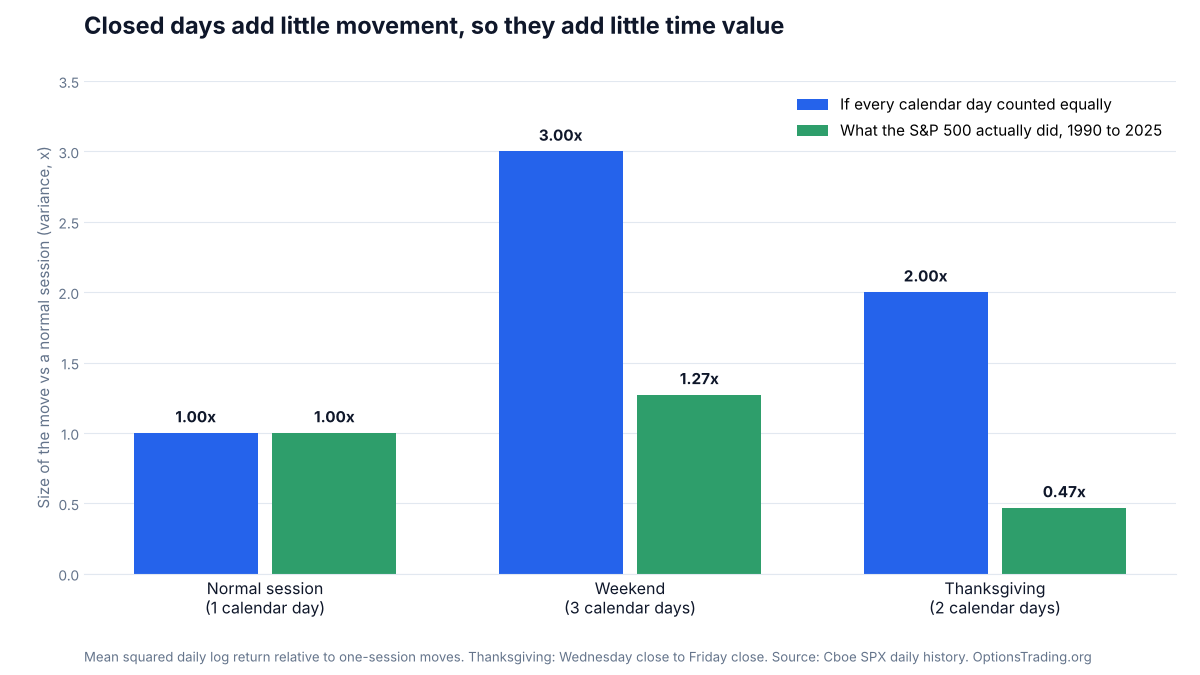
The measure here is the average squared daily log return (the percentage move, measured on a log scale), the building block of variance, compared across 36 Thanksgivings, about 1,600 weekends and about 7,100 ordinary one-session moves. Closed days still add some risk, because news keeps arriving, but far less than a full trading day. The result holds if the sample starts in 2000 or if you compare median moves instead of averages.
That's the reason the trading-time view in the worked example is the more realistic one. An option's value depends on how much the stock can move before expiration, and a closed day contributes little movement.
How Holiday Decay Differs From Weekend Decay
Holiday decay and weekend decay come from the same mechanism, but the details change how much they matter. Some weekend strategies treat closed days as extra profit for option sellers. The S&P 500 data above shows why closed days are usually priced as carrying little risk, so much of that decay is in the premium before the close. Research on weekends suggests the adjustment isn't always complete: a 2018 Journal of Finance study found option returns significantly lower over nontrading periods, which the authors attribute to mispricing. Any leftover edge has to be weighed against the risk of a sharp move when trading resumes.
- Frequency: weekends come every week, so their effect is built into how short-dated options are routinely quoted. Market holidays come a handful of times a year and fall on different weekdays.
- Size of the gap: a normal weekend is two closed calendar days. Thanksgiving adds a closed Thursday, and the day after Thanksgiving is a half session, so a single week can lose one and a half sessions instead of none.
- Expiration timing: a holiday can move an expiration date or cut the last trading day short. A weekend never does.
- Who notices: holders of options expiring within a few days feel holiday decay most, because time value makes up most of their premium. Our ranking of the positions that suffer most from time decay shows why.
The practical difference is that a holiday is easy to forget when you set up a position the week before. A five-session expiration week that turns into three and a half sessions changes how fast an option's time value has to disappear.
Why Holiday Time Decay Matters to Traders
The main error it prevents is expecting free money from the calendar. A common idea is to sell options on Wednesday and collect an extra day of decay while the market is closed. If the market has already priced the holiday in through lower implied volatility, the seller collects roughly what the closure is worth, not a bonus day, and still carries the risk that the stock gaps, or opens sharply higher or lower, when trading resumes.
It also explains why implied volatility can look lower ahead of a holiday and then bounce back afterward even if nothing in the market changed. A buyer comparing Wednesday's quote with Monday's may see a jump in implied volatility that's mostly a quoting convention, not a change in risk. For example, in the trading-time model above, the same option would show about 23.7% implied volatility at Monday's close with nothing else changed. Our guide to vega explains why that matters for option prices.
Finally, it matters for planning around expiration. A position that needs a few trading days to work has fewer of them in a holiday week, and an option that would have had a full Friday session to recover may stop trading at 1:00 p.m. ET.
Edge Cases and Gotchas
Early-close expirations. Options that expire on the day after Thanksgiving stop trading early, but not always at the same minute. Cboe's SPX specifications say expiring SPXW options (SPX Weeklys and End-of-Month options) stop trading at 1:00 p.m. ET on a half-day holiday instead of the usual 4:00 p.m. ET, while non-expiring SPX options and some other index and ETF options can trade until 1:15 p.m. ET. Know your contract's last trading time before you plan an exit on that Friday.
Expirations that land on a holiday. When an expiration date falls on a market holiday, it usually moves. Cboe's SPX Weeklys specifications say a holiday settlement date moves back one business day, from Friday to Thursday for example, except for Monday Weeklys, which move forward a day. Check the exact rule for each product you trade.
Not every market is fully closed. Cboe's options hours page lists overnight sessions, called global trading hours, for some index options, such as SPX and VIX, that run until 11:30 a.m. ET on Thanksgiving Day, even though regular trading hours are closed. Most stock and ETF options don't trade then, so check whether your contract has a session.
Your platform's day count. Brokers and analytics tools differ in how they count days to expiration and how they compute theta. Some use calendar days, some use trading days, and some let you choose. Two screens can show different theta for the same option, so check the platform's documentation before comparing numbers.
Thin holiday sessions. Trading volume on a shortened session can be lighter than usual, which can mean wider bid-ask spreads (the gap between the prices buyers pay and sellers receive). The theoretical decay can be smaller than the cost of getting in and out.
The Bottom Line
Options do keep losing time value over Thanksgiving, but the closed Thursday rarely shows up as a fresh drop when trading resumes. The market tends to price the break in ahead of time, so by Wednesday's close an option is a little cheaper and its quoted implied volatility a little lower.
For short-dated options, the details that matter most are Friday's early close, your contract's exact last trading time, and the fact that a seller collects what the closure is worth, not a free extra day.
This article is for educational purposes only and isn't a recommendation to buy or sell any security or option. Options involve risk and aren't suitable for all investors.
FAQ
These answers cover the questions traders usually ask the week of Thanksgiving, once the basic mechanism is clear.