Humans have always had a thing for the planet’s natural rhythms—especially the kinds of cycles we can’t control, like the change of seasons or the pull of the tides. And one of the oldest of these fascinations is the moon. We’ve been looking up at it for centuries, and some of you might feel like it has an effect on how we behave. People talk about full moons like it’s some kind of cosmic agitator, changing our moods, sending our sleep patterns wonky, and even changing humans into werewolves (at least in the movies).
Stay with us here and suspend reality—if the moon’s that powerful to disrupt our circadian rhythm and make us cranky, could it also affect the stock market? Yes, it sounds nutty. But there are people who genuinely believe that the lunar cycles have an impact on financial markets. And if that’s true, it would be the kind of info that options traders could actually use to their benefit!
The belief that the moon is pulling the strings on human behavior is not a new thing—ancient civilizations believed the moon’s phases impacted everything from crop growth to fertility, and over time, people started associating those same phases with mood swings and bursts of energy (or lack thereof). And if the moon’s got that kind of a rep, it’s not so out there to think that it might influence other things, like market trends.
What exactly are we getting at, and are we off our rockers on this theory? Maybe! That’s why we want to explore and see if there is any merit to this whole moon-market theory. Are lunar cycles just whimsical things, or is there actual evidence that could possibly help traders? If you’re a skeptic or a believer in the cosmos, we’ll try to figure out if watching the moon could actually be a practical part of an options strategy. Is there something in the stars—or is it just a lovely myth?
Understanding Moon Phases and Their Traditional Impact
The moon has been our constant companion at nighttime—it marks the passage of time and adds beauty to the night sky. But it’s not just an orb to be admired; the moon’s phases have guided everything from farming to fishing, and people swear that the moon can affect the way we feel. So, what exactly is it about the lunar cycle that gets under our skin?
Explanation of the Lunar Cycle
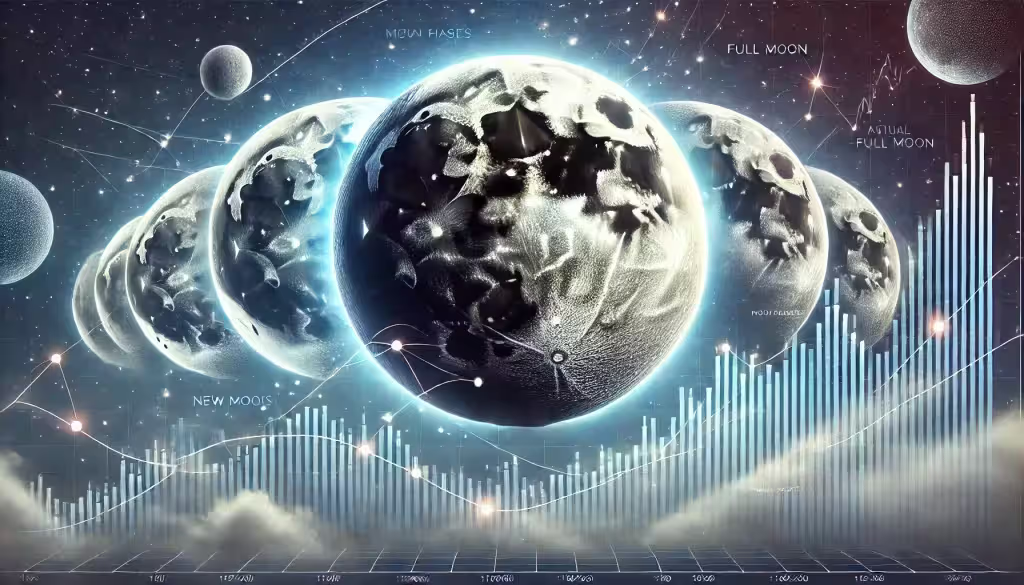
The lunar cycle takes about 29.5 days, and each phase has its own character and history:
- New Moon: Positioned between the Earth and the sun, the moon is nearly invisible during this phase. Traditionally, it’s seen as a time for new beginnings, a fresh slate for planting seeds or setting intentions.
- First Quarter: The half-moon appears as the moon “waxes,” or grows brighter. This phase often symbolizes a time of decision-making, energy, and facing challenges.
- Full Moon: The moon shines bright in the sky, fully illuminated. Many cultures have linked the full moon with peak energy and intensity, sometimes even attributing changes in mood or behavior to its light.
- Last Quarter: Another half-moon phase, but this time as the moon “wanes” or fades. Traditionally, it’s a moment for reflection and letting go, moving toward completion.
Farmers have planted and harvested with the lunar phases for centuries, and fishermen have followed its pull on the tides. But the moon’s reputation doesn’t stop there—it’s long been thought to have an influence on the human mind and full moons have been blamed for everything from restless behavior to erratic emotions.
Influence of the Moon on Human Psychology
There’s a popular belief that the moon can impact moods, especially when the moon is full. Some studies have investigated whether lunar phases have any influence on behavior or decision-making, but the findings are all over the place. A few researchers have noticed patterns in things like sleep quality, as some people report they have more trouble sleeping during a full moon. Others have found anecdotal connections between the full moon and mood swings or bursts of energy, though there isn’t any strong scientific evidence to back up the claims.
Still, the beliefs remain, and it’s probably because of cultural stories and our own personal experiences. When something strange happens under a full moon, it stays with us and reinforces that link, even if it’s only a coincidence. But there are traders out there who keep a watchful eye on the lunar calendar, just in case the phases do indeed affect investor mood confidence or sway their decision-making in the markets.
Theories Behind Moon Phases and Market Volatility
Could something as ancient as the moon have anything to do with the ups and downs of the stock market? Sounds like a big stretch, but it’s a theory that’s been bandied about in trading circles for some time. The basic idea is that just like the moon has been tied to cycles of behavior, it could also influence the moods and choices of investors in ways that could show up in market patterns.

Full Moon and Emotional Volatility
The full moon is notorious for stirring up weird emotions, and some believe this could influence trading as well. The theory goes that during a full moon, emotions run amok, which could cause more impulsive trading decisions. A study in the Journal of Empirical Finance observed lower stock returns around full moons than new moons, hinting that heightened emotional states may result in quick reactions or riskier moves.
In practical terms, this might mean that under the full moon, traders are less restrained and making rapid buy-sell decisions that pump up trading volumes. If a bunch of traders are letting their instincts take over, it would correlate to price swings that wouldn’t normally happen. If the full moon amplifies emotions, it could mean more unpredictability in the market.
New Moon and Market Calmness
The new moon is usually observed as a time for renewal or a chance to start anew. Some theories suggest that during the new moon, traders might approach the market with more caution, which means a smoother, more stable environment. The same study found that stock returns were higher around new moons, which shows a much more measured approach—traders are taking the time to reassess.
If the full moon brings an emotional charge, the new moon hits the pause button. Traders could feel more level-headed, which equals steadier trading patterns and lower volatility. For those investors out there who are curious about any kind of lunar connection, this phase represents a rare moment of calm in the crazy market space.
Waxing and Waning Cycles as Market Trends
The moon’s waxing (growth) and waning (decline) phases are also part of the whole lunar theory. During the waxing phase, as the moon grows toward fullness, it is viewed as a time of building up energy, which some connect with bullish (growth-focused) market sentiment. As the moon wanes from full to new, it could echo a change toward reflection and caution, and that lines up with a more bearish (profit-taking) mindset.
A study called “Lunar Cycle Effects in Stock Returns” noted that returns around new moons were about twice as high as those around full moons, reinforcing the idea that the cycles could sway investor behavior in subtle ways.
We know that these ideas don’t hold for everyone, and countless other factors drive markets. But for those who are intrigued by a possible lunar connection, tracking the phases could be a fun new way to read the market’s moods!
Reviewing Research and Case Studies
The moon has long fascinated people, not just as a celestial body but as something that might influence everyday life. Could its phases have an impact on market trends, too? While it sounds unusual, researchers have taken a closer look at whether these lunar cycles correspond with shifts in trading behavior, market volatility, or stock performance. Let’s explore some studies and case examples that aim to untangle this moon-market theory.
Existing Studies on Moon Phases and Market Behavior
Researchers have tested the idea that moon phases might sway investor behavior, and a few studies have emerged with findings that are certainly interesting:
- “Lunar Cycle Effects in Stock Returns”: This study observed stock returns across different countries and found a noticeable pattern. Returns in the days around new moons were nearly double those around full moons, suggesting that investor behavior might subtly shift in sync with the moon. The theory is that psychological factors tied to the lunar cycle could lead investors to act differently depending on the phase—feeling more cautious around a full moon and perhaps more optimistic about a new moon. While it’s hard to call this conclusive, the findings have certainly added to the conversation about how market psychology might align with natural cycles.
- “Are Investors Moonstruck? Lunar Phases and Stock Returns”: This paper studied global stock markets and found that stock returns were consistently lower around the full moon compared to the new moon. The researchers proposed that a full moon’s reputation for stirring emotions could influence investor behavior, leading to more hesitation or caution in trading. While they didn’t find a direct cause-and-effect relationship, the study hints that moon phases might subtly play into market sentiment.
Case Study Examples
Alongside academic studies, anecdotal observations suggest that market activity could indeed show patterns during particular moon phases. While these are observations rather than formal case studies, they give an intriguing view into how some people see lunar phases impacting market behavior.
- Full Moon Periods: Some traders have noted that market volatility seems heightened around full moons, with trading volumes rising as more people engage in the market. This aligns with the idea that the full moon could amplify emotional responses, leading traders to act on impulses rather than sticking to their strategies. This effect might be even more noticeable in times of economic uncertainty, as emotions are already running high. But you have to remember that any patterns are not always consistent and can be really hard to track across different time periods and economic conditions.
- New Moon Periods: New moons are sometimes associated with a steadier market, as some traders perceive this phase as a “reset” moment, encouraging a cooler, more calculated approach. Trading patterns will likely show less extreme swings and a generally calmer environment during these periods. If you are a believer in lunar influence, the new moon could appear as a safer window of relative stability in trading.
A Note on Correlation vs. CausationSure, the patterns are super interesting, but you have to keep it in perspective! Just because there are correlations between moon phases and market behavior doesn’t mean one directly causes the other. The stock market is influenced by countless factors—global news, economic indicators, and investor sentiment, to name just a few. So, while lunar phases may show up in the data, they are only one small part of a very complex system. Still, the moon’s influence on human behavior is a story that continues to draw attention, and for those open to the idea, it’s another unique lens through which to view the world of trading.
Practical Considerations for Options Traders
Could moon phases play a small role in how options traders approach the market? Some traders are open to the idea of weaving lunar cycles into their strategy toolkit. Here’s a look at how this theory can be applied thoughtfully alongside more traditional analysis.

How Options Traders Can Use Moon Phase Insights
One approach for those interested in adding lunar phases to their routine involves aligning trading strategies with the full and new moon cycles. During a full moon, which is often linked to heightened emotions, traders could consider implementing strategies known for thriving in volatile conditions, such as straddles or strangles. These strategies work well in environments where large price movements are expected, so aligning them with times traditionally seen as “charged” could make sense.
On the other hand, the new moon is often associated with a sense of reset or calm. Traders might lean toward less volatile strategies during this time, focusing on options that capitalize on steadier market conditions, like spreads or covered calls. This doesn’t mean abandoning other indicators but adding another dimension to the way trades are planned.
Balancing Moon Phase Observations with Technical Analysis
Moon phase insights are, by nature, speculative, so combining them with standard technical tools can help add context and structure. For instance, keeping an eye on indicators like the VIX (volatility index) could reveal if there’s any increase in volatility around a full moon. Traders can also track RSI (Relative Strength Index) for momentum or watch moving averages to gauge broader trends. This mix of technical and lunar analysis could provide a more grounded view, helping to avoid making decisions based solely on moon phases.
Tracking results over time can be useful for traders who are interested in the moon’s potential influence. This could mean noting market conditions, strategy performance, and trading outcomes across various moon phases. Patterns may emerge, and they could give some personal insight into how (or if, and that’s a big “if”) the cycles appear to coincide with any market behavior.
Potential Risks of Relying on Moon Phases in Trading
Relying solely on moon phases introduces an element of speculation into trading. While the moon’s cycles can be interesting to explore, it’s important to prioritize tried-and-true principles that ground trading decisions. Moon phases could serve as a supplement—an added layer of interest or curiosity—rather than a primary factor driving trades. In the world of options, where price movements can be swift and complex, anchoring decisions in well-established analysis techniques and sound risk management is essential.
Treat lunar cycles as a complementary tool—do not rely on them as a guiding force! Stick to solid strategies, but there is no harm in explaining this fun and unconventional angle!
Examples of Real-Time Applications
The notion of tracking the different moon phases as a part of a trading approach can spice up the life of traders! If you want to test out something a little off the beaten path, below is how you could experiment with the concept!
Tracking the Next Full Moon or New Moon
For traders that are curious about possible moon-phase effects, it can help to mark the following upcoming dates on the calendar:
- Full Moon: November 15, 2024
- New Moon: December 1, 2024
- Full Moon: December 15, 2024
- New Moon: December 30, 2024
And to get the most out of this approach, you should jot things down in your trading journal (which you should be doing already if you’re trading, regardless of the lunar phases)! Write down things like the following:
- Personal and Market Sentiment: Notice any changes in mood or decision-making around these dates.
- Volatility and Market Movement: Track how much the market fluctuates and how active trading volumes are during these phases.
This kind of tracking can help reveal any patterns in your trading behavior or in the market overall!
Case Example: Moon Phase Strategy with Covered Straddles and Ratio Spreads
Let’s try out a hypothetical strategy to see if the moon’s phases affect trading performance, shall we?
- Choose a Moon Phase for Strategy Focus: Mark your calendar with the full and new moon dates, setting up a plan to test specific strategies around each phase.
- Full Moon Phase: During this phase, you could try a covered straddle—a strategy designed to handle volatility, with both a call and a put at the same strike price. If the full moon does correspond with unpredictable movements, this strategy can help manage both ups and downs.
- New Moon Phase: Around the new moon, try a ratio spread. This setup is a bit more conservative and involves selling multiple options at one strike price and buying fewer at another. If the new moon feels calmer, this approach would suit the quieter conditions some traders associate with it.
- Evaluate and Reflect: After each phase, review the trades. Look for patterns in the outcomes, any unexpected risks, and how your strategies held up against what you expected.
Cautionary NoteIncorporating lunar phases into your trading is an interesting and novel addition, but do not base your decisions on it alone—use a comprehensive analysis. So many other factors influence the stock market, and any observed correlations with moon phases should be looked at as a supplementary perspective and nothing more.
Conclusion: Don’t Be Looney With the Lunar Phases
The moon gets a lot of blame for some people’s actions, especially when it’s full! We aren’t saying there is any basis to the theory that it can affect financial markets—there is no scientific proof. Don’t go outside and howl at it for advice on your market moves!
Below is a quick recap of everything we covered above:
- Moon Phases and Market Psychology: Throughout the article, we explored the idea that moon phases—especially full and new moons—could have subtle effects on investor sentiment, possibly influencing trading behavior and even volatility.
- Theories and Research: Studies like ”Lunar Cycle Effects in Stock Returns and Are Investors Moonstruck?” present intriguing findings showing correlations between lunar phases and market patterns. Although these theories don’t establish a clear cause-and-effect relationship, they open the door to considering new angles on market psychology.
- Practical Application for Options Traders: We discussed how traders can experiment with moon phases in their strategies. By matching volatile options plays, like straddles, with full moons, and more steady strategies, like covered calls, with new moons, traders can observe any effects these lunar events might have on the market. Pairing moon phase insights with technical indicators, like RSI or the VIX, creates a balanced approach that still leans on established tools.
Final Thoughts
The moon’s phases can bring an interesting angle to trading, blending traditional tools with a more cosmic lens. It’s a fun concept that can add a bit of variety to a trader’s toolkit, but the idea isn’t a substitute for solid analysis and well-tested strategies. Market dynamics are influenced by a complex mix of factors, from economic indicators to geopolitical events, so lunar phases should be seen as one of many potential insights rather than a primary driver.
Approaching the lunar influence with curiosity but grounding it in strong trading principles is a way to enjoy the concept without getting carried away. As with any new strategy, documenting patterns and analyzing results over time will reveal whether these observations are useful for your own trading style.
Have you ever studied the markets with the moon phases in mind or tried lining up your trades with full or new moons? Did you notice or find any patterns? How about new or unexpected insights? We’d love to hear about your cosmic takes, so share your experiences and thoughts with us!