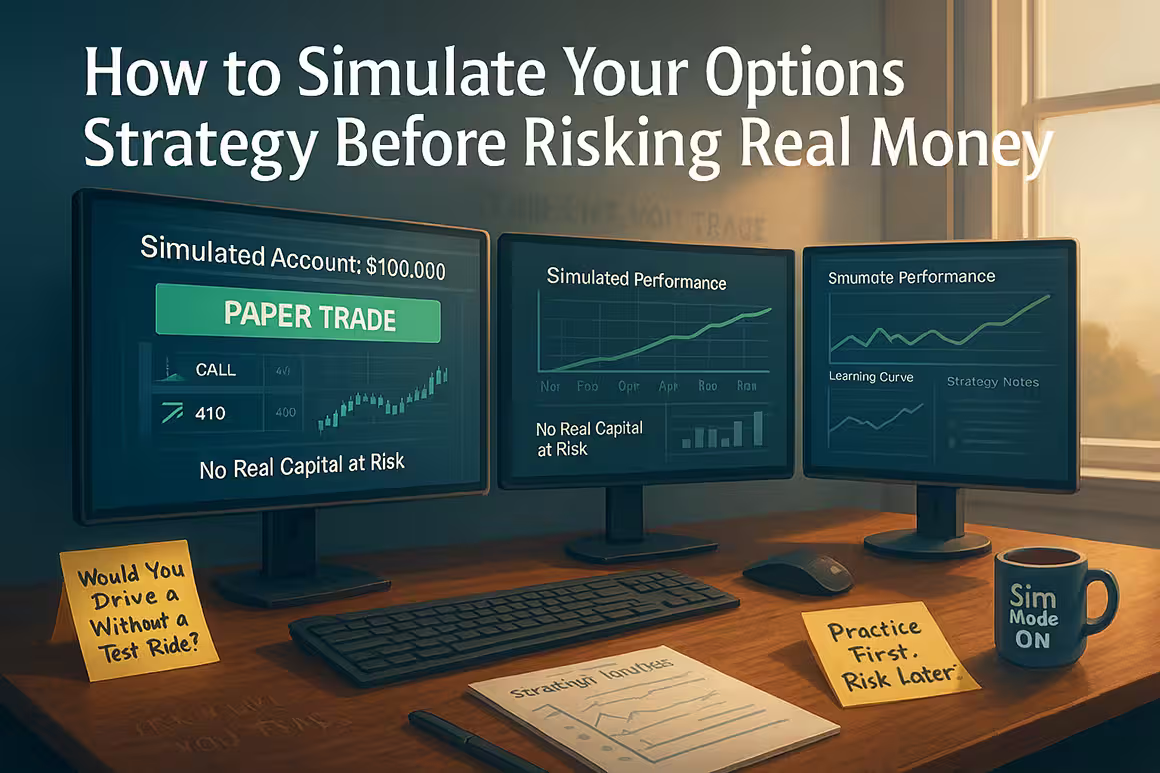
Would you test-drive a car before buying it? Then why not test your options strategy?
Simulated trading, also known as paper trading, provides traders and investors with simulated market conditions in which they can practice options trading strategies using a virtual balance of money without risking their own capital. Simulated trading provides investors with a path to test different methods or approaches, allowing them to gain experience without incurring financial expenses.
While there are several benefits to simulated trading, like risk-free learning, strategy testing, and confidence building, there are several other elements to this practice that are worth knowing about before you dive in further. Our guide will cover the best tools available, discuss the methods you can adopt when using them to achieve optimal results, and provide some general tips we recommend knowing before engaging in simulated trading.
What Does It Mean to Simulate an Options Strategy?
In the context of options trading, simulation refers to a tool or feature offered by many online options apps where traders can practice potential strategies or run hypothetical trading scenarios in an environment where market conditions are simulated. The trader is using a virtual balance of money to practice with, which eliminates any financial risk. Paper trading is the same thing as simulation, but there’s a subtle difference.
Paper Trading—This is a specific type of simulation where you use virtual money to practice buying and selling with a virtual balance. The main difference is that simulation is the environment itself, and paper trading is the practice you’re getting inside of that environment.
Other Ways to Strengthen Paper Trading Results
There are a few other simulation formats that many online traders and investors use to develop their strategies and determine which path is most worthwhile for each option or financial instrument they’re trading.
- Backtesting—The process of evaluating a trading strategy by testing it against historical market data. Traders can use backtesting to gain insights into how a trading strategy might perform over a prior period to see how it would have performed. It’s essentially simulating a trading strategy’s performance to determine if it’s worth the time and effort to pursue.
- Forward Testing—A method for evaluating trading strategies in real time. The trader would be using simulated accounts to reflect live market conditions. As known as “out-of-sample testing,” forward testing accounts for the space between actual trade execution in a live trading setting and the hypothetical strategy performance that a trade might generate through backtesting and looking at historical performance.
Goals of Paper Trading and Simulation
We’ve already given you a general idea of how simulated trading environments work, but let’s delve a bit further into the mechanics of the process to provide you with an idea of how to simulate a trade on your broker app of choice, using none of your personal capital.
Mechanics of Simulated Trading
- The Simulated Environment: Not only does the trader receive a virtual balance to practice with, but they can also access an environment that simulates real-market conditions, although it may not perfectly replicate every aspect.
- Place Various Order Types: Traders can choose which stocks they’d like to practice with and then place a wide range of order types, including market orders, stop-loss orders, and limit orders.
- Practicing Your Strategies: Not only can traders build their confidence through the practice gained from simulation, but they can also learn how the broker’s app or platform works, understand order execution, and determine which strategies are most effective for their trading plan.
- Keep Track of Your Progress: Simulated trading also allows traders to track their performance progress. It can give you a good idea of simulated gains or losses and what was the source of each.
Refining Entries or Exits
Simulated trading can also allow you to review the simulated trades and analyze different aspects of their performance, including the risk-reward ratio or your overall win rate. The key thing with this analysis is that traders can use it to adjust their entry or exit points on various trades. Through this process of evaluation and refining, traders can experiment with different strategies and approaches to improve their overall performance with time.
Position Sizing
Simulated trading gives you a decent idea of your risk tolerance for specific trading strategies, and that can inform the position size you choose to take with each trade. Adjust your size slightly if you feel more comfortable with particular strategies. Traders should generally stick with the 1-2% of your total capital range when allocating money to each position, but you could use 1% for the strategies you’re not so confident in and reserve 2% for the trades you’re willing to take more of a risk on.
Paper Trading—The Most Popular Starting Point
Paper trading is a practice where traders or investors simulate strategies using a virtual balance of money in a simulated environment. It’s a risk-free way to practice buying and selling without putting any of your own money at risk.
It might be a great way of getting started with options trading in general, but what are some of the highs and lows of paper trading that are worth knowing about ahead of time? We’ve outlined the pros and cons in this section, as well as a few recommendations on the best paper trading platforms out there for traders to use in 2026.
Pros
- No Capital at Risk—Traders aren’t putting their own money in jeopardy with paper trading, allowing them to gain practice and experience for free.
- Real-Time Learning—Because you’re dealing with a simulated environment, paper trading allows you to learn from something as close to a live trade setting as possible. It’s not perfect, but you can gain significant knowledge from these trading environments, which closely simulate real-time.
- Ideal for Beginners and New Strategies—Paper trading might not be a tool you use all of the time. It’s an especially popular feature for beginners and newbies to use when they’re learning the ropes. Paper trading and simulation are also beneficial for traders of all skill levels who want to test new strategies. It’s an excellent tool for helping traders expand their knowledge and expertise.
Cons
- Emotional Disconnect—Since it’s not real money, you aren’t as emotionally invested in the process if you lose money on a practice trade. A real loss will hit you harder emotionally, but that will only even occur in the live market with real money. The virtual experience doesn’t account for the emotions you’ll feel doing the real thing.
- Might Not Include Other Factors—Paper trading is beneficial up to a certain point, but there are a few aspects of trading that it might not be able to simulate, if at all, completely. For instance, paper trading may not account for slippage that can occur when executing trades (the difference between the expected price of the trade and the actual price at which it’s executed). Simulation or paper trading might not account for commission costs either.
Best Platforms for Paper Trading
- Thinkorswim by TD Ameritrade
- Webull Paper Trading
- Interactive Brokers PaperTrader
- TradingView (w/ options plugin)
- Tastytrade’s Simulated Trading
Backtesting Your Strategy—Analyze Past Performance
We mentioned backtesting earlier in this guide, and it’s a process in options trading that can significantly help traders analyze their past performance with specific strategies to see how they might play out in the future. To reiterate, backtesting is the process of evaluating a trading strategy by testing it against historical market data to determine how the strategy would have performed over a specific period in the past. It can provide clues as to how it might do in a future trade setup.
Pros
- Speed—The primary strength of backtesting your strategy is that you can test months/years of data quickly. It can be easy and fast for traders to collect the data they need to draw the conclusions they require at the time.
- Identify Statistical Edge—Backtesting achieves this by evaluating the historical performance of a trading strategy and determining if there is a significant difference in the results compared to randomness. This can give traders a better idea of whether or not they have a real advantage.
Cons
- “Curve Fitting” Risk—This phenomenon arises when a trading strategy is over-optimized to fit historical data sets that are used in the backtesting process. Curve fitting can struggle to adapt well to new or unseen data. What traders will encounter with the curve-fitting risk is strategies that appear to perform well on paper but fail to meet those expectations in the real world.
- Doesn’t Account for Market Regime Changes—Backtesting might not be representative of the current market regime you’re trading in. For instance, you could be using historical data for a strategy that was developed during a period when a bull market was dominant. It may not work best if you’re dealing with a bear market in today’s market. Traders need to consider the entire market context before moving forward with their backtesting results.
Recommended Tools
Real-Time Simulators and Strategy Labs
Real-time simulators are systems that model and replicate real-world systems, allowing users to interact with and observe the simulated environment in the same way they would in the actual system. In a nutshell, this is what paper trading does for online options traders. The strategy lab portion of a real-time simulator provides a safe and controlled environment for traders of different skill levels to test various approaches and determine which strategies are most effective.

Some of the real-time market simulators out there have semi-paper trading with live data. The primary difference between this and traditional paper trading is that traders can access real-time market data, even when practicing with a virtual balance. If you’re interested in using this tool, there are several features you’ll want to look for when choosing a service or platform:
Features to Look For
- Realistic Fills and Bid/Ask Spreads: Higher liquidity and tighter spreads generally lead to better fill rates and lower transaction costs. Therefore, traders must find semi-paper trading simulators with live data that offer the most realistic simulations of order fills and bid/ask spreads.
- Ability to Simulate Multi-Leg Strategies: Look for a platform that offers support for multi-leg strategies where you can simulate moves or trades like iron condors, spreads, straddles, or butterflies.
- Real-Time P&L Tracking: Ensure the service or platform offers real-time profit and loss tracking, which involves monitoring revenue and expenses as they occur. This can be a helpful tool that enhances decision-making, facilitates proactive financial management, and provides an up-to-the-minute view of your overall economic performance.
Key Metrics to Track During Simulation
What should you be tracking during the time you’re paper trading and testing out new strategies? It’s a great question, and we’re more than happy to answer it in this section of the guide. You can consider this your checklist of what to keep records of during your practice sessions, allowing you to learn continually over time.
- Win Rate—The percentage of traders that result in profit compared to the number of trades taken altogether. This is a helpful metric for traders to track, as it can be used to evaluate the success and effectiveness of different strategies based on the number of wins or losses they incur.
- Risk-to-Reward Ratio—This metric is a comparison of the potential profit of the trade to the possible losses. It measures how desirable the trading strategy might be based on the amount you have to risk and the potential reward you could receive in return. A little hint is that a risk-reward ratio of 1:3 or higher is what you should be shooting for!
- Max Drawdown—An interesting metric to track in paper trading, the max drawdown is the most significant peak-to-trough decline in the value of the underlying asset you’re dealing with. It’s a simulation of the worst-case scenario that your investment might face.
- Average Profit/Loss Per Trade—This number is calculated by dividing the average profit of winning traders by the average loss on losing trades. Tracking this information can help traders test out strategies with paper trading to understand the approach’s overall profitability. It takes into account the average gain and loss on each trade, giving you a realistic picture of the strategy’s performance.
- Return on Risk (ROR)—This refers to a situation where traders are more willing to take on risk in the hopes of a higher return rate. Traders can refine their strategies to take realistic risks in specific areas, thereby increasing their overall profits over time.
- Position Sizing Consistency—The more a trader can practice with paper trading, the more familiar they can get with the best position size and when to either scale it upward or downward when they’re either confident of a trade’s success or are hesitant due to uncertainty.
Common Simulation Mistakes to Avoid
Traders using simulation and paper trading can make these common mistakes if they aren’t careful or haven’t taken the time to research the associated risks. Before paper trading, you should keep these mistakes in mind so you can effectively sidestep these issues as they come up. Be proactive now and enjoy a more harmonious outcome later.
- Ignoring Slippage and Commissions—Traders who fail to account for commissions and fees will be negatively impacted by the overall profitability of their trading plan. Even small commissions or fees can quickly erode any profits gained through trading options. It can also lead traders to overestimate the profit margin and believe that specific strategies are effective when, in fact, this is not an accurate reflection due to the omission of commissions or fees.
- Overfitting Your Strategy—Avoid over-tailoring the historical data found in backtesting to fit the result you’re hoping to achieve with each strategy. You’ll find that your plan might not perform in the real world the way it does in your paper trading simulations due to any new data that comes in or any data that you didn’t see when setting the trade up.
- Emotional Detachment (Overconfidence)—Online paper trading and simulators do an excellent job of replicating the virtual trading environment as closely as possible to real-world conditions. However, there’s an element of emotional detachment that can set in because you’re not dealing with real money and the emotions that can arise when real money is lost in a bad trade. In addition, paper trading doesn’t always completely simulate slippages or even account for trading fees, all of which can have a significant impact on your outcome.
- Not Tracking Results or Journaling Trades—There can be a significant problem when traders don’t continually make learning a priority, as they can stagnate in terms of their ability and skill over time. It’s through continual learning, which comes from tracking and learning from past results that traders can refine their approach and improve their trading skills over time.
Turning Simulated Results into Real-World Action
Taking the big step from the simulated world of paper trading and entering the real-world action of the live market can be scary, and that’s completely understandable. No matter how much experience you gain with paper trading, it can never fully replicate real-world conditions, and many traders find it jarring to transition from one format to the next.

Follow the steps below to make the transition as easy as possible for yourself. This is not a guarantee of success, but rather some best practices to help you turn what you’ve learned into action in the live market with as few headaches as possible.
- Set a Benchmark: After you’ve done your research during the simulation and recorded the key metrics like win rate, average profit-to-loss, and max drawdown, go ahead and set a benchmark for your first real-world trade. For instance, your trade on ABC stock should have an X% win rate over Y trades before going live.
- Start Small with Real Money: The best place to begin with your first real trade is to make a small stake initially and then gradually increase your position size as you gain more confidence and familiarity with the live market. You can start by taking on micro-contracts or spreads where you won’t be risking much capital. As you gain confidence, you can up your stake to 1% or 2% of your total capital on each position.
- Maintain a Trade Journal: This is the most effective way for traders to track their live performance and learn from their experiences over time. It can be done effectively when you keep a trade journal, going through each strategy and noting what has worked and what has not worked with each. You’ll find that this can be a helpful tool in documenting which paper traders work best and then applying them with increased confidence in the live markets.
- Continuously Retest and Refine—Continue to paper trade, running different scenarios based on the current market conditions. Simulation doesn’t always account for regime changes, such as a bull market transitioning to a bear market or vice versa. The continual process of retesting and refining helps to produce accurate tests for various market contexts, yielding the best results.
Our Favorite Tools to Help You Get Started
In case you didn’t read the entire guide and you didn’t catch any recommendations on your favorite tools for paper trading, backtesting, and the like, we’ve included them in this section for your convenience. Feel free to visit any of the included links to see what these products offer and how you can begin using their services.
Paper Trading Tools
- Thinkorswim by TD Ameritrade
- Webull Paper Trading
- Interactive Brokers PaperTrader
- TradingView (w/ options plugin)
- Tastytrade’s Simulated Trading
Backtesting Tools
- OptionStrat
- OptionStack
- QuantConnect (for advanced users)
- Thinkorswim’s OnDemand Feature
Strategy Labs
- Tradier + Option Alpha Lab
- OptionNet Explorer
- LiveVol X
Ready to Put Your Strategy to the Test?
When you’re looking to learn more about options trading, or you’re interested in learning about new trading strategies, it’s key to use paper trading and backtesting to your advantage to find out which approaches are best and do this research without putting any of your own money at risk. The idea is to trade smarter and not harder. The sooner you can begin simulating or paper trading today, the sooner you can tackle trading tomorrow with much more confidence.
Key Takeaways
- Simulating your options strategy is the safest way to improve.
- Use both paper trading and backtesting for a complete view.
- Track performance metrics to know when you’re ready to go live.
- Leverage the right tools to make your simulation as real as possible.