Earnings season is a goldmine for options traders.
One of the most powerful setups for earnings season in options trading is the “earnings whisper trade,” where traders anticipate how the markets might react to earnings beyond what the published consensus on Wall Street. While earning seasons can be exciting, it’s also a volatile and highly unpredictable time for options traders where premiums can surge, and stock prices can gap overnight in a dramatic fashion.
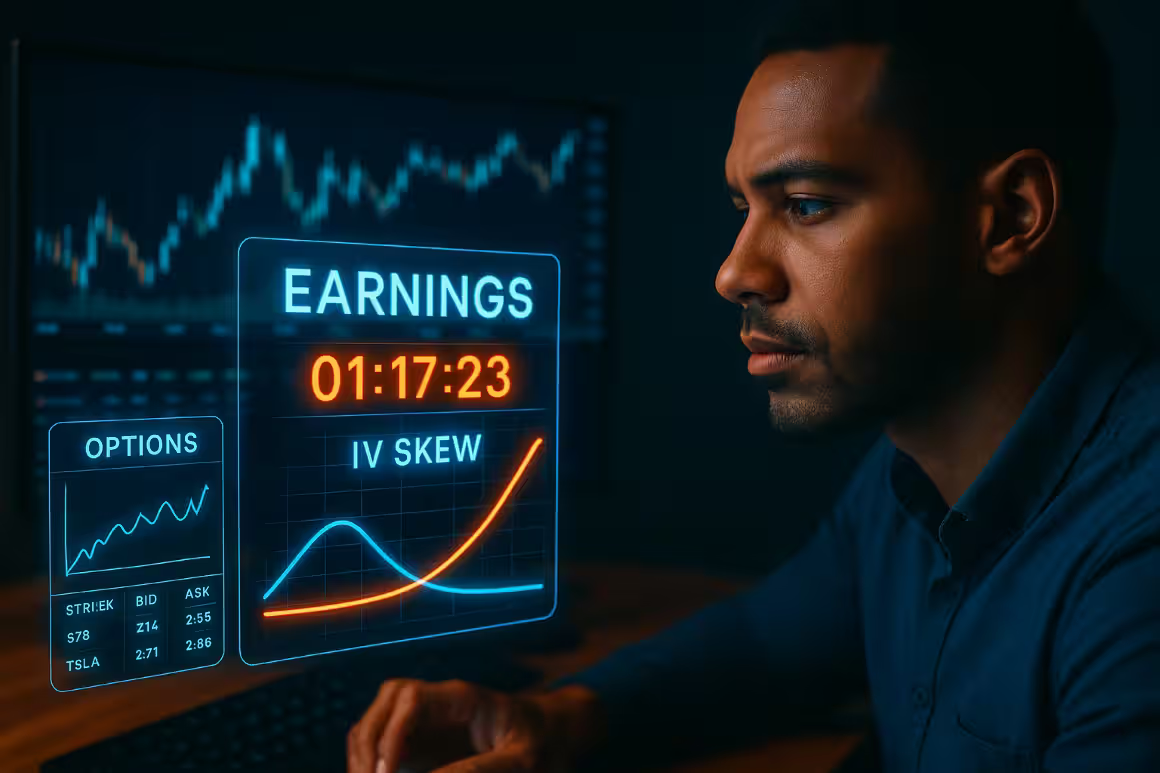
Learning more about the earnings whisper trade and underlying IV skew is key to understanding the developments you end up seeing around earnings announcements. Looking into option pricing dynamics gives traders the opportunity to find a true edge by finding strikes or expiration dates that have become mispriced in the greater scheme of options pricing.
This guide will break down exactly what earnings whisper trades are, how implied volatility skew plays a role, and which options strategies work best for traders looking to capture pre-earnings edges.
What Are Earnings Whisper Trades?
What does it mean to be an “earnings whisperer?” It’s a stance that options traders can take, which goes against the official market consensus and instead takes a more aggressive earnings expectation. What it looks like most of the time is a trader believing that the market is going to outperform expectations—it’s somewhat similar to a contrarian stance in betting or investing, where traders are positioning themselves ahead of the announcement based on other information that is coloring their decision.
Markets often respond more strongly to whispers than to consensus. If whispers predict a beat and the company merely meets consensus, the reaction can still be negative. That disconnect is where options traders find opportunities.
Earnings whisper trades involve positioning ahead of announcements, using options to capitalize on the expected gap move—or, in some cases, to profit from volatility itself. A good example of how this might work is a hypothetical scenario where the Wall Street consensus might expect a company to report $1.20 EPS, but the whisper number could be $1.35, reflecting a belief that the company will outperform.
Understanding Implied Volatility Skew Around Earnings
Implied volatility (IV) represents the market’s expectation of future price movement, reflected directly in option premiums. When you’re talking about situations ahead of earnings, there are three elements of IV that are important to fully understand.

- When uncertainty begins to be priced in, options across strikes and expirations get more expensive as implied volatility rises sharply.
- OTM calls or puts can become inflated disproportionately based on market sentiment, and this is where the IV skew begins developing.
- Traders will usually see the highest implied volatility levels when there are weekly options expiring right after the earnings dates. This is what’s known as “event risk premium.”
Not only does implied volatility skew play a large role in earning whisper traders, but it’s also important for traders to know how IV typically behaves before earnings in ways like rising premiums or skewed OTM calls/puts. Recognizing “overpriced” vs. “underpriced” options in different strikes is another key to understanding what is going on right before an earnings report is released to the public.
Example
If whispers predict a strong upside surprise, OTM calls may trade at a hefty premium compared to puts. However, when whispers lean bearish, OTM puts inflate faster. Recognizing these skews helps traders with their next decision. They can either sell into overpriced premiums or strategically buy mispriced options with favorable risk/reward.
Key Strategies to Exploit IV Skew Before Earnings
Exploiting IV skew before earnings can be done using several different strategies, which we’ve outlined below to help you prepare for your next move. You’ll see the risk and reward balance for each as well as the best conditions in which to use each approach. Find one that suits your capital balance and risk appetite!
Buying Straddles or Strangles
These two strategies only profit from volatility moving in either direction, so traders don’t have to get the direction correct when they go to use either the straddle or the strangle.
- Best Conditions: Works best when IV is high but still underpricing the expected earnings move.
- Profitability: If options imply a 5% move but whisper sentiment suggests a 10% reaction, buying a straddle can be profitable.
- Risks: Overpaying for IV crush after the announcement.
Selling Iron Condors or Butterflies
The iron condor and butterfly are range-bound strategies that only profit when the stock prices are trading within a narrow range between the two strike prices.
- Best Conditions: Effective when IV skew has made both sides of the options chain expensive.
- Profitability: Traders collect a premium by betting the actual post-earnings move will be smaller than priced in.
- Risk: A large earnings gap blowing through short strikes.
Directional Trades Using Skew
Options traders can profit from strategies that revolve around betting on which direction the stock prices are going to move next, and these strategies can be greatly informed by IV skew.
- Best Conditions: If whispers strongly lean bullish and OTM calls are relatively cheap compared to puts, buying calls or call spreads can exploit the imbalance.
- Biggest Risk: Similarly, if bearish whispers dominate, put spreads may offer asymmetric payoffs.
Calendar Spreads
Calendar spreads profit when the underlying asset’s price stays near the strike price, causing the shorter-term option to decay faster than the longer-term option, and when implied volatility increases after the trade is opened. You can also profit if the price of the short-term option remains stable while the price of the longer-term option increases due to rising implied volatility.
- Objective: Sell the overpriced near-term options (with earnings premium) and buy longer-dated options.
- Profitability: This benefits from post-earnings IV crush while maintaining directional exposure.
Case Studies & Historical Examples
If you’re wondering how whisper trades and IV skew work together in the real world toward profitable setups, we’ve included some examples to show you how you can exploit IV skew before earnings announcements. We’ll look at some examples involving well-known companies, some great starting points if you’re interested in getting into this form of options trading.
Tesla (TSLA)
TSLA is notorious for inflated IV around earnings. In one quarter, whispers hinted at weak delivery numbers. OTM puts were overpriced, and selling put spreads (or iron condors) captured the rapid IV collapse when the stock held steady post-announcement.
Apple (AAPL)
Apple’s whispers often diverge from consensus. Traders tracking implied volatility skew in short-dated options have used butterflies to profit from overestimation of the move.
Netflix (NFLX)
Before several recent earnings, whispers suggested subscriber growth far above consensus. Traders noticed OTM calls were aggressively bid. Those who bought call spreads pre-earnings captured outsized gains when the stock gapped higher.
In every one of these cases, you have the market saying one thing as its official consensus, but traders, who are in the know about the little things that might be going on underneath, saying another. It’s in this discrepancy that alert traders and investors can have a big opportunity to profit from an earnings overperformance.
Risk Management in Earnings Whisper Trades
Whisper traders come with some significant risks, so it’s key for options traders to use defined-risk spreads, use a conservative position size, and hedge exposure with opposite directional traders in correlated tickers. These are some of the solutions to the risk, but let’s dive a little deeper into the risks themselves to reveal what you might have going against you in earnings whisper trades.

- Dangers of Overpaying for IV: Traders can make the big mistake of underestimating how much the premium is going to lose value following the announcement. This poses the risk of traders overpaying for IV.
- Gap Risk After Earnings Announcement: When there is surprise guidance, stocks can gap far beyond the expected moves that the official market consensus is predicting. This risk can cause traders to lose a lot of money if they aren’t aware of what’s going on around the earnings announcement.
- Misinterpreting Whispers: There are some scenarios where whispers can be misleading or unreliable, so traders must cross-check whispers with other indicators for official confirmation of a reliable whisper signal.
Just like with any other options trading strategy you use, remember to apply the basic risk management techniques like stop-loss to keep losses to a minimum and use a position size that is only around 1-2% of your total available capital.
Advanced Tactics—Institutional Flow & Smart Money Signals
Options traders would do well to combine whispers with options flow analysis to create a powerful strategy that harnesses the power of unusual options activity (UOA), revealing skew exploitation by pros. By doing this, they can confirm if the market is pricing in the same expectations that insiders are whispering about.
Tools Retail Traders Can Use to Track Flow
By studying unusual options activity (UOA) every day, retail traders can see what the advanced traders and institutional investors are doing to gain insights into potential whispers:
- Block Trades: Institutional traders might be using deep OTM strikes right before an earnings announcement, which could be a big signal of directional conviction. Reading block trades and large volume in OTM options before earnings is a great advanced tactic that can offer insights into what’s going on.
- Heavy Volume in Skewed Strikes: This unusual options activity can be a signal of which way smart money might be leaning before earnings.
- Flow-Tracking Platforms: Retail traders can use these services to piggyback on the unusual options activity that is going on behind the scenes with institutional investors.
Even though you might only be a retail trader, you can use these tools to gain insight into what more advanced investors are doing and how you can use that information to your advantage to profit from a whisper trade strategy. These discrepancies between the official market expectation and what more sophisticated traders are whispering about are where a real profit opportunity lies.
Putting It All Together—A Whisper Trade Framework
Check out this comprehensive checklist that you can use before entering a whisper/IV skew trade. Consider this a sound framework for structuring your next whisper trade.
- Earnings Date Confirmed: Ensure the options you trade actually capture the event.
- Consensus vs. Whisper: Compare how expectations diverge.
- IV Rank & Skew Analysis: Is volatility overpriced or misaligned across strikes?
- Strategy Fit: Choose between buying premium, selling premium, or directional plays.
- Risk Limits: Pre-define max loss and avoid over-leveraging.
Although this guide is a bit straightforward, it provides a basic roadmap of how you can begin implementing a whisper trade into your trading plan and doing so with a high degree of success. Sticking with this framework can improve consistency and better results over time.
Key Takeaways on Earnings Whisper Trades
Earnings whisper trades thrive at the intersection of market psychology, implied volatility, and trader expectations. By studying IV skew dynamics before announcements, traders can uncover mispriced opportunities—whether through buying cheap options, selling inflated premiums, or using spreads to hedge.
The key takeaway: whispers may guide direction, but the real edge is spotting how the options market misprices that expectation.
FAQ—Earnings Whisper Trades & Implied Volatility
Let’s take a look at some of the most common questions we have received over time from our customers and readers about whisper trades. You can get a good sense of the key highlights in this guide by perusing this FAQ section—we answered each one of these questions to the best of our ability.
What Is the Difference between a Consensus Estimate and a Whisper Number?
A consensus estimate reflects Wall Street analysts’ average forecast, while a whisper number reflects unofficial expectations, often more bullish or bearish. Traders consider whispers more accurate for predicting market reactions.
Why Does Implied Volatility Rise before Earnings?
Uncertainty drives option demand. Traders hedge against gaps by buying options, which inflates premiums. This creates the classic “IV ramp” into earnings.
What Happens to Implied Volatility after Earnings?
It collapses almost immediately—a phenomenon known as IV crush—because uncertainty has passed. Traders must plan for this when entering positions.
How Do I Know if Options Are Overpriced Ahead of Earnings?
Compare the implied move (based on straddle pricing) to historical post-earnings moves. If options imply a 12% move but the stock averages only 6%, the premium may be overpriced.
Can I Trade Earnings Whispers without Options?
Yes, but options allow defined-risk plays with potentially higher leverage. Stocks can be traded directly, but options strategies like spreads or calendars are better suited for exploiting IV dynamics.
What Is the Safest Options Strategy around Earnings?
Defined-risk strategies such as butterflies, iron condors, or debit spreads. These allow participation while capping potential losses.
Do Whispers Always Predict Earnings Reactions Correctly?
No. Whispers can be wrong or already priced in. That’s why combining whisper sentiment with IV skew analysis provides stronger conviction.
Which Tools Help Track Whisper Numbers and IV Skew?
• EarningsWhispers.com for unofficial estimates.
• Brokerage platforms (thinkorswim, Interactive Brokers) for IV rank & skew charts.
• Options flow services for monitoring institutional activity.
What Tickers Are Best for Whisper Trades?
Highly liquid, event-driven names like AAPL, AMZN, TSLA, NFLX, and NVDA. These stocks have active options markets and large pre-earnings IV moves.
Should Beginners Attempt Earnings Whisper Trades?
Beginners should start small, paper trade, and focus on understanding IV behavior before risking real capital. Whisper trades carry elevated risk.