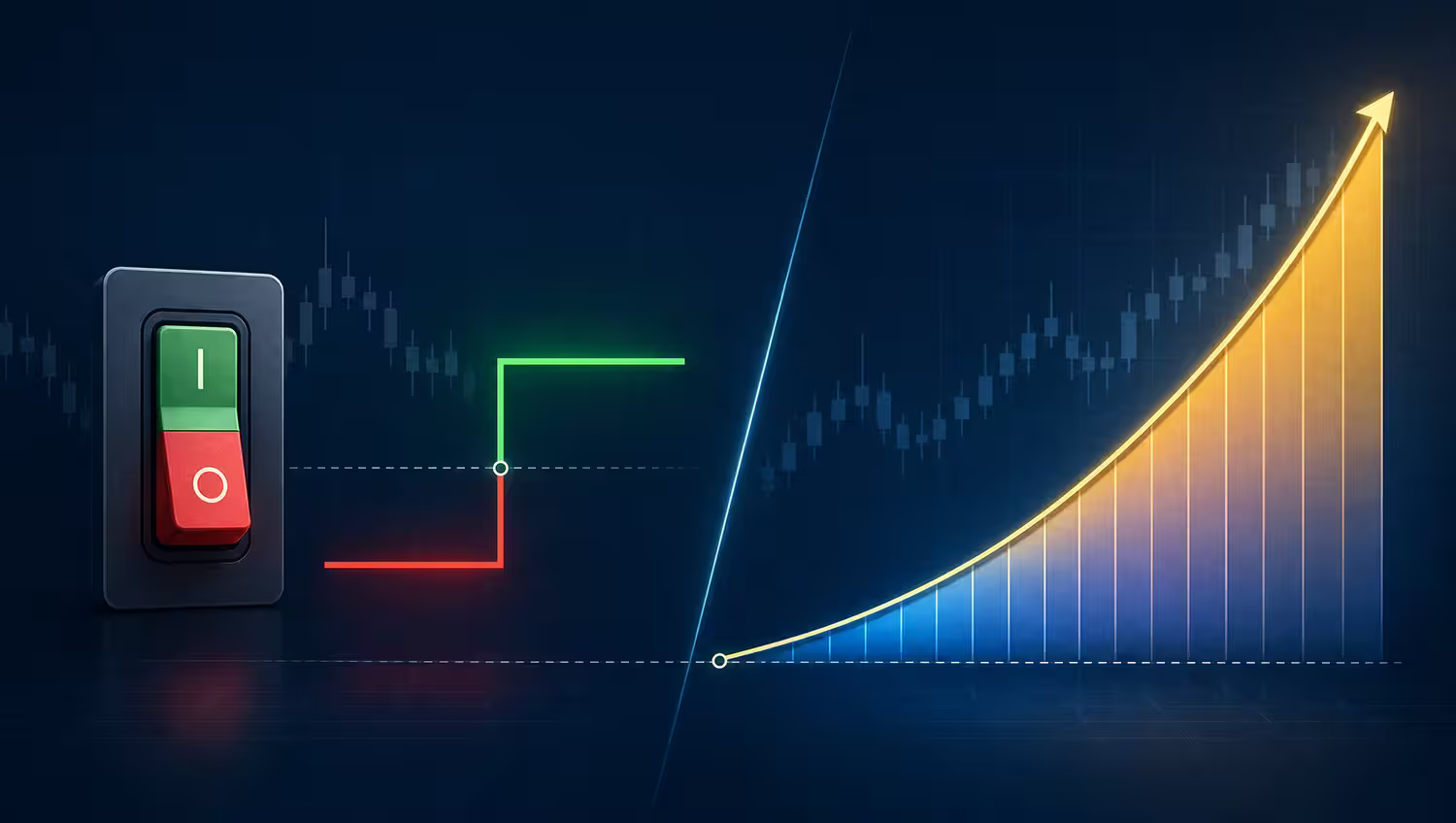
A binary option and a standard listed call can both express the view that a market will finish above a level. That surface similarity hides a major difference.
The binary contract usually pays a fixed amount if a yes-or-no condition is met and nothing if it is not. A standard call has a variable payoff that grows as the underlying rises above the strike. One asks whether the trader crossed a line. The other also cares how far the market moved beyond it.
That payout structure determines the break-even win rate, maximum gain, value of a near miss, usefulness of a large move, and choices available before expiration. Those mechanics matter more than the simplicity of the order ticket.
Quick Takeaways
- Binary options generally have two settlement outcomes: a fixed cash amount or zero. Standard listed calls and puts have payoffs that vary with the underlying price.
- A high binary win rate can still lose money when the gain on a winner is smaller than the loss on a loser.
- A listed option buyer can lose the full premium, but a large favorable move can produce more than one fixed payout amount.
- Binary pricing may resemble a market-implied probability, but fees, spreads, market structure, and information quality still matter.
- Standard listed options add strike, time value, implied volatility, exercise, assignment, and potentially much larger writer risk.
- Regulated binary markets exist, but regulators warn that many internet-based binary platforms are unregistered or fraudulent. Verify the venue before sending money or personal information.
The Core Payout Difference
Investor.gov defines a binary option as a contract whose payout depends entirely on a yes-or-no proposition. At expiration, the holder typically receives a predetermined cash amount or nothing. The contract does not give the holder the right to buy or sell the referenced asset.
A standard listed call gives its holder the right, but not the obligation, to buy the underlying at the strike price. A listed put gives the right to sell. At expiration, intrinsic value changes dollar for dollar as the underlying moves beyond the strike, subject to the contract multiplier.
The OCC disclosure document also describes binary options as cash-settled options with two possible payoff outcomes. That is an important legal nuance: some binary options can themselves be standardized or exchange-traded. In this comparison, listed options means the familiar standard calls and puts with variable intrinsic value, not a claim that every binary contract is off-exchange.
For the regulator definitions, see Investor.gov’s binary options overview and OCC’s Characteristics and Risks of Standardized Options.
Binary Options And Standard Listed Options At A Glance
The comparison criteria below focus on payout mechanics, risk, and trade management. Exact contract rules vary by venue and product.
Feature | Binary Option | Standard Listed Call Or Put |
|---|---|---|
Expiration payout | Usually a fixed cash amount or zero. | Variable intrinsic value based on how far the underlying finishes beyond the strike. |
Near miss | Usually receives the losing outcome even if the threshold is missed by one cent. | May still retain value before expiration; at expiration, out-of-the-money options have no intrinsic value. |
Large favorable move | Does not increase the fixed settlement once the winning condition is met. | Can increase intrinsic value and profit beyond the original premium. |
Buyer maximum loss | Typically the amount paid or collateral committed, plus fees, under a fully collateralized structure. | Premium paid plus transaction costs. |
Buyer maximum gain | Capped by the fixed settlement amount less cost and fees. | Calls can have theoretically unlimited upside; puts have substantial but limited maximum value as the underlying approaches zero. |
Exercise and settlement | Commonly automatic cash settlement from the specified condition. | Equity and ETF options commonly use share delivery; many index options use cash settlement. |
Price interpretation | Often discussed as market-implied odds when quoted between zero and the fixed payout. | Premium reflects intrinsic value, time, volatility, rates, dividends, and supply and demand. |
Primary question | Will the threshold condition be true at the specified time? | How far, how fast, and by when might the underlying move relative to the strike? |
Binary Payouts Turn The Trade Into A Break-Even Win-Rate Problem
A fixed payout makes expected value easier to see, but only if the trader calculates it. Suppose a contract costs $70 and settles at $100 when the condition is met. A winner earns $30 before fees. A loser loses $70.
The break-even success rate is 70% before fees: cost divided by the $100 settlement amount. Winning six trades out of ten would sound impressive, but the math would still be negative. Six winners earn $180 while four losers lose $280, for a net loss of $100 before costs.
The same principle applies when a platform advertises a percentage return rather than a contract price. If a trader risks $100 to earn $80, the break-even win rate is about 55.6% before fees: $100 divided by $180. A 50% forecast accuracy is not enough because losses are larger than gains.
Investor.gov specifically warns that some binary platforms overstate expected returns by emphasizing the winning percentage while hiding an unfavorable payout structure. The right question is not only how often the trade wins, but how much winners earn compared with what losers lose.
Example: The Required Win Rate Changes With The Payout
These examples are hypothetical, exclude taxes, and assume every trade is held to settlement or expiration.
Structure | Cost Or Risk | Winning Result | Losing Result | Break-Even Insight |
|---|---|---|---|---|
Binary contract bought for $70, settles at $100 | $70 | +$30 | -$70 | Needs a 70% win rate before fees. |
Binary platform offer: risk $100 to earn 80% | $100 | +$80 | -$100 | Needs about a 55.6% win rate before fees. |
Listed 100-strike call bought for $4 | $400 per standard contract | At $110 expiration value is $1,000, or +$600 net | At or below $100, loss is $400 | Break-even at expiration is $104, but upside is not capped at one fixed award. |
Listed call expires with stock at $103 | $400 | No net profit despite $3 intrinsic value | Net loss is $100 | A favorable direction can still be insufficient after premium. |
Listed Options Care About Magnitude, Not Just Direction
Consider the 100-strike call bought for $4. If the stock finishes at $100 or lower, the option expires worthless and the buyer loses $400. At $104, the $4 of intrinsic value offsets the premium at simplified expiration breakeven. At $110, the option is worth $10 per share, or $1,000 per standard contract, for a $600 gain before costs.
Unlike the binary payout, an even larger stock move can create a larger call payoff. That makes the size of the move part of the thesis. It also means a trader can have a low win rate and still be profitable if gains on large winners exceed losses on losing premiums.
The reverse is also possible. A trader can win frequently by selling options, then suffer a loss larger than many collected premiums. Standard listed option writers take on obligations, and uncovered calls can have theoretically unlimited loss.
The OptionsTrading.org article on whether an options trader can lose more than the amount invested helps separate buyer risk from writer risk.
A One-Cent Difference Can Be Everything In A Binary Contract
Suppose a binary contract asks whether a stock will finish above $100 at a stated time. Under one rule set, $100.01 may produce the full winning settlement while $100.00 or $99.99 produces zero. The economic difference between those final stock prices is tiny, but the contract difference is total.
That cliff makes the exact rule language essential. Traders need the observation time, official price source, treatment of market disruptions, threshold wording, and settlement procedure. Above is different from at or above. A regular-session close may be different from a later official value.
Standard listed calls also have a strike boundary, but the expiration payoff is continuous above it. A 100-strike call finishing at $100.01 has one cent of intrinsic value per share, not the same payoff as a call finishing at $110.
The payout cliff can encourage all-or-nothing thinking. It can also make last-minute price noise dominate the result even when the trader’s broader market thesis was mostly right.
Before Expiration, The Two Markets Can Behave Differently
Standard listed options trade with time value before expiration. Their premiums respond to the underlying price, time remaining, implied volatility, interest rates, dividends, and order flow. A trader may close the position rather than exercise it or wait for expiration.
That creates more management choices but more variables. A call can lose money even when the stock rises if the move is too small, time decay is too large, or implied volatility falls. Intrinsic and extrinsic value are separate pieces of the premium.
Binary contracts on regulated order-book venues may also be bought or sold before settlement when liquidity is available. Their price may move toward the fixed winning amount as the market views the outcome as more likely. But exit availability, order types, fees, and settlement rules depend on the venue.
A platform that only offers a dealer-style take-it-or-leave-it payout is a different structure from a transparent two-sided exchange. Read the market rules instead of assuming every product with a Yes-No screen works the same way.
Why A Binary Price Is Not A Guaranteed Probability
When a $100-settlement binary contract trades at $65, people often describe that as roughly 65% market-implied odds. That interpretation can be useful in a competitive market, but it is not an objective probability or a promise.
The price reflects the traders, information, capital, position limits, spread, and liquidity available at that moment. A thin order book can move sharply. Fees change the true break-even point. A platform acting as counterparty may quote a payout schedule rather than a market-clearing probability.
By comparison, a listed call premium is not a direct probability quote. It includes the value of a range of possible favorable outcomes, not one fixed settlement. Delta is sometimes used as a rough probability-related shorthand, but it is a changing model sensitivity, not a guaranteed chance of profit.
Probability language should always be tied back to payout. A 70% chance can be unattractive at a cost of $80 for a $100 settlement, while a lower-probability listed call might still have positive expected value if its favorable payoff is large enough.
Liquidity And Fees Can Reverse A Seemingly Fair Trade
Expected-value examples often assume fills at one clean price. Real trading introduces a bid-ask spread, commissions or transaction fees, and sometimes settlement or withdrawal costs.
If a binary contract has a fair estimated probability of 60% and costs $60 for a $100 settlement, the pre-fee expected value is roughly zero. Add fees or cross a spread and the trade becomes negative unless the estimate is better than the market price by enough to cover those costs.
Listed options have the same execution problem. A wide spread can consume a meaningful part of the premium on entry and exit. Our guide to tight bid-ask spreads explains why percentage spread width matters more than the quoted cents alone.
Limit orders can control the worst accepted price, but they cannot guarantee a fill or create a liquid exit. The payout diagram should be adjusted for the price that can actually be traded.
Risks Traders Commonly Underestimate
- A high binary win rate can still produce losses when the reward per winner is smaller than the loss per loser.
- A threshold missed by one cent can receive the same zero payout as a prediction that was completely wrong.
- Short expirations can turn ordinary price noise into an all-or-nothing result.
- Binary prices can look like precise probabilities even when liquidity is thin or the platform controls the quote.
- Listed option buyers can lose the full premium from direction, timing, volatility, or execution errors.
- Listed option sellers can face assignment, margin pressure, and losses much larger than the premium received.
- Unregistered online platforms may refuse withdrawals, misuse personal information, or manipulate displayed trading software.
- Fees and spreads raise the break-even win rate for either structure.
Platform Registration Is Part Of The Product Risk
Regulated binary options and event contracts can exist on CFTC-designated contract markets. The CFTC’s current prediction-markets and event-contract overview describes federal market-integrity and customer-protection requirements for regulated venues and intermediaries.
That does not make every website using binary option language legitimate. Investor.gov reports complaints involving refused withdrawals, identity theft, and software manipulation. The CFTC also warns U.S. customers to verify that a binary-options venue is properly registered before depositing funds.
Registration depends on the product and venue, so there is no single logo or marketing phrase that settles the question. Check the regulator’s official database, confirm the legal entity rather than only the brand name, and do not send additional money to unlock a withdrawal.
A polished interface does not change the payout math, and an attractive payout does not compensate for counterparty or fraud risk.
Exercise And Assignment Create A Different Listed-Options Risk
A typical binary holder does not choose whether to exercise into the referenced asset. Settlement is automatic according to the stated condition and pays cash or nothing.
Standard equity and ETF options create rights and obligations involving shares. A long option holder may exercise. A short option writer may be assigned. A short put can require buying 100 shares per standard contract at the strike, and a short call can require delivering 100 shares.
That share-delivery obligation is a major difference from a fully collateralized fixed-payout binary. It affects buying power, dividends, borrow availability, overnight exposure, and broker liquidation risk. OptionsTrading.org’s walkthrough of what happens when an option gets assigned covers the operational details.
Index options and some other listed products may settle in cash instead, so the exact option specifications still matter.
Which Structure Best Fits Which Use Case?
The best fit depends on the use case, not on which order ticket looks simpler. A regulated binary contract can directly express a narrowly defined threshold view when the trader understands the fixed payout, break-even probability, settlement source, and venue. Its main trade-off is that extra magnitude beyond the winning threshold does not increase the final award.
A standard listed call or put can fit a view that includes magnitude, timing, or volatility. It allows more strikes, expirations, spreads, and early-exit choices. The trade-off is additional pricing complexity and, for writers, assignment and potentially much larger loss exposure.
Neither structure is automatically safer. A binary contract can cap the amount at risk but still have a structurally unfavorable reward. A purchased listed option can cap loss at the premium but still expire worthless frequently. A written option can have a small maximum gain and a much larger maximum loss.
The comparison is useful only after maximum loss, maximum gain, break-even, fees, liquidity, and settlement terms are written in the same units.
Pre-Trade Comparison Checklist
- Identify the legal product, venue, regulator, and exact entity holding customer funds.
- Write the binary settlement condition or listed option strike and expiration in plain language.
- Calculate maximum gain, maximum loss, and all fees in dollars.
- For a binary contract, calculate the break-even win rate from cost divided by settlement value, or loss divided by total win-plus-loss payoff.
- For a listed option, calculate simplified expiration breakeven and review intrinsic value, time value, implied volatility, and Greeks.
- Check whether a favorable move earns one fixed payout or a payoff that grows with magnitude.
- Review bid, ask, spread, depth, volume, open interest where available, and realistic early-exit choices.
- Confirm observation source, threshold wording, expiration time, exercise style, settlement method, and assignment outcome.
- Verify registration in an official regulator database and treat withdrawal fees or requests for more deposits as warning signs.
- Skip the trade when the payout cannot be explained without relying on the platform’s advertised win rate.
The Payout Diagram Is The Trade
Binary options simplify the final result into two boxes. Standard listed options create a slope: payoff changes as the underlying moves beyond the strike. Neither diagram tells the trader whether the price paid is attractive.
A binary trade needs an estimated probability high enough to overcome its cost, fees, and spread. A listed option needs a movement and volatility thesis strong enough to overcome premium, time decay, and execution. Option writers also need the account capacity to meet assignment and margin obligations.
The durable habit is to ignore the advertised win rate until the payout is calculated. Once every outcome is shown in dollars, the comparison becomes less exciting and much more useful.
FAQ
These answers compare common fixed-payout binary structures with standard listed calls and puts. Individual contracts and regulations can differ.
Are all binary options illegal in the United States?
No. Regulated binary options or event contracts can be offered on appropriately registered U.S. venues. However, regulators warn that many internet-based platforms are unregistered or fraudulent. Verify the exact entity and product in official regulator databases before depositing funds.
Is a binary option price the probability of winning?
It may be interpreted as market-implied odds on a transparent fixed-payout order book, but it is not a guarantee. Fees, spreads, liquidity, participant access, market structure, and information quality affect the price and true break-even point.
Why can a 60% binary win rate still lose money?
Win rate must be compared with payoff size. If each winner earns $30 and each loser loses $70, a 60% win rate loses money. Before fees, that structure requires a 70% win rate to break even.
Can a listed option buyer lose more than the premium?
A straightforward long call or put generally limits loss to the premium and transaction costs. Option writers and some multi-leg strategies can have larger obligations and losses, especially when assignment or an uncovered short option is involved.
Do binary options have time decay?
Their market price can change as time passes and the outcome becomes more or less likely, but they do not have the same variable intrinsic-and-extrinsic payoff structure as standard calls and puts. The exact pricing and exit mechanics depend on the contract and venue.
Which is better for a directional trade?
Neither is universally better. A binary contract isolates a threshold outcome but caps the reward. A listed option can benefit from a larger move but adds premium, volatility, time, and exercise or assignment considerations. Compare the actual payout, price, and risk rather than the label.
Source and Freshness Note
This article was source-reviewed on July 2026. Binary-option availability, venue registration, fees, contract rules, and regulatory treatment can change. Readers should verify the current product and legal entity in official regulator databases before trading or sharing personal information.