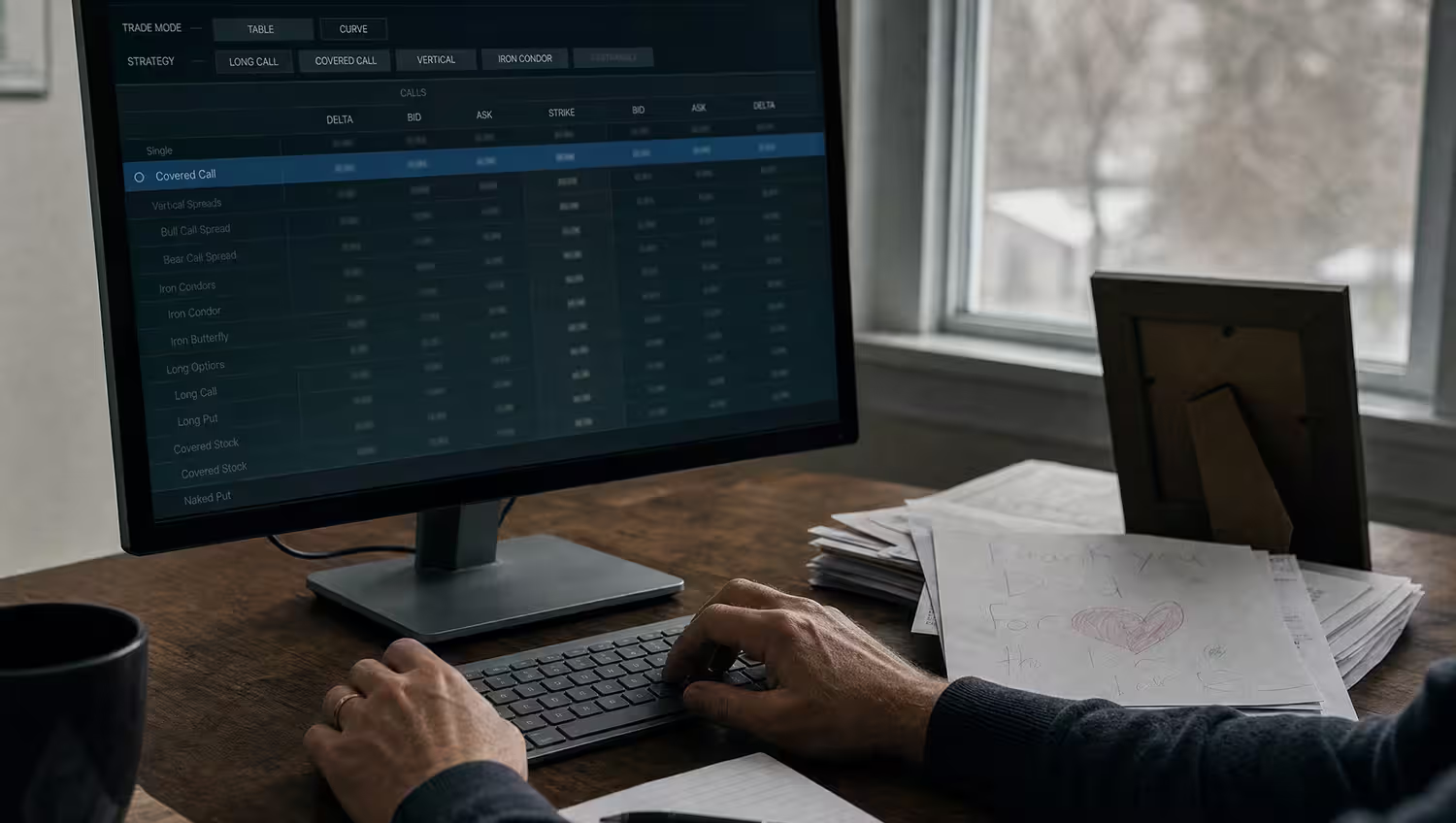

Are you looking for the right stocks and options for your portfolio, but you face the daunting task of sifting through a ton of choices for the ideal investments? Use stock screeners! These are a highly reliable and efficient tool for finding stock options quickly using a wide range of criteria and filters such as option types, strike price, expiration date, implied volatility, open interest, and trading volume. Attempting to find stock options without a screener can be time-intensive, and there’s a greater chance that a trader’s personal bias could influence their analysis.
Another benefit of using stock screeners is to find underpriced options contracts, which can lead to high returns. Traders can enter contracts at a lower price, which improves the bottom-line profit that could be realized. Stock screeners are, therefore, a super valuable tool for uncovering opportunities, and we highly recommend that investors or traders take the time to use them during their trading sessions.
Explore this guide on stock screeners for the best tools and tips to get started!
Why Stock Screeners Are Essential for Options Traders
This part of our guide will cover the role of stock screeners in options trading, basically, the major reasons that they are essential to the online options trader. Not only will we give you a clear idea of what these useful tools are, but we’ll also review the features you should be looking for when choosing one for yourself.
What Are Stock Screeners?
Stock screeners are instruments that traders use to filter stocks based on specific criteria like price, volume, or volatility. They help investors sort through stocks and ETFs to find those that best match their own trading and investment preferences. These tools are designed for investors to find the most valuable investments that are aligned with their trading goals and objectives.
Why Are They Important for Options Trading?
There are two great reasons that traders and investors should be using stock screeners when constructing a diverse portfolio.
First, it can save the investor a lot of time that would be spent searching for these opportunities manually. Simply enter your search criteria (strike price, expiration date, option types, etc.) and you get results quickly for the ideal options contracts that you need for your portfolio.
Second, investors can avoid choosing investments based on their personal bias. Entering search criteria in the stock screener keeps the process objective. When investors look for options contracts manually, they could make the mistake of not fully researching each position and choosing the positive information they’re looking for that gives them the green light to choose the investment. They ultimately provide data-driven insights to support trading strategies.
Features to Look for in a Stock Screener
When choosing a quality stock screener, there are several features and elements that investors should take into consideration. These include, but aren’t limited to, the following:
- Alert Notifications: Look for stock screeners that come with alerts for significant events like news, price changes, or when a stock appears that best fits your trading criteria.
- Market Data Access: The best stock screeners come with real-time updates on factors like volume and stock prices.
- Dividend Screening: This useful tool helps investors find stocks that have high dividend yields and dividend payouts that are extraordinarily consistent.
- Sector and Industry Filters: Look for the best stocks in certain sectors or industries with this nimble screening filter. This allows traders to invest in the sectors/industries that appeal most to them.
- Growth Metrics: Traders can filter stocks based on revenue growth or earnings per share growth. This lets them invest in stocks based on company expansion.
- Technical Analysis Indicators: Choose stock screeners that come with the following indicators—moving averages, relative strength index, and volume trends.
- Valuation Ratios: This tool for fundamental metrics should include the P/E ratio, the price-to-book ratio, and the price-to-sales ratio.
How to Identify Underpriced Options Contracts Using Screeners
One of the primary goals of any online options traders is to find options contracts that are underpriced, the main reason being that investors can greatly improve their profit potential by doing so. Find out how to use stock screeners to find undervalued contracts and the steps you can take from there to increase the profit you make on each option contract you trade.
Key Metrics to Analyze
There are several metrics to consider and analyze in the pursuit of finding underpriced options contracts. These include implied and historical volatility, the Greeks, open interest, and volume. When options traders check these metrics and enter the data into their stock screeners accordingly, they can get a good idea of which options are going to give them the best profit potential.
Implied Volatility (IV) vs. Historical Volatility (HV)
Implied volatility is a forward-looking metric that estimates how much an asset’s price will change over a certain period of time. Implied volatility or IV is used to determine option contract prices. More specifically, it’s a metric that’s useful for predicting the price range of a certain asset by a certain date. The higher the implied volatility, the higher the options price.
Historical volatility, unlike IV, is a metric that’s based on past returns of options contracts instead of being a forward-looking metric. It’s a statistical measurement of how much an asset’s price changes over a given period, but it’s calculated by measuring how much its price deviates from its average price.
Option Greeks
These are a set of calculations that investors and traders can use to measure how sensitive the option’s price is to changes in underlying factors including IV, the underlying asset’s price, or the time left until the expiration date.
– Delta measures how much an option’s price is expected to change for every $1 change in the price of the underlying asset.
– Gamma measures how much the Delta will change if the price of the underlying asset changes by $1.
– Vega is a measure of how sensitive an option’s price is to any implied volatility changes.
– Theta indicates the rate of an option value’s decline with time. It’s also known as theta decay.
– Rho measures how much the price of the option contract will change with a change in the risk-free interest rate.
Open Interest and Volume
Open interest refers to the number of outstanding options contracts traded, but those that haven’t been closed or liquidated. The option market’s liquidity level is measured by the number of contracts that are still active. If the open interest is high or rising, it’s an indicator that other investors are actively trading and showing interest in those options. Open interest goes up when a new option order is added to the option chain. If the open interest is decreasing, it’s an indicator that other investors are closing out those positions and there’s little demand for them.
Volume is another important metric to analyze when looking for options contracts that are underpriced. When volume is high for options contracts, this means that there’s much better liquidity making it easier for traders to enter and exit positions quickly. Volume is also a helpful tool in predicting market volatility due to an increase in trading volume preceding significant price shifts.
Screening Strategies
One of the most common screening strategies is to look for stocks with earnings announcements or high volatility on the horizon. Buying stocks in this manner significantly lowers the investor’s average cost-per-share. This can help an investor’s portfolio and its performance when the market rebounds following the announcement of the period of expected volatility.
Another way for investors to execute a screening strategy is to identify contracts with favorable risk/reward profiles. This strategy lies in looking for deals where the upside reward is much greater than the downside risk. Calculate the risk/reward ratio by dividing the potential loss on the options contract by the potential profit. This ratio provides a clear picture of the reward an investor can earn for every dollar they risk on the investment.
Pro Tip
Combine screener results with technical and fundamental analysis. Use a stock screener to find potential stocks based on your trading criteria and preferences. Analyze these shortlisted stocks with technical indicators from price charts to find the best possible entry and exit points. Traders can leverage the strength of the market movement and the fundamental valuation to make the best possible investment decision.
The benefits of using this pro tip include the following:
- Better investment decisions overall from considering long-term value and short-term market trends
- Fundamental analysis helps traders avoid overvalued stocks through a successful assessment of the company’s intrinsic value.
- Technical analysis helps investors find the best times to buy and sell stocks (find the best entry and exit points)
Best Stock Screeners for Options Traders
Let’s check out the trading platforms and brokers that have the best stock screeners and other trading tools that allow investors to find the best in underpriced options contracts.
thinkorswim at Charles Schwab

Pros
- Historical Price Data
- Strategy Analysis
- Probability Analysis
- Earnings Analysis
- Risk Profile
- Market Data Integration
- Customize Visualizations
Cons
- Requires a Robust Computer for Optimal Performance
- Steeper Learning Curve for Beginners
TradeStation

Pros
- Commission-free stock, options, and ETF trades
- Advanced trading platform for professionals and highly skilled traders
- Automation, simulation, and backtesting
- Competitive Pricing
- Great order routing control
- Excellent trade execution
- Comprehensive research
- Highly active trading community
- Trading tools include OptionsStation Pro and Portfolio Maestro
- TradeStation can be customized with apps
- Gain access to IPOs and foreign equities markets
Cons
- No transaction-fee-free mutual funds
- $2,000 minimum deposit on free trades (desktop application)
- Low interest rates on uninvested cash
- Membership plans and pricing can be confusing
- No fractional shares
- The account fees are higher than the average
- It can be difficult for new traders to get started
- The returns on excess cash aren’t that great
- Spotty customer service
- Receives payment for order flow
- Trading commissions on mutual funds and bonds
Finviz (Elite)

Pros
- Comprehensive stock screeners
- Visual sector map
- Insider trading data
- Advanced charting capabilities
- Backtesting and correlations
- Analyst ratings
- Customizable news feeds
- Insider trading data
Cons
- Futures data delay
- No mobile app
- Limited market coverage
- ETF limitations
- Price point
- Complex interface
Market Chameleon

Pros
- In-depth options research
- Wide range of market research tools
- Free trial for one week
- Create watchlists for data points
- Access historical performance data
Cons
- 15-minute market delay
- No mobile app
- Clunky user interface
- Pricing tiers
Comparison of the Top Stock Screeners
If you’re skimming the guide and you want to get the key highlights of each trading platform and their respective stock screeners, we’ve included the comparison chart below for your convenience.
Screener Name | Best For | Key Features | Cost | Pros and Cons |
|---|---|---|---|---|
thinkorswim | Analyzing market trends, price action, and volume | – Charts | No fees on stocks or ETFs | Pros – Historical price data Cons – Steep learning curve for beginners |
TradeStation | Best for active traders | – Fixed income screeners | No fees on stocks or ETFs | Pros – Advanced trading platforms Cons – Low interest rates on uninvested cash |
Finviz (Elite) | Best for day, swing, momentum, and technical traders | – Real-time data | Plan starts at $39.50/month or for $299.50 for annual pre-payment plan | Pros – Comprehensive stock screeners Cons – Futures data delay |
Market Chameleon | Gain valuable data-driven insights | – Earnings options strategy screener | Stock Trader: $39/month | Pros – In-depth options research Cons – 15-minute market delay |
How to Choose the Right Stock Screener for Your Needs
To decide which tool best suits your trading goals and objectives, we’ve included a brief guide on how to select the right stock screeners for getting the job done. Use this guide to narrow down your options to the best stock screener for your needs.
Beginner vs. Advanced Trader
Consider your current skill level in options trading. If you’re new, use stock screeners that have user-friendliness and perhaps a simplified design that is compatible with your skill and experience. Consider using a more advanced system if you have a lot more experience in trading options contracts.
Budget Considerations
Another consideration is your current budget. If you’re tight on money or available capital, you might want to use Thinkorswim or Finviz (Elite) which have free stock screeners. The other three trading platforms have stock screeners that you must pay for, but they come with more advanced features and a wider range of screening criteria.
If you’re a trader who has a more casual approach to investing or you have limited money on hand, free stock screeners might be preferable. However, we’d recommend that any trader/investor with considerable experience or a lot of capital at their disposal use the premium screener to access the deeper data analysis capabilities.
Trading Style
Think about your trading style. Are you a swing trader or a day trader? How advanced should your stock screener be to accommodate your trading goals?
For instance, if you’re a day trader, you could benefit from a free stock screener, but it’s preferable to use a premium screener to access the more advanced tools like in-depth analysis and real-time data. The same would go for swing traders. Newer investors who are using low-risk investment techniques might prefer to use the free stock screeners to keep their overhead low.
Use Stock Screener to Save Time and Avoid Biased Trading
Use stock screeners to find stock options quickly using a wide range of criteria and filters like implied volatility, open interest, option types, strike price, expiration date, and trading volume. Attempting to find stock options without a screener can be time-intensive, and there’s a greater chance that a trader’s personal bias could influence their analysis. Stock screeners are especially helpful in finding undervalued options that can maximize investors’ profitability.
Check out the following platforms for top-notch stock screeners:
- Thinkorswim at Charles Schwab: Best for analyzing market trends, price action, and volume
- TradeStation: Best for active traders
- Finviz (Elite): Best for day, swing, momentum, and technical traders
- Market Chameleon: Best for gaining valuable data-driven insights
Related Articles
Test out our favorite stock screeners for free to find the best one for you! If you’re looking to learn more before diving in, check out these related articles and helpful resources that we offer.