
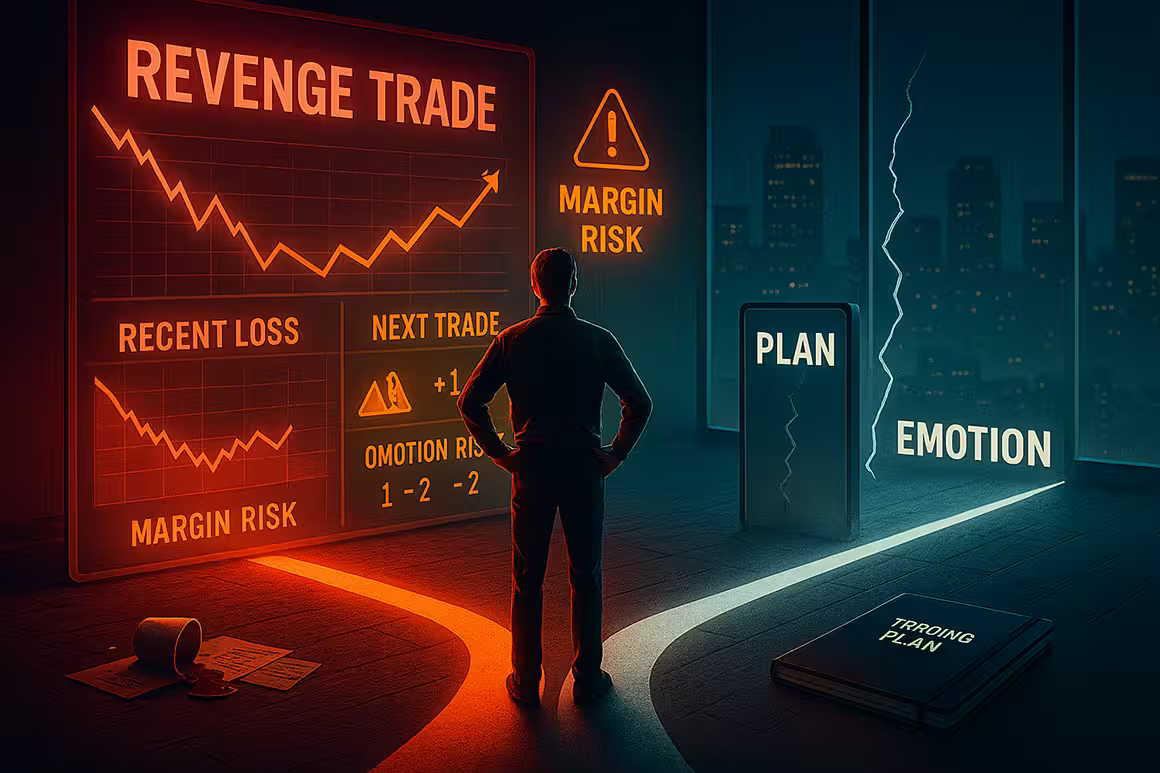
Losses are an inherent part of options trading. But sometimes the response to a loss can send you into a downward spiral. When that happens, you size up on the next position, shorten your timeframe, or abandon your plan. At this point, you aren’t following the trade anymore; you’re chasing the last one. And that’s known as revenge trading.
In options, this can get out of hand faster than you think. Leverage works both ways, and a single missed exit or an emotional entry can turn a manageable drawdown into a margin call or a wiped-out account. What starts out as a $150 mistake can multiply when your emotions are making the decisions for you.
How does revenge trading start? Why is it riskier in options? What are the red flags? And how can you avoid doing it (or stop it when it’s happening)? We’ll answer all of these questions, because we have been there. The market tests your patience, but you can hold on to your head!
What Is Revenge Trading?
Revenge trading is when your trades are a reaction to previous losses and not a part of your plan. It usually starts out with frustration or disbelief, like if you took a setup you trusted, followed your rules, and still got smoked. So you want to fire back. You take another trade. Maybe you double your position size. Maybe you totally abandon your risk limits.
What does revenge trading look like in the options market? Like this:
- Buying deep OTM calls or puts with unrealistic break-evens just to get a quick win
- Doubling down on the same ticker that just wrecked you
- Holding past your stop in hopes of a reversal that rarely, if ever, comes
- Scalping with no setup, just to “make back what you lost”
There is nothing strategic about it. It’s all emotional. And in a market where premiums decay by the hour, it does not end well.
Then there are the most common triggers that cause revenge trading. They include the following:
- Back-to-back red trades, especially after a winning streak
- Sudden market reversals or high-volatility events like Fed announcements
- Earnings plays gone wrong
- FOMO from watching a trade you skipped take off
- Attachment to a specific stock, you keep trying to “beat”
Why It’s So Dangerous in Options Trading
Revenge trading in any market is always risky, but in options trading? It pours gasoline on a four-alarm fire.

Leverage and Volatility = More Risk
In options, you’re not just trading price action; you’re also trading volatility, time decay, and sentiment. A stock might move 1%, but the contract you bought could swing 40% or more. That kind of leverage magnifies not only your gains, but your mistakes, too!
Short Timeframes = Quicker Emotional Decisions
Almost all revenge trades are impulsive. But options necessitate planning. You need to pick the right strike, expiration, risk profile, and entry timing. Rushing a decision in this space means that you’re likely to misjudge either one or all of those variables, particularly the time decay one.
It Summons Tilt
This is where trading psychology overlaps with problematic gambling behavior. After a few losses, the urge to “get it back” clouds your judgment. You start making knee-jerk decisions that you wouldn’t tolerate from a beginner. Your trading journal—if you’re keeping one—starts to look like a record of swings, not setups.
Here are some examples of how quickly it can escalate:
- A trader loses $300 on a SPY put during CPI week. Instead of stopping, they buy twice the size on the next trade, this time a zero-DTE contract. That trade loses $900 in 10 minutes. Now they’re down $1,200. And they are still trading.
- Someone holds through an earnings miss on AMD, watches their $2.50 call go to $0.30, then reloads the same trade two days later because “it’s due for a bounce.” They get smoked again.
- A trader on a losing streak enters five trades in a single hour without confirming any setups, as they’re trying to force a green day. It ends with a $2,000 loss that started with one $150 miss.
Signs You Might Be Revenge Trading
Some people are super self-aware and know when they aren’t making rational decisions. But just because they realize it’s happening, it’s not easy to stop it. If it’s not obvious that emotions have taken over, you need to read this, because even if you’re unaware, there are deliberate patterns. If you have noticed any of the things below, you should pay attention!
- You’re entering trades without a clear setup or ignoring the rules that you usually follow
- You increase your size after a loss without rechecking your risk tolerance
- You’re trying to force a green trade in order to “salvage the day.”
- You ignore your stop-loss or move it after getting close to being stopped out
- You say things like, “I have to make that back today,” or “I’m due”
- You’re placing more trades than usual, and on tickers that you wouldn’t normally touch
- You feel relief instead of conviction when a trade goes your way
- You finish the session with no idea why you entered half your positions
If you’re journaling (and you should be), look at the notes. Are your entries getting shorter? Are you skipping your checklist? Is the tone reactive or rushed? These are all signs that you’re off track.
How to Stop Revenge Trading (For Good)
We aren’t gonna lie to you and say there’s a switch you can hit to turn off emotional trading, but there are proven systems that’ll keep it from running your account. You don’t have to trade with zero emotion, because that’s not realistic. The goal is to build guardrails that protect your capital even when you’re not thinking clearly.
The following are six strategies that are designed to interrupt revenge behavior, and each one is rooted in structure, repetition, and self-awareness!
1. Have a Written Trading Plan
If you’re trading without a defined plan? All your trades become judgment calls, and those calls are easy to skew when feelings are in the mix. A good plan takes away the guesswork. It tells you when to get in, how much to risk, and what to do when things go wrong.
Your plan should cover the things below:
- Entry criteria: What setups do you take? (Breakout re-tests? VWAP bounces? Reversal patterns?) Be specific. Include which indicators or price action structures you need to see before pulling the trigger.
- Contract selection: Define the types of contracts you trade. Weekly expiration or monthly? What delta range (0.30–0.50)? How far OTM is too far? Do you avoid trades with IV over 80%? These guardrails help prevent emotional grabs for “cheap” contracts.
- Position sizing: Know your maximum per-trade risk as a percentage of your account. Most experienced traders risk 1–2% per trade. You can scale this up later, but not when you’re coming off of a loss.
- Exit plan: Detail your stop-loss method based on price, premium, or a combo of both, and your profit targets. If you leave this undefined, you’ll make those decisions in real-time, and that doesn’t work out well.
Revenge trades are so easy to do when everything’s flexible. But they’re harder when your system gives you a yes/no on whether a setup qualifies. Your plan should give you structure before you get emotional, not after!
2. Use a Cooling-Off Rule
This one sounds pretty basic, but it’s one of the most effective safety mechanisms that you can use. Set a hard limit for how many losing trades, or how much of a drawdown, you can tolerate in a session before you’re done. Then stick to it like it’s the law.
Here are some cooling-off rules that work:
- 2 red trades = mandatory break: No matter what the market is doing, once you’ve taken two losers in a row, you walk away for 30–60 minutes. This interrupts momentum-based tilt.
- Max daily loss = 3x your average trade risk: If your normal risk is $200/trade, you shut down the session if you’re down $600, even if your “favorite setup” shows up right after. Emotional capital is finite.
- One full green-to-red swing = stop for the day: Going from up $800 to down $200 is usually a tilt trigger. If this happens, stop.
You aren’t punishing yourself! You’re forcing space between the emotions and the next decision. Emotional trading feeds on speed, so breaking that rhythm will reset your thinking.
3. Track Your Emotions in a Trading Journal
Most traders already log entries and exits. But if you’re trying to curb revenge trading, you need to journal how you felt and not just what you did. You’re looking to see emotional patterns, not only trading mistakes.
Your journal should include fields like this:
- What made me take this trade? (Was it a setup from my plan or something I saw last-minute?)
- What was my emotional state before entry? (Calm, anxious, angry, bored?)
- Did I follow my plan? If not, why?
- What was the result, and how did it make me feel?
- Would I take this trade again if I were up on the day?
As time goes by, you’ll see patterns like: “I take worse setups after two red trades,” or “I always size up when I’m behind.” The patterns become warning signs, and you’ll catch yourself mid-action, and that’s where change happens. You can also use voice notes or videos if writing slows you down!
4. Reduce Trade Size After a Loss
If revenge trading is an overreaction to pain, one way to defuse it is to decrease your emotional load. Downsizing your trades after a loss cuts the stakes and the anxious voices in your mind.
Below is how to apply it:
- If your usual position size is 5 contracts, drop to 2 on the next trade after a red one.
- If you normally risk $400/trade, scale it back to $200 or even $100 for your “cooldown” trade.
- If your loss came from breaking your plan, the next trade has to be plan-approved and half-sized. Zero exceptions.
This does three things:
- It lowers the emotional intensity. You’re way less likely to overreact again.
- It builds positive reinforcement around staying in control.
- It forces you to slow down and reassess your setups in a more careful manner.
You don’t always have to take a break to stop revenge trading, but you do need to make the next trade feel like it’s less “urgent.” Size control is how you do that without freezing entirely.
5. Automate Entries/Exits When Possible
The biggest place where revenge trading rears its greedy head is after you’re already in a trade. A loss hits way harder when you feel like you could’ve avoided it by staying in longer. So you start to tinker. Moving stops. Letting losses run. Cutting winners short. It’s all downstream from emotional exits.
Pre-setting your exits takes that out of the equation!
- Use limit orders for profit targets so you’re not manually taking gains based on how you “feel” about the market at the time.
- Use hard stop-loss orders when slippage risk is low, especially if you’re trading liquid options like SPY, QQQ, or AAPL.
- Use OCO (One Cancels Other) orders: When your profit order hits, the stop automatically cancels, and vice versa.
- Set time-based exits if you’re prone to holding too long. Example: “If I’m not green on this 0DTE trade in 15 minutes, I cut it no matter what.”
Automation isn’t ceding control. It’s you protecting yourself from your worst impulses when control is at its weakest!
6. Practice Mindfulness or Stress Relief
Revenge trading is driven by fight-or-flight. Your body doesn’t know the difference between losing money and being physically threatened, and it just reacts. That’s why it’s almost impossible to logic your way out of an emotional spiral in real-time.
What works better? Changing your physical state.
The following are some practical reset habits that help you get out of tilt mode:
- Leave your trading desk after a red trade and do something physical: walk, stretch, go outside. Even five minutes helps.
- Breathing drills: Try “box breathing” (inhale 4 seconds, hold 4, exhale 4, hold 4). This lowers cortisol in the body and slows down racing thoughts.
- Set a rule: After two losses, you can’t re-enter the market until you’ve logged the last trade and taken a physical break.
- Mindfulness apps: Use tools like Headspace, Calm, or Breathwrk. No, they aren’t just for “zen” types; they’re for pattern recognition and emotional recovery.
Your trading decisions will improve when your nervous system isn’t in panic mode. You don’t need to be a spiritual guru; you just have to do a little rewiring with how you respond to volatility.
Tools to Help You Stay Disciplined
It’s one thing to say “just be disciplined,” but it’s harder than you realize when you’re staring down your PnL after a bad day. That’s where the tools come to the rescue. They help turn discipline into a system. The more friction you remove from your process, the less room there is for emotion to run the show. The right tools give you guardrails before, during, and after a trade.
And they aren’t just for beginners! Pro traders all use structure, not because they lack the skills, but because they know what happens without it. Look below for the six tools that we recommend!
1. Trading Journals That Track Behavior (Not Just Trades)
Almost every trading platform lets you log entries, exits, PnL, and setup types. That’s the bare minimum. The best way to identify if you are revenge trading is to track your emotional state and behavioral patterns.
Journal platforms:
- TraderSync: Great UI, supports tagging trades as revenge/fomo/impulse, and generates analytics like win rate after two losses. Will spot tilt spirals.
- Edgewonk: More advanced, customizable tags and emotional tracking. Ideal for traders who want to explore the psychology and long-term performance metrics.
- Tradervue: Simplified for faster journaling with automatic trade import from brokers like TOS, IBKR, and TradeStation. You can label revenge trades, track streaks, and analyze by time of day.
- Notion (custom-built): If you want to create your own templates, Notion lets you build journal dashboards with reflection prompts like “What triggered this trade?” or “Was this setup from my plan?”
A solid journaling habit means that you’ll be able to measure revenge trading instead of just wondering if it’s happening. If every red day is followed by larger size and worse setups, that’s a trend you can fix!
2. Profit and Risk Calculators for Option Contracts
Options pricing isn’t always intuitive. The price of the contract is just one piece; there’s theta, delta, vega, and implied volatility. When you’re in a frenzied state, you’re not likely to process all of that. Profit calculators help you sanity-check trades before you place them.
Recommended tools:
- OptionStrat: Lets you visualize option strategy payoffs and quickly compare strikes and expirations. Also factors in volatility shifts and break-even prices.
- ThinkOrSwim Analyze Tab: For TOS users, this is a deep feature set. You can simulate trades with PnL curves, project risk at different spot prices, and run “what-if” scenarios based on IV crush.
- Option Creator: A simple, clean interface for testing directional trades and multi-leg strategies like debit spreads or iron condors. Use it to get a feel for max loss/max gain before entering under any stress.
The real value of these tools is that they slow you down. They force you to run the numbers, and almost all revenge trades fall apart under the math.
3. Paper Trading for Emotional Simulation
Revenge trading usually happens when a trader is out of practice or hasn’t emotionally “stress tested” their process. Sim trading not only helps you test strategies; it helps you build assurance in your plan without the financial risk.
But there is a caveat: paper trading only works if you treat it like real money. That means journaling paper trades, respecting stop-losses, and logging your emotions.
Where to Practice:
- ThinkOrSwim PaperMoney: One of the best platforms for simulating real fills on options trades, including zero-DTE and multi-leg spreads.
- Webull Paper Trade: Free access to paper accounts, good for simple calls and puts. Less strong in strategy modeling.
- Tastyworks: Great for traders using verticals, iron condors, and other structured plays. Pricing and fills are way more realistic than most free sims.
Build in “revenge tests” for yourself! If you lose two trades on paper, then log how you’d respond. Practicing tilt management in sim builds up your muscle memory for live trading.
4. Automation and Broker Features to Control Risk
You don’t have to manually manage every single trade. A lot of revenge trades happen because traders overreact in the moment, but automation can eliminate these moments.
Broker tools that are well worth using:
- Brackets (OCO Orders): Set your profit target and stop-loss at entry. One cancels the other. This prevents you from “just watching it for a bit longer” or exiting early out of fear.
- Conditional Orders: Execute only if your setup confirms. For example: “Buy SPY 445c if price breaks over 444.75 with volume >100k.” This stops you from guessing.
- Position Limits: Some brokers let you cap position size or total open contracts. Use this if you’re scaling too fast when you’re emotional.
- Max Daily Loss Alerts: On platforms like Interactive Brokers or Tradestation, you can set auto-alerts if you hit a preset loss on the day.
The best traders automate when they’re at their smartest, and that’s before the market opens. It’s not while they’re chasing a bounce that’s not coming.
5. AI and Pattern Recognition Tools
A lot of newer trading platforms are integrating AI to flag behavioral patterns before they get to a destructive point.
Here are the platforms that are already using AI:
- TradeZella: Has emotion-based tagging and trade quality scoring. Tracks revenge tendencies like increasing size after losses, frequency spikes, or PnL drop-offs after red trades.
- TradersPost AI Alerts: Can flag trade streaks, “overtrading days,” and trades placed outside your usual session time or setup parameters.
- Custom Notion AI Templates: You can build your own AI-assisted journal that suggests emotional patterns based on your trade comments (e.g., if you keep writing “had to get it back” or “just needed a win”).
These aren’t mandatory, but if you want to spot emotional patterns before they cost you thousands, the above tools are worth integrating into your process!
6. Community & Accountability Systems
Sometimes you can’t see when you’re spiraling, but others sure can! And that’s why structured communities and accountability partners are super underrated trading tools.
The following are some ways to build this into your trading system:
- Join a Discord or Slack group where other traders share live setups and post-session reviews. Concentrate on the ones where PnL screenshots are banned and setup analysis is emphasized.
- Use an accountability tracker: Every morning, post your trading plan. At the end of the day, post what trades you took. This creates awareness and external structure.
- Pair with a buddy: Have a trading partner you text before each trade with a quick “Setup: ABC. Risk: $X. Target: $Y.” Just the act of stating your intent out loud forces clarity.
When you know someone else will see your behavior? You’ll probably trade with less emotion.
Final Thoughts: Don’t Let Emotions Do Your Trading
It’s not like revenge trading feels irrational when you’re in the heat of the moment—it feels urgent and like you have to do it. Your thought process is along the lines of, “If I can get back to breakeven, I’ll stop.” But that sort of logic is how small red days turn into catastrophic ones.
Options magnify mistakes. The contracts move super fast. The decay works against you. The volatility spikes when you least expect it. That’s why it’s even more important to treat discipline as a tenet of your strategy, not something that’s separate from it!
Look below for a recap of the fixes to cease and desist revenge trading:
- Write your trading plan down. Follow it like it’s your job, because it is.
- Stop after two red trades or a set dollar amount. No exceptions, period.
- Journal how you feel and not just what you did.
- Downsize on your next trade after a loss.
- Pre-set your exits. Eliminate the random guessing.
- Build habits that will interrupt any emotional spirals.
- Use the tools that track patterns, enforce limits, and give you the space to reset.
You don’t have to win every trade. You have to survive the bad ones without compounding them. That’s what separates long-term traders from those who self-implode and get out of the trading game.
Keep your rules. Keep your capital. And don’t let one bad trade demolish your entire day, or your entire account, with it!