
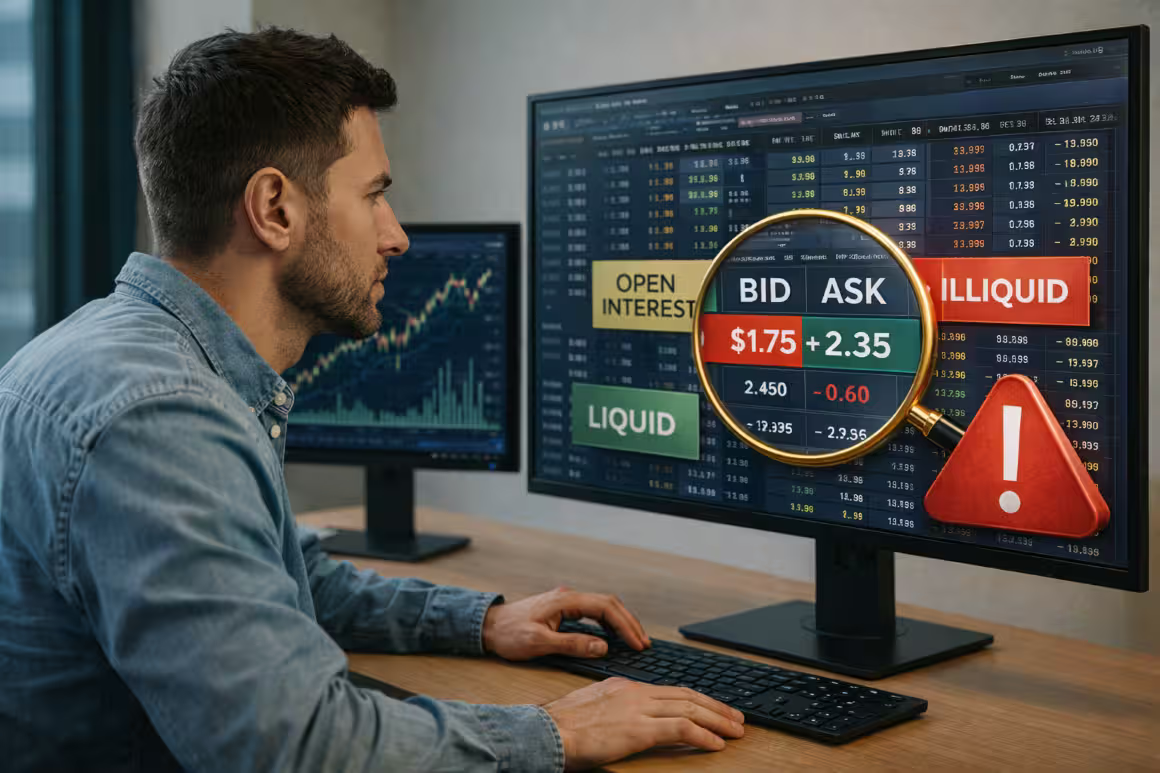
Most options traders underestimate liquidity until they’re stuck in a bad fill. It’s immediately afterward that they wonder what went wrong. Liquidity is an invisible aspect of options trading that has a lot of power because it can smooth executions from slipping in options trading, which can cause a lot of frustration.
Liquidity refers to how easily you can buy or sell an options contract without significantly impacting the price—it’s measured by options volume, open interest, and bid-ask spreads. Our guide will uncover the hidden liquidity traps that can catch some traders off guard, as well as some pro tips and professional tactics that you can take to execute smarter trading to get around some of the execution risks.
What is Options Liquidity and Why Does It Matter?
Higher trading volume means tighter spreads and smoother execution when it comes to stock trading, which makes liquidity a straightforward concept for stock traders. However, if you take a look at options, you’ll notice that liquidity plays a more complex role. The stock might be liquid but the options chain might not be.
- High-Liquidity Names: Tickers like SPY or AAPL are well-known for their deep markets and tight spreads. This makes things much easier when it comes to getting fair fills.
- Low-Liquidity Tickers: These tickers are different from the high-quality names in that they come with wider spreads and thin order books. This leads to slippage in execution.
Liquidity impacts trade execution, slippage, and profitability at the end of the day. You can have a great directional setup, and you could still lose money if you sacrifice too much edge when it comes to your entry and exit. As a result, poor liquidity directly impacts execution costs and profitability.
The Core Metrics of Options Liquidity
What are the main ingredients that go into liquidity when trading options? We’ve outlined them below to give you a good idea of what to be looking for when you begin looking into new investments or if you’re starting for the first time as a new options trader.

Bid-Ask Spread
The most viable sign of liquidity in options trading is the bid-ask spread, which should be narrow because this means that buyers and sellers are actively competing. On the other hand, a wide spread suggests that market participation overall is low, and this is an undesirable place to be when trading online options.
Example: AAPL options may trade with a $0.01–$0.05 spread, while a small-cap biotech could have spreads as wide as $0.50–$1.00.
Takeaway: Due to AAPL’s tighter spreads, there’s a healthier dose of liquidity in the market and less hidden cost.
Trading Volume
When you hear people talking about trading volume, they’re referring to how many contracts changed hands on any given day. The higher the trading volume, the higher the market participation, generally. Sometimes you might be seeing some one-off spikes which could be signalling something else. For the most part, though, trading volume is a good sign of a liquid ticker or position.
Pitfall: A contract might have high volume today due to news, but if that activity disappears tomorrow, you’re stuck with an illiquid position.
Open Interest
Symbolized as “OI,” open interest is a measure of how many contracts are currently outstanding. It ultimately reflects the depth of the market over time, unlike volume, which gauges the depth of the market moment by moment.
Pro Tip: High OI confirms there’s an active market, but check spreads. High OI with wide spreads is a red flag of “false liquidity.”
Hidden Liquidity Traps to Avoid
Don’t fall victim to a liquidity trap that doesn’t seem apparent at first glance. We’ve outlined several of these hidden pitfalls to get you familiar with what to look for as you go forward with trading online options. The more you can sidestep these disasters, the better your results will be over the long run.
- Illiquid Weeklies and Far-Dated Options: Liquidity often clusters in front-month contracts. Weeklies or far-dated options may look attractive, but often lack real activity. Liquidity often dries up outside front-month contracts.
- “False Liquidity” from Market Makers: MM quotes can disappear in fast-moving markets. Even though market makers take the time to post quotes, those quotes can vanish in fast-moving markets. What this means for the traders who hit a market order is that they will get a far worse fill than expected.
- Wide Bid-Ask Spreads on Exotic Strikes: Chasing OTM lotto-style contracts kills fills. Deep OTM “lottery ticket” options may look cheap, but their wide spreads make them expensive to trade—and nearly impossible to exit profitably.
Pro Tips to Trade with Maximum Liquidity
To best use liquidity to your advantage, we’d encourage you to follow these pro tips for maximum impact and effect.
- Stick to Liquid Underlyings: Focus on index ETFs (SPY, QQQ, IWM) and top-volume names. Not only is it important to trade index ETFs (SPY, QQQ, IWM), but it’s preferable to focus on high-volume stocks where the options market is most active.
- Use Limit Orders, Not Market Orders: Smart order placement preserves edge. By using limited orders, traders can control their execution and avoid sacrificing anything in terms of advantage.
- Check Multiple Expiration Cycles: Some months trade better than others, and they attract more flow than others. To maintain long-term momentum, traders need to compare speeds and open interest across multiple expirations before choosing.
- Time-of-Day Matters: The best hours for liquidity are the first 90 minutes and last 30 minutes of the trading day. By sticking to this window, traders can avoid thin midday trading, which doesn’t do anyone any good.
Case Study—Liquidity in Action
Now let’s look at a few case studies—we’ll be comparing trading a SPY option vs. a thinly traded small-cap biotech option. We’ll show how spreads and slippage working together can turn a winning setup into a loser.
Scenario 1: SPY OptionBid: $1.00, Ask: $1.02 → Easy to enter and exit with minimal slippage.
Scenario 2: Small-Cap Biotech OptionBid: $0.50, Ask: $1.00 → Even if you enter halfway at $0.75, exiting could cost you $0.20–$0.30 per contract.
The result with both of these examples is that the same setup that works in SPY can quickly become unprofitable in an illiquid option.
Advanced Liquidity Tactics
If you’re interested in using advanced liquidity tactics, check out a few of the ways you can pull this off through using options flow tools to gauge hidden liquidity, understanding dark pools and block trades, and pairing open interest analysis with implied volatility. We’ll delve into a few of these higher-level strategies in more detail below.

- Options Flow Tools: Traders can use options flow tools to track large block trades and unusual activity. Using these strategies lets them spot where liquidity is clustering.
- Dark Pools & Block Trades: Institutions often transact off-exchange, so traders can use these occurrences to their advantage. They can begin watching these flows to gain clues about hidden liquidity.
- Pair OI with Implied Volatility: If you begin seeing open interest rise along with implied volatility, you can see genuine market participation, and this is a strong signal that is devoid of the noise that comes from examining the markets.
Common Liquidity Mistakes Retail Traders Make
Don’t make these mistakes when you’re dealing with liquidity as a retail options trader. The more you can keep away from these blunders, the less potential headaches you’ll have with the value of the positions you find in your portfolio.
- Chasing Illiquid Options—You might get in for a cheaper price, but it’s cheap for a reason. It’s because it’s a contract that is going to be hard to buy or sell without changing the value of the position.
- Ignoring Execution Costs—Slippage adds up more than traders realize, and if they aren’t careful, they can blow through a ton of unnecessary capital to cover these discrepancies between the fill price and the desired price.
- Failing to Check Open Interest—Before placing multi-leg spreads, traders can make the mistake of checking the level of open interest, which is one of the most important steps to choosing options contracts that are easy to buy or sell.
Liquidity is Just as Important as Direction
Liquidity is just as important as direction in options trading. Wide spreads, low OI, and false signals can erode profits even if your market call is correct. Master liquidity to trade like the pros. By doing so, you can trade like a professional—executing smarter, preserving edge, and avoiding hidden risks. Explore more advanced guides on OptionsTrading.org to sharpen your trading edge.
Frequently Asked Questions
Let’s look at some of the common questions that our customers and readers have been asking about options, liquidity, and some of the secrets beyond harnessing its advantages and sidestepping some of the issues that come with liquidity.
What Is Good Liquidity in Options Trading?
Good liquidity means tight bid-ask spreads, high option volume, and strong open interest, so you can enter and exit trades easily.
How Do Bid-Ask Spreads Affect Options Traders?
Wider spreads increase slippage and execution costs, while narrow spreads make trading more efficient.
Why Is Open Interest Important in Options?
Open interest shows market depth and confirms sustained participation beyond one-day volume spikes.
Which Options Are the Most Liquid?
Index ETFs (SPY, QQQ, IWM) and mega-cap stocks like AAPL, MSFT, and TSLA usually have the most liquid options.
When Is the Best Time of Day to Trade Options for Liquidity?
Liquidity is usually highest in the first 90 minutes after the market opens and the last 30 minutes before it closes.
Can Illiquid Options Still Be Profitable?
Yes, but execution costs are higher, and it can be harder to exit. Illiquid contracts should generally be avoided unless you have a very specific strategy.
How Does Option Volume Differ from Open Interest?
Volume measures contracts traded today, while open interest tracks total outstanding contracts. High volume without OI can be a false signal of liquidity.
What’s the Biggest Risk of Trading Illiquid Options?
The biggest risk is slippage—getting filled at unfavorable prices—which can quickly turn a winning setup into a losing trade.