
Ever wonder why stock prices mysteriously drift toward a certain level on options expiration Friday?
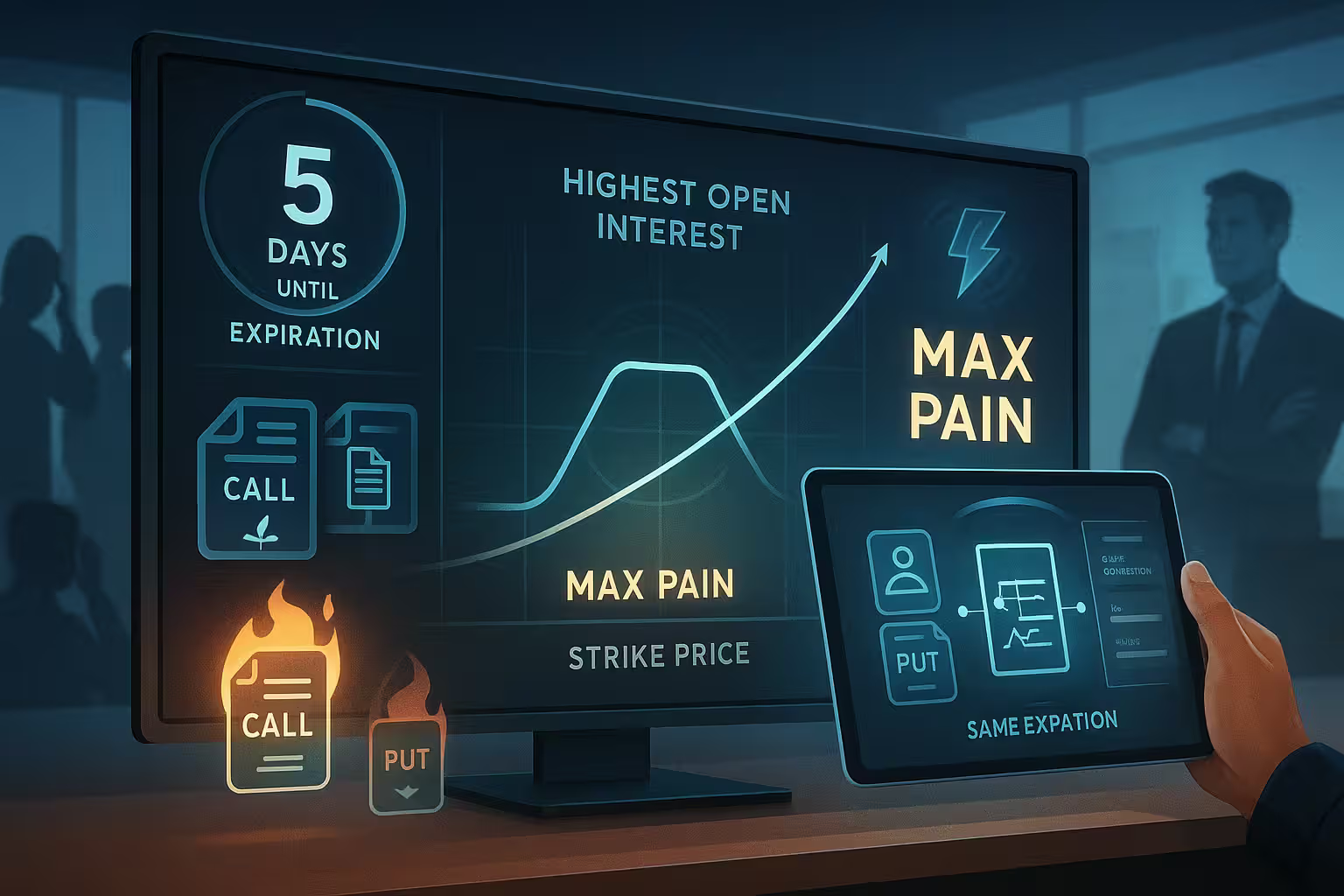
The Max Pain Theory is the idea in options trading that market makers may benefit most when options expire at a price that causes the most pain to options buyers. The max pain is the price at which the most open options contracts are standing. The theory is that market markets will attempt to drive the underlying asset prices to the current strike price, which causes them to benefit the most, but for regular options traders to lose the most amount of money, especially those selling calls and puts.
Understanding this Max Pain Theory can help traders better time entries and exits, especially near expiration. Retail traders can anticipate the moves of smart money using the Max Pain Theory and correctly navigate each situation, so they don’t get burned when selling calls or puts.
What Is Max Pain in Options Trading?
The Max Pain (aka the Maximum Pain Theory) is a theory that suggests the price of the underlying asset will move toward the price points when the greatest number of contracts will expire as worthless. The idea is that the market makers will try to drive down the price of the underlying asset to the strike price, where most retail traders will experience the most pain. Even though retail traders stand to lose a lot of money in these situations, the market makers can maximize their profits from selling options, while also minimizing their losses.
How Is Max Pain Calculated
- Look at all the available options contracts and list all of the current strike prices. Then record the open interest for all calls and puts at each strike price.
- The next step is to calculate the payoff for each strike price. Traders need to figure out the difference between the strike price and the stock price for in-the-money options, and then multiplying it by the open interest.
- Once you’ve calculated the total payoffs, you must add them to the calls and put them at each strike price.
- The last step is identifying the Max Pain point, which is the strike price where the total payoff to options holders is the lowest (the “pain” point is where the combined loss for options holders is the greatest).
Why Max Pain Matters During Expiration Week

As options approach their expiration date, the time value usually decreases. This is the risk or uncertainty of holding the option. Along with this theta decay, there’s the matter of the gamma, which is the measurement of how quickly a stock’s delta changes (delta is how much the option’s price is expected to change for every $1 change in the price of the underlying asset). Gamma changes dramatically for at-the-money options. The option’s price becomes highly sensitive to small changes in the price of the underlying stock. In fact, gamma is at its pearl for at-the-money options as the expiration date gets closer.
Max Pain may create a magnetic effect on stock price due to market makers hedging their contracts along with the gamma dynamics at play. Another consideration is the behavior of stocks near options expiration, especially monthly OPEX Fridays, which are marked by increased market volatility as options positions are settled. During this time, there can be such great volatility that it can lead to price swings in the underlying asset.
Expiration week is the period of time when most options buyers would experience the most financial loss. In theory, the idea is that the market makers will push the underlying asset down toward the Max Pain strike prices, which would ultimately minimize the potential losses for the average retail trader. This is just a theory. In reality, it’s not guaranteed, but patterns are statistically interesting.
How to Find the Max Pain Level for a Stock
To pinpoint the Max Pain level of a certain stock, traders can take advantage of free online tools or websites that provide Max Pain data. These include places like Barchart, OptionStrat, and Market Chameleon.
How to Manually Calculate
Check out this step-by-step walkthrough of calculating the Max Pain level for a stock if you opt not to use the free online tools or resources.
- Figure out the strike prices and the open interest at each strike price (the number of contracts that are still outstanding). List all the strike prices that are linked to all the relevant options contracts.
- Next, you must calculate the intrinsic value of the in-the-money calls and puts.
- Multiply the intrinsic value of each strike price by its open interest.
- Add the dollar values of the call and put options at each strike price.
- Next, you must identify the Max Pain Point, this being the strike price with the highest total calculated value. It’s at this price where the most option contracts are likely to expire in the money.
Key Note: Confirming the validity of the Max Pain Point is to look at the combination of high open interest and low volume.
Trading Strategies Using Max Pain
Now, let’s talk about the best trading strategies to use when you want to work the Max Pain theory into your trading sessions.

Fade the Extremes Strategy
“Fading the extremes” refers to selling when the market is rising and buying when the market is falling. This strategy is basically centered on the idea of betting against the current trends.
When it comes to options trading and working the Max Pain point into your trading plan, fading the extremes strategy could involve something like looking for overextended moves away from Max Pain early in the week. A good potential trade idea would be to bet on a pullback toward Max Pain as expiration nears.
Pinning Trades on Friday
This strategy would have the trader or investor entering zero-day or 1DTE options trades (straddles or spreads) near the Max Pain level. With tight spreads and short timeframes, investors can make some money on volatility moves in the eleventh hour when volatility begins to kick up. You’ll see increased volatility during this final day, so straddles and strangles are a great trade for generating some profit due to the major swings in options prices.
Max Pain Combined With Technical Analysis
Don’t rely on Max Pain alone — use it with support/resistance, trendlines, and other technical analysis tools. It’s best not to use Max Pain in isolation without comparing it against other technical and fundamental indicators. For instance, if Max Pain aligns with a key resistance, the trader can begin thinking about a potential pin level.
Common Pitfalls and Limitations
Max Pain is a theory, not a guarantee—it has not been proven to be consistently accurate. The theory comes with plenty of pitfalls and limitations, so you need to be aware of some of the issues you might encounter before working Max Pain into your trading plan.
- Price Manipulation Myths vs. Actual Hedging Behavior—While some traders believe that there is deliberate price manipulation occurring at the hands of the market makers, there is substantial research that points to hedging behaviors and predictable price reversals being the actual cause for the stock price getting closer to the strike price.
- Doesn’t Always Work in Highly Volatile Environments—In addition to the Max Pain theory not always working in market environments where volatility is high, it doesn’t always work in conditions where there is low open interest either.
- Beware of Using Illiquid Stocks or Weekly Options with Thin Open Interest—The Max Pain theory doesn’t work well in scenarios where you’re dealing with stocks that are difficult to buy or sell quickly and easily. The same applies to weekly options that have little open interest with other investors.
Example—Max Pain Setup on AAPL Expiration Week
Let’s walk through a hypothetical trade using Max Pain on a well-known stock like Apple. Before getting into the trade, it’s good for traders to analyze open interest charts, identify the Max Pain level, and show what happened on expiration.
If Apple is currently trading at $110. If the Max Pain price for the expiration date is $110, it means that a significant number of options have strike prices around $110. Options sellers or market makers would like to see the stock price settle around $110. These sellers will be able to keep their premiums if the price stays around $110, especially the options that have strike prices that are significantly higher or lower.
Best Practices for Using Max Pain in Your Trading Plan
Check out the best ways to use the Max Pain theory in the context of online options trading.
- The best way to view Max Pain theory and incorporate it into your trading strategy is to treat it as a supplemental signal, not the core strategy. Use it in conjunction with other fundamental and technical indicators.
- Max Pain is best used with weekly/short-dated options where price action is tight.
- Practice paper trading to test setups before going live.
Final Thoughts: Making Max Pain Work for You
Max Pain can be a helpful tool for expiration-week setups, but it’s not magic. As we mentioned a few times, it’s best for investors and traders to combine it with other tools like volatility analysis and technicals. If you’re interested in working the Max Pain metric into your trading sessions, we’d recommend practicing with paper trading to test out possible scenarios before taking your money to a live trading environment.
Curious how Max Pain levels line up with your next trade? Use our Options Strategy Builder to map it out.