Interest rates are the proportion of a loan charged as interest to the borrower. In relation to options trading, the Federal Reserve raises or lowers interest rates to influence the economy and achieve its objectives of low inflation, price stability, and economic growth. Interest rate hikes by central banks are significant because they can create ripple effects across all financial markets, including options, as it costs more to invest and borrow money.
Interest rate hikes can greatly influence options pricing—understanding this relationship is important for options traders. Interest rates are a hidden factor in options pricing that can dramatically shift the playing field. If you learn how to keep ahead, you can be prepared when the Fed makes a move. Our guide will show you how to navigate the impact of interest rate hikes on the options market.
Understanding Interest Rates and Options Pricing
To understand how interest rates work and affect options pricing, let’s start by addressing interest rates, who manages them, and how they affect the core basics of options pricing.
What Are Interest Rates?
Interest rates are the percentage a borrower pays to a lender for using money. The federal funds rate in the stock market is the interest rate credit unions, banks, and savings and loans charge each other for loans. The Federal Reserve is tasked with influencing these federal fund rates to control inflation. Ultimately, interest rates are determined by central banks like the Federal Reserve.
When interest rates rise, stock prices typically fall. When interest rates lower, stock prices usually go up. The general rule of thumb is that interest rates and stock prices move in opposite directions. Higher interest rates can increase financing costs, put pressure on stock valuations, and make bonds more appealing because they pay higher yields than stocks during times of interest rate hikes.
There are two different types of interest rates:
- Nominal Interest Rates: These interest rates aren’t adjusted for inflation. They’re usually presented as a percentage and are the actual rate paid. It’s the percentage of the loan amount or investment principle that must be paid as interest during a specific period. They’re impacted by several factors, including the central bank’s monetary policy, money supply and demand, and federal government actions.
- Real Interest Rates: This is the return on an investment after adjusting for inflation, reflecting the true purchasing power of the interest earned. The real return on a loan is less when there’s inflation. You can take the stated nominal interest rate and subtract the current inflation rate to find the real interest rate. Real interest rates ultimately give you a clear picture of the true cost of borrowing and the real return on investments.
The Basics of Options Pricing
To better understand how interest rates affect options pricing, we’ll highlight the basic components of options pricing to show how a rise or drop in interest rates affects each aspect of an option.
- Strike Price: This is the set price at which a buyer or seller can exercise the option to buy or sell the security. Buyers or sellers can purchase or sell the underlying security at the strike price when an option is exercised. When the strike price is below the market price for a fall or higher than the market price for a put, the option is considered in-the-money.
- Premium: An option’s premium is the price the investor pays to purchase the option contract. This gives them the right to buy or sell an underlying asset at a specific strike price by a certain expiration date. The premium is composed of two parts: the intrinsic value and the time value, which we’ll discuss more in the next two bullet points.
- Intrinsic Value: This indicates the amount of money the investor would get if they exercised the option immediately. It’s the difference between the option’s strike price and the underlying asset’s price.
- Time Value: This is the amount an investor might pay above the intrinsic value of the option contract in the hopes that the investment will become profitable with time.
- Volatility: This indicates how much or how quickly an asset’s price can change—it helps investors understand how options prices behave. Implied volatility (IV) predicts how much an asset’s price will change in the future, and it’s expressed as an annualized percentage, while Vega measures an option’s sensitivity to volatility.
Interest rates factor into the option pricing models in several ways. They dictate how lenders set interest rates, the type of interest models used, and how interest rates affect options. A well-known pricing model that considers interest rates is the Black-Scholes model. It was one of the first widely used mathematical models to determine the theoretical value of an options contract, using expected dividends, strike prices, time to expiration, current stock prices, and expected interest rates.
How Interest Rate Hikes Influence Options Pricing

Interest rate hikes can profoundly influence options pricing and how the market responds when the Fed announces them. Let’s look at some of the most significant ways a rise in interest rates influences the price that investors must pay to enter options trades.
Call Options and Interest Rates
Rising interest rates increase the cost of holding cash because the opportunity costs of holding cash increase—the trader or investor could earn money by investing the cash at a higher interest rate. As interest rates rise, people tend to have less cash on hand. Though the cash flows themselves don’t change, the present value of cash flows dips when interest rates rise.
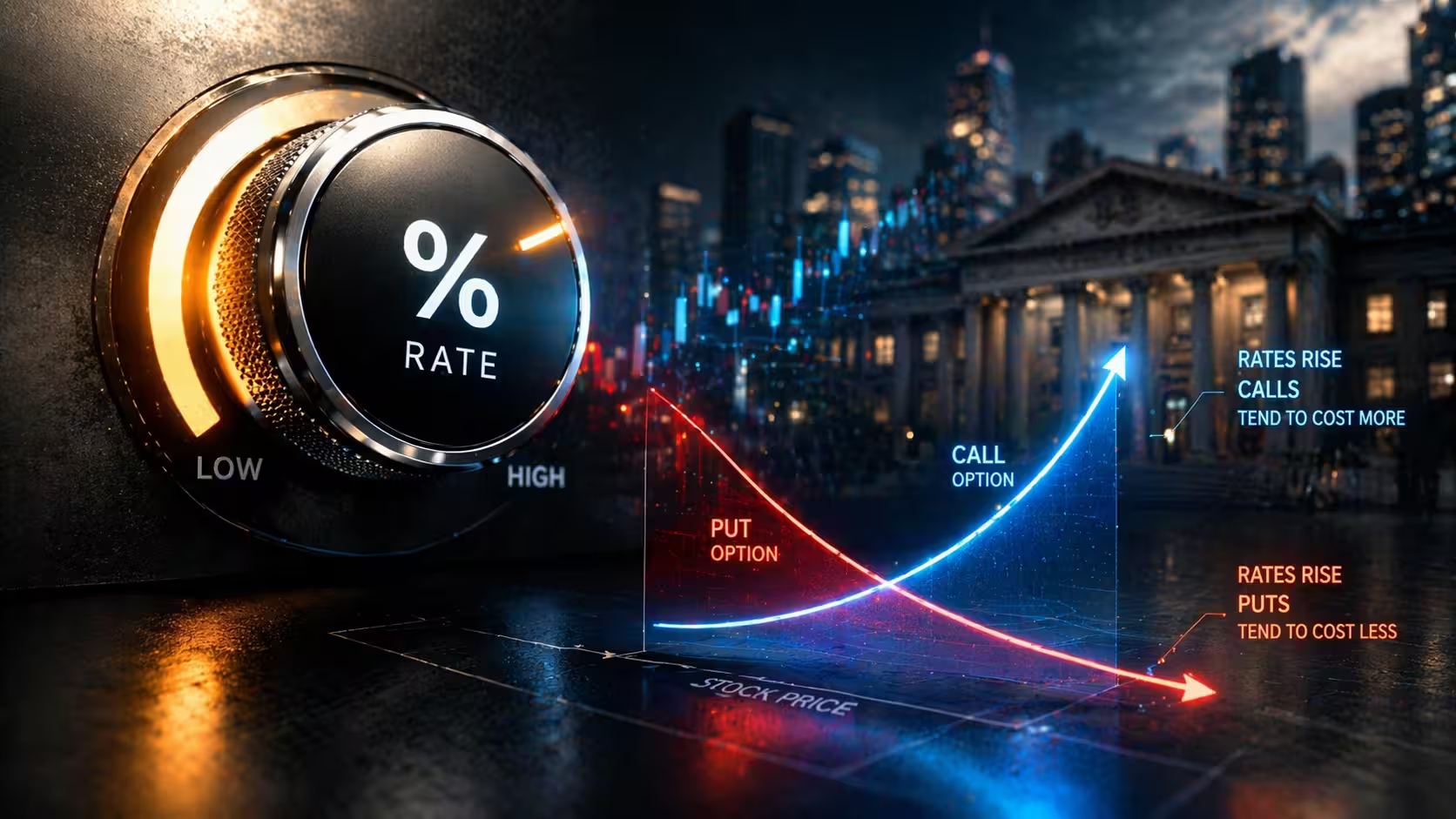
As interest rates rise, the price of call options tends to increase, leading to an overall positive relationship between interest rates and call option premiums. This ultimately makes call options much more attractive to investors because they are more beneficial than outright buying the underlying stock. It can also reduce the cost of carrying any given position on margin.
Put Options and Interest Rates
Interest rate hikes can reduce the value of put options as it becomes more expensive to hold cash for exercising.
There’s a negative correlation between interest rates and put option premiums. As interest rates increase, the price of put options decreases (generally) as investors are more willing to short an interest-income-generating stock than buy a put option. Therefore, higher interest rates lower demand for puts and their prices.
Investors who short a stock instead of buying a put can earn interest on the borrowed shares, which results in a much more profitable strategy. Plus, the cost of carrying a put increased following interest rate hikes, which continues to contribute to a severe decrease in that option’s premium.
Impact on Implied Volatility
Interest rate changes also have a habit of affecting implied volatility, which typically springs up when investors are uncertain about the future of the economy, inflation, or the current monetary policies. One of the monetary policies is the interest rates we’ve been talking about, so implied volatility usually goes up when there are interest rate hikes.
As we’ve already discussed, implied volatility measures uncertainty around the market’s future and specific financial variables tied to that market. Increased uncertainty and volatility can lead to higher prices when entering trades. IV can be used in conjunction with measures like futures prices and forward interest rates.
When interest rate hikes appear suddenly, consumers and businesses tend to cut back on spending, which can lead to lower earnings and stock prices. These reactions can lead to additional uncertainty. The exact opposite happens when interest rates drop: spending increases, and stock prices rise once more.
Practical Examples—Real-World Impact on Traders
To give you a better idea of how interest rates can affect the markets, for good or for bad, we’ll take a trip down memory lane and look at the Fed’s last interest rate hike, which occurred in July 2023. It was the most recent instance of the Federal Reserve hiking up interest rates in the hopes of slowing inflation, and their new interest rate target range following this hike was 5.25-5.50%.
Uploader Note: I will include this section next week.
- Compare options prices before and after a rate hike.
- Discuss case studies, such as during Federal Reserve rate hikes in recent years.
Hedging Strategies for Interest Rate Hikes

Traders and investors with a keen eye will notice that there are ways to hedge their portfolios against interest rate hikes and their sometimes adverse effects on options trading. One strategy specifically deals in interest rate futures investments, but there are a few other approaches, like portfolio rebalancing and investing in either long-term or short-term options.
Using Interest Rate Futures to Hedge
There’s a way for traders to hedge against interest rate changes by trading interest rate futures. Investors must trade interest rate futures contracts to lock in future interest rates and protect themselves from unfavorable market movements. It all begins with buying or selling contracts, though it depends on the direction of rate changes you predict will happen. Buy contracts if you expect rates to fall, and sell contracts if you expect rates to rise. This hedging strategy is best used by banks managing loans with variable rates, investors with large fixed-income portfolios, and businesses planning future debt issuances.
Investors agree to purchase a bond at the premium and the interest rate at a future date when they buy an interest-rate futures contract. The value of those existing bonds will fall if market interest rates go up. However, any loss is offset by the value of your futures contract increasing under those same conditions!
Adjusting Portfolio Risk
Another common tactic with inventors looking to protect themselves from rising interest rates is to rebalance their portfolios, which can be done once a year or quarterly. The danger is that interest rate hikes can cause your portfolio to get away from its target asset allocation, leading to reduced returns and increased risk. In keeping an eye on inflations, monetary policies, and yield curve movements, investors will want to compare their current asset allocation to their target and adjust accordingly. A portfolio rebalance should also align with your trading and investment goals and strategies.
Investors rebalancing their portfolios to mitigate the impact of interest rate hikes might employ a technique that favors call options during rising rates. This is because call options increase in value as interest rates go up. If you have a lot of investments that are put options, it might be time to sell some off and replace them with call options that fare much better during times when interest rates are up.
Long-Term vs. Short-Term Options
Another consideration during interest rate hikes is having a portfolio that leans more toward short-term options because they aren’t as sensitive to these changes as long-term options. Their value isn’t impacted as significantly by interest rate fluctuations over a longer period the way a long-term option would. The key for investors to understand here is that getting a lower rate for a shorter period is preferable in the midst of an interest rate hike.
Long-term bonds have much more interest rate risk, which leads to more severe price fluctuations due to changing rates. This is largely due to the longer time they have to expire. The price of bonds with longer maturities also falls more significantly than the price of bonds with shorter maturities (short-term bonds).
Key Takeaways for Options Traders
There’s a lot to learn and know about when it comes to interest rates from the Federal Reserve and how they ultimately affect options pricing. However, there are three key takeaways that you should know about the subject when you walk away from reading this guide.
Here are the most critical lessons on options trading and rising interest rates:
- Higher interest rates tend to increase call option premiums.
- Rising interest rates reduce the attractiveness of put options.
- Traders should monitor central bank policies closely to anticipate shifts in options pricing.
Knowing what might be coming down the pike from the Federal Reserve gives you the time to readjust your investment effectively, shifting the action to short-term bonds and call options.
Focus on Short-Term Call Options to Weather Interest Rate Hikes
Whether you’re holding calls or puts, knowing how interest rates influence options pricing can give you the edge you need to profit in changing markets.
Traders and investors need to stay informed about the Fed’s monetary policies and possible interest rate hikes or drops—it’s the best way to stay completely informed about market conditions. To navigate interest rate hikes effectively, they should adapt their strategies discussed in this guide. Call options and short-term bonds are the way to go when interest rate hikes are inevitable. If you catch wind of an interest rate change-up, begin rebalancing your portfolio to include these positions and investments.