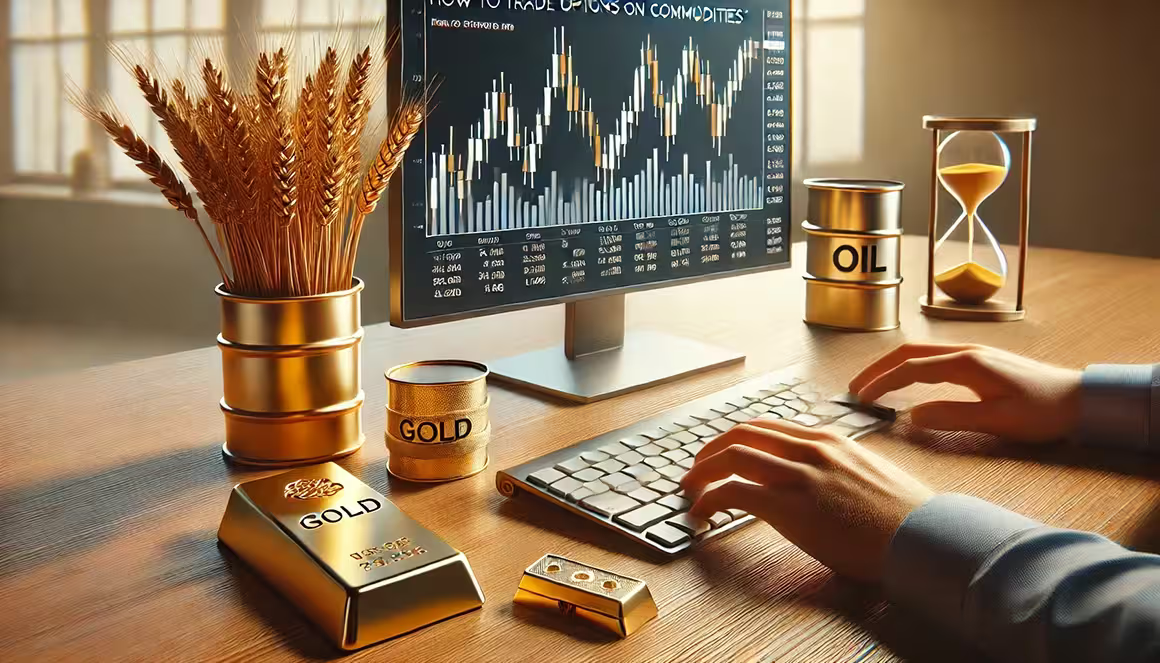
Options trading on commodities is an exciting and lucrative opportunity for traders. This refers to buying and selling options contracts on commodities like metals, agricultural products, or energy products without having to physically handle the materials yourself. Unlike stock options, commodity options are based on the price movements of tangible goods rather than securities.
New commodity options traders will learn several things in this guide, most notably being able to access a helpful step-by-step guide to understanding, analyzing, and trading options on commodities. If you’re new to the commodities market, we’ve included some of the best reasons to get involved and a few of the key considerations you must take in mind before lining up your investments. As with any other kind of trading, we’ve taken the time to run through several of the best trading techniques and ways to manage risk when trading tangible goods.
What Are Commodity Options?
Commodity options can be risky to deal with, but many traders like to deal with these because they offer opportunities for hedging against pricing risk, minimizing risk, taking advantage of price volatility, and taking short positions in futures. For a better idea of what options trading with commodities entails, we’ve highlighted what commodity options are and the types of commodity options available to online traders.
Definition
Commodity options are a financial contract that gives the trader (buyer or seller) the right to buy or sell commodities like energy products, metals, or agricultural products at a strike price and by an expiration date. Commodity options are best on the price movements of the aforementioned physical assets. Two types of commodity options include calls and puts.
It’s worth noting that there’s a big difference between commodity options and commodity futures, even though they are both derivative contracts that give investors the right to buy or sell assets in the future. Here are several ways that commodity futures are different from commodity options:
- Commodity traders are required to purchase the commodity when dealing with a futures contract
- Commodities futures are settled daily
- Futures can be used on commodities, currencies, and interest rates (a wide range of deliverables)
- Commodity futures control a specific quantity of a commodity
- Companies use commodity futures to manage risks
- Commodity futures can be risky because of price fluctuations rooted in supply and demand
Commodity options give traders the right (not the obligation) to buy or sell an underlying asset at a specific strike price before the option expires. For commodity options, traders must pay a premium to get this right. Traders can buy or sell call options and put options on commodities like livestock, industrial/precious metals, energy commodities, or agricultural products.
Types of Commodity Options
Underlying commodity types are how commodity options can be organized. There’s a further distinction where each commodity is further divided into various options based on option type, strike price, and expiration date.
Commodity Options Categories
- Agricultural Products—Corn or soybeans
- Livestock—Cattle or hogs
- Precious Metals—Gold or silver
- Industrial Metals—Copper or aluminum
- Energy Commodities—Oil or gas
Examples
Just like regular options contracts, those trading commodity options can buy and sell call and put options for commodities like oil, gold, and agricultural products. These contracts give the trader the right to buy or sell commodities by a certain expiration date at a certain price.
- For instance, a crude oil put contract would give the trader the right to sell a certain amount of crude oil at a specific price before a set date.
- Another great example would be investing in precious metals like gold, silver, or platinum to work as a hedge against inflation when currency is devalued or during times of market volatility.
Why Trade Options on Commodities?
Commodity options let traders hedge their investments and speculate on future price movements without having to be involved in the physical delivery of the commodity itself. Trading options on commodities give the trader the right to buy or sell the underlying asset at a strike price and by expiration date, just the same as you’d encounter with trading options trading. There are many reasons why some traders prefer to trade commodity options online and we’ll dive into further detail on these popular investments.

Hedging
Options can be used by traders as an insurance policy against unfavorable price movements in the commodities they hold. Options can also be used to generate good profits, but also limit potential losses at the same time. The best way to hedge with options is to buy put options because they give the trader the right to sell the commodity at a certain strike price if the value declines.
Speculation
Commodity options give traders the ability to speculate on price movements. They can make money by buying and selling assets–traders don’t have to worry about handling the commodities directly, but they can still control them. Commodity speculators, unlike hedgers, don’t have to physically handle, ship, or store the products that hold in options.
Leverage
Another significant upside of trading options on commodities is the fact that traders can pay a relatively small premium and still get some decent market exposure. In other words, commodity options provide good leverage for traders. They gain around 100 shares of the underlying stock through the premium they pay, which is great exposure when compared to the contract value. Even when there are only small percentage moves in the underlying commodity, traders can see significant percentage gains! The limited upfront investment can generate some considerable profit.
Diverse Market Opportunities
Options traders who focus on commodities have access to a wide range of exciting products, including energy, metals, and agricultural products:
- Agricultural Products—Corn or soybeans
- Livestock—Cattle or hogs
- Precious Metals—Gold or silver
- Industrial Metals—Copper or aluminum
- Energy Commodities—Oil or gas
Because there are so many sectors from which traders and investors can acquire commodity options, these investments can be excellent for portfolio diversification, which is a position that any trader would want to be in.
Key Factors to Consider before Trading
Anyone who wants to begin trading options in commodities needs to consider these key factors before starting. We’d like to emphasize the importance of volatility, supply and demand patterns, and global events because these factors play a giant role in trading in the commodities market. Keep reading to learn about some of the challenges you might come up against when trading in this realm.
Volatility in Commodity Markets
As volatility increases, the prices of options on the underlying asset tend to rise. This is the same for call options and put options alike. The chances of these options finishing in the money tend to increase as well. Therefore, there is considerable volatility that a trader will experience when dealing with the commodity market. They need to be aware of the trading strategies needed for dealing with volatile conditions such as straddles or strangles.
Seasonality and Supply/Demand
There are several different ways in which seasonality impacts commodity prices, and they’re generally predictable. For instance, agricultural products have predictable supply and demand due to the impacts of weather and the times of harvest. The fluctuations throughout the year are pretty clearly telegraphed, but there are some unknowns in there, too. Traders will usually see lower prices during harvest periods and higher prices during periods of low supply, basically the time between harvests.
- The Impact of Weather: Prices can spike when there’s weather that negatively impacts the harvest. During these times, the supply can also be affected in less-than-ideal ways.
- Harvest Lows: During harvest time, there can be moments when the market is flooded with a large volume of products. Due to the oversupply, commodity prices tend to be at their lowest. Prices tend to go up when a commodity is scarce.
- Post-Harvest: As supply tightens after the harvest season, prices will begin to go back up. Demand remains stable during this period following the harvest.
We’ve already alluded to the concept while discussing the seasonality of commodities, but the laws of supply and demand are in full swing when it comes to trading commodity options. When there’s high demand for a product, but the supply is low, this will lead to higher commodity prices. On the other hand, if there’s a low demand and the supply is high, the commodity prices will be much lower. As you can see, supply and demand directly influences commodity prices.
Global Events
The biggest way in which geopolitical events or economic data can impact commodity prices is by causing disruptions in the supply chain. When this occurs, production levels can be affected, which directly impacts the demand for certain commodities. As demand fluctuates due to uncertainties and market volatility, commodity prices will spike or drop.
A few examples of global events that could greatly impact commodity prices include the following:
- Trade Restrictions—Something that could significantly limit the movement of goods is sanctions or trade wars. Trade restrictions like these can impact the supply and demand dynamics, which can cause huge price swings in commodities.
- Global Conflicts—Geopolitical conflicts, such as political unrest or wars, can cause disruptions to supply and demand for commodities that are produced in the affected countries or regions. Production and exports can be greatly affected, leading to price swings.
- Natural Disasters—Agricultural commodities can be especially susceptible to the impacts of natural disasters like floods, droughts, or hurricanes. Devastating effects on production systems or infrastructure can lead to rising prices of agricultural products due to reduced supply.
How to Get Started Trading Commodity Options
To anyone ready to trade commodities online, we’ve outlined a helpful guide that will get you set up in no time. To be honest, this largely works the same way as preparing yourself for trading options. It’s all rooted in choosing a suitable broker, taking the time to practice trade strategies, and learning the fundamentals of trading options. The one way where trading commodities differs is that newcomers need to have a good understanding of the commodity market before trading these goods.

Step 1—Choose a Broker
Obviously, the first step is choosing a good broker app that will let you access the commodities markets you want to trade in, but also platforms that have the trading tools you need to meet your trading goals. To give you an idea of what to look for as you choose a new broker app, here are a few suggestions of areas to focus on:
- Research Tools: Choose a broker app that has the right research capabilities, like charting tools, analyst reports, news feeds, real-time market data, and stock screeners.
- Fees/Commissions: When trading commodities, it’s best to keep your operating overhead low to make the most of your profits. Look over the broker app fees to ensure you’re not paying too much on operational fees like commissions, inactivity, or account maintenance.
- User-Friendliness: Find a broker app that lets you trade commodities options, but do so with an intuitive, easy-to-navigate interface. Make sure the app is visually appealing and allows you to trade commodities quickly and nimbly.
- Security: Use commodity trading apps that have the standard security protocols available, like encryption and two-factor authentication. Make sure it’s a platform that will keep all your private data completely safe and secure.
- Educational Resources: It’s recommended to trade with an app that offers resources for continuous learning and education. Find a platform that carries videos, articles, and tutorials to guide you as you are first learning or to keep you sharp even after many experiences.
- Order Types: Find out if your commodity trading platform supports a wide range of order types, such as markets, limits, stop-losses, or trailing stops.
- Investment Vehicles: Perhaps you want to use a platform that lets you do more than just trade commodities. If that’s the case, research each option to find out which platforms carry which investment vehicles. Some platforms let you trade commodities as well as stocks, ETFs, mutual funds, options, or bonds.
Step 2—Understand the Commodity Market
Before trading commodities online, it’s best to research the specific commodity you’d like to trade options on, like oil, gold, or soybeans. There are hard commodities (those that can be mined or extracted) and soft commodities (agricultural products, for the most part), plus there’s the concept of trading commodities in physical markets versus derivative markets. The more familiar you are with the different forms of commodity trading, the more likely you are to find the mode that fits your trading style or goals.
Once you’ve found the commodity market you’d like to focus on, it’s best to begin using charts and data to analyze trends. Understand how supply and demand can affect the price of commodities, as well as the volatility that comes from seasonal fluctuations and global events. Keep in mind, too, that commodities are a form of trading where investors benefit from a well-diversified portfolio and from leveraging a large position with little capital.
Step 3—Learn the Basics of Options Trading
Not only will you want to know about the commodity market you want to trade in, but you’ll also want to review the fundamentals of options trading with concepts like calls, puts, strike price, expiration date, and others. Commodity options work a lot like traditional options trading—traders profit when there are price movements in a desired direction or if there’s a market volatility period. The commodity option is a financial contract giving the trader the right to buy or sell a specific quantity of that commodity at a particular strike price by a particular expiration date.
Check out Beginner Guide/Glossary Terms to get familiar with these terms and ideas. They can provide you with invaluable insights that will help you get your footing in the commodities market.
Step 4—Paper Trade First
Before diving into commodity options trading, we recommend taking the time to practice trading with a demo account to gain confidence. You can find these demo accounts at many broker apps and other trading platforms. Traders can get a virtual balance to use to practice strategies and other trading techniques. The advantage to practicing trading is that you don’t have to use any of your capital during the early stages when you’re getting familiar with trading commodities or trying out new strategies.
Common Trading Strategies for Commodity Options
If you’re wondering which trading strategies are best for commodity options, we’ll be highlighting them here and they are some of the most common trading techniques that inventors use for trading traditional options. Find out how covered calls, protective puts, straddles, strangles, and iron condors can serve you well as you turn a profit trading commodities.
Covered Calls
Covered calls are a trading strategy that is best used when the underlying commodity’s price is expected to either be flat or moderately bullish. Investors execute a covered call when they own a commodity (one that covers them if the price of the commodity rises and the call option expires in the money). Commodity traders can collect the premium in the process and wait to see if the call expires or is exercised.
Covered calls will limit the trader’s potential upside, which is one of the disadvantages that comes with this technique. However, covered calls offer traders some protection against losses if the commodity price declines. Overall, the strategy is considered lower risk and it’s a good commodity trading method for beginners or traders who have minimal experience.
Protective Puts
Traders can buy a put option on a commodity they own outright or are in the process of buying. This put option gives the trader the right to sell the stock at the set strike price and before the expiration date. The best timing for exercising the protective put is if the commodity price drops below the put’s strike price. Once traders exercise the put option, they can sell the commodity at the strike price.
One good reason traders use protective puts is as a substitute for stop-loss orders which can sometimes be triggered when they aren’t necessarily wanted. The protective put limits downside risk while also increasing the potential for upside gains. Traders can offset their losses if the put option contract increases in value when the commodity price drops.
Straddles
Commodity traders can simultaneously buy a call and put an option on the same underlying asset with the same strike price and expiration date. Traders are betting that there will be market volatility that will move the asset price significantly in either direction. The trade becomes profitable when there’s volatility but traders don’t have to get the direction of the market correct. The underlying commodity must move significantly above or below the strike price while also exceeding the cost of the options premium.
Straddles are a neutral strategy overall and the biggest profits come in when high volatility is expected. Straddles are best to use when traders believe that the commodity is likely to go through a significant price swing but they aren’t confident on which direction the movement will go. They’re ideal to use before a major news announcement or the release of an earnings report.
Strangles
Another commodity trading strategy that profits from volatility in commodity prices, strangles is focused on traders buying a call and a put option on the same underlying commodity, but with different strike prices. Like staddles, strangles profit when there are considerable price swings in either direction, so traders don’t have to correctly predict the direction of the price swing. Where strangles differ is that they carry the risk of larger losses if the commodity prices stay within the strike price range.
With the strangles, the maximum loss is the premium paid-for options. However, larger losses are also possible if the price moves in the opposite direction sharply. The maximum profit has no ceiling with the price of the commodity moving considerably beyond either strike price.
Iron Condors
Commodity traders can also use an iron condor to trade commodities successfully. They are best used when traders expect low volatility and they’re considered a neutral trading strategy where the trader profits from the stability of an underlying asset. An iron condor is executed when traders buy an out-of-the-money call and put contracts while also selling an out-of-the-money call and put with a higher strike price.
The iron condor is a solid strategy for range-bound commodities. The maximum profit is the premium that the trader pays for the iron condor package. On the other hand, the maximum loss associated with an iron condor is the difference between the two strike prices of the two sets of options.
Risk Management in Commodity Options Trading
One of the key characteristics of the commodity options trading market is price volatility. Economic changes, weather, war, and other major factors, can have effects on the marketing and production of commodities on local, regional, and global levels. Therefore, it becomes important for traders to effectively manage the risk that comes from trading commodities. Here are some of the best ways for investors to keep their losses to a minimum and keep the potential to turn a profit trading commodities.

Position Sizing
Like any other form of options trading, it’s key to use the correct position size for each trade you enter. How much capital should you allocate per trade? It’s best to stick to 1%, but never go higher than 2%. This comes with having a well-diversified portfolio. The smaller the amount of capital you have tied into a single trade, the more capital that can be used in other market sectors or asset classes. This also helps commodity traders in that there isn’t a whole lot of risk in a single trade which means that a single losing trade isn’t that big of a deal because it doesn’t have a significant impact on the bottom line.
Setting Stop Losses
A surefire way to limit losses in highly volatile markets is to set stop-loss orders. This is a tool that commodity traders can use to limit their losses to a pre-determined level based on their trading plan. If a commodity stock begins losing value and hits the level the trader set up in their stop-loss order, that option contract will be automatically sold to ensure that traders can limit the loss before it potentially goes lower.
Managing Margin Requirements
Margin refers to the amount of money that a commodities trader must deposit into their account as collateral to cover potential losses on short option positions. The margin requirement depends on the underlying commodity, strike, price, and market volatility.
Using margin on commodity options lets traders control a larger position with a small amount of capital. However, they run the risk of losses exceeding the initial margin deposited due to bad market moves against short option positions. It’s important to know that high-volatility commodities require a higher margin deposit, options with far out-of-the-money strike prices have lower margin requirements, and options with a longer time to expiration have higher margin requirements (typically).
Case Study—Trading Options on Gold
Let’s run through an example of trading options on a precious metals commodity like gold. We hope this case study can give you a better understanding of how the process of trading options on commodities would work for the average online trader. We’ll outline a hypothetical trade scenario and some of the lessons that traders can learn along the way.
Scenario
To trade gold options, follow these steps to get started:
Choose a Strike Price
If you’re interested in trading options on gold, the first step is choosing a strike price. To choose a strike price properly, traders must consider their personal risk tolerance, time horizon, and market outlook. For instance, traders who have a more conservative approach to their investing might want to select a strike price that’s close to the current market price. Traders who are willing to take more risks than others might choose a strike price that is further away from the strike price to hopefully secure a larger profit.
Calculating Profit and Loss
The next step is to figure out what your potential profit and loss scenarios are. To calculate profits for gold options, traders must subtract the strike price and the option price from the current share price. Traders must then multiply by the number of contracts, typically 100 shares.
To find out what their loss potential (net loss) is, traders must subtract the premium they paid for a long position in a gold option or add the premium they received from a short position in a gold option from the value of the final options at the expiration date.
Managing the Position
To effectively get around market movements, traders must manage their gold options responsibly through the use of calls, puts, and other trading strategies. For instance, it’s best to use call options around your gold investments to profit from rises in the commodity’s price. On the flip side, traders should purchase put options so they can benefit from downturns in gold prices.
Lesson Learned
- Customize your strike price around your taste for risk and your personal trading style. If you’re playing it safe, choose a strike price that’s closer to the current market price.
- Figure out your highest possible profit and highest possible loss with each gold option contract. This lets you set up appropriate take-profit and stop-loss orders.
- Use trading strategies to effectively manage your gold options. As much as you can, use call and put options on gold to take advantage of rises and falls in the commodity’s price.
Trade Commodity Options Today!
Trading options contracts on commodities give traders and investors the right to buy or sell commodities like energy products, metals, or agricultural products without having to physically handle the product. They can speculate on price movements, use their commodity investments as a hedge, and control a large position with a limited initial capital investment.
To get started, investors must have a reliable broker app that offers commodity trading, understand how the options and commodities markets work, and then practice their commodity trades using a demo account to gain the knowledge and experience they need to succeed. In time, these investors learn how to harness the power of covered calls, protective puts, iron condors, and other trading strategies to properly manage their commodity investments.
Even though learning about commodity trading can take time, the steps to getting started aren’t too time-consuming, after exploring more guides, you can sign up for a recommended broker and start paper trading on commodities in a matter of minutes. Start today and begin benefitting from trading options contracts on physical assets like gold, soybeans, wheat, or iron.