What do massive options trades by market whales reveal about future price moves?
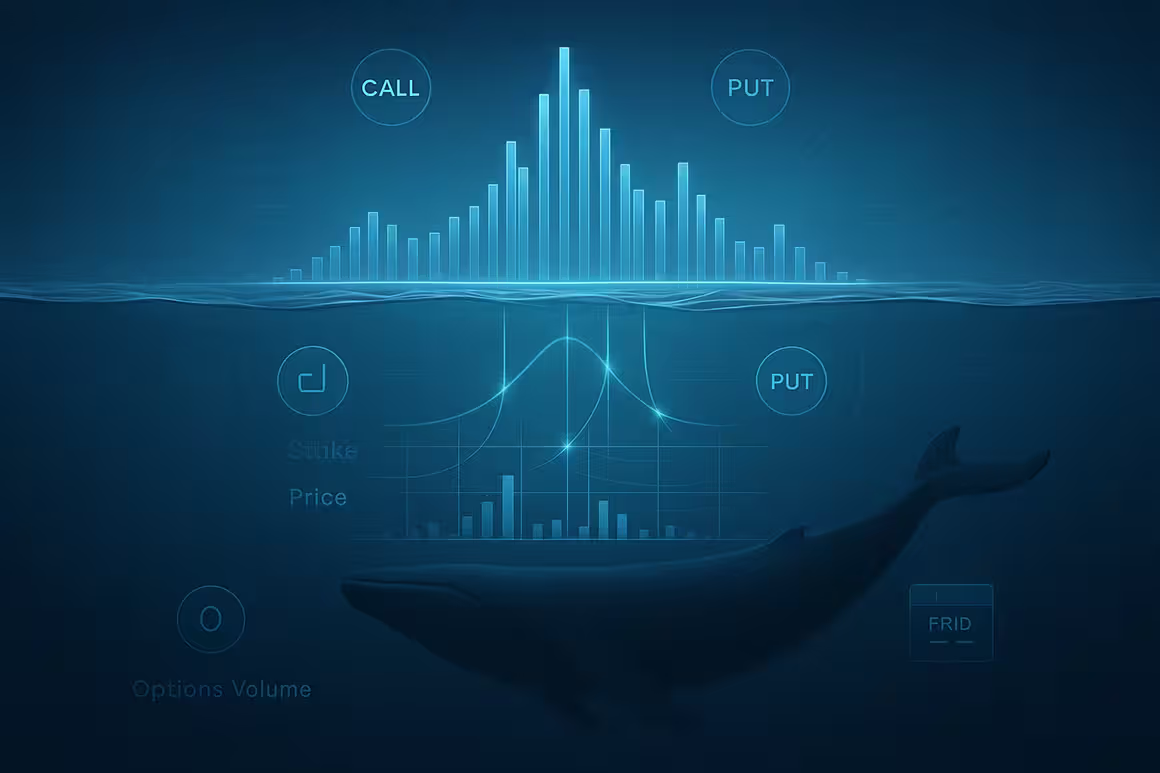
“Whales” refer to traders and investors who work on behalf of large institutions. Spotting when these traders are active in the options market can be used by retail traders as a rough gauge for market sentiment or to anticipate potential price movements for certain options in the future. This guide will discuss how to spot these large trades, why they matter, and how to use that info to your advantage.
What Is Whale Activity in Options Trading?
In options trading, a “whale” refers to institutional investors like hedge funds, mutual funds, insurance companies, banks, or pension funds that make large trades online that can significantly impact volatility and market pricing.
Because of the volume and frequency with which they trade, whales can create temporary increases or decreases in options or stock prices. Institutional investors’ buying or selling power can overwhelm the liquidity of the market, and this can lead to increased volatility and sudden shifts in pricing. When it comes to the options space, institutional investors can have a substantial influence on price movements, which we’ll talk about in greater detail throughout our guide.
What Does Whale Behavior Look Like?
Though there are several other signs of whale activity outside of these three, we feel these are the top three signs of whale activity that are relatively easy for the average retail trader to spot.
- Large Open Interest—Whale activity can contribute to an increase in open interest, which means that there’s a high number of outstanding contracts in the market for particular options.
- Unusual Option Chains—If there’s increased activity in option chains that have high volatility, short expirations, and high open interest, this can be a strong sign of whale activity.
- Unusual Volume That’s Larger Than Normal—If you begin seeing large trades taking place that results in a huge volume spike with certain options contracts, this can be a prime example of institutional investors’ money at work.
Why Whale Activity Matters for Retail Traders

Having a rough idea of why whale activity is occurring with certain options contracts can offer insight into big money sentiment and the possible direction of the market. For instance, if whales are trading a high number of call options on energy stocks, it’s a strong sign that the big players in the options market are feeling bullish about the future stock prices for energy companies or producers.
Whale activity can also be used as a leading indicator for future price movements. Based on the example we just discussed, retail traders could speculate that it’s best to buy calls on energy options to benefit from an increase in their stock price. Another significant benefit of monitoring and following whale activity is that traders can piggyback off these smart money moves to be on the right side of a trend more often than not.
Caveat: Not all volume spikes are bullish/bearish; context is key.
Key Indicators of Whale Activity in Options Volume
How do you know when institutional investors are at play in the options market? Although you need confirmation through tools like option flow dashboards and unusual options activity scanners, there are some signs on the surface that traders can observe that suggest smart money is active and having an impact on options prices.
Unusual Volume
- When the daily volume is significantly above average for certain options, there’s a terrific chance that smart money is working behind the scenes. It could indicate either buying or selling.
- It’s key to note that high volume differs from high open interest in that volume refers to the number of contracts being traded, while high open interest refers to the number of positions being opened that are outstanding for certain options.
Unusual Open Interest (OI) Changes
- Surging OI signals positions are being opened, not closed. This is a strong sign that institutional investors and smart money are at play.
- Institutional investors use the closing and opening of trades strategically to take advantage of price manipulation and market sentiment.
Large Block Trades
- A clear signal of smart money trades is when the deals are conducted in large round numbers like 10,000 contracts.
- When these large block trades are done in a decentralized market outside of formal exchanges like OTC or through dark pools, it’s one of the key indicators of whale activity in the options market.
Skewed Strike Activity
- Often with whale activity, you’ll see heavily skewed strike activity where there’s heavy interest in far out-of-the-money calls/puts.
- When retail traders see skewer strike activity, this can be a major sign of directional conviction on the part of institutional investors and other smart money entities.
Short-Dated Contracts with High Volume
Another big sign of institutional investing in options is when there’s a high volume of short-dated contracts being traded in preparation for significant market events like earnings announcements or Fed meetings. It usually means that whales and other smart money investors are speculating on near-term catalysts to secure a profit.
Tools and Platforms to Track Whale Options Activity
Being able to spot institutional trading activity requires the use of the best tools, so we encourage you to check out these UOA essentials.
- Unusual Options Activity Scanners—These are platforms that track unusual options activity to show retail traders where smart money might be afoot in the options market. A few good scanners include those provided by FlowAlgo, Cheddar Flow, or Market Chameleon.
- Broker Tools—Use a good trading app or website that carries UOA scanners, so you can use everything in one place. A few good trading apps that are good for tracking smart money orders are Thinkorswim, Fidelity, and Interactive Brokers.
- Options Flow Dashboards—Traders can use these tools to visualize and analyze the flow of options traders with a focus on smart money. View real-time data on option orders to understand possible price movements and market sentiment. They typically come with helpful time & sales feeds.
How to Use This Information in Your Own Strategy
Check out these tips for piggybacking on whale trades (with caution). You can emulate the trades of the professionals and work them into your own strategy that’s tailored to your trading style, skill level, and risk tolerance.

- Look for Confirmation—Although you might be able to spot what you think is whale activity in the options market, it’s best to back this up with technical and fundamental analysis as well as UOA tools like scanners and options flow dashboards for confirmation of the trends you’re seeing.
- Don’t Blindly Follow—Use whale activity as a signal, not a system. You shouldn’t be centering your entire trading plan around institutional investors and their trading decisions. It’s key to take time to understand the underlying factors that are driving the market movement in the first place.
- Combine with Your Own Risk Management—Not only should you make informed trading or investment decisions based on your own analysis, but you should combine your strategy with your own risk management practices. Use a small position size, figure out the risk-to-reward ratio with each position you enter, and use stop-loss orders to minimize your potential losses.
Common Pitfalls to Avoid
Be sure not to make these big mistakes when working whale activity into your options trading strategy. It’s possible to trade around institutional investing and smart money activity, but it has to be done with due diligence and some thought.
- Mistaking Large Volume for Bullish Intent—While high volume is usually a good sign of strong demand, it could also serve as an indicator of a potential trend reversal. Don’t make the mistake of betting on the stock price rising with certain options and then getting burned by a market that moves in the other direction. For a more complete understanding of the market, check other factors like price action, volume divergence, etc.
- Not Checking if Trades Were Bought/Sold—Making this mistake is rooted in not checking to verify whether a transaction has actually occurred as intended. Not checking the status of these trades can result in financial losses and misunderstandings about which positions could turn a profit.
- Ignoring Market Context—Traders have to take other events in the market into account to understand the full text. Look at upcoming events like earnings reports, news stories on the companies or industries you’re investing in, and other relevant macro events to get a firm idea of which smart money investments are worth chasing.
- Chasing Illiquid Contracts—Make sure you’re not hurrying into an investment that cannot be easily sold. You could end up with a trade that no one wants to buy, and will lose you money.
Don’t Just Watch the Whales—Learn From Them
Whale trades can offer powerful clues — but context and caution are critical. Observe these moves, but back up your thoughts and theories of what’s occurring with other technical analyses and indicators. If you’re adamant about working unusual options activity into your trading strategy, we’d encourage you to test tracking tools and build awareness over time. To explore more advanced options trading strategies, check out our complete guide!