Have you ever noticed unusual options activity before a big stock move? It’s not a coincidence.
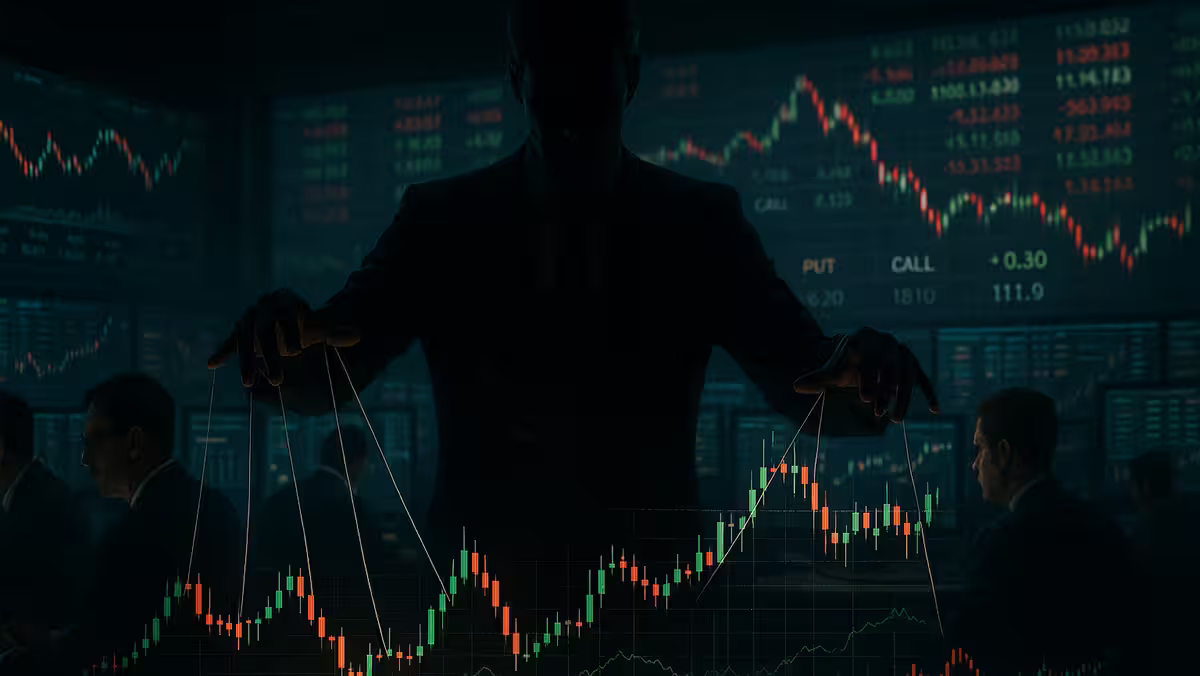
“Smart money” is a term commonly used in the options trading world to refer to institutional investors, hedge funds, and market makers. These investors have substantial experience and the means to influence market trends in a major way with their trading moves. It’s these traders who are responsible for the unusual options activity you might commonly see before a big stock move.
With that said, it’s no surprise that options can be used to influence stock prices. Our guide will address how smart money uses options to manipulate stock prices and the primary tactics that are used along the way. If you want to succeed in trading options online, it’s good to know the signs of these manipulative moves and know the best course of action to take in reaction so you can profit as well—keep reading to gain some of these valuable insights!
Understanding the Role of Smart Money in the Markets
“Smart money” refers to money that is invested by well-informed or highly experienced professionals including institutional investors like hedge funds, venture capitalists, or investment banks. These kinds of traders have access to extensive market information (unlike retail investors) and they can move large amounts of capital when they invest. As a result, smart money investors have a lot of influence in the market with access to more money, advanced data, and strategies.
“Retail investing” refers to individual investors who generally make smaller traders and they do it on their own. Retail traders have less knowledge of the market and they use a smaller amount of capital compared to institutional investors. They might not be able to significantly influence the movement of the market the way that smart money investors can, but retail traders can use options to profit from the large market movements when the time is right.
Our guide will get into more detail on how to spot smart money moves and the unusual options activity that is typical of these bigger investors. Once retail traders are able to know the signs of smart money working within the market, they can use the leverage of options which allows for greater control over stock movements.
Why Options Are a Powerful Tool for Market Manipulation

Options trades can provide traders with a lot more leverage than traditional stocks can. An option buyer can pay a relatively small premium for market exposure through an options contract. When we say market exposure, we’re referring to around 100 shares of the underlying stock that you see most often with options contracts. As a result, investors using options will see a large percentage gain from small movements in the underlying asset in a favorable direction, all for a much smaller capital investment compared to stocks.
Options can drive stock price movement due to delta hedging by market makers. This technique is used by smart money investors to manage their exposure to price fluctuations which means they buy or sell shares of the underlying stock to offset their potential gains or losses from the option they’re selling. Options can be such a powerful tool for market manipulation due to delta hedging and its ability to influence the stock price as smart money investors adjust their positions to remain neutral to price movements.
There are several ways that traders can identify market manipulation including the following:
- Open Interest: Large changes in open interest can indicate when participants are entering or leaving the market, while usual changes in open interest can be a sign of insider trading or other market manipulation tactics. When open interest increases, it can confirm a trend and those trends tend to lose strength when you see a drop off in open interest.
- Volume: Market movers can artificially inflate trading volume in a security to make it look as if there’s high demand, in an effort to manipulate the price. A common tactic of smart money to create the appearance of significant market activity is through “trade washing” where the trader buys and sells the same security repeatedly to create fake volume.
- Gamma Squeeze: This phenomenon is caused by a large number of investors buying call options which creates a cycle that drives the stock price higher. It happens when market makers buy the underlying stock in response to many investors buying call options for a stock. The higher stock price makes more call options profitable and encourages more investors to buy call options, which drives the price higher.
Manipulation Tactics Used by Smart Money
Much of the financial markets are driven by the emotions of fear and greed—smart money investors know this and take advantage by creating situations that are based on these strong emotions. You can see these manipulation tactics in price action and volume if you’re looking closely enough. Let’s look at the most common market manipulation tactics that smart money investors tend to use.
Large Volume “Sweeps” and Unusual Options Activity
A large volume sweep is a situation where a prime market player places a large order to trigger a large volume of pending buy or sell orders at specific price points. They accomplish this by rapidly moving through multiple price levels. Being a key manipulation tactic used by smart money investors, these large options orders signal upcoming stock moves to retail investors with a keen eye.
Large volume sweeps are considered a form of unusual options activity and they indicate that institutional investors are making a substantial bet on the future price movement of an underlying stock. Sweeps can be a symbol of a significant market shift incoming.
Another key to understanding unusual options activity that institutional investors partake in is understanding “dark pools,” which are private trading venues where large institutional investors can execute significant options orders without revealing their trading activity to the public market. It’s a form of discreet trading that occurs away from the main exchange order book. Institutions use these dark pools as well as hidden transactions to accumulate options without exposure. These moves prevent heavy price devaluation.
Delta Hedging Influence
This is a move that’s popular for reducing the risk of price changes in an underlying asset. Institutions and smart money investors will take a position in a related financial instrument that goes against the original investment. These more experienced traders can hedge their risk when selling options and it protects them from losing money if the price of the asset they invested in moves in the wrong direction.
Large institutions strategically buy or sell options to force market makers into buying or selling the underlying stock. By creating delta-neutral positions, it doesn’t matter which way the market moves because they’re insulated against the loss and this gives them the time and space to focus on the other risk factors associated with the trade like time decay or volatility.
Gamma Squeezes
Gamma squeezes refer to a sudden increase in a stock’s price which is triggered by a large number of investors buying call options. Many investors will buy call options for a stock and, in turn, market makers will buy the underlying stock to manage risk. The higher stock price makes more call options profitable and this encourages more investors to buy call options. This ultimately leads to more stock buying by the market makers. In addition to creating rapid price movements, gamma squeezes are known for creating cycles that drive stock prices higher.
Case Study
A stock like Tesla’s has been subject to several gamma squeezes over the last five years. The first of these happened in August 2020 when Tesla options were bought out by SoftBank. The resulting gamma squeeze made Tesla’s stock price over 74%. Another squeeze occurred in November 2021 when Tesla’s stock price increased sharply.
The more notable gamma squeeze for Tesla stock was around the time of the US elections in 2024. Following the victory of Donald Trump, there was a high demand for Tesla call options which led to a significant gamma squeeze. What this shift did was it forced market makers to hedge their risk by purchasing Tesla stock which drove the underlying price higher.
Pinning a Stock at a Strike Price (Max Pain Theory)
The Max Pain Theory (or pinning a stock at a strike price) is based on the idea that the price of the underlying asset will tend to gravitate toward a specific price point where the maximum number of options contracts will expire as worthless. The likelihood of this occurring gets greater the closer an options contract gets to its expiration date and the phenomenon can cause the most loss to options buyers and maximize profits significantly for option sellers.
Institutions apply the Max Pain Theory to their traders by using their market influence to manipulate the price of an underlying asset toward the specific price point they want. By doing this, they can maximize their profits by minimizing their payout obligations to option buyers as the expiration date gets closer. Institutions are driving the price point where most option holders will lose money on their investments. This benefits the option sellers by having the highest number of contracts expire as worthless.
Selling Overpriced Premiums to Trap Retail Traders
Another favorite move of the smart money investor is selling options with high implied volatility before IV crush and it’s done through selling overpriced premiums to unsuspecting retail traders. These smart money traders are betting that the market is overestimating the potential price fluctuation and they are selling options at a premium price to reap a profit, even though it will decline once the event happens. Selling these premiums to retail investors is timed to make it seem like they’re a good trading decision, but the smart money trader knows that an IV crush is likely imminent when a significant decrease in volatility kicks in.
Case Studies: Real-World Examples of Options-Based Manipulation
If you’re looking for some good examples of options-based manipulation in the market, check out a few real-world case studies that cover subjects like gamma squeezes, forced stock movement, and earnings manipulation.
GameStop (GME) & AMC
A prime example of options-based manipulation occurred in 2021 when GameStop’s stock had a gamma squeeze which led to a parabolic movement in the stock’s price. Speculative investors bought many call options on GameStop stock, then market makers bought shares to hedge their positions. What occurred was the higher share price led to more call buying which created a feedback loop that forced market makers to buy even more shares.
The gamma squeeze, as seen with the GameStop stock example, can cause large price movements in a stock. It was a gamma squeeze that’s been considered by many to be particularly extreme and caused by a few factors like the rise of Robinhood which attracted a ton of retail traders and COVID-19 where people had time at home and money to throw toward investing.
Tesla (TSLA)
When institutions use options to force stock movement, they’re leveraging the power of large positions to influence the supply and demand of the stock. They can push the stock price in a desired direction by burying or selling large quantities of call or put options strategically. This typically results in significant buying or selling pressure being triggered on the underlying stock when exercised.
Earnings Manipulation
Earnings manipulation occurs when a company might intentionally alter its financial results around the earnings announcement to influence the price of its stock options. This provides an opportunity for traders who can exploit the increased volatility around these releases. They use options trading to artificially inflate or deflate earnings to profit from the subsequent market reaction.
For instance, implied volatility usually spikes around the time of earnings announcements which can create opportunities for traders to use manipulation tactics to take advantage of the large potential profit window. Another great example would be traders taking advantage of sharp price movements that occur when a company or business announces significantly better or worse earnings than expected. Any traders who were able to correctly predict the direction of the movement stand to enjoy large gains.
How Retail Traders Can Identify and React to Smart Money Manipulation
A way to improve your skill and experience as a retail trader is to be aware of how smart money operates and be able to spot the manipulation tactics that can be afoot in the market. Once you gain an understanding of how to identify smart money manipulation, you can begin developing strategies on how to react to these occurrences and capitalize on the ensuing market activity.
- Tracking Unusual Options Activity: The heart and soul of identifying and reacting to smart money manipulation is tracking unusual options activity. There are plenty of tree and paid tools for monitoring big trades which can significantly help retail traders who want to copy the moves of bigger investors.
- Following Market Maker Behavior: Understanding how institutions hedge positions begins with observing the buying and selling activity of large financial institutions to identify price trends and trading opportunities. A great way to capitalize on market maker behavior is to place similar trades in the same direction as the large orders of the institutions.
- Avoiding the Traps: There are several insightful strategies to avoid falling victim to manipulation. Be cautious with penny stocks or microcap securities that are easier to manipulate due to low trading volume. It’s key to pay attention to candlestick patterns that could indicate unusual volume or manipulation like sudden price reversals.
Spot the Telltale Sign of Smart Money Manipulating the Market
Smart money traders and big institutional investors use options to influence prices by placing large options orders that create significant market imbalances and push the price in the direction they want. You can see it clear as day with artificially inflated volatility, liquidity grabs, and directional signals where a large amount of call or put options are purchased.
Retail traders can use this knowledge to their advantage. Once they can successfully track unusual options activity and follow market maker behavior, they can gain key insights into where the market prices might be going and which strategies to use accordingly. It’s key to pay attention to options activity and institutional flows.