
What if you could sleep better at night knowing your portfolio is protected—even during a market crash?
Hedging is a risk management strategy in which investors or traders take an offsetting position in a related asset to reduce their potential losses from price movements that go against their original investment, including adverse market movements like crashes. Investors can use a wide range of asset classes as hedges, including option contracts, which provide a wide degree of flexibility and adjustability.
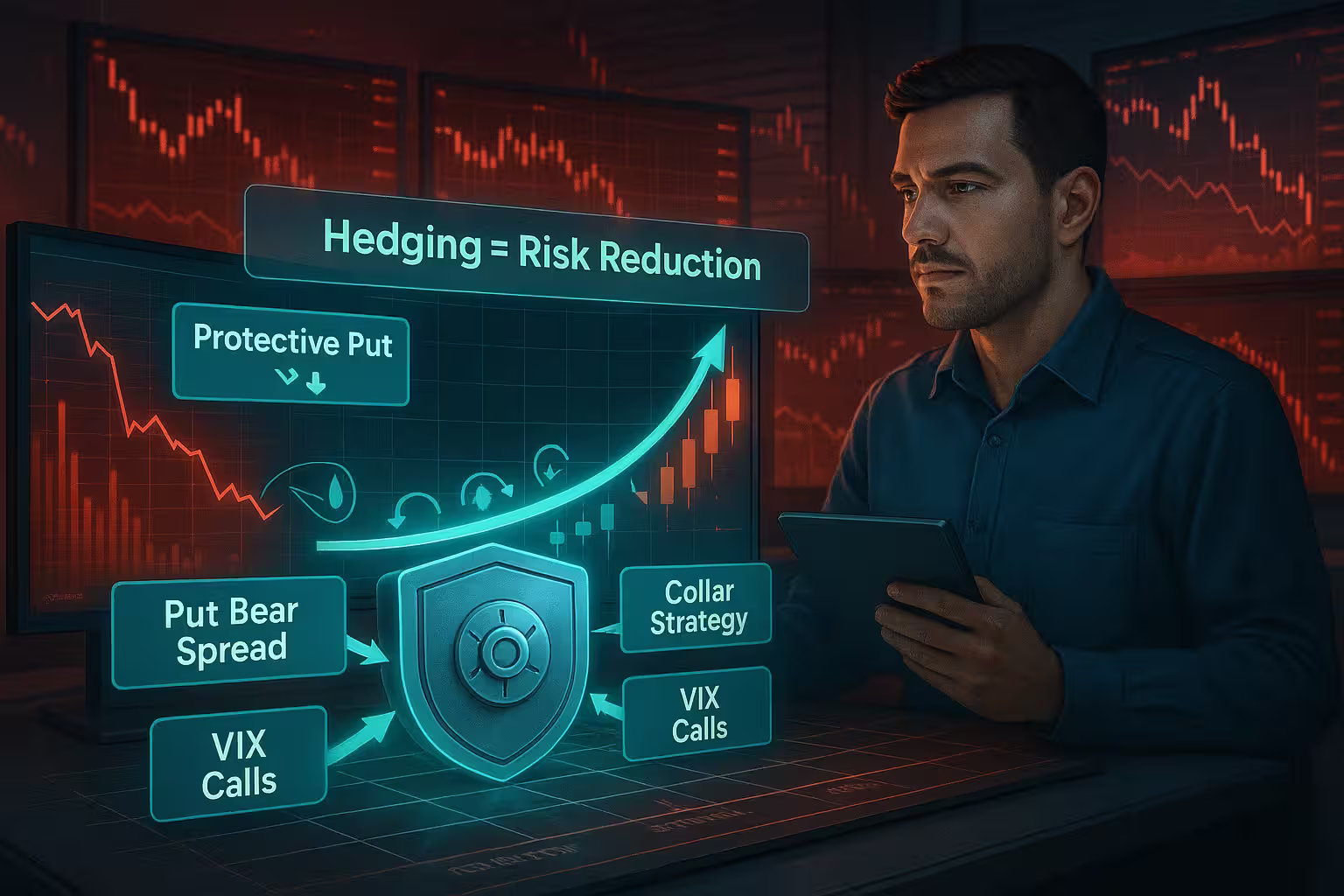
Being a powerful tool for hedging, options strategies come in many shapes and sizes including protective puts, put bear spread, collars, and VIX call options. Our guide will walk you through all the hedging strategies you can begin implementing to guard the investments in your portfolio—learn practical strategies to guard against losses when the market outlook isn’t looking all that hot.
What Is Hedging in the Stock Market?
Hedging refers to a risk management strategy in stock market trading where traders and investors take an offsetting position in a related asset to cut down the potential losses from a price movement that goes against their primary investment. The purpose of hedging is to minimize the impact that a price fluctuation in the market will have on your portfolio by having an offsetting position.
A good example of stock market hedging would be when an investor uses portfolio insurance to limit potential losses when stocks decline in value. Portfolio insurance allows the investor to keep their stock and have protection against a potential decline at the same time.
During times of uncertainty in the markets, hedging your investments can be especially important because you never really know what could happen in an unpredictable and unstable market. Traders can hedge using a wide range of asset classes, including the following:
Common Ways Investors Hedge
- Bonds—Bonds can be used as a hedging technique when interest rates are on the rise. Traders can use interest-rate hedge bond strategies to eliminate interest rate risk while still allowing them to keep full exposure to credit risk.
- Diversification—Traders can use diversification of their investments across multiple sectors and asset classes to hedge against specific market downturns. The best portfolios out there are a good mix of bonds, stocks, commodities, and options.
- Inverse ETFs—Traders can use these investments to hedge a portfolio’s exposure to market risk. Instead of liquidating individual securities, traders or even portfolio managers can buy inverse ETF shares to hedge against potential risks.
- Options—Traders can also use options contracts to hedge against potential risks. It’s done when traders buy put options to protect against a potential decline in stock value. Another good strategy to hedge using options is to sell call options to make extra income upfront while also limiting the upside potential.
Why Use Options to Hedge Against a Market Crash?
Why do so many traders look to option contracts as an effective tool for hedging against a market crash? Compared to other investments you could be making for the purpose of hedging, options offer a lot more in terms of customization and flexibility, as well as the ability to leverage a bigger position with less capital. Options also come with the advantage of having a defined risk and reward profile, which lets investors know the potential outcomes.

- Flexibility and Customization—One of the best aspects of using option contracts for hedging is that they are easily customizable, offering flexible strategies for trades to maneuver around various market conditions and scenarios. Traders can use put options to hedge positions that are expecting the stock to go up in value, and they can use call options to hedge positions that are expecting the stock to go down in value.
- Leverage with Limited Capital—Using option contracts to hedge your position against a market downturn comes with the added bonus of the trader being able to manage a larger position with limited capital. Though traders can incur losses that are bigger than their initial investment, they can also rake in profit that is worth a lot more compared to how much money they dedicate to entering the trade.
- Defined Risk vs Reward—Options contracts come with a defined risk and reward profile where the max profit and loss potential are known upfront, though it depends on whether you’re buying or selling options. Traders can get into a hedging strategy with options and know what is at risk or how much you could potentially make.
Compared to other hedging tools, option contracts offer more flexibility because they can be easily adjusted by strike price and expiration dates. However, options come with the downside of a higher upfront premium to enter the trade, which can be significant compared to other investments that can be used for hedging.
Best Options Strategies for Hedging a Market Crash
What are the best moves that options traders can make to hedge against the possibility of a market crash? We’d like to take some time to explain the power behind using strategies like protective puts, bear put spreads, collars, and VIX call options.
1- Buying Protective Puts
Protective puts involve traders buy put options on a stock or an index they already own. The strategy works in two ways where traders can enjoy any potential upside gains that come from the trade, but it also acts as an insurance policy if the stock price falls. Protective puts act like an insurance policy because the trade pays a premium for the option, and they can enjoy downside protection because they paid that premium.
- Using a protective put when the stock price rises lets the trader benefit from the increase in value, and the put option expires as worthless if they don’t exercise it.
- Using a protective put when the stock price falls below the strike price lets investors or traders exercise the put option, which results in selling the stock at a higher strike price and limiting your potential losses along the way.
When to Use It
Not only are protective puts good for protecting unrealized gains, but they’re good to use in scenarios where traders are bullish on a stock’s long-term success, but you expect there to be a short-term downturn at some point. Another appropriate time to use the protective put is when you’re restricted from selling a certain stock for a period of time.
Example
A trader owns 100 shares of a certain stock that is currently trading at $50 per share. To implement a protective put strategy to guard against a possible market downturn or crash, traders can buy a put option that is set to expire in 30 days and comes with a strike price of $48. This protective put would come at a premium of $2 per share.
What are the possible outcomes of using the protective put?
- The investor could break even in the trade if the stock price rises and the strike price reaches $52. The result would be the put option expiring as worthless, and the investor would lose the premium they paid to enter the trader ($200).
- In the event the stock price drops, the trader can exercise the put option and sell their shares at the $48 strike price. This would limit their potential losses to $2 per share, along with the premium you paid to enter the trade. All told, it would be $400.
- There’s the possibility that the stock price stays the same and remains right around $50. The put would expire as worthless, and the trader or investor would lose the premium they paid ($200) to employ this hedging strategy.
Pros
- Enjoy Upside Gains: Traders can keep their shares and still benefit from any kind of upward movement in the stock price.
- Flexibility: Protective puts can be used as a standalone strategy, but it can also be used in combination with other moves. Traders can work protective puts into a broader investment plan to meet their financial and investment goals.
- Limit Downside Risk: Protective puts act like insurance because they protect against potential price drops.
- Insurance Offers Peace of Mind: Protective puts can put a lot of traders’ minds at ease when the market conditions become volatile. Plus, traders know the maximum loss and risks because of the defined risk and reward profile that comes with this strategy.
- Tax Advantages and No Commissions: Protective puts offer tax advantages to investors, and the put options that are a part of the strategy can help protect traders against commissions if the stock price goes down in value.
Cons
- Time Decay Considerations: The benefits of the protective put can erode the time decay that happens within the options contracts that are a part of the strategy. Time decay can really hurt the strategy if the current market conditions are trending upward or are stable.
- False Sense of Security: Because protective puts act as a form of insurance for traders, some people can get lulled into a false sense of security and end up holding onto their positions for too long, which could make potential losses much worse.
- Protection is Limited: The protection that this strategy provides is limited to the life of the options contract, so traders can still be exposed to potential losses after the contract expires.
- The Cost of the Premium: The money it takes to enter the protective put can eat into the trader’s profit margin. It can be a considerable cost in underlying stocks that either go up in value or remain stable.
- Protective Puts Can Be Complex: It can take a good amount of experience and a certain level of knowledge to use protective puts correctly in options trading. It’s not the best strategy or maneuver for beginning traders or those with only a little background experience.
2- Put Spreads (Bear Put Spread)
Using a put spread involves buying and selling put options at the same time on the same underlying asset. The put options come with the same expiration date but different strike prices. The idea behind using a put spread (also called a bear put spread) is to profit from a limited price decline or a market that is characterized by a slightly bullish or neutral outlook.
How do you create a bear put spread? The trader would buy put options with a higher strike price and (at the same time) sell a put option with a lower strike price. The maximum loss is limited to the spread’s net cost, while the maximum profit is the difference between the strike price (minus the premium).
Example
If there’s a stock that’s trading at $400 and you believe the stock will fall to $390 by the next time the option contract expires, you can buy a Buy $400 put, which gives you the right to sell 100 shares of that stock at $400 if the price falls. At the same time, you would also want to sell a $390 put option, which obligates you to buy 100 shares of the stock at $390 if the price drops below $390.
If the stock price falls to $390 or lower, you’ll be able to realize your maximum profit, which is the difference between the strike prices of the two positions (minus the net debit).
Pros
- Limited Risk: The maximum loss with the bear put spread is limited to the net premium paid instead of the entire premium like you’d see with many other options strategies. The stakes are much higher with this trading technique.
- Flexibility: It can be easy for traders to curate the bear put spread to match their current market outlook. Part of the flexibility achieved through this move comes from being able to adjust strike prices and expiration dates.
- Cost Efficient: It costs less for traders to pay the premium to enter the bear put spread than it is to buy the put option outright. Bear put spreads are, therefore, much more cost-effective than other strategies for dealing with market crashes.
Cons
- Limited Downside Protection: Traders will experience limited downside protection using a bear put spread, but the protection isn’t absolute. If the underlying stock prices fall significantly below the short put’s strike price, the profit will be limited, which means that traders’ profit potential is capped, alongside the limited protection.
- Not Good for Bearish Markets: Traders should consider other strategies if they’re looking to profit from bear markets where the asset’s prices drop in value. Bear put spreads work better in stable markets or those where there is a moderate rise in prices. The strategy is contingent on there being a temporary downturn in a bull market.
- Good Timing is Needed: The bear put spread isn’t a good move for inexperienced traders or though who don’t have the best timing in trading. You must be able to correctly predict the decline of an asset price. If it doesn’t happen, the strategy could lose the trader money.
3- Collars
Collars in options trading are a combination of the protective put and the covered call strategy. The put option forms the floor of the trade and the call option forms the ceiling. Collars are good for a neutral market outlook and can be used when traders would like to secure gains on appreciated stocks while also hedging any potential losses they might incur.
Example
For the sake of argument, let’s say that a trader owns 100 shares of a stock that is currently trading at $100 per share. To pull off a collar strategy, traders would need to buy a put option with a strike price of $90, which would form the floor of the trade. This portion of the trade would protect against a price drop below $90. The next step would be to create the ceiling of the trade, and this involves selling call options with a strike price of $110—this would limit the potential upside over $110.
Great for Long-Term Investors
Collars are a trading strategy that long-term traders might like to use due to the downside protection that comes with the maneuver while still capturing the upside potential. Long-term traders don’t have to completely exit their long-term investments, but they can use a collar to hedge against market volatility or potential downturns, even though they come with some limitations.
4- Buying VIX Call Options or VIX ETFs
VIX spikes during market fear, so buying VIX call options or trading VIX ETFs can be a good option for investors or traders who are interested in securing a profit amid a market crash or a major downturn.
- VIX Calls—This refers to a way to bet on increased market volatility. If VIX rises above the strike price by the expiration date, the call option will be profitable to the trader. However, if it stays below, the call option will ultimately expire as worthless.
- UVXY/TVIX Options (VIX ETFs)—Traders can also trade ETFs that track VIX and can be used to speculate on or hedge against future market moves.
Something for traders to keep in mind about buying VIX call options is that theta decay plays a big role in dealing with these contracts. VIX options lose value as they get closer to their expiration date and this is relevant, especially for options that are out-of-the-money. There is also something called volatility erosion that can work against long-term investors who don’t take the risks of decay or timing issues seriously.
When Should You Hedge?
Traders should keep these signs in mind to know when to hedge their investments against a potential market downturn or crash. To keep informed on relevant economic events, we recommend that all options traders use economic calendars, the CBOE Volatility Index, economic indicators, and other key trading tools to stay on top of what’s going on in the market.

- Signs of a Potential Crash—If you see the signs of a potential market crash coming through things like volatility spikes or other economic indicators, it could be a good time to begin using any of the strategies discussed in our guide, which comes down to your trading style and risk tolerance.
- Portfolio Value at Risk—Traders should begin hedging their current positions if they see that their portfolio value is in danger. Implementing some hedging strategies at key moments in your investment timeline can ensure that you keep your current capital protected against potential market crashes or downturns.
- Key Market Events—Another great opportunity to hedge your current investments is around big events like earnings reports or Fed meetings. By looking over economic calendars, traders can mark these dates down and plan their hedging strategies accordingly.
Cost vs Benefit of Hedging with Options
Although there are many benefits to hedging with options, the investor or trader has to pay a price to enjoy the perks of these “insurance policies” against market downturns or crashes. Another term for the price traders pay for protection is the “premium” or the amount of money paid to enter the trade. Knowing when to hedge with options can be tricky because it’s never quite known with certainty if the hedge is going to be worth the money spent, especially since there’s a chance that the potential risks may never come to fruition.
Historical Examples
We’d like to outline a few examples from recent history where hedging with options absolutely benefited online options traders. The money that these traders and investors spent on the premiums to enter the offsetting positions that ultimately save their investments or minimize the potential losses was absolutely worth the time, money, and effort.
- 2020 COVID Crash—A good example of traders hedging with options was during the onset of COVID-19 in 2020. A few common ways that traders hedge during this tumultuous and uncertain time was buying put options against a decline in the value of indices or stocks. Protective puts were a common strategy during this time. Trades used options to speculate on the direction of implied volatility as there was plenty of volatility in the world markets, especially early on during March and April.
- 2008 Financial Crisis—This was the time of the great financial crisis, which was triggered by the US housing market collapse, leading to a global economic downturn. During this time, options traders did a lot of short selling, where they were betting on the stocks falling, profiting from the decline. Market-neutral strategies were another great method that investors used to hedge during that time, where they profited from price discrepancies between different securities, regardless of overall market direction.
- When is it worth paying for protection? It can be hard to determine at times (some investors pay for protection by setting up a hedge, and it goes to waste), but there are some moments and instances where it’s completely justified and it’s worth the money paid. The key is to not over-hedge but to have a proportionate response to the situation at hand.
Check out a few of the scenarios where it’s a safe bet to hedge your investments:
- Market Corrections—When there’s news that a market correction is imminent or that a major sell-off is about to occur, hedging is worth the time and money to mitigate possible losses that are common during these events.
- Major Events—Big developments like major economic news, a black swan event, or something that rocks the political landscape can all constitute investors or traders using hedges for their options portfolio.
How to Set Up a Basic Hedge (Step-by-Step)
Anyone who wants to set up a basic hedge, but isn’t sure how to get started, can use this step-by-step guide to getting a hedge setup and implemented in preparation for rough economic conditions. It’s relatively simple and can be done in as few as four or five basic steps.
- The first step in setting up your hedge is to identify assets needing protection.
- Next, you’ll want to choose your hedging method. For instance, you can use a protective put to enjoy insurance against potential price declines while still capturing potential upside. Choose a hedging strategy that works for your trading plan.
- Next, traders need to select their expiration and strike price. The great thing about hedging with options is that they can adjust these parts of the trade to customize positions that work well for their personal trading plan. Adjust these factors as needed.
- The next step in setting up your hedge, you calculate the cost to enter the trade along with the amount of money you’d need to make to break even. From here, you can figure out how much you’d need to make to become profitable.
- After these four initial steps, traders need to monitor their hedges to see how things play out. If needed, they might have to make adjustments to their strategy to navigate potential changes in the market.
Pro Tip: Use paper trading tools to practice your hedge.
Risks and Considerations
Traders who are looking to hedge the investments in their online options portfolio should take a little bit of time to get familiar with the potential risks that can come from hedging incorrectly and not having a well-developed and well-diversified portfolio, to begin with. A lot of the issues and headaches you might encounter can be worked out by simply having your investments spread across various asset classes or sectors.

- Timing Risk—This refers to the potential for good or bad market movements due to the action or inaction of the stock market. Traders who buy or sell options based on where they see the market going in the future are subject to incurring losses based on their decisions.
- Overpaying For Protection—Hedging your investments costs money, and traders incur premiums to set up new positions to insulate their current investments against the potential risks that could come down the pike. There’s the possibility that traders pay too much to protect their positions, and then they end up not needing it.
- False Alarms—Misreading market direction and the potential risks that could be coming your way could result in a trader either hedging too early or too often, which could cut into their profitability or offer them protection for the wrong window of time.
- Hedging a Diversified Portfolio vs Concentrated Holdings—When investors or traders have a diverse portfolio, the need to hedge their positions is a lot lower in comparison to a trader who might have 10% or more of their entire portfolio concentrated in a single stock or other asset class. Not having your portfolio investments spread out over multiple sectors or industries, and instead having a large stack in a concentrated place, can be a significant risk.
Tools to Help You Hedge Smarter
To get better at preparing hedges for your current investments, you can begin working these tools and resources into your trading routine for better results over time. Get a super clear picture of the current state of the market and where it might go before spending the money to form a hedge around your investments in certain sectors, industries, or asset classes.
- Options Profit Calculator—Traders can visualize the potential profit and loss scenarios for different options strategies. Options profit calculators are useful for helping traders figure out how effective a possible hedging strategy could be.
- Volatility Charts—These charts can be helpful in determining sound hedging strategies. Traders can look at the current level of market volatility and gauge future trends so they can adjust their positions in a way where they are hedged against potential risks. Volatility charts like the VIX Index can be particularly helpful in pinpointing the right hedging approach for your investments.
- Technical Analysis Tools—These tools can help traders develop and implement certain hedging strategies. Traders can begin to understand the potential risks and the likelihood of future market trends by analyzing price charts and figuring out support and resistance levels.
- Broker Platforms with Hedging Tools—If you’re interested in using hedging tools but keeping all your trading activity contained to a single platform, we’d recommend looking at the tools your current broker app or website is offering for hedging purposes.
Peace of Mind in Volatile Times
Options are so well-liked by traders and investors because they can secure profits when the stock market isn’t looking that great. As mentioned in our guide, there are four primary options strategies that traders can use to remain profitable during events like a market crash or a major downturn when prices are dropping significantly.
Best Hedging Moves
- Protective Puts—Limit potential losses on stock position while also allowing the possibility of upside gains with a protective put. They’re best used on positions that traders are feeling bullish about, but they’re also expecting a short-term downturn first.
- Bear Put Spreads—Traders can profit from limited price declines that happen in neutral or slightly bullish markets.
- Collars—This strategy is a good form of hedging, especially when you have a neutral market outlook, and can be used when traders would like to secure gains on appreciated stocks while also hedging any potential losses they might incur.
- VIX Calls—Another great way to hedge your current investments during a market downturn or crash is to use volatility moves to profit when the market is experiencing major swings in either direction.
When options trades get experience with hedging their investments, they can begin feeling more confident and peace of mind that comes with this form of long-term planning. Exploring options as a form of hedging takes some time to learn, but you shouldn’t be intimidated by them because they can be a powerful tool for safeguarding the investments in your options or stock portfolio.
If you’re new to options, start small. Test one of these strategies in a simulator or consult with a financial advisor.