
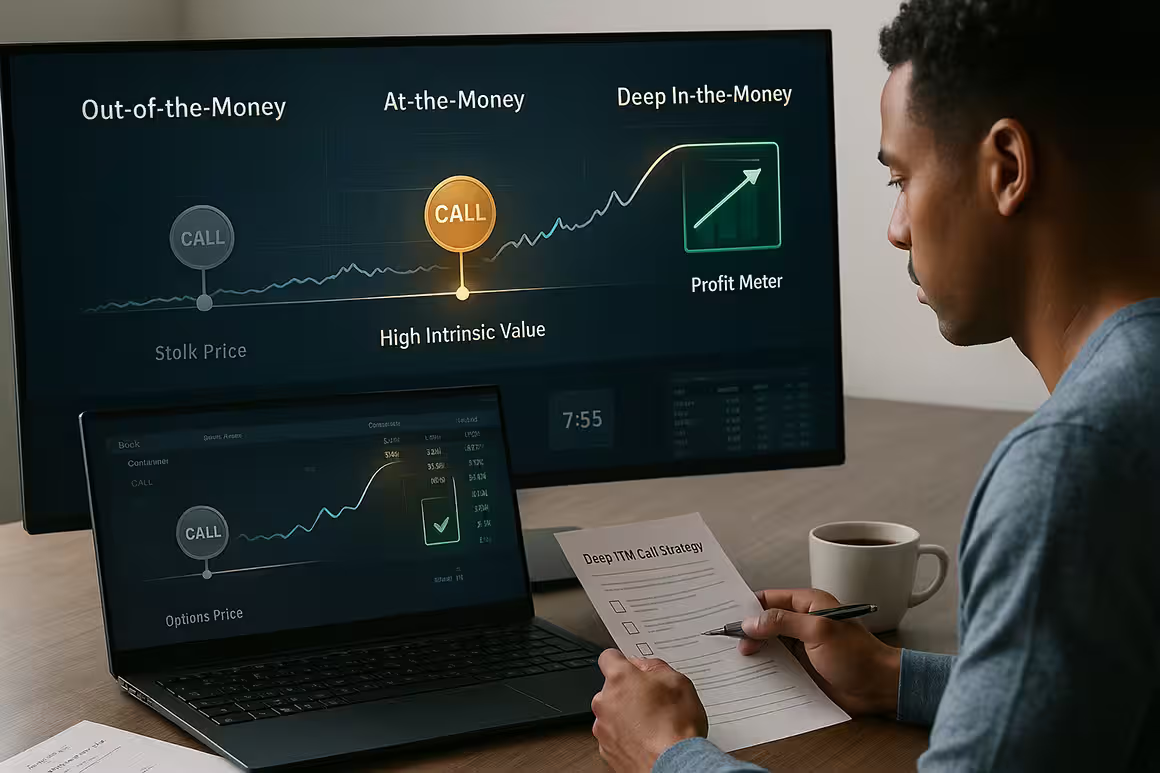
As options traders look for the best strategies to profit, understanding the deeper intricacies of options, such as deep in-the-money options, can give you a significant advantage.
There’s something in options trading known as “moneyness” which is the relationship between the option contract’s strike price and the current price of the underlying stock or asset. Simply put, “moneyness” is a determining factor in dictating if an option contract has any kind of intrinsic value if it were to expire today. The intrinsic value is the immediate profit the contract would generate were it to be exercised.
Our guide will focus specifically on deep in-the-money (ITM) options for enhancing trading strategies, though we will briefly address at-the-money and out-of-the-money contracts as well for the sake of comparison. Learn the advantages and disadvantages of trading options contracts that are deep in-the-money and how you can work them into a long-term strategy for incremental success over time!
What Does “Deep In-the-Money” Mean?
“In-the-money” (ITM) options are contracts that can be exercised right away and are guaranteed to secure the trader a profit. Another way of putting it is that ITM options have intrinsic value. Moneyness looks different for call and put options. If the strike price is below the current market price of the underlying asset with a call option, the option is considered in-the-money. In the case of put options, they’re in the money if the strike price is above the current market price.
Deep in-the-Money and “Moneyness”
Options that are considered deep-in-the-money have a strike price that’s significantly below the market price for a call option or a strike price that is considerably higher than the market price for a put option. Referring to the options as “deep” is significant because of its intrinsic value, which is larger in comparison to options that are simply in-the-money.
Example
A call option with a strike price of $50 while the stock is trading at $100 is deep in-the-money. By comparison, if the stock was trading at around $52, it would be considered in the money, having much less intrinsic value than a stock that would be deep-in-the-money at $100.
How Deep In-the-Money Options Differ from Other Options
To give you a deeper understanding of in-the-the-money and deep-in-the-money options, we’d like to draw some comparisons between those two types and the other kinds of moneyness in options trading, specifically at-the-money (ATM) and out-of-the-money (OTM) options.

- At-the-Money Options: This refers to options contracts where the strike price is exactly the amount of the current market price of the underlying asset. At-the-money options are neither in-the-money nor out-of-the-money, which means that they have no immediate intrinsic value. ATM options can be sensitive to fluctuations in the market making them a popular choice for traders who use strategies to benefit from short-term price movements.
- Out-of-the-Money Options: Just like ATM options, out-of-the-money options have no intrinsic value because they have an unfavorable strike price compared to the underlying asset’s current market price. They have no immediate profit potential, and they would incur a loss if exercised by the trader. However, there’s still potential for them to profit—it simply takes time for the price to move favorably before the expiration date.
ITM Options Compared to ATM and OTM Options
Comparison Point | ITM Options | ATM/OTM Options |
|---|---|---|
Profitability Potential | Immediate | Not Currently Profitable |
Intrinsic Value | Yes | No |
Risks | Higher premium costs, limited upside, and assignment possibility | Risk factors include changes to implied volatility, time decay, or interest rates |
Pricing | Deep in-the-money options have a higher premium to enter | ATM Options—the strike price is the same as the current market price |
Examples
Let’s take a look at a deep ITM call compared to a near ATM call with the same expiration. These two options will primarily differ in their price, risk, and profit potential. The at-the-money option will be cheaper, but it carries a higher risk of expiration as worthless, while the in-the-money call will have a higher price because it’s an immediately profitable position and carries a lower risk of expiring as worthless for the trader.
Near ATM Call: The price will have a lower premium due to little or no intrinsic value. The primary risk is that the option will expire worthless if the market price doesn’t rise significantly, and the best profit potential comes when the market moves significantly upward, putting the call option in the money.
Deep ITM Call: The premium for this one will be higher because it already has the potential to profit. Because the market price is already well above the strike price, this contract is in little danger of expiring as worthless.
Premiums
The premium of deep ITM options is typically higher due to their intrinsic value. This is where options traders have to consider when it’s worth getting into these positions because they offer little risk, but also little reward. However, over a long time horizon, these small rewards can add up to something considerable. Deep ITM options are naturally going to be more expensive positions to enter because they’re immediately profitable.
By comparison, something like an at-the-money option is better for price speculation moves in the short term because the premiums are a lot less expensive than ITM options, and there’s a shot at a good profit if the price moves in the expected direction. Due to the high cost to enter and the smaller profit made, deep ITM options are better long-term investments where you build profits over time.
When Should You Use Deep In-the-Money Options?
There’s a time and a place for using deep ITM options in your trading strategy. We’ve outlined some of the key scenarios where you’re going to benefit well from purchasing these contracts. We’d like to point out upfront that they are good investments if you’re looking at a long-term growth strategy where you’re gaining exposure to an asset with a lower capital commitment without having to own the asset.
Lower Risk, Lower Reward
While deep ITM options have very little risk attached to them, the profit potential is also limited as well. The nice thing with these kinds of trades is that they provide small, steady returns for the trader, but it’s up to each trade to determine if these positions are worth taking on due to the higher premium associated with entering the position. They are good investments for conservative traders with a low appetite for risk.
Because of the high intrinsic value that comes with these options, contracts that are deep in-the-money don’t carry much risk, but they might not always be super profitable. You have to subtract the cost of the premium from the money you make selling the contract. This is why the reward is limited compared to other option contracts.
Hedging
Deep ITM options can be used as a safer hedge against large moves in the underlying asset. Traders can use them to hedge against the potential downside risks that come with their existing positions. A good example of this is when a trader owns a stock and they want to protect themselves against possible price decline—they could buy a deep ITM put option. If the stock price goes down, the put option will increase, which can offset the losses the trade incurs on the stock they already own.
Long-Term Strategy
Traders can take advantage of deep ITM options as a way to gain exposure to an asset with a lower capital investment upfront. This long-term strategy move also comes with limited risk and gives the trader a chance to benefit from this leverage. Unlike owning an asset where the losses could be unlimited, the max loss with using the deep ITM options is the premium the trader pays upfront.
Lower Theta Decay
Deep ITM options experience slower time decay compared to OTM options. Deep ITM options are good for long-term strategies because of their reduced time decay and volatility impacts. They’re ultimately a more stable investment over the long term, offering traders something with resiliency, and attractive positions that require more time to develop. They are less reliable in generating profits through price speculation trades.
Advantages of Trading Deep In-the-Money Options
Why should you trade options contracts which are deep in-the-money? Check out the three best reasons that we know of where deep ITM options can benefit your trading plan. It’s important to note that there are some drawbacks to their contracts, even though they look like a layup on paper. Read about those in the next section.
Intrinsic Value Focus
Deep ITM options have the investors more focused on developing the best profit possible and spending less time worrying about their investment eroding with time. These options have a lot of intrinsic value because they can be sold immediately for a profit, and that amount is even higher than with options contracts, which are just slightly in-the-money. Options with high intrinsic value retain more value as the expiration date gets closer because time decay has less of an impact on the option’s profitability.
Reduced Volatility Sensitivity
Deep ITM options also carry the advantage of being a lot less sensitive to volatility changes (vega) than OTM options. This can be a major advantage in certain markets, and it can greatly benefit traders with a more predictable performance. Instead of being driven by price fluctuations, the deep ITM option’s value is mainly driven by the stock price.
Improved Delta
Another notable aspect of deep ITM options that favors traders and investors is the high delta and how it increases the option’s price movement sensitivity relative to the underlying stock. The option’s price will change in lockstep (for the most part) with the price of the underlying asset. The improved delta of deep ITM options makes having these positions almost like owning the asset itself because of the leverage exposure that the trader can experience.
Disadvantages of Deep In-the-Money Options
Believe it or not, there are some drawbacks to deep-in-the-money options, even though they’re immediately profitable for the trader. Become aware of the disadvantages of deep ITM options to learn how to navigate these contracts in a way where the trader is worth the time and money to take on.

High Premiums
Because ITM options are immediately profitable for the investor, they are a hot commodity and therefore come at a higher price than options that are at-the-money, out-of-the-money, or even slightly in-the-money. This cost factor makes deep ITM options expensive, and they can be a challenge to take on if you don’t have the capital to maintain a position like that. They are much less suitable for small accounts.
Limited Profit Potential
On top of being more expensive than other kinds of options contracts, deep ITM options carry limited profit potential, so traders have to gauge if the larger cost to buy these options is worth it in terms of the profits they would be getting in return. Profit potential can be cut down significantly when the stock has already moved significantly in one direction. It’s something to consider before entering an option contract that’s deep in-the-money.
Not Ideal for Short-Term Speculation
Deep ITM options are less effective for short-term speculative trades due to their high cost and lower risk/reward ratio. They are better suited for long-term investments. If you’d like to make money from speculating on short-term price fluctuations or market volatility, it’s better to focus on ATM options or even OTM contracts.
How to Trade Deep In-the-Money Options
Anyone who wants to successfully trade deep ITM options will need to have the right risk management practices set up within their trading plan, and they must use the right strategies to develop the most profit potential from these investments. We’ve outlined how to correctly size each of these positions to ensure you’re staying away from overexposure, plus the best trading strategies and approaches for handling these trades with the best of them!
Position Sizing and Risk Management
Compared to other options contracts, deep ITM options can be approached more linearly. Because these options are immediately profitable, traders could hypothetically double the number of contracts they pick up, and they could roughly double the profits (or the losses).
Although it might be tempting to dedicate a larger-than-normal portion of your capital to these trades, we’d still ultimately recommend playing it safe and only using 1-2% of your capital on these contracts. Remember that deep ITM options deliver minimal profits and are better used with a long-term trading plan. What you’re getting might not be worth what you’re putting into it.
Strategies
Now let’s address some of the best trading strategies you can be using in tandem with deep ITM options contracts. Because you’re dealing with a contract that’s in little danger of falling out of profitability, and they’re generally better long-term investments, strategies where you’re collecting premiums and banking on the contract not to expire worthless are some of the best moves you can make when using deep ITM options.
- Covered Calls: Using deep ITM options with the covered call strategy can allow the trader to boost their income and possibly lower the cost of owning the stock. Using these options with a covered call is sometimes referred to as “the poor man’s covered call,” where the trade pays the deep ITM contract with a less deep call option, which does the same work as the covered call but with less capital upfront.
- Cash-Secured Puts: This move would involve the trade selling put options with a strike price that is significantly higher than the market price for the underlying stock, while also having the cash in your account to purchase the underlying stock if assigned. Deep ITM options can be used as a hedge against possible stock price declines. Not only can traders get a premium for starting the trade, but they could possibly get a stock at a discounted price and limit their downside risk with the ITM option at the same time.
Considering the strategies we just mentioned for deep ITM options, these kinds of contracts can be best used as part of a conservative options strategy to generate steady returns. It’s about focusing on a long-term time horizon and slowly building up profit over time in small, incremental steps.
Key Takeaways Before You Trade
When trading deep ITM options, there are several perks and benefits, but also risks that you’ll run across when dealing with these contracts, though it seems like it’s all benefits on the surface. When you’re considering using deep ITM options, think about your own trading style and goals to determine if trading these contracts is the right move.
Perks/Benefits
- A focus on intrinsic value (you can sell right away to make a profit)
- Reduced sensitivity to volatility
- Improve delta
- Good contracts for long-term trade moves
- Small, but steady profits over time
Risks
- High price to pay to enter deep ITM options (high premium)
- Limited profit potential
- Not good for short-term price speculation moves
Explore trading deep ITM options with practice and start by paper trading before using real capital. If you want to put these strategies to the test, try using our free options strategy builder to simulate trades with deep in-the-money options. You can find this and other helpful resources at OptionsTrading.org.