
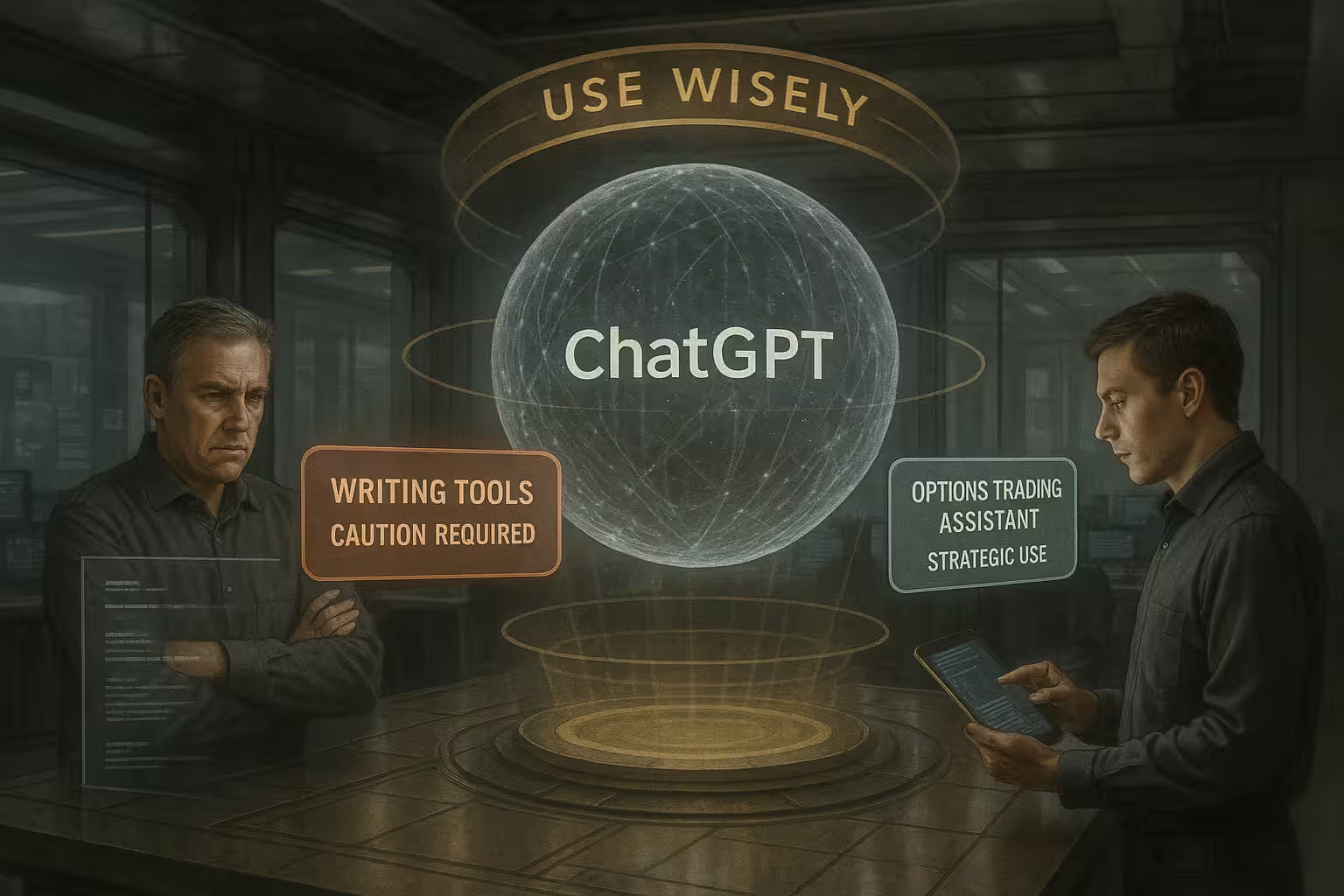
Before I get into the topic of this article, I have to make something really clear: I detest ChatGPT on principle. As a writer, AI writing tools are nefarious entities that will replace me. They’ll do what I do faster and for free (or for a monthly subscription fee).
ChatGPT has to get its info from somewhere, and when people use it as writing “assistance,” it’s taking what it’s found on the internet, which is the original content of human writers, and spinning it. And for those of you who don’t know what spinning is, it’s a nicer way of saying plagiarize. But it’s still very much plagiarism.
That being said, there are some instances where I feel like ChatGPT isn’t a threat and is mostly harmless. And one of those areas is for options trading help. Which is what we’ll be talking about today, now that I’ve had my “GET OFF MY LAWN” rant.
All options traders want a leg up. Some are chart pattern chasers. Others swear by economic reports. And now, there are a growing number of traders who are turning to something newer and a lot more high-tech, and that’s the aforementioned ChatGPT.
Since its launch, ChatGPT has turned into a go-to assistant for writers (see?), coders, researchers, and yes, traders. Type in a question and you’ll get a response that reads like it came from a real person, not a robot. That kind of accessibility and speed has us wondering: can this thing actually help with options trading?
We want to explore the upsides, the limitations, and where it makes sense to plug ChatGPT into your trading process. From learning strategy basics to organizing your trade journal, we’re walking through exactly what ChatGPT is capable of—and where it runs into a wall. If you’ve ever thought about consulting AI before pulling the trigger on a trade, let’s get into what ChatGPT can and can’t do for an options trader, and how to make the most of this AI assistant without getting burned.
What Is ChatGPT? A Quick Overview
ChatGPT is an AI-powered language tool that was created by OpenAI. It’s trained on an enormous amount of text that is pulled from books, websites, code, and public data sources. Instead of giving you canned answers, it processes your question, figures out what you’re asking, and responds in a way that feels close to human, some say it’s conversational.
What makes ChatGPT different is its ability to explain stuff in plain English. Ask it how something works, and most times it’ll give you an easy-to-understand answer. It’s the robot version of, “Explain this to me like I’m a four-year-old.” And that’s why it’s being used everywhere and in almost all sectors, from classrooms to boardrooms. You’ll find it in customer service chatbots, writing assistants, coding tools, and yes, trading forums.
For traders, the appeal is really easy to see. You’ve got a tool that can break down tough concepts in the simplest terms, brainstorm strategies, and explain the difference between a butterfly and an iron condor with no condescension or attitude. And it does all this instantly. It’s not exactly a surprise that more trading tools are starting to bake in GPT-like features. If you’re curious about what’s already out there, we have a list of the Top AI-Powered Tools for Options Trading!
But just because ChatGPT can talk the talk doesn’t mean that it can in any way, shape, or form replace research, instinct, or experience. What it can do is act as a pretty helpful sounding board. How can it fit into your workflow? Keep reading to find out and to understand what you shouldn’t expect it to do.
How ChatGPT Can Help Options Traders
ChatGPT isn’t a replacement for your broker, your charts, or your knowledge, but it can slot into a lot of parts of your process. Below is where traders are using it to save time, learn faster, and make a few more structured decisions.

Education and Learning
Trying to learn options trading by searching through Reddit threads and YouTube videos? It’s exhausting. ChatGPT takes that away and gives you direct answers, and it’s pretty good at adapting based on how you ask.
Don’t know what theta decay is? Ask it to explain. Want that same concept broken down using baseball analogies? It’ll try. You can go back and forth until you actually get it. This works for both beginner-level stuff (calls, puts, spreads) and advanced topics like volatility skew, Black-Scholes, and gamma exposure.
A lot of traders use it as a personal tutor. It won’t get annoyed or roll its eyes when you ask something twice. And if you say, “Explain this like I’m new,” it usually keeps it digestible. You don’t get words for word’s sake. You get basics and clarity.
Trade Idea Generation
One of the more interesting uses for ChatGPT is brainstorming strategies based on what the market’s doing—or what you think it might do. You can ask it things like, “What are some lower-risk ways to trade SPY if I think it’s going to trade sideways for a few weeks?” and it’ll spit out a list of possible strategies: iron condor, calendar spread, maybe a butterfly.
The main thing is how you frame your prompt. The more context you provide—about your market view, your risk tolerance, your timeframe—the more on-target the responses will be. It won’t give you a signal, but it will walk you through scenarios.
Some traders even drop in sample trade setups or market summaries and ask for pros and cons. You’re not getting a recommendation, but you are getting a structured breakdown that can help you organize your thinking.
Strategy Comparison and Explanation
If you’ve gotten stuck deciding between two strategies, ChatGPT can be the tiebreaker. Should you sell a put or use a bull put spread? Is it better to use a strangle or a straddle for an upcoming earnings event?
ChatGPT can walk you through the differences. It’ll compare strategies, outline risk and reward profiles, and help you weigh trade-offs. You can even ask it to lay things out in a table or give you bullet points—something that’s a lot harder to get from forums or articles.
It’s not nearly the same as talking to another trader, but in some ways it’s easier. You don’t have to worry about sounding inexperienced, and you can keep drilling down until the differences actually click.
Risk Management Guidance
ChatGPT will NOT replace a professional risk manager, but it can help clarify common risk issues in options trading. If you ask, “What happens if implied volatility jumps while I’m holding a put spread?” it will walk you through the mechanics.
It’s also useful for thinking through hypothetical outcomes. Want to stress test a position? Describe the trade and the market scenario—like a big move or a volatility event—and ChatGPT will highlight what could go wrong (or right). It can even walk through outcomes at different expirations or strike distances if you’re trying to build a payoff matrix.
You can also ask broader questions like, “What’s a responsible way to size my options trades given a $10k account?” and get general guidelines around risk-per-trade percentages, diversification, and not overloading on premium.
Again, nothing it says should be treated as gospel, but it helps get your thinking headed in the right direction.
Journal and Trade Review Help
This is where ChatGPT is super helpful. It’s excellent for helping you build and maintain a trading journal.
Ask it for a journal template and you’ll get a structure that includes entry/exit data, trade rationale, emotions before and after, outcome, and lessons. You can also paste in your trade log and ask it to help you identify patterns or mistakes.
Some traders even use it as a coach. “Here’s what I did. What would a disciplined trader have done instead?” Or, “Why do I keep taking profits too early?” It doesn’t psychoanalyze you, but it can walk through possible thought traps and risk behaviors.
It’s not going to scold you, but it might remind you why doubling down on a losing trade probably isn’t the move.
What ChatGPT Can’t Do for Options Traders
Ok, let’s talk about the limits of ChatGPT. It can handle a lot, but it has some huge blind spots, and this is where you need to tread carefully when using it, let alone relying on it as a sole source.

Real-Time Market Data
ChatGPT isn’t connected to the markets. It doesn’t know where SPY closed today or whether Tesla is surging after hours. If you ask it, “What’s the best trade based on today’s option chain?” it’s not going to help—unless you feed it the entire chain manually.
So no quotes, no live news, no chart analysis. It doesn’t update in real time, and it doesn’t have access to your brokerage account. If you want accurate market data, you still need to check your trading platform or a market scanner.
Predict the Market
It doesn’t predict price movement. At all. Because it can’t, no one can, not even Warren Buffett. Well, maybe he could.
Ask ChatGPT, “Where will Apple be next month?” and you’ll get a very cautious answer about how prices are unpredictable. And that’s the right response—because AI doesn’t know what Jerome Powell is going to say tomorrow or whether an earnings report will surprise the market.
ChatGPT can talk through historical reactions, common setups, and probabilities—but it doesn’t have a crystal ball. It’s not designed to forecast. Use it to plan for different possibilities, not to try and nail a direction.
Replace Human Experience
ChatGPT has read a lot of stuff, but it hasn’t traded. It doesn’t know what it feels like to hit your max loss three trades in a row or to hold your breath while a position moves against you before snapping back.
So it can’t replace instinct, screen time, or actual decision-making under pressure. And it definitely doesn’t understand how emotions affect trading. That’s something you only learn through real trades and real stakes.
It won’t sense the hesitation in your plan, or tell you to wait instead of chase. That’s all on you.
Account for Unique Personal Constraints
ChatGPT doesn’t know your portfolio size, your risk appetite, or what you’re comfortable with losing. It also doesn’t know what kind of tax implications a trade might trigger for you. Unless you type out all of that info and explain your situation thoroughly, it gives you generic responses.
Even if you do provide all of these details, it still won’t act like a fiduciary or tailor advice specifically to your long-term financial goals. It’s a simulator for ideas, not a personal advisor. Use it to get context, not direction.
How to Use ChatGPT the Right Way in Your Trading
Okay, we’ve covered ChatGPT’s superpowers and its kryptonite, so the next logical step is learning to work with this tool effectively. Look at ChatGPT as a sophisticated assistant: it can give you valuable input, but you are still the pilot in command. To get the most out of ChatGPT in your trading (and to avoid misusing it), follow the practices below!
Be Specific with Prompts
With ChatGPT, garbage in, garbage out applies. The quality of the answers you get is heavily dependent on the quality of the question or prompt you give. Vague or overly broad questions tend to yield generic answers, which might not be very useful. To harness ChatGPT’s full power, be as specific and detailed as possible in your prompts.
For example, instead of asking “What option strategy should I use?” (far too broad – the bot has no idea about your situation), you could ask: “I own 100 shares of XYZ stock (currently at $50). I want to generate some income but I’m okay if the stock gets called away at $55 in the next month. What option strategy might suit this goal, and what are the risks?” Now that’s a rich prompt with context! ChatGPT can respond with something like: “You could consider selling a covered call at the $55 strike expiring next month. This would generate premium income now. If XYZ stays below $55, you keep the stock and the premium; if it goes above $55, you’ll likely have to sell at $55 (capping your upside). Risks include missing out on gains above $55 and the stock falling (you’d still own the shares minus the premium buffer)… etc.” You’ve essentially guided the AI into giving you the exact analysis that you need.
Likewise, if you want an explanation of a concept, include what you already know or what angle you’re interested in. “Explain theta decay” might get you a definition, but “Explain how theta decay affects a long call option as it nears expiration, with an example” will get a much more insightful answer. If you don’t understand the answer you got, ask a follow-up like “Can you simplify that?” or “Can you give me an analogy?”. ChatGPT is great at rephrasing and elaborating when prompted.
Another tip: set a role or context in your prompt. For instance, you can say, “Act as a risk manager and analyze this trade: …” or “Act as an experienced options trader and critique my strategy: …”. This can slightly influence the tone and detail of the answer. If you say “act as a risk manager,” it might focus more on risk factors; if you say “act as a mentor,” it might give a more pedagogical answer. It’s not foolproof, but it can nudge the response style in a direction you find helpful.
The more background you give, the better ChatGPT can tailor its answer. If you want it to consider a certain stock’s specifics, provide them. Example: “I’m considering a straddle on ABC Corp. The stock has earnings in two weeks, historically moves +/-8% on earnings, and current IV (implied volatility) is relatively high compared to past quarters. What are some considerations for this trade?” Now the AI has context: earnings event, historical move, IV info. The answer will likely mention volatility crush, the cost of the straddle vs expected move, and so on—very pertinent points it might have missed with a generic “Should I do a straddle on ABC?” question.
Use as a Thought Partner, Not a Guru
This point cannot be stressed enough: ChatGPT works best as a thought partner or brainstorming assistant, not as an infallible oracle. You should approach its output as if you were getting a second opinion or bouncing ideas off a colleague, not as if you received commandments from a trading god. In practice, this means maintaining a healthy skepticism and using your own judgment at all times.
If you had a really smart friend who read all the trading books but never actually traded, you’d value their input, but you wouldn’t let them dictate your every move, right? That’s ChatGPT. It can remind you of things you forgot, suggest new angles, or even challenge your assumptions, all of which are good for refining your thinking. But it doesn’t know your personal judgment, and it doesn’t bear any consequences for being wrong. You do.
When ChatGPT gives you an idea or an analysis, treat it as a starting point or a supplement to your own analysis. If it suggests a particular strategy, use that suggestion to do further research: check if the strategy truly fits the current market and your portfolio, consider other sources, and discuss it with human peers if you are able to. If it provides an analysis, cross-check key points with your charts or data. Engage in a dialogue. You can even debate with ChatGPT: “You suggested strategy X, but what about scenario Y where that could fail?” This can lead to a richer exploration of the idea’s strength.
One of the best ways to use ChatGPT is to help clarify your own reasoning. Sometimes, explaining your trade idea to the AI (and by extension, to yourself) can show any holes in your logic. If you say, “Here’s my plan: … Do you see any issues with this approach?”, ChatGPT might enumerate risks or assumptions you hadn’t fully considered. That’s invaluable, because it’s easier to adjust a plan before money is on the line. But remember that ChatGPT’s perspective is broad and historical! It might bring up very generic risks that apply to any trade, or it might miss very specific, real-time risks. Always weigh its input with other pertinent info.
The main attitude here is collaboration, not delegation. Don’t delegate your decision-making to ChatGPT. Collaborate with it to broaden your perspective. It’s like having an assistant who’s extremely knowledgeable but still needs your direction and oversight. As one finance blog noted, given its limitations, ChatGPT is best used as a supplementary tool, not as the sole decision-maker in trading. It should only supplement your analysis.
Always remind yourself: you press the buy/sell button, not ChatGPT. If a trade goes wrong, you can’t blame the AI. Maintain that responsibility and use the AI to improve your decision process, not replace it. This frame of mind will keep you safe from following a suggestion that doesn’t pan out.
A practical way to implement this? After getting an answer from ChatGPT, write down in your own words what you’re going to do and why. If your reasoning is “Because ChatGPT said so,” that’s a red flag. There should be other supporting reasons from your own analysis or other research. If you can’t come up with any, it’s a sign to hold off. If ChatGPT helped you to see pros and cons and you combine that with your knowledge, and it all makes sense to you, then you’re using it correctly—as an aid to your own informed decision.
Validate Everything
ChatGPT can produce very convincing and authoritative-sounding responses, so you can never discount that it can and does make mistakes. Sometimes small, sometimes big. Therefore, one of your golden rules when using ChatGPT for trading should be: trust, but verify. Or perhaps more accurately: be skeptical, and verify everything that’s important.
What needs validation? Pretty much any factual claim or calculation that you plan to act on. If ChatGPT tells you, “The breakeven of this spread is $45.50,” double-check that math yourself or with a reliable calculator. If it says, “Historically, gold performs well in Q4,” you might want to quickly verify that with actual historical data—maybe it’s true, maybe not, but don’t just take it at face value. If it claims “Strategy X will limit your loss to $500,” definitely ensure that’s correct by analyzing the payoff yourself. The last thing you want is to trade based on a miscalculation or a misunderstood fact.
A known quirk of AI language models is that they sometimes “hallucinate,” which is a fancy way of saying that they fabricate info that sounds plausible but isn’t true. It might cite a bogus statistic or mix up details from different sources. In a trading context, a hallucination could be something like quoting an option Greek value that is way off, or referencing a rule (maybe a tax rule or brokerage rule) that doesn’t actually exist. Usually, basic trading concepts are handled well, but as you get into nuanced territory, be vigilant.
How do you validate? Use trusted sources and your own analysis:
– If it’s a calculation (P/L, Greeks impact, breakeven, etc.), redo the math manually or using a spreadsheet/calculator. This is especially important for anything involving multiple legs or nonlinear payoffs.
– If it’s a statement about market history or data, quickly look up the data from a reputable site. For instance, if ChatGPT says, “XYZ stock usually jumps 5% on earnings,” check the last few earnings moves from a chart or financial site.
– If it’s explaining a concept or rule and you’re not already well-versed in it, cross-reference with educational resources or the official source. For example, if it’s explaining IRS tax treatment for options, maybe glance at the IRS publication or a tax expert’s summary to see if it aligns.
– If it suggests a certain interpretation of news (“This merger typically means the options will be adjusted like so”), try to confirm via news articles or forums if possible.
Even something like “Company ABC doesn’t pay dividends, so covered calls have no early assignment risk due to dividends.” Sounds legit? Make sure ABC indeed has no dividend. A quick check could prevent a wrong assumption.
The process of verification not only protects you from errors, but it also reinforces learning. When you check something and it matches, great! Your confidence in that information increases. If it doesn’t match, you just caught a potential mistake and saved yourself from a potential loss or embarrassment. You’ll start to get a feel for what types of things ChatGPT is reliable about and what it’s not. You may find that it’s consistently good at theoretical knowledge (like describing strategies) but flubs exact numbers for a scenario, so you learn to double-check numbers more carefully.
Also, always be skeptical. If an answer seems too pat or one-sided, ask yourself, “Does this really make sense? Did it consider all factors?” If something feels off, probe further or do more research. ChatGPT sounds extremely confident in an answer that is actually only a guess. Don’t let its confident tone override your own critical thinking.
Last but not least, consider running extreme or edge cases to test what it says. If ChatGPT claims a strategy has limited risk, challenge it with “what if the stock goes to zero or to infinity?” See if its logic holds. This kind of validation through counter-questioning can show any problems in the initial answer.
Tools and Prompts You Can Try Today
Next up? Some practical ways to integrate ChatGPT into your trading routine right now. This includes some creative prompt ideas specifically for options traders, as well as a nod to a few tools that leverage ChatGPT or AI to make your trading life easier.
First off, let’s look at the following seven prompts you can experiment with. Think of these as starting templates – you can modify them to fit your needs:
1. Options Concept Explainer: “Explain [options concept] in simple terms with an example.”
Example: “Explain implied volatility in simple terms with an example.” This prompt will get ChatGPT to break down a core concept like IV in a digestible way. You can follow up with questions if you need more details or another analogy.
2. Strategy Brainstorm: “I have a [bullish/bearish/neutral] outlook on [Stock] over [timeframe]. Generate 3 different options strategies (with pros and cons) that could align with this view.”
Example: “I have a neutral outlook on ABC stock for the next month. Generate 3 different options strategies (with pros and cons) for that scenario.” This should yield something like: Iron Condor (pros/cons), Short Straddle (pros/cons), maybe Calendar Spread (pros/cons), etc. It’s a great way to see a menu of choices.
3. Trade Checkup: “Here’s my trade idea: [describe trade]. What potential risks or downsides should I be aware of, and are there any adjustments that could improve it?”
Example: “Here’s my trade idea: Sell 1 XYZ 50 put expiring next month for $2. What potential risks or downsides should I be aware of, and are there any adjustments that could improve it?” ChatGPT will likely remind you of the risk (stock could drop, assignment risk, etc.) and maybe suggest adjustments like turning it into a spread to limit risk.
4. Compare Strategies: “Compare [Strategy A] and [Strategy B] for [situation]. Which might be more suitable and why?”
Example: “Compare a bull call spread and a long call for a moderately bullish view on stock XYZ. Which might be more suitable and why?” Expect an answer detailing how the bull call spread costs less and has limited upside (and why that might be good or bad) vs. the long call’s unlimited upside but higher premium and potential total loss, etc.
5. Risk Scenario Analysis: “If [scenario/event] happens, how would it likely impact [your positions/strategy]?”
Example: “If the market drops 10% in a week, how would it likely impact a portfolio of long call options?” This prompt helps explore worst-case or what-if scenarios so you can mentally prepare or hedge accordingly.
6. Learning by Quiz: “Give me a quiz with 5 questions to test my understanding of [topic]. Then provide the answers after I try to answer.”
Example: “Give me a quiz with 5 questions to test my understanding of covered calls. Then provide the answers.” This is a fun way to reinforce what you’ve learned. You try answering the questions yourself, then see the answers ChatGPT provides to check your accuracy.
7. Journal Prompt: “Help me review my recent trade: I [describe what you did]. What questions should I ask myself to learn from this trade, and what might I do differently next time?”
Example: “Help me review my recent trade: I bought a call option on ABC before earnings, and it lost value after earnings because the stock didn’t move much. What questions should I ask myself to learn from this trade, and what might I do differently next time?” This can lead to introspective questions (Was the strategy appropriate? Did I consider IV crush? etc.) and suggestions (maybe use a spread, or avoid trading right before earnings unless you have an edge).
You can play around with the prompts or come up with your own. Ask clear questions and give ChatGPT enough context. You’ll likely discover that a well-crafted question gets you a very insightful answer.
And past the basic ChatGPT interface, there are AI-powered tools and integrations that are specifically designed for traders that you might want to check out. A lot of trading platforms and fintech startups are incorporating ChatGPT or similar AI into their offerings:
- AI Trading Assistants: Some brokerages or third-party apps have introduced chatbot assistants that answer market questions or even interface with your trading account. For example, there are plugins where you can ask something like “What’s my portfolio’s beta?” or “Scan for stocks with high volatility and low PE ratio,” and the AI will retrieve that info if it has access to your data. These are essentially ChatGPT-like tools but with access to financial databases. (Always exercise caution and make sure that you trust the platform with any account access!)
- Strategy Builders: A few innovative tools let you describe a strategy in plain English and then generate the code or parameters for it. For instance, you might type “I want a strategy that buys a call when the 10-day moving average crosses above the 50-day on high volume,” and the tool could output a script or at least the logic in a more formal way. This lowers the bar for backtesting ideas without deep programming knowledge.
- Options Analytics Bots: There are websites and bots that use AI to analyze options flow or unusual activity. They might summarize, “AI noticed unusual bullish options flow in XYZ today,” or answer your query about open interest changes. These are quite specialized and often use a combination of algorithms (not just ChatGPT) to provide insights. They can be interesting to explore if you are into flow trading or want a different perspective on what’s happening in the options market.
- Educational Platforms: Some learning platforms incorporate ChatGPT to explain concepts or quiz you. If you’re following an options trading course, there might be a built-in ChatGPT helper where you can ask, “I didn’t get that part about gamma, can you explain differently?” and get instant tutoring. This isn’t a trading tool per se, but it’s useful for improving your knowledge base.
- Coding and Backtesting with ChatGPT: If you’re a bit technical, you can even use ChatGPT (especially with the Code Interpreter / Advanced Data Analysis plugin in OpenAI’s interface) to do some data analysis. For example, you could upload a CSV of historical prices and have ChatGPT calculate how a certain strategy would have performed – basically a rudimentary backtest. It might not be as robust as professional software, but it’s impressive for quick tests or learning purposes. Similarly, people have used ChatGPT to help write trading algorithms or indicators by describing what they want (though you have to debug and verify the code, of course).
To try some of the more advanced uses, you’ll need to subscribe to ChatGPT’s Plus version (which offers plugins and such) or use specific platforms that have integrated the technology.
Conclusion: ChatGPT Is a Tool, But Not a Trader
Used the right way, ChatGPT can make your trading prep cleaner, your strategies tighter, and your reviews more insightful. It won’t ever be a replacement for experience or solid research, but it’s a tool that can save you time and keep your thinking sharp. Treat it like a sounding board, not a shortcut, and you’ll probably wonder how you managed without it.
Look below for a recap of what we covered:
- ChatGPT can simplify complex ideas, organize your thoughts, and help you reflect on trades.
- It’s helpful for brainstorming strategies, comparing setups, and explaining risk.
- It doesn’t know real-time prices, can’t predict the market, and won’t act like a seasoned trader.
- It has no insight into your personal goals, emotional tendencies, or constraints.
- It should support your decision-making, not replace it.
Use it like you would any tool—carefully, thoughtfully, and with a healthy amount of skepticism. If you do that, it can actually become a real asset in your trading playbook.
FAQs
Want to plug ChatGPT into your trading process without over-relying on it? Below are some of the most common questions that we get from traders when they’re testing AI in their workflow!
Can ChatGPT Analyze Live Market Data for My Trades?
Nope. ChatGPT doesn’t have real-time access to markets. You’d have to feed it the data yourself. For anything that’s moving minute-to-minute, you’ll want to stick to your trading platform or a dedicated data tool.
Is It Safe to Use ChatGPT to Help Pick Option Strategies?
It’s safe to use for education or idea generation, as long as you understand that it’s not tailoring suggestions to your specific financial situation. Don’t treat it like a trading signal.
What’s the Best Way to Learn Options Trading with ChatGPT?
Use it to walk through concepts, quiz yourself, and review scenarios. Pair it with paper trading or a simulator so you’re learning by doing, not just reading about what ChatGPT says.