
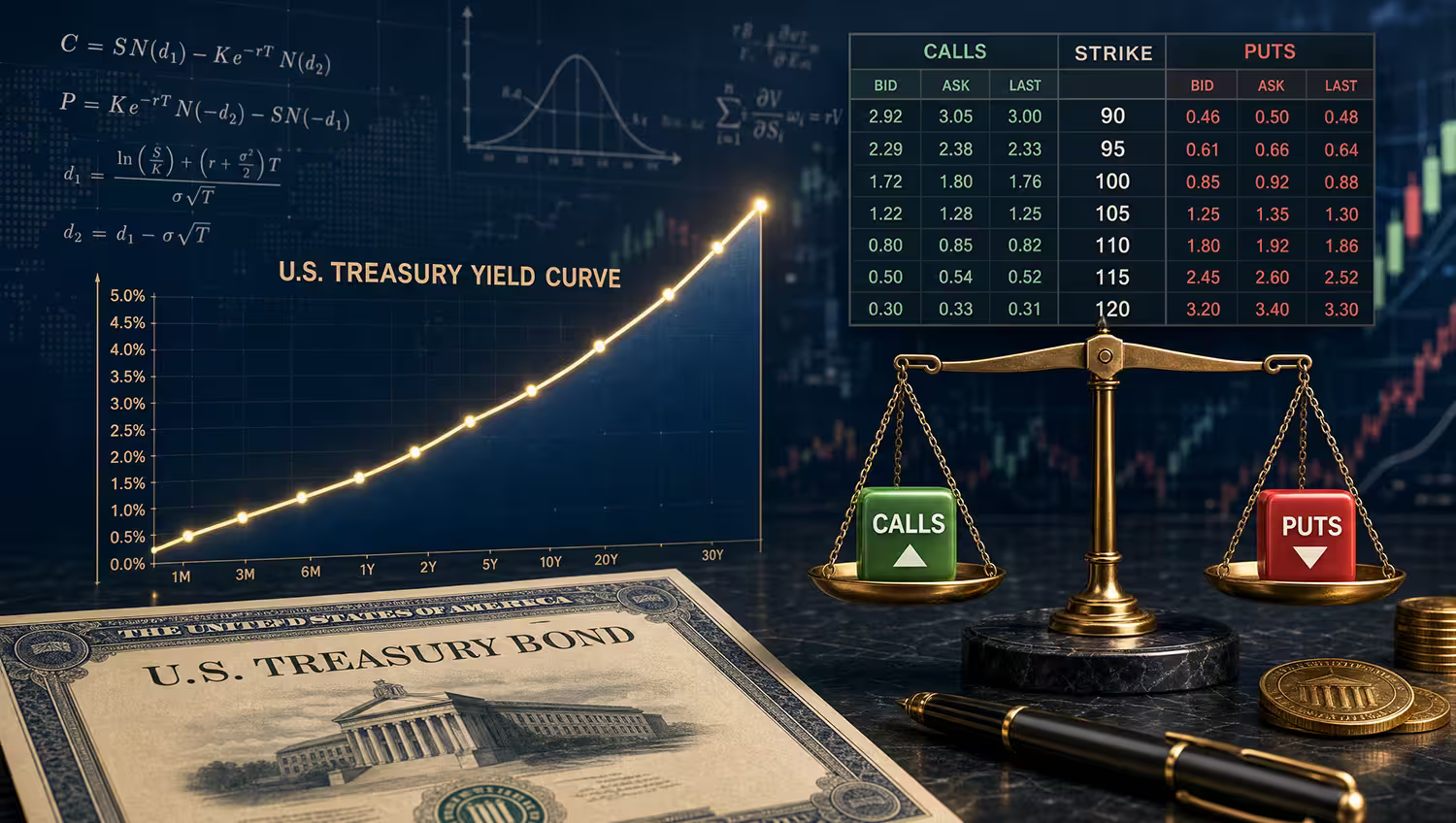
When most people think about options trading, they focus on the underlying stock price, time decay, and implied volatility. But there’s another crucial factor that often flies under the radar: bond yields. Understanding how bond yields can impact stock options pricing is essential for traders who want a complete picture of the market, especially in an environment where interest rates are fluctuating.
In the options world, the risk-free interest rate — often benchmarked to U.S. Treasury yields — plays a direct role in calculating the fair value of both call and put options. While it might seem like a minor detail compared to wild swings in stock prices, the “cost of carry” can significantly shift options premiums over time. In this guide, we’ll break down exactly how bond yields affect options pricing, explore the Greek metric known as Rho, and show you how to adjust your strategies when rates are on the move.
Table of Contents
- The Role of Interest Rates in the Black-Scholes Model
- How Rising Bond Yields Affect Call Options
- How Rising Bond Yields Affect Put Options
- Understanding Rho: The Interest Rate Greek
- The Yield Curve and Broader Market Context
- Practical Strategies for Changing Rate Environments
- Frequently Asked Questions
The Role of Interest Rates in the Black-Scholes Model
To understand the connection between bond yields and options, we have to look at the math behind the curtain. The Black-Scholes model is the standard formula used to determine the theoretical fair value of an option. It relies on several key inputs: the current stock price, the strike price, time until expiration, implied volatility, and the risk-free interest rate.
The risk-free rate is typically based on the yield of short-term U.S. Treasury bills or notes. Why does this matter? Because options pricing accounts for the time value of money. When you buy a call option, you control 100 shares of stock without having to pay the full price of those shares upfront. The money you save by not buying the stock outright could theoretically be invested in a risk-free asset — like a Treasury bond — earning interest.
This concept is known as the “cost of carry.” It represents the theoretical return you could earn on the capital you are not deploying into the stock. As bond yields change, so does this cost of carry, which directly shifts the theoretical value of options across the entire chain.
Key Takeaway: The Black-Scholes model uses the risk-free interest rate to discount the expected future payoff of an option back to its present value. As bond yields rise or fall, this discount rate shifts, directly impacting the option’s premium — especially for longer-dated contracts.
How Rising Bond Yields Affect Call Options
When interest rates and bond yields climb, call options generally become more valuable. This might seem counterintuitive at first, but it comes down to leverage and capital efficiency.
Imagine you want to gain exposure to 100 shares of a $100 stock. You could buy the shares outright for $10,000, or you could buy a call option for, say, $500. If you choose the option, you keep $9,500 in your pocket. In a high-interest-rate environment, that $9,500 can earn a meaningful return if parked in a Treasury bond or high-yield savings account.
Because the call option allows you to defer the purchase of the stock while still participating in its upside, the option itself becomes more attractive as rates rise. Market makers price this advantage into the premium. Therefore, all else being equal, higher bond yields lead to higher call option prices.
The effect is most pronounced for deep in-the-money calls and long-dated options like LEAPS (Long-Term Equity Anticipation Securities), where the cost of carry compounds over a longer holding period. For a near-term, out-of-the-money call expiring in two weeks, the rate impact is almost imperceptible.
⚠️ Risk Warning: While rising rates theoretically boost call premiums, they can also drag down the broader stock market. If rising yields cause the underlying stock price to fall, that negative impact will quickly outweigh any theoretical premium gain from higher interest rates. Always evaluate the full macro picture before entering a position.
How Rising Bond Yields Affect Put Options
For put options, the relationship is flipped. When bond yields rise, the value of put options generally decreases, all else being equal. Let’s break down why this happens.
A put option gives you the right to sell shares at a specific strike price. If you exercise a put, you receive cash. However, because you have to wait until expiration (or the time of exercise) to receive that cash, you are missing out on the interest you could have earned if you had the cash in hand today.
In a high-rate environment, the “opportunity cost” of waiting for that future cash payout is higher. The present value of the strike price you will receive in the future is discounted at a higher rate. To compensate for this delay in receiving funds that could be earning high interest elsewhere, the market prices put options lower.
If you are looking to generate monthly income with options by selling cash-secured puts, be aware that higher interest rates might slightly compress the premiums you can collect, assuming volatility and the underlying stock price remain constant. The good news is that in practice, rate-driven changes in put premiums are usually small compared to the effect of implied volatility shifts.
Understanding Rho: The Interest Rate Greek
To measure exactly how much an option’s price will change based on interest rate movements, traders look to the Options Greeks — specifically, a metric called Rho.
Rho measures the expected change in an option’s price for a 1% (100 basis point) change in the risk-free interest rate. For example, if a call option has a Rho of 0.05, and the risk-free rate increases from 4% to 5%, the price of the call option should theoretically increase by $0.05, or $5 per contract (since each contract covers 100 shares).
Option Type | Typical Rho Sign | Impact of 1% Rate Increase | Impact of 1% Rate Decrease | Most Affected By Rho |
|---|---|---|---|---|
Call Options | Positive (+) | Premium Increases | Premium Decreases | Long-dated, deep ITM calls |
Put Options | Negative (−) | Premium Decreases | Premium Increases | Long-dated, deep ITM puts |
Rho is typically the least discussed of the major Greeks — compared to Delta, Gamma, Theta, and Vega. This is because interest rates tend to move slowly and in small increments (usually 0.25% at a time). For short-term options expiring in a few days or weeks, the impact of Rho is practically negligible. However, for long-term options like LEAPS that expire in a year or more, Rho becomes a much more significant factor, as the cost of carry compounds over a longer period.
For a deeper dive into all the Greeks and how they interact, check out our Options Greeks cheat sheet — it’s a handy one-page reference for traders at every level.
The Yield Curve and Broader Market Context
It’s not just the level of bond yields that matters — the shape of the yield curve can also send important signals to options traders. The yield curve plots the interest rates of Treasury bonds across different maturities, from short-term (1-month) to long-term (30-year).
A normal yield curve slopes upward, meaning longer-term bonds pay higher yields than shorter-term ones. This reflects the expectation of continued economic growth and moderate inflation. In this environment, implied volatility in the stock market tends to be lower, which generally keeps options premiums in check.
An inverted yield curve — where short-term yields exceed long-term yields — is a classic recession warning signal. Historically, yield curve inversions have preceded economic downturns. When traders sense a potential recession, fear rises, and so does implied volatility (IV). Higher IV inflates both call and put premiums, creating a more expensive options market overall.
The key takeaway here is that bond yields influence options pricing through two separate channels: directly through the risk-free rate input in Black-Scholes, and indirectly through their effect on stock prices and market sentiment.
Key Takeaway: Bond yields affect options pricing both directly (via the risk-free rate in the Black-Scholes formula) and indirectly (by influencing stock prices and implied volatility). Monitoring the yield curve gives options traders an early warning system for potential volatility spikes.
Practical Strategies for Changing Rate Environments
When the Federal Reserve is actively hiking or cutting rates, bond yields can swing significantly. Here are some practical ways to adjust your approach based on the rate environment.
Trading LEAPS in a Rising Rate Environment
If you are buying long-term call options (LEAPS), rising rates provide a slight tailwind to your position due to positive Rho. The cost of carry advantage becomes more valuable as rates climb. Conversely, buying long-term puts becomes slightly less attractive, as the delayed payoff is more heavily discounted.
Prioritize Volatility Over Rho for Short-Term Trades
For short-term options (weekly or monthly expirations), the impact of interest rate changes is usually negligible. A 0.25% Fed rate hike will move your near-term options premium by fractions of a cent. In contrast, a 5-point spike in the VIX (the market’s “fear gauge”) can dramatically reprice the entire options chain in minutes. For short-term traders, focus on managing Vega and Theta rather than Rho.
Consider Spreads to Neutralize Rate Sensitivity
Options spread strategies — such as bull call spreads or bear put spreads — involve buying one option and selling another. Because both legs of the spread are affected by interest rates in a similar way, the net Rho of the spread is much smaller than that of a single-leg position. This makes spreads a natural way to reduce your exposure to rate-driven premium changes while still maintaining a directional view on the stock.
For a full breakdown of beginner-friendly spread strategies, our guide on simple options strategies for new traders is a great starting point.
Use the Right Tools to Monitor Your Greeks
To see exactly how rate changes and volatility shifts will impact your specific trades in real time, you need a robust tracking system. Manually calculating Rho across a multi-leg portfolio is tedious and error-prone. A dedicated options journal and analytics platform can do the heavy lifting for you.
Our #1 Pick OptionsPro Track multi-leg strategies, analyze your patterns with AI, and sync your brokerage automatically.
Putting It All Together
Bond yields and options pricing are more connected than most traders realize. The risk-free rate embedded in the Black-Scholes model means that every time the Federal Reserve moves rates — or even signals a future move — the theoretical value of every option in the market shifts slightly. For most short-term traders, this effect is a rounding error. But for anyone trading LEAPS, managing large multi-leg portfolios, or trying to understand why premiums are behaving unexpectedly, Rho and the yield curve deserve a permanent spot on your radar.
Here are the three key ideas to take away from this guide:
- Rising bond yields increase call option premiums and decrease put option premiums, all else being equal, due to the cost of carry advantage.
- Rho is the Greek that measures this sensitivity — positive for calls, negative for puts — and matters most for long-dated options like LEAPS.
- The yield curve shape matters too — an inverted yield curve signals recession risk, which tends to spike implied volatility and inflate all option premiums.
Ready to put this knowledge to work? Start by reviewing the full Options Greeks guide to understand how Rho interacts with Delta, Theta, and Vega in your positions.
Frequently Asked Questions
Here are answers to some of the most common questions about how bond yields can impact stock options pricing. For more in-depth explanations, visit our options trading basics section.
Why do call options increase in value when interest rates rise?
Call options increase in value when interest rates rise because they allow traders to defer the purchase of the underlying stock. The cash saved by buying the option instead of the stock outright can be invested at the higher risk-free interest rate, making the option itself more attractive and therefore more valuable.
What is Rho in options trading?
Rho is an Options Greek that measures the expected change in an option’s price for a 1% change in the risk-free interest rate. Call options generally have a positive Rho (they gain value as rates rise), while put options have a negative Rho (they lose value as rates rise). Rho has the most impact on long-dated options like LEAPS.
Do interest rates matter for short-term options?
For short-term options expiring in a few days or weeks, the impact of interest rate changes is usually negligible. A 0.25% rate hike will move a near-term option’s premium by fractions of a cent. Interest rates have a much more significant impact on long-term options, such as LEAPS, where the cost of carry compounds over many months or years.
How does an inverted yield curve affect options traders?
An inverted yield curve — where short-term Treasury yields exceed long-term yields — is historically associated with economic slowdowns. This uncertainty tends to drive up implied volatility (IV) in the stock market, which inflates both call and put premiums across the board, making options more expensive to buy.
Should I change my options strategy when the Fed raises rates?
For most short-term traders, a Fed rate hike has a minimal direct impact on options premiums. However, if you trade long-dated options like LEAPS, you should factor in the positive Rho effect on calls and the negative Rho effect on puts. More importantly, watch for the indirect effects: rate hikes can suppress stock prices and alter implied volatility, which will have a far larger impact on your positions.
What is the risk-free rate used in options pricing?
The risk-free rate used in options pricing models like Black-Scholes is typically the yield on short-term U.S. Treasury bills (T-bills), most commonly the 3-month or 1-year T-bill yield. This rate represents the return an investor could earn with essentially zero risk, and it serves as the baseline discount rate for calculating the present value of an option’s expected future payoff.