
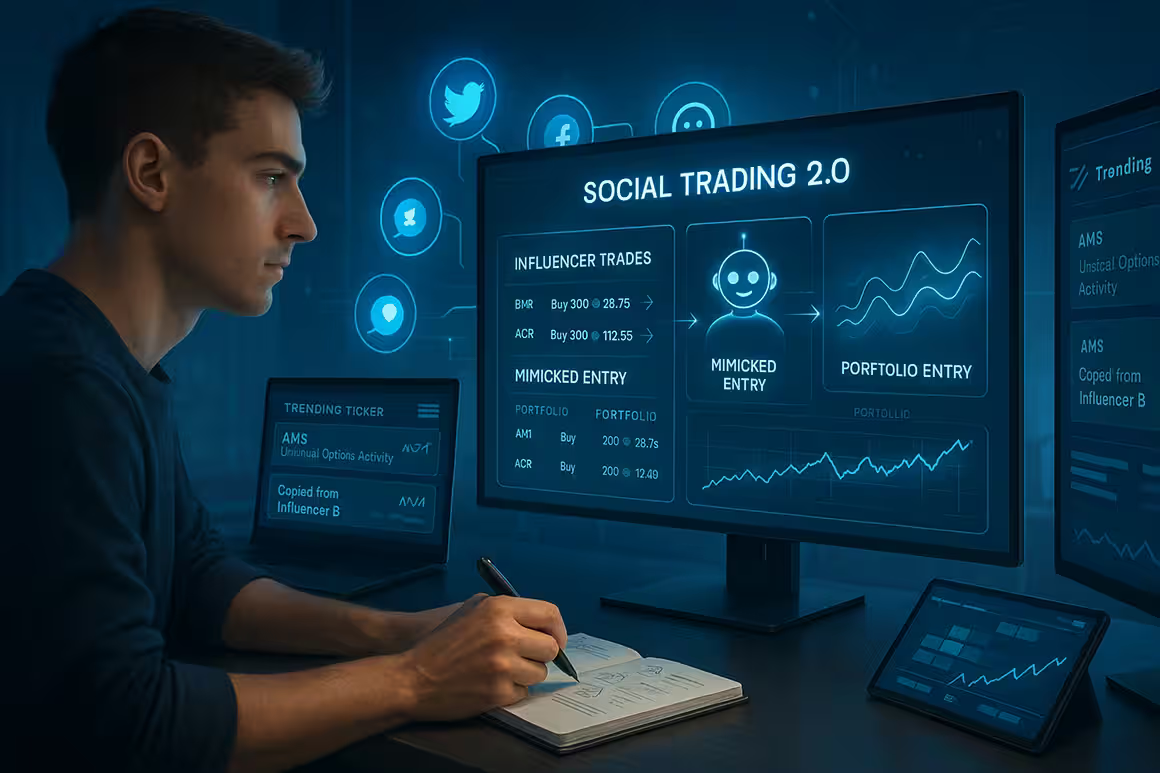
What if your trading bot could shadow the moves of a top options trader on X or Reddit in real time?
Social trading is a way for traders with little background experience to look at more experienced investors’ trades and copy them to generate profit for themselves as they learn the ins and outs of options trading. Primitive forms of social trading have been around since the early 2000s, but the systems have evolved over time and become better. Most recently, copy trading systems have introduced AI into the mix, leading to better results for newbie traders and investors.
This guide on Social Trading 2.0 and its AI-powered mimicry of influencer trades will cover how these systems work and benefit new traders. You can learn about the most effective copy trading platforms and some tips on how to use them for the best results. While it’s a great tool for learning, traders shouldn’t just blindly copy other investors’ trades all the time and instead focus some time on developing their one approach too. We’ll also talk a bit about how to strike this balance.
What Is Social Trading and How Has It Evolved?
Social trading or basic peer-to-peer trade copying is a way for investors to learn from one another and mimic the trading styles of each other. You find this most often with inexperienced traders learning from traders or investors with more experience and knowledge, trying ultimately to emulate their style.
Social trading has become more prevalent in today’s options trading world, and there are several platforms that have popularized it, including eToro and ZuluTrade. These brokerages offer social trading features with tools that analyze other traders, copy trades, and interact with other investors. With social trading on the rise thanks to these platforms and many other factors, a robust community of investors has been fostered over time that has led to valuable discussions and multiple learning opportunities for new traders and investors who are just getting their feet wet.
When social trading was first getting started, there were several limitations that came with the early iterations of the technology. One good example of this was the systems copying trades without taking the underlying strategies into consideration, basically a lack of analysis. There were also delays that came with the primitive systems attempting to balance transparency with timely information releases.
Enter Social Trading 2.0 — The Rise of AI-Powered Trade Mimicry
To accommodate for the limitations that were prevalent in the early forms of social trading, Social Trading 2.0 was brought to market. This form moved beyond mirroring traders and went much deeper, focusing on community engagement functions, a more thorough analysis, and personalized AI-powered trading tools. With Social Trading 2.0, that delicate balance of data transparency, speed, proper context, risk management, and strategy customization was finally achieved for new traders looking to emulate the moves of their more successful and educated peers.

The Integration of AI
As is the case with a lot of new technologies, Social Trading 2.0 has leveraged the power of AI to master trade mimicry. Using AI bots, Social Trading 2.0 is now able to:
- Scrape platforms like X (Twitter), Reddit, Discord
- Identify high-engagement posts and trade signals
- Analyze sentiment and execution timing
As we dig deeper into this guide, we’ll address these abilities in more detail to give you a good sense of how successful the integration of AI has been with these social trading platforms, apps, and websites.
Manual Copy Trading vs. AI-Automated Replication
When comparing manual copy trading with AI-automated replication, it’s no contest whatsoever. There are some pros and cons to consider with each method, but the AI systems seem to offer the most benefits for new traders who want to effectively copy the style of more experienced traders.
Manual Copy Trading
Manual copying lets traders adapt new strategies at any time, giving them the control and flexibility to respond to sudden price movements or unexpected market news. However, while traders can make manual adjustments on the fly, there is the possibility of traders making more mistakes in fast-moving markets, not to mention the fact that it can be time-consuming.
AI-Automated Copy Trading
The AI systems are much faster than manual copy trading at executing trades quickly, plus they can greatly reduce the risk of slippage and capitalize better on various market opportunities. The systems can adhere to predefined rules and strategies, which can generally lead to better consistency with time. A few other perks include the technology’s scalability, backtesting capabilities, and ability to reduce emotional bias.
How AI Bots Track Influencer Activity
Source bots monitor a wide range of influencer activity to learn how these investors are trading and to develop a copy trading plan that new traders can learn from. These AI bots take a look at the following aspects of more experienced traders’ online moves to get a firm understanding of what they’re doing and how a trade with less experience could emulate their style or approach.
- Public Posts—AI bots will gather data from social media platforms like Reddit or Twitter.
- Options Flow and Order Books—AI bots will also study which stocks, or underlying assets, are being traded the most or the least, a good way to spot institutional traders. These bots will consult APIs or platforms like Unusual Whales to find out where experienced investors are putting their money.
- SEC Filings and Guru Portfolios—The bots also study the documents that are submitted to the SEC by publicly traded companies, as well as the investments that are sitting in the portfolios of advanced traders, to track the investment/trading choices of guru traders.
- Natural Language Processing (NLP)—AI bots conduct sentiment analysis by interpreting the emotional tone and context of posts, news articles, or comments that are related to certain market trends, stocks, or underlying assets.
- Real-Time Decision-Making—These bots also harness the power of filtering the noise out of the market to make the best possible decisions for new traders who are interested in copying the moves of professional traders.
Mimicking Trades: Automation, Execution, and Risk
How do the AI bots actually place trades? This next section will go into some more detail about how the automation process works for options traders who are new to the game including information on trade execution and the risks associated with using the technology. It’s all best summed up with the pros and cons list we’ve included.
AI Bot Capabilities
- Integration with Broker APIs—The AI bots that work in the API systems of various online brokers offer automated trading by mimicking other traders’ actions. It’s done through having access to real-time market data, which gives them the ability to place orders and manage traders’ accounts.
- Execution Timing—AI copy bots generally work quickly and execute orders at a fast pace, usually within milliseconds. It doesn’t matter if the trader is interested in submitting market or limit orders—these AI bots take care of the order execution in a way that capitalizes on market fluctuations.
- Setting Thresholds for Trade Execution—Traders can train these AI bots to execute trades according to customized criteria, including factors like volume, strike price, and sentiment score.
Pros of AI Copy Trading Bots
- Speed — Using AI bots to execute trades is much faster than manual copy trading as all of the conditions and parameters of trade execution are laid out ahead of time by the trader.
- Emotionless Trading — The primary advantage of having AI-automated replication is that it keeps the trader or investors away from temptations to trade based on emotions like fear, frustration, or greed. The automated systems carry out the trading plan, leaving no room for the trader’s emotions to become involved.
- Scalability — AI bots can enhance the trading strategies that investors are using by analyzing large sets of data, executing trades automatically, and identifying patterns. These capabilities allow the bots to deal with complicated market dynamics and make timely changes to the strategy when it’s appropriate and advantageous.
Cons of AI Copy Trading Bots
- Mimicking Bad/Inaccurate Trades — While these AI-driven systems can greatly benefit new traders, there’s the possibility that they could make a mistake and copy inaccurate trades. This is why there’s still a lot of value in human oversight with these systems to catch these errors when they occur.
- Overreliance on Influencers — Using AI bots to copy-trade the moves of experienced traders you trust doesn’t always mean that you’re going to profit. Even experienced traders or investors make mistakes, so copying their strategies or approaches can result in some losses if they’re incorrect.
- Latency vs Speed of Big Institutions — Latency refers to the time delay between the execution of the trade and its confirmation, which is what new traders are going to experience as they use AI bots to copy the moves of bigger traders. The institutional investors move at a quicker pace and in many cases, new traders using these AI systems might not be able to keep up.
Popular Platforms and Tools Enabling This Trend
If you’re interested in checking out some of the most competitive and dynamic AI-driven platforms, you need to look at these recommendations below.

Composer — An AI social trading platform, Composer features an algorithmic trading system, an AI assistant, and backtesting/optimization tools. It’s also a no-code platform, meaning that you don’t need advanced programming skills to use it.

Zignaly — A cryptocurrency copy trading platform, Zignaly lets its users replicate the trades of professional traders. It comes with several useful features, including profit sharing, copy trading capabilities, a rank and score system, democratized access, and a community where traders can share their experience and connect with one another.

TradeUI — This platform combines a bunch of data analysis tools to help traders make the best possible decisions as they copy the trades of more experienced investors. They include sentiment analysis, pattern recognition, and AI signals. Pairing TradeUI and its capabilities with Discord scraping tools is a terrific recipe for success.
Custom GPTs
Custom GPTs or trading APIs, along with OpenAI integrations, are another way for traders or investors to find good trades to copy as they learn the ins and outs of options trading online. ChatGPT can be customized for specific tasks through custom GPTs by providing knowledge, and instructions, and connecting to external services. Traders can also enjoy real-time data access using APIs as well as automated trade execution.
The “DIY” Stack
Integrating Python with broker API, LLM, and scraping allows for the automation of data collection, trading strategy execution, and analysis. Financial news and market sentiment are two examples of data collected through scraping and it’s then cleaned and preprocessed using Python libraries. Traders can then use broker APIs to retrieve real-time market data, palace orders, and manage positions.
The Ethics and Risks of Influencer Mimicry
When it comes to new traders mimicking the moves of influencer traders, there are some conversations out there about its legality. We’ll talk about some of the ethical questions surrounding the subject and some of the risks that new traders might be taking on by using AI-powered copy trading technologies to guide their trading sessions.
Is It Legal to Copy Influencer Trades?
Yes, it’s legal in most countries to copy the traders of influencers. There are plenty of legal copy trading platforms out there which automatically replicate the traders of the most experienced people spending time in the options market. A few good examples of these legal platforms are eToro and ZuluTrade. It’s important to note that regulations around copy trading may vary regionally, so it’s best to check your local laws before proceeding.
Are Influencers Manipulating Markets?
It has been known to happen. The manipulation that you’d want to be looking out for is the spreading of false or misleading information and price inflation. Some influencers are known for their pump-and-dump schemes where they convince their followers to buy certain stocks or options, inflating the price, and then selling their own shares at a higher price.
Fake Clout
There are some scenarios in AI-powered social and copy trading where traders run the risk of having their bots chase “engagement” instead of going after trades that will work effectively toward their trading goals. This risk of “fake clout” can come up if the AI hasn’t been properly trained by the user to copy the traders of the more experienced investors. Giving the AI the proper prompts and criteria to work with can ensure that the trades copied are working to your benefit.
Should You Use an AI-Powered Social Trading Bot?
Using AI-powered social trading bots can have its advantages, but there are some instances where traders should not use them or rely too heavily on their services. For instance, the best type of trader to use this technology would be someone tech-savvy and data-driven. They might not be the best fit for investors who aren’t familiar with the technology.

Best-Fit Profiles
- Tech-savvy traders
- Data-driven investors
It’s also worth mentioning that there are certain situations where copy trading with an AI system is beneficial, but there are some cases where it might be either a waste of time or a hindrance to your trading plans or goals. AI-powered social trading can really shine with short-term news plays and sentiment shifts in the broader market, but it’s not the best move with complex spread or illiquid options.
Situations Where AI Social Trading Is Beneficial
- Short-Term News Plays—Copy the moves of advanced traders who are taking advantage of the market reacting to news developments like a company rolling out a new product or announcing an earnings report.
- Sentiment Shifts—If there’s a broader shift in the market sentiment around certain stocks, new traders can use these AI systems to copy advanced traders who are already making moves to profit from this sentiment shift.
Situations to Avoid
- Illiquid Options: It’s best in general for traders to avoid illiquid options as they’re difficult to buy or sell quickly without having a major impact on the underlying asset price.
- Complex Spreads: Simplicity is key when copy trading, so new traders should avoid trying to copy complex spreads when using AI to mimic advanced investors.
Tips for Getting Started with Social Trading 2.0
Follow these tips and tricks for the best results in social trading using AI systems.
- Choose your data sources wisely. Use well-regarded AI-powered social trading websites or apps to get the best read on the market.
- Vet influencers are based on track records, not followers. Make sure that they aren’t known for shady moves like the pump-and-dump schemes, mentioned earlier.
- Set strict risk management rules in your bot logic. This makes sure that the bot keeps in line with your trading plan, adhering to sound position size, and gets you out of losing trades sooner rather than later.
- Start with paper trading or small allocations. Once you’ve gained more experience and confidence with the process, you can work your way up to more advanced strategies and put more capital at stake.
What’s Next? The Future of AI-Driven Social Trading
Although Social Trading 2.0 is here and thriving, we anticipate that there will be further developments with this technology to make the process of copy trading and social trading that much easier to learn, bringing in even more interest from new investors or traders looking to learn the ropes. This next section goes over all the possible advancements that could be coming in the future, which could take Social Trading 2.0 to the next level.
- Predictive Modeling—One of the possible technologies that is coming as AI-driven social trading develops further is predictive modeling, which is based on influencer behavior. AI might eventually be used to forecast consumer behavior. Combining machine learning algos and analyzing historical data, traders can better predict strategy outcomes and predict audience preferences or engagement levels.
- Decentralized AI Trading Communities—This future technological advancement of AI social trading is expected to use blockchain to create a secure, accessible, and transparent trading environment where users can enjoy AI-driven strategies without relying on centralized platforms.
- Potential Regulation and Transparency Initiatives—Another real possibility of future developments when it comes to social trading using AI moves at regulation and initiatives toward increased transparency. Some of these outcomes could be avoided by the creation of decentralized trading communities that aren’t subject to oversight by a centralized agency.
- Integration with VR/AR—Another possibility is the integration of these AI social trading systems with VR or AR where traders can access real-time sentiment dashboards to get a better idea of how other investors are feeling about the current market conditions and what that means for future outlook.
Common Questions
Let’s check out the most common questions we’ve gotten about AI-automated copy trading from our customers and dedicated readers to give you a rough idea of the most relevant topics about this subject. We’ve taken the liberty of answering these important questions, giving you the key highlights of the most asked-about aspects of using AI for copy trading.
Can I Legally Use AI to Mimic Trades I Find Online?
Of course, you can. It’s what we’ve been talking about the entire time in this guide. There are plenty of legit systems and businesses that are designed to do this, and they can operate in many areas of the world. However, it might not be allowed everywhere across the world. You’ll have to check your local laws first before proceeding, just to play it safe.
What if an Influencer Deletes a Tweet after the Trade?
If the tweet was related to a certain trading strategy or options trading technique, the tweet’s deletion by the influencer could raise questions as to their intentions. It could indicate a coverup of what they said, as a deleted tweet means that it’s permanently removed from their public profile and timeline, in addition to any associated retweets being deleted.
Are There Free Tools to Get Started?
There are several platforms out there that offer free trials to any new traders who are interested in AI-automated copy trading. They include names like Superalgos, Tickeron, Composer, Trade Ideas, AlgoTrader, TradingView, Kavout, AInvest, and StockHero. It’s important to know that these are limited free trials and traders will need to pay for a premium membership to enjoy all the perks and benefits these tools have to offer new options traders.
How Much Does a Good AI Trading Bot Cost to Build or Use?
If you’re interested in developing and maintaining a basic to moderate trading bot, you could be looking at a total cost of around $6,500 with upwards of $500 per month coming out in continual expenses.
Strategy development could also be done for free, or some traders could spend around $5,000 for an enhanced experience. Security measures can range from $100 to $500. Testing/backtesting could be done for free, or it could cost as much as $500.
Market Data API costs can be free or range upward to $200 per month. A few other monthly upkeep expenses could include ongoing maintenance ($50-200 per month) and infrastructure ($10-100 per month).
The Copycat Revolution, Upgraded
Although there are more perks that come with using AI-powered systems to mimic the trading moves or more advanced and experienced investors, there’s still room for human oversight in the situation. Let the bots do the following, but keep your eyes open for times when manual intervention might be necessary to react promptly to unexpected events or sudden price movements that the bots cannot always catch—smart automation needs smarter oversight.
- AI bots are changing the way social trading works—faster, smarter, and riskier.
- Influencer mimicry isn’t foolproof, but it can surface hidden opportunities.
- You still need good risk management, transparency, and common sense.
- The next generation of traders may rely less on intuition and more on real-time data and machine learning.